

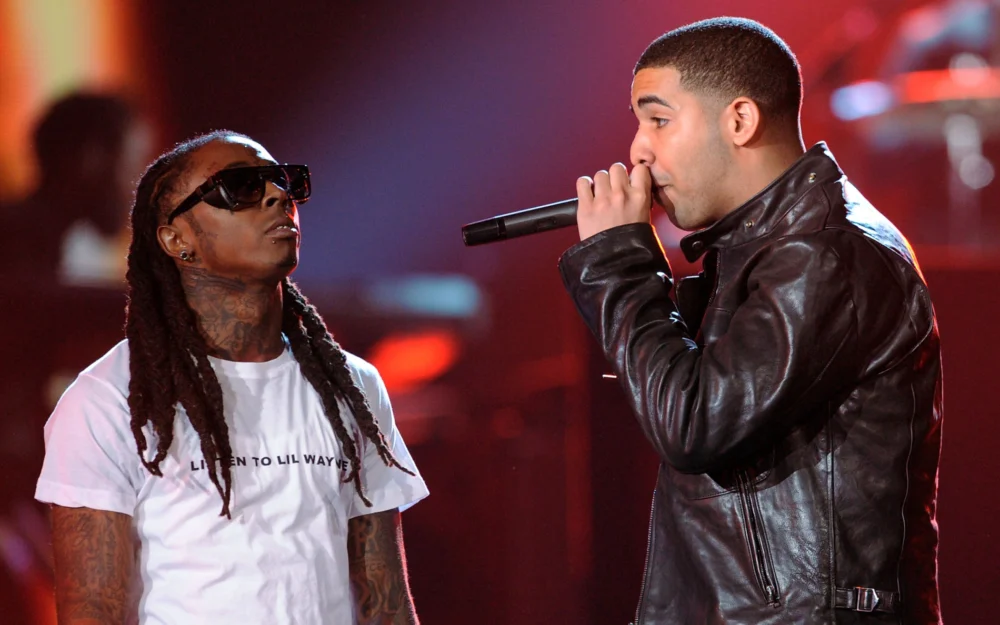
The ascent of Drake from a budding artist to a global music phenomenon is a narrative etched into the annals of hip-hop history. While his undeniable impact on the trajectory of Young Money Entertainment is widely acknowledged, a recently resurfaced anecdote from Adam Bhala Lough, the director behind Lil Wayne’s seminal documentary series, "The Carter," sheds light on a surprisingly humble and even exclusionary beginning for the future rap titan. Lough’s revelations, shared in an interview with music journalist Andre Gee for his Substack newsletter, paint a vivid picture of a young Drake, seemingly on the periphery of the burgeoning Young Money empire, struggling for acceptance even within the confines of his mentor’s tour bus.
Lough’s documentary work, particularly his deep dive into Lil Wayne’s meteoric rise during the Tha Carter III era, provided him with an intimate vantage point into the dynamics of the Young Money collective. It was during this period, when Lil Wayne was at the zenith of his creative powers and commercial success, that Lough observed a distinct separation between Drake and the core members of the crew. He recounted instances where, while not actively filming Wayne, he found himself in the company of Tez Bryant (Lil Wayne’s then-manager), Mack Maine, and Nicki Minaj, observing their interactions and the nascent stages of their collective journey.
"The majority of the time when I wasn’t shooting with Wayne, but when I was on set, Wayne would disappear and I was just hanging out with Tez [Bryant, Wayne’s then-manager], Mack Maine and Nicki Minaj," Lough stated. He continued, revealing the surprising exclusion of Drake: "At one point, I spent some time with her [Nicki Minaj] before Wayne did The Jimmy Kimmel Show, when nobody knew who she was, and they wouldn’t even let Drake on the bus. He was, like, such a dork that they wouldn’t even let him on the bus."
This assertion is particularly striking given Drake’s eventual status as a co-founder and a driving force behind Young Money’s unprecedented success. The anecdote suggests that in these formative years, Drake was perceived as an outsider, his artistic identity and potential not yet fully recognized or embraced by the established inner circle. Lough elaborated on the reasons behind this ostracization, citing the presence of hardened Blood gang members within Lil Wayne’s entourage. "When he started selling millions and millions of records, it was a different story entirely. But he was definitely not allowed on the bus and wouldn’t hang out with any of [them] because there were real Blood gang members around all the time. And I’m sure he was intimidated by them, too. I was, even though they were super cool to me. These are serious, Blood gang members with guns on them. Like, some shit could go down."
This detail underscores the gritty realities of the hip-hop landscape at the time and the perceived need for a certain level of toughness and street credibility within Lil Wayne’s immediate circle. Drake, whose early persona was more introspective and less overtly street-oriented, may have not fit the mold of the individuals deemed suitable for the immediate protection and camaraderie of the tour bus. The implication is that his early integration into the Young Money fold was a gradual process, one that unfolded as his own star power began to eclipse the initial perceptions of his peers.
The Genesis of "The Carter" Documentary and Unexpected Financiers
Beyond the intriguing insights into Drake’s early days, Adam Bhala Lough also unveiled a surprising chapter in the production history of The Carter documentary itself. He revealed that the initial funding for the project was slated to come from a partnership involving disgraced Hollywood producer Harvey Weinstein and former Trump strategist Steve Bannon.
Lough explained that Quincy Jones III, who had previously worked with Lough on other film projects, approached him with the proposition. "Quincy Jones III contacted me. He had seen one of my previous films, and he was like, ‘I really want to work with you. I have this company. We have a deal with an offshoot of Miramax.’ You’re not going to believe this, but it was a company owned by Harvey Weinstein and Steve Bannon," Lough recounted.
He further elaborated on Bannon’s background: "A lot of people don’t remember, but Steve Bannon actually came from Hollywood; he was a movie producer. So the original financiers of The Carter were going to be Harvey Weinstein and Steve Bannon, which would have been amazing if it had actually happened, but they shut down their company during production of the film." This revelation adds a layer of complexity to the documentary’s genesis, highlighting the unconventional alliances and potential for vastly different outcomes that often characterize creative projects. The eventual withdrawal of these financiers likely presented significant challenges, forcing Lough and his team to navigate alternative funding routes.
A Leaked Sequel and the Unfolding Legacy of "The Carter"
The conversation also delved into the much-anticipated sequel to The Carter documentary, footage for which was recorded during the Tha Carter and Tha Carter II eras. This project experienced an unexpected turn of events when hackers leaked a rough cut of the film online. Lough, in response to the leak, decided to share the raw footage publicly on YouTube.
The leaked two-hour video offers a rare glimpse into Lil Wayne’s creative process during a pivotal stage of his career. It features him experimenting with unreleased music, engaging in studio sessions with emerging artists like 2 Chainz (then known as Tity Boi) and Curren$y, and candidly discussing his complex relationship and ongoing issues with Cash Money Records. These interactions provide valuable historical context for the evolution of these artists and the internal dynamics of the label that would shape the landscape of hip-hop for years to come.
The footage serves as a testament to Lil Wayne’s prolific output and his willingness to collaborate with a diverse range of talent. His discussions with Cash Money Records also foreshadow some of the controversies and legal battles that would later emerge, adding a prescient dimension to the documentary’s content.
The Future of "The Carter" Sequel: Official Release Prospects
While the leaked rough cut offers fans an unprecedented look at Lil Wayne’s past, the official release of a polished version of the sequel remains uncertain. However, Lough expressed optimism about its future, indicating that he is actively pursuing avenues for its completion and distribution. He has engaged in positive discussions with Lil Wayne’s manager, Fabian Marasciullo, about potential release strategies.
"There’s basically two options: There’s a big [streaming network] that would pick it up and put it out," Lough explained, outlining his preferred scenario. "The other option that I talked to [Fabian] about was some type of self-distribution where we just put it out ourselves to the fans. We’ll see where it ends up. It’ll go how it needs to go."
The prospect of a major streaming platform acquiring the rights could provide significant resources for post-production and a wide audience reach. Alternatively, a direct-to-fan distribution model, while potentially more challenging logistically, could offer greater creative control and a more intimate connection with the dedicated fanbase.
Lough also indicated that the sheer volume of footage captured for the sequel might necessitate a two-part release. "There’s so much footage, I think maybe there could be two films. So in that regard, it would be like 40% done. But if it’s just this one part, then I would say closer to 70% done. But then it also needs to be mixed and color corrected and all that stuff." This suggests that the project is in various stages of completion, with significant work still required to bring it to a professional standard for public consumption.
Broader Implications and the Narrative of Hip-Hop Evolution
The anecdotes shared by Adam Bhala Lough offer more than just behind-the-scenes gossip; they provide a valuable lens through which to examine the intricate and often unpredictable pathways of artistic development and industry success. Drake’s initial exclusion from Lil Wayne’s tour bus, while seemingly minor in retrospect, highlights the fluid nature of power dynamics and acceptance within creative collectives. It underscores that even for artists who achieve monumental success, their journey is rarely linear and often involves overcoming initial hurdles and perceptions.
Furthermore, the revelations about the original financiers of The Carter serve as a reminder of the often-opaque and complex world of film financing, where unexpected figures can emerge and disappear, influencing the course of artistic endeavors. The involvement of individuals like Harvey Weinstein and Steve Bannon, particularly in a documentary about a prominent hip-hop artist, adds a layer of historical irony and raises questions about the intersection of different cultural spheres and the potential for diverse ideological influences on artistic expression.
The leaked sequel, despite its unpolished state, offers a rich historical document for fans and scholars alike. It provides primary source material on the creative processes of influential artists during a formative period, shedding light on their collaborations, challenges, and aspirations. The ongoing efforts to officially release the film, whether through traditional distribution channels or direct-to-fan models, signify the enduring legacy of Lil Wayne and the cultural significance of the Tha Carter series. These stories, unearthed and shared, continue to enrich our understanding of hip-hop’s evolution and the remarkable individuals who have shaped its sound and narrative.
