

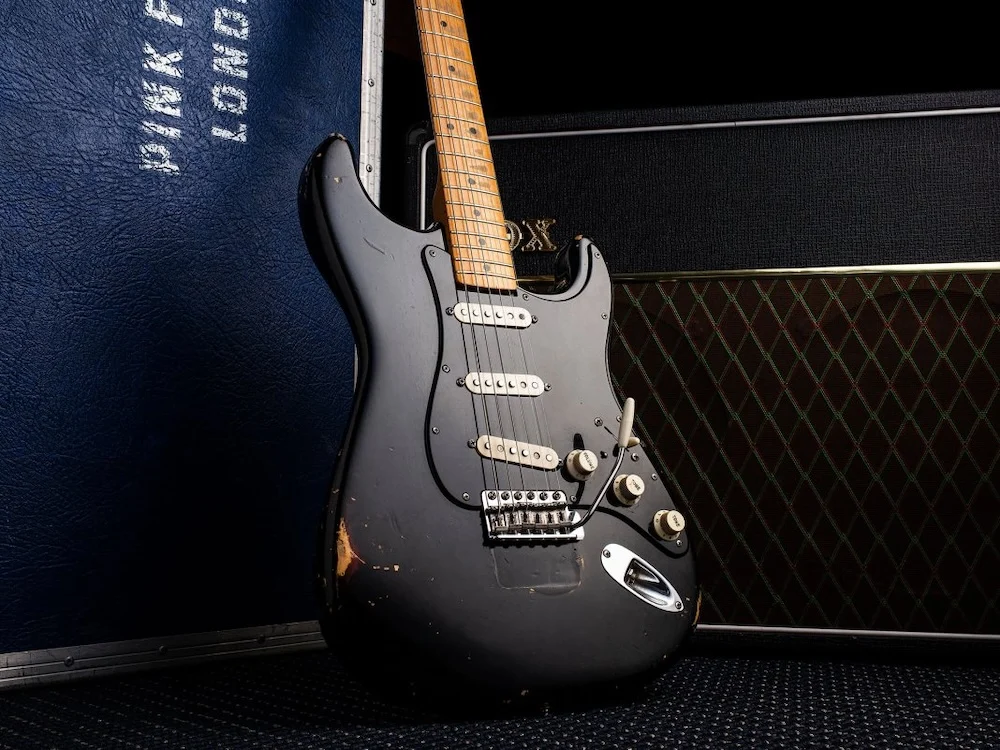
The legendary 1969 Black Fender Stratocaster, synonymous with Pink Floyd guitarist David Gilmour, has once again etched its name into history, commanding an unprecedented $12.1 million at a recent Christie’s auction in New York. This staggering sum not only re-establishes the "Black Strat" as the most expensive guitar ever sold but also significantly surpasses its own previous record of $3,975,000, which it achieved in 2019. The sale was a highlight of the highly anticipated auction of the Jim Irsay Collection, a monumental assemblage of cultural artifacts curated by the Indianapolis Colts owner and CEO.
The instrument, revered by musicians and fans alike for its distinctive tone and profound influence on generations of rock music, had an estimated pre-sale value of $2-4 million. Its final hammer price more than tripled the upper end of these expectations, underscoring the enduring power of rock provenance and the escalating market for culturally significant memorabilia. The previous record for a guitar was held by Kurt Cobain’s Martin D-18E, famously played during Nirvana’s iconic MTV Unplugged performance, which sold for $6 million in 2020. The Black Strat’s latest sale has now effectively doubled that benchmark, setting a new, formidable standard in the collector’s market.
The Black Strat: A Legacy Forged in Sound
The story of the Black Strat begins in 1970 when David Gilmour acquired it from Manny’s Music in New York City. Initially one of several Fender Stratocasters Gilmour owned, this particular instrument quickly became his primary guitar due to its exceptional playability and versatile sound. Over the decades, the guitar underwent numerous modifications, a testament to Gilmour’s relentless pursuit of sonic perfection. These changes included experimenting with different pickups, tremolo systems, and wiring configurations, each iteration contributing to its evolving sonic identity.
Key modifications included the installation of a mini-toggle switch for additional pickup combinations, various changes to the pickguard (from white to black and back again), and the eventual use of a shortened tremolo arm, which allowed Gilmour to execute his signature vibrato techniques with unparalleled control and nuance. It was these meticulous adjustments, combined with Gilmour’s masterful playing, that sculpted the guitar’s legendary voice.
The Black Strat is inextricably linked to some of the most seminal albums in rock history. Its distinct tone can be heard throughout Pink Floyd’s monumental works, including The Dark Side of the Moon (1973), Wish You Were Here (1975), Animals (1977), and The Wall (1979). Its iconic presence is particularly notable on tracks such as "Comfortably Numb," "Shine On You Crazy Diamond," and "Money," where Gilmour’s soaring, lyrical solos became defining moments for the band and the genre. Beyond Pink Floyd’s studio albums, the Black Strat was Gilmour’s primary live instrument for decades, gracing countless stages worldwide and becoming an instantly recognizable symbol of his artistry. Its status is not merely that of a musical instrument but a historical artifact, a conduit through which some of rock’s most enduring melodies and sonic textures were created.
A Chronology of Record-Breaking Auctions and Cultural Milestones
The recent sale marks the second time the Black Strat has made global headlines for its astonishing auction price, illustrating a fascinating journey through the high-stakes world of music memorabilia.
-
2019: The First Record-Shattering Sale
In June 2019, David Gilmour made the philanthropic decision to auction off more than 120 of his personal guitars, including the Black Strat, through Christie’s in New York. Titled "The David Gilmour Guitar Collection," the sale was intended to raise funds for ClientEarth, an environmental law charity. At that time, the Black Strat sold for an astonishing $3,975,000, setting a new world record for the most expensive guitar ever sold at auction. This sale far exceeded the previous record, held by a Bob Dylan Fender Stratocaster that fetched $965,000 in 2013, and surpassed even the iconic "Blackie" Stratocaster owned by Eric Clapton, which sold for $959,500 in 2004. Gilmour’s intent was clear: to use his musical legacy for a global cause, stating, "The money will be a huge help and is just what ClientEarth needs." The 2019 auction ultimately raised over $21 million for the charity, demonstrating the immense value placed on Gilmour’s instruments and the power of his benevolence. It was at this auction that the Black Strat was acquired by Jim Irsay, adding a cornerstone to his already impressive collection. -
2020: Kurt Cobain’s Martin D-18E Sets a New Mark (Temporarily)
The record established by the Black Strat in 2019 was momentarily eclipsed in June 2020 when Kurt Cobain’s 1959 Martin D-18E, used during Nirvana’s legendary MTV Unplugged in New York performance in 1993, sold for $6,010,000. This sale highlighted the profound cultural impact of grunge music and Cobain’s tragic legacy, demonstrating that guitars tied to pivotal, globally recognized performances held immense value. The Martin D-18E, with its unique history and association with a defining moment in 90s music, represented a significant milestone in the guitar auction market. -
November 2023: The Black Strat Reclaims Its Throne
The most recent auction, held by Christie’s in New York in November 2023, saw the Black Strat return to the auction block as part of "The Jim Irsay Collection" sale. Its re-emergence in the public market, just four years after its initial record-breaking sale, generated considerable buzz. The guitar’s final price of $12.1 million not only shattered Cobain’s record but also underscored a dramatic escalation in the perceived value of such unique cultural artifacts. This latest sale confirms the Black Strat’s unparalleled status and the enduring, almost mythical, allure of an instrument so intrinsically linked to rock history.
The Jim Irsay Collection: A Billion-Dollar Legacy
The auction of David Gilmour’s Black Strat was merely one highlight in a broader sale from the extraordinary Jim Irsay Collection. Jim Irsay, the owner and CEO of the NFL’s Indianapolis Colts, is renowned not just for his sports leadership but also for his unparalleled passion for collecting historical and cultural artifacts. His collection, estimated to be worth well over a billion dollars, spans an astonishing array of items, from significant historical documents like the original manuscript for Jack Kerouac’s On the Road and a 1777 Revolutionary War proclamation by George Washington, to iconic musical instruments and pop culture memorabilia.
Irsay’s philosophy behind collecting is rooted in a desire to preserve history and share it with the public. Elements of his collection frequently tour the United States, offering free exhibitions that allow ordinary people to engage directly with pieces of American and global heritage. These exhibitions feature items such as the original drum kit used by Ringo Starr, guitars from Bob Dylan, Prince, and Elvis Presley, and even Abraham Lincoln’s personal pocketknife. The inclusion of the Black Strat in his collection after the 2019 sale further solidified its place among the most cherished and valuable cultural objects in private hands, emphasizing its dual status as both a musical instrument and a historical relic.
The recent Christie’s auction of items from Irsay’s collection saw other significant sales, further illustrating the immense value of his holdings. Notably, Jerry Garcia’s custom-built "Tiger" guitar, an instrument synonymous with the Grateful Dead frontman, fetched an impressive $10 million in the same sale. This particular guitar was Garcia’s primary instrument from 1979 to 1989 and was custom-built by luthier Doug Irwin, known for its intricate design and advanced electronics. Its sale for such a high figure reinforces the robust demand for instruments with deep historical ties to legendary musicians and movements.
Supporting Data and Market Analysis: The Booming Collectibles Market
The astronomical price fetched by the Black Strat is indicative of a burgeoning market for high-value musical instruments and rock memorabilia. Several factors contribute to this escalating trend:
- Provenance and Legacy: The direct connection to a legendary artist like David Gilmour and a band as iconic as Pink Floyd imbues the instrument with unparalleled historical and cultural significance. Collectors are not just buying a guitar; they are buying a piece of history, a tangible link to moments that shaped music and culture.
- Rarity and Uniqueness: Iconic instruments like the Black Strat are, by definition, one-of-a-kind. There is only one such guitar, making it an ultimate prize for collectors who value exclusivity.
- Investment Potential: In an era of fluctuating financial markets, high-end collectibles are increasingly viewed as alternative investments. Their value tends to appreciate over time, especially when tied to enduring cultural figures.
- Global Wealth and Demand: The rise of ultra-high-net-worth individuals globally has created a larger pool of potential buyers capable of competing for such extraordinary items.
- Digital Age Influence: Paradoxically, in a world increasingly dominated by digital experiences, tangible artifacts from music history hold even greater allure. They offer a physical connection to the past, a counterpoint to ephemeral streaming.
- Cultural Resonance: The music of Pink Floyd, Nirvana, and the Grateful Dead continues to resonate across generations. This sustained cultural relevance ensures that artifacts associated with these bands maintain, and often increase, their appeal and value.
The market for high-end musical instruments mirrors aspects of the fine art market, where masterpieces command exorbitant prices due to their artistic merit, historical context, and the artist’s legacy. Auctions like those at Christie’s serve as critical platforms, legitimizing and formalizing the valuation of these cultural assets.
Official Responses and Industry Reactions
While specific official statements regarding the latest sale are often carefully managed, the general sentiment from key stakeholders can be inferred:
- Christie’s Auction House: A spokesperson for Christie’s would likely express immense satisfaction with the auction’s outcome, highlighting the extraordinary prices achieved for both the Black Strat and Jerry Garcia’s Tiger guitar. They would emphasize the auction house’s expertise in handling such rare and valuable cultural artifacts and its ability to connect them with discerning collectors worldwide. The record-breaking sale reinforces Christie’s position as a leading venue for high-value collectibles.
- The Jim Irsay Collection: Representatives for Jim Irsay would undoubtedly convey pride in the collection’s continued success and the public’s enthusiastic response to the items offered. They might reiterate Irsay’s commitment to sharing these historical treasures, potentially hinting at future public exhibitions where the Black Strat might be displayed alongside other iconic instruments from his extensive holdings. The sale reflects the careful curation and profound historical significance of Irsay’s acquisitions.
- Music Historians and Industry Experts: Experts in music history and memorabilia valuation would likely acknowledge the sale as a pivotal moment, affirming the ever-increasing appreciation for rock and roll artifacts. They might discuss the guitar’s dual status as both a functional instrument and a museum-quality exhibit, emphasizing its role in shaping sonic landscapes and cultural narratives. The Black Strat’s record-breaking price serves as a benchmark for how the legacies of influential musicians are monetized and preserved.
Broader Impact and Implications
The $12.1 million sale of David Gilmour’s Black Strat is more than just an auction result; it carries significant implications for the world of music, collecting, and cultural preservation:
- New Valuation Benchmark: This sale sets a dramatically higher benchmark for the valuation of iconic musical instruments. It suggests that the market has entered a new phase, where instruments with unparalleled provenance and cultural impact can command prices previously reserved for fine art or rare historical documents. This could potentially re-evaluate other highly prized instruments currently in private hands.
- Convergence of Art and Music Markets: The figures achieved in this auction underscore the growing convergence between the music memorabilia market and the traditional art market. Musical instruments are increasingly recognized not just for their utility but as sculptural, historical, and artistic objects in their own right.
- Enduring Legacy of Pink Floyd and Gilmour: The Black Strat’s value is a direct reflection of the enduring and profound legacy of Pink Floyd and David Gilmour. It reaffirms their status as titans of rock music, whose influence continues to resonate and whose artifacts are deemed priceless by a global audience.
- Philanthropic Precedent: While the latest sale of the Black Strat was not for charity, its journey began with Gilmour’s philanthropic 2019 auction. This established a precedent for using such valuable items to generate significant funds for global causes, demonstrating how cultural assets can serve broader societal good.
- Future of Collecting: This record-breaking sale will likely inspire other collectors and institutions to seek out and preserve similar artifacts, ensuring that the material history of music is not lost. It highlights the importance of provenance, historical documentation, and the narrative surrounding an object in determining its ultimate value.
In conclusion, the Black Strat’s journey from a working musician’s tool to a multi-million-dollar historical artifact encapsulates the power of music, the enduring allure of legendary artists, and the escalating value placed on tangible pieces of cultural heritage. Its latest record-breaking sale is not just a financial transaction; it is a reaffirmation of its indelible mark on music history and its status as one of the most significant instruments ever created.
