

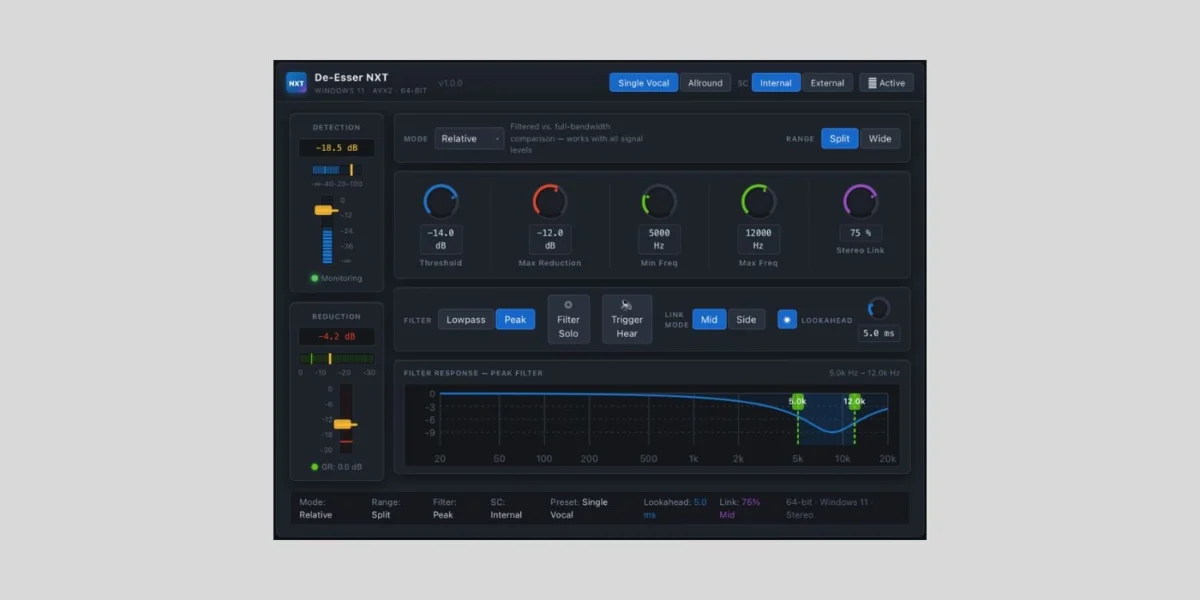
Subhankarda, an independent developer, has introduced De-Esser NXT, a new VST3 plugin meticulously engineered for the Windows 11 operating system. This native plugin is designed with the singular purpose of eradicating sibilance from audio recordings, striving to leave behind an unblemished and professional-grade sound. The strategic decision by Subhankarda to develop De-Esser NXT exclusively for Windows 11 underscores a growing trend in specialized software development: leveraging specific operating system advantages to achieve peak performance and functionality. This targeted approach allows the plugin to capitalize on Windows 11’s enhanced audio infrastructure, promising an unparalleled level of efficiency and sound quality for its users.
The Imperative of Sibilance Control in Audio Production
Sibilance, characterized by the harsh, hissing "s" and "sh" sounds in vocal recordings, is a pervasive challenge in audio production. While a natural component of human speech, excessive sibilance can detract significantly from the clarity and professionalism of a recording, leading to listener fatigue and an overall unpleasant auditory experience. These undesirable high-frequency sounds often become exaggerated during microphone recording, especially with condenser microphones, and can be further amplified during compression, equalization, or mastering processes. Effective sibilance removal is therefore not merely an aesthetic choice but a critical technical requirement for achieving broadcast-quality audio in music production, podcasts, voiceovers, and post-production for film and television.
Historically, audio engineers have employed various methods to combat sibilance. Manual de-essing, involving painstakingly editing individual sibilant sounds, offers surgical precision but is incredibly time-consuming. Analog hardware de-essers, which became prominent in the 1970s and 80s, provided dedicated solutions, but their cost and bulk limited accessibility. With the advent of digital audio workstations (DAWs) and plugin technology, software de-essers emerged as a flexible and affordable alternative, evolving from basic frequency-band compressors to sophisticated algorithms that can intelligently detect and attenuate sibilant frequencies. De-Esser NXT represents the latest iteration in this evolution, aiming to push the boundaries of what is achievable within a modern digital environment.
Leveraging Windows 11’s Advanced Audio Infrastructure
The developer’s choice to make De-Esser NXT a Windows 11 exclusive is a deliberate move to harness the operating system’s specific advancements in audio processing. Windows 11, released in October 2021, brought with it significant refinements to its audio stack, designed to offer lower latency, higher fidelity, and greater stability for professional audio applications. This includes improvements to core audio APIs and driver models that allow developers to create more tightly integrated and performant audio software.
De-Esser NXT leverages this infrastructure by offering users the flexibility to choose their preferred driver mode from WASAPI Shared, WASAPI Exclusive, WaveRT, and ASIO. Each of these modes offers distinct advantages:
- WASAPI (Windows Audio Session API): This modern audio API introduced with Windows Vista (and refined in subsequent versions, including Windows 11) provides direct access to audio hardware.
- WASAPI Shared Mode: Allows multiple applications to share the audio device simultaneously. While convenient for general use, it involves a mixer and processing by the OS, potentially introducing a slight increase in latency.
- WASAPI Exclusive Mode: Grants a single application direct, unshared access to the audio hardware, bypassing the Windows audio engine’s mixer and any associated processing. This results in the lowest possible latency and bit-perfect audio, making it ideal for critical audio production tasks where fidelity and responsiveness are paramount.
- WaveRT (Wave Real-Time): Introduced with Windows Vista, WaveRT is a kernel streaming driver model specifically designed for professional audio devices, aiming to provide very low latency and high-throughput audio streams directly from the application to the audio hardware, often used in conjunction with specific sound card drivers.
- ASIO (Audio Stream Input/Output): Developed by Steinberg, ASIO is a de facto standard for professional audio applications on Windows. It bypasses the operating system’s normal audio path entirely, offering the lowest possible latency and direct communication with audio hardware. While not a native Windows API, its widespread adoption and performance benefits make it a crucial option for professional audio users.
By offering this comprehensive suite of driver options, De-Esser NXT allows users to tailor their audio setup for optimal performance, whether prioritizing multi-application compatibility or striving for the absolute lowest latency and highest fidelity. This level of integration speaks to a design philosophy focused on maximizing the potential of the host operating system, a characteristic often found in high-performance computing applications.
Technical Prowess: DSP Optimization and Double-Precision Processing
A cornerstone of De-Esser NXT’s performance claims is its highly optimized Digital Signal Processing (DSP) engine. The plugin features an "optimised DSP hot path" that enables the processing of four 64-bit samples per CPU cycle. This technical detail is crucial for understanding the plugin’s efficiency and power. Modern CPUs are designed to process data in "cycles," and the ability to handle multiple samples (especially 64-bit samples, which offer higher resolution than standard 32-bit) within a single cycle significantly boosts computational efficiency. This optimization minimizes the CPU overhead, allowing users to run numerous instances of De-Esser NXT concurrently on modern Windows 11 hardware without encountering performance bottlenecks or audio dropouts. For audio producers working on complex projects with multiple vocal tracks, this capability translates directly into a smoother workflow and the ability to maintain creative momentum without technical interruptions.
Further enhancing its audio quality, De-Esser NXT boasts "truly double-precision DSP." This refers to the use of 64-bit floating-point numbers for all internal calculations, as opposed to the more common 32-bit single-precision. The implications of double-precision processing in audio are substantial:
- More Accurate Detection: Higher precision allows for more granular and accurate detection of sibilant frequencies, preventing false positives or missed sibilance.
- Cleaner Transients: By maintaining a higher level of numerical accuracy throughout the processing chain, the plugin can preserve the integrity of audio transients, ensuring that the attack phases of sounds remain sharp and clear, rather than being smeared or softened.
- No Degradation at Extreme Settings: A common challenge with audio processing plugins is that pushing them to their limits (e.g., extreme gain reduction or filtering) can introduce artifacts, distortion, or a general degradation of sound quality due to cumulative rounding errors in calculations. Double-precision processing significantly mitigates this risk, allowing users to apply aggressive de-essing without compromising the overall audio quality. This is particularly valuable for tackling severe sibilance issues where a less precise algorithm might introduce unwanted coloration or pumping.
The promise of "no degradation at extreme settings" is an interesting proposition, suggesting that De-Esser NXT could handle even the most challenging sibilant vocal tracks with transparency and fidelity. This claim invites rigorous testing by the professional audio community, as it addresses a long-standing limitation in many de-essing solutions, which often reach a point of diminishing returns where the "cure" starts to sound worse than the "disease."
Operational Versatility: Modes and Processing Types
De-Esser NXT provides audio engineers with two distinct operational modes and two processing types, offering a flexible toolkit to address a wide spectrum of sibilance issues:
Detection Modes:
- Relative Mode: This mode intelligently adapts to varying vocal levels. In dynamic vocal performances where the singer’s volume might fluctuate significantly, Relative Mode continuously adjusts its detection threshold based on the incoming signal’s perceived loudness. This ensures consistent de-essing across the entire performance, preventing overly aggressive processing during quieter passages or insufficient processing during louder sections. It’s particularly well-suited for live vocal recordings or performances with expressive dynamics.
- Absolute Mode: In contrast, Absolute Mode operates with a fixed, threshold-based detection. Users set a specific amplitude level, and any sibilant sounds exceeding this threshold are targeted for reduction. This mode is ideal for more consistent sources, such as voiceovers, podcasts, or tightly controlled studio vocals where the vocal level remains relatively stable. It provides precise, predictable control once the optimal threshold is established.
Processing Types:
- Split Processing: This method focuses attenuation exclusively on the detected sibilant frequency band. When sibilance is identified, only the specific frequencies containing the harsh "s" or "sh" sounds are reduced, leaving the rest of the vocal signal untouched. The benefit of Split Processing is its transparency; it minimizes the impact on the overall vocal timbre, ensuring that the voice retains its natural character while only the problematic frequencies are attenuated. This is often the preferred method for subtle and natural de-essing.
- Wide Processing: In cases of more severe sibilance, or when a broader effect is desired, Wide Processing applies gain reduction to the entire signal whenever sibilance is detected. Instead of just attenuating a narrow frequency band, the entire vocal signal’s volume is momentarily reduced. While potentially less transparent than Split Processing, Wide Processing can be highly effective for aggressively taming very harsh sibilance or for achieving a more controlled, compressed vocal sound where the sibilance is part of a broader issue. The developer notes that this is "ideal for those more severe cases."
Comprehensive Feature Set for Precision Control
Beyond its core modes, De-Esser NXT integrates a suite of additional features designed to provide granular control and enhance its utility in diverse audio production scenarios:
- Peak/Lowpass Filter Modes: These allow users to precisely define the frequency range where the de-esser operates. A peak filter can target a very specific sibilant frequency, while a lowpass filter can set an upper frequency limit for the de-essing action, preventing the plugin from affecting desirable high-frequency content.
- Lookahead up to 20ms: The lookahead function allows the plugin to "see" incoming audio before it reaches the processing engine. With up to 20 milliseconds of lookahead, De-Esser NXT can anticipate sibilant events and react pre-emptively, enabling smoother and more transparent gain reduction without audible pumping or artifacts. This feature is crucial for achieving natural-sounding de-essing, especially on fast transients.
- Per-Sample Stereo Link: This option ensures that de-essing applied to one channel (e.g., left) is mirrored precisely and simultaneously on the other channel (right) at the sample level. This maintains the stereo image integrity of a vocal recording, preventing any shifts or imbalances that could occur if each channel were processed independently, which is vital for maintaining a solid stereo center for vocals.
- Internal/External Sidechain Options: Sidechaining is a powerful tool in dynamic processing.
- Internal Sidechain: The plugin uses its own internal analysis of the input signal to trigger the de-essing action.
- External Sidechain: This allows an external signal (e.g., a duplicate of the vocal track with an exaggerated sibilance EQ) to trigger the de-esser, offering even greater control over when and how the de-essing engages. This can be useful for fine-tuning the detection and ensuring that only specific sibilant sounds, rather than other high-frequency content, are targeted.
User Interface and Workflow Integration
The visual design and user experience of a plugin are almost as crucial as its sonic capabilities. De-Esser NXT’s interface is described as "very good," favoring "function over style" while incorporating "nice touches." This suggests a design philosophy centered on clarity, intuitiveness, and efficiency. Key elements likely include:
- Clear Visual Feedback: A well-designed frequency response display is paramount for de-essers, allowing users to visualize the sibilant frequencies and the extent of gain reduction.
- Draggable Min/Max Handles: The mention of "draggable min/max handles on the frequency response display" indicates a direct and interactive way for users to define the operational frequency range of the de-esser. This hands-on approach streamlines the workflow, making it easier to pinpoint and target problematic areas without resorting to numerical input alone.
- Logical Layout: An interface that prioritizes function typically means controls are logically grouped, clearly labeled, and easily accessible, reducing the learning curve and allowing producers to focus on the audio rather than navigating complex menus.
Such design considerations contribute significantly to a seamless workflow, allowing audio engineers to quickly diagnose and treat sibilance, ultimately saving time and enhancing productivity in demanding production environments.
The Broader Plugin Landscape: Exclusivity vs. Cross-Platform Solutions
The decision for Windows 11 exclusivity for De-Esser NXT naturally raises questions within the diverse audio production community, which relies heavily on both Windows and macOS platforms. While Windows users benefit from the optimized performance, Mac users might feel excluded. However, Subhankarda’s broader ecosystem, or at least the developer community, appears to be conscious of this. The news article notes that the previously Windows-exclusive fy_nicetape is now available for macOS, which is indeed "awesome news" for Mac-based producers. This indicates a potential strategy of platform-specific optimization for new releases while eventually broadening compatibility for established plugins, or perhaps different developers focusing on different platforms.
Moreover, the article highlights GARUC Audio's free Deess-ertic Lite as a cross-platform alternative. This acknowledges the reality of a competitive plugin market where users often seek solutions that work across multiple operating systems, especially those who work in hybrid studios or collaborate with peers on different platforms. The availability of free, cross-platform options ensures that users always have choices, even if they cannot access the hyper-optimized, OS-exclusive solutions. This dynamic fosters innovation across the board, as developers strive to differentiate their offerings through unique features, superior algorithms, or targeted platform advantages.
Implications for Audio Producers and the Industry
The introduction of De-Esser NXT carries several implications for the audio production landscape:
- For Windows 11 Users: This plugin offers a highly specialized and optimized tool that potentially sets a new standard for de-essing performance on their platform. The combination of OS-specific optimization, advanced DSP, and double-precision processing promises cleaner results with less CPU strain, enhancing the quality and efficiency of their productions. This could solidify Windows 11’s appeal for professional audio workstations.
- For the Plugin Market: De-Esser NXT’s Windows 11 exclusivity might encourage other developers to explore similar deep integrations with specific operating system features, leading to a new wave of highly optimized, platform-specific tools. This could spur innovation but also potentially contribute to platform fragmentation if not balanced with cross-platform considerations.
- For Audio Quality Standards: If De-Esser NXT lives up to its claims of "truly double-precision DSP" and "no degradation at extreme settings," it could raise expectations for the transparency and effectiveness of de-essing plugins across the industry. This would benefit all producers by pushing the boundaries of what is possible in audio repair and enhancement.
- Developer’s Vision: Subhankarda’s focus on a niche, high-performance solution suggests a commitment to pushing technical boundaries rather than simply broad market reach. This philosophy often leads to highly effective tools that cater to the most demanding users.
The release of De-Esser NXT on March 16, 2026, or its last update date, marks a significant moment for Windows 11 audio production. The plugin’s comprehensive feature set, combined with its deep integration with the operating system’s audio infrastructure, positions it as a potentially indispensable tool for professionals seeking the cleanest possible vocal recordings. As the developer and the broader audio community await feedback from Windows 11 users, the true impact and real-world performance of De-Esser NXT will undoubtedly become clearer, shaping its place in the ever-evolving world of audio production software.
