

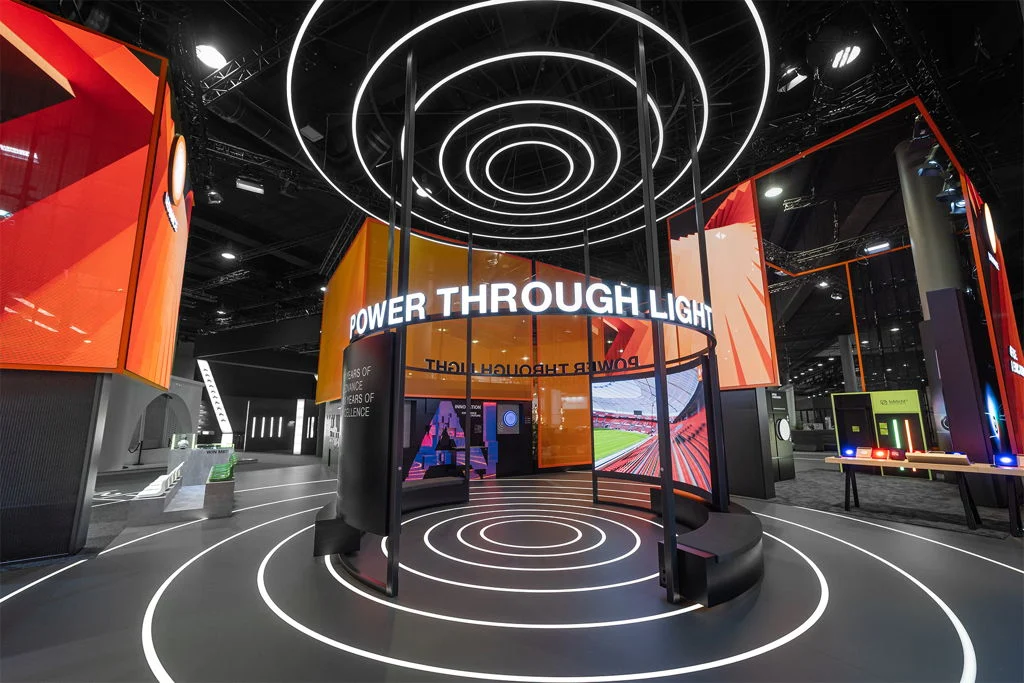
The Light + Building 2026 trade fair in Frankfurt am Main served as the stage for a transformative approach to brand communication, headlined by Ledvance’s sophisticated exhibition presence. Centered on the concept of "Mediatecture," the installation utilized translucent LED bodies to blur the traditional boundaries between architectural structure and digital communication. By integrating glowing volumes that define spatial edges and functional zones, the booth created a dynamic environment where light and movement continuously reshaped the visitor experience. Opake surfaces were replaced by permeable membranes, and rigid architectural borders dissolved into fluid transitions, resulting in a versatile space that redefined transparency, depth, and kinetic design. This choreographed synergy of technology and design provided a physical manifestation of the brand’s evolving identity within the global lighting industry.
The Strategic Context of Light + Building 2026
As the world’s leading trade fair for lighting and building services technology, Light + Building has long been the primary barometer for innovation in the electrical engineering and home automation sectors. The 2026 edition arrived at a critical juncture for the industry, characterized by the accelerated convergence of smart city infrastructure, human-centric lighting (HCL), and the urgent demands of global decarbonization. In this high-stakes environment, Ledvance aimed to move beyond the presentation of standalone products, seeking instead to demonstrate its role as a provider of integrated, intelligent, and energy-efficient systems.
The exhibition design was built upon the brand promise "Power Through Light." Rather than treating this as a mere marketing slogan, the design team translated the phrase into a spatial leitmotif. Light was utilized as the primary engine of the booth—functioning as a visual guide, a functional tool, and a dramatic narrative device. By structuring the 2026 appearance around this concept, Ledvance positioned itself as a driver of energy and innovation, using light to activate content and create an immersive atmosphere that resonated with international architects, designers, and facility managers.
Architectural Anatomy: The Brand Core and the Radial Narrative
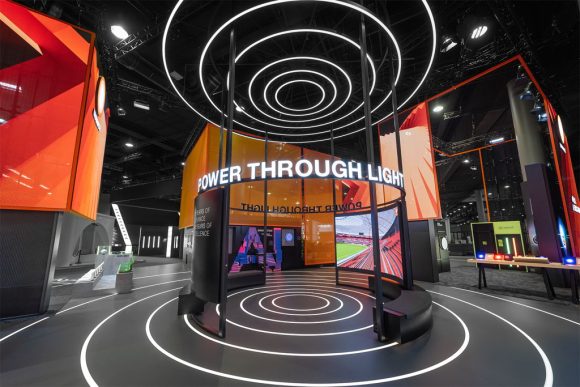
At the heart of the 1,200-square-meter installation sat the "Brand Core," described by designers as the energetic epicenter of the exhibit. This central hub featured a large-scale, circular LED installation designed to emit visual impulses that radiated outward across the entire stand. These pulses were not merely decorative; they represented the flow of information and energy, which were subsequently caught and reflected by peripheral structures known as "Power Cubes."
The Brand Core’s verticality was emphasized by filigreed frames stretching from the ceiling to the floor, where the digital content found its graphic continuation in the floor design. Inside this core, two concentric LED surfaces served as a dual-layered narrative screen. This setup allowed Ledvance to showcase its unique corporate history—a complex duality involving its ten-year journey as an independent brand and its century-long heritage rooted in the traditions of its predecessor, Osram. This visual storytelling allowed visitors to experience the brand’s evolution from a traditional lamp manufacturer to a modern leader in smart lighting and renewable energy solutions.
The Power Cubes: A Modular Approach to Product Worlds
Surrounding the Brand Core were six "Power Cubes," which functioned as thematic anchors for the company’s diverse product portfolios. These cubes acted as spatial activators, translating technical specifications into atmospheric, real-world scenarios. By moving away from static product displays, the cubes allowed visitors to experience the practical application of light in specific professional environments.
Each cube was dedicated to a distinct sector, reflecting the current market demands of 2026:
- Office & Education: This zone focused on Human Centric Lighting (HCL) and smart controls, demonstrating how light can improve productivity, concentration, and well-being in workplaces and schools.
- Sport: Emphasizing high-performance floodlighting and flicker-free technology, this area showcased solutions for both professional arenas and local community facilities.
- Shop: Here, the focus shifted to color rendering and atmospheric lighting designed to enhance the retail experience and influence consumer behavior.
- Outdoor & Area: This cube addressed the needs of urban planners, focusing on safety, durability, and the integration of lighting into smart city grids.
- Industry & Logistics: Highlighting efficiency and resilience, this section displayed robust lighting systems capable of withstanding harsh industrial conditions while minimizing energy consumption.
- Project Services: A dedicated space for consultants and engineers, focusing on the software and support systems Ledvance provides for large-scale lighting design and energy auditing.
The interconnected nature of the Brand Core and the Power Cubes created a unified "energy field." In this configuration, light was no longer viewed as a static product but as a central medium of communication—an architecture of light that merged information, orientation, and emotion into a holistic brand experience.
Design Philosophy and Execution by Studio Bachmannkern
The conceptualization and realization of this ambitious project were led by Studio Bachmannkern, a design firm that has managed Ledvance’s spatial experience design since the brand’s inception a decade ago. Dirk Bachmann-Kern, CCO and founder of the studio, noted that the goal for 2026 was to move beyond mere illumination. "With the Mediatecture for Ledvance, we did not just stage light; we made it tangible as an architectural medium," Bachmann-Kern stated. "The result is a space that communicates, reacts, and makes energy visible—a living system of light and movement."
This partnership has historically been fruitful, with previous collaborations at Light + Building receiving numerous national and international design accolades, including Red Dot and German Design Awards. The 2026 booth continued this trajectory by utilizing advanced materials, such as semi-transparent LED meshes and high-resolution digital surfaces, to create a sense of "weightless" architecture.
Technical Analysis and Industry Implications
From a technical perspective, the 2026 installation represented a significant leap in exhibition technology. The use of translucent LED bodies required a high degree of synchronization between the architectural framework and the media playback systems. Industry analysts noted that the "Mediatecture" approach is indicative of a broader trend in B2B marketing: the shift from "showing" to "experiencing."
The integration of these digital elements also reflects the lighting industry’s pivot toward the "Internet of Lights." By 2026, the market has moved largely toward software-defined lighting, where the value lies as much in the control system and data analytics as it does in the physical fixture. The Ledvance booth mirrored this by using its own "Power Cubes" to demonstrate how light can be networked to create responsive environments.
Furthermore, the emphasis on energy and "power" aligns with the European Green Deal and the lighting industry’s role in reducing the carbon footprint of the built environment. Ledvance’s focus on efficiency within the cubes served as a direct response to the increasing regulatory pressure on building owners to modernize aging lighting infrastructure with LED and smart-control alternatives.

Chronology of a Decade: From 2016 to 2026
The 2026 fair also served as a milestone anniversary for Ledvance. Following its spin-off from Osram in 2016, the company initially focused on maintaining its dominant position in the traditional lamp market while pivoting toward LED luminaires. Over the subsequent decade, the brand expanded its portfolio to include smart home systems, professional lighting solutions, and most recently, renewable energy products such as photovoltaic systems and battery storage.
The chronology of the brand’s exhibition presence at Light + Building reflects this evolution:
- 2018: Focus on brand establishment and the transition from lamps to luminaires.
- 2022/2024: Emphasis on "Human Centric Lighting" and the "Nature of Light."
- 2026: The full integration of media, architecture, and energy systems under the "Mediatecture" banner.
Broader Impact on Trade Fair Design
The success of the Ledvance stand is expected to influence future exhibition strategies across the tech sector. By utilizing light as a structural element rather than a secondary feature, the design challenged the traditional "shell and tube" booth construction. The use of translucent materials allowed for a more open, inviting stand layout that maximized the 360-degree visibility of the brand without creating solid visual barriers.
Reaction from industry observers in Frankfurt suggested that the "Mediatecture" concept successfully addressed the "digital fatigue" often found at major trade shows. Instead of bombarding visitors with flat screens, the integration of light into the very fabric of the building created a more organic and less intrusive way to consume information.
As the 2026 Light + Building concludes, the industry looks toward a future where the boundaries between the physical and digital worlds continue to dissolve. Ledvance’s exhibition stands as a testament to the power of light—not just as a tool for visibility, but as a fundamental building block of modern architecture and brand storytelling. Through the collaborative vision of Studio Bachmannkern, the brand has demonstrated that in the future of the built environment, light is the architecture.
