

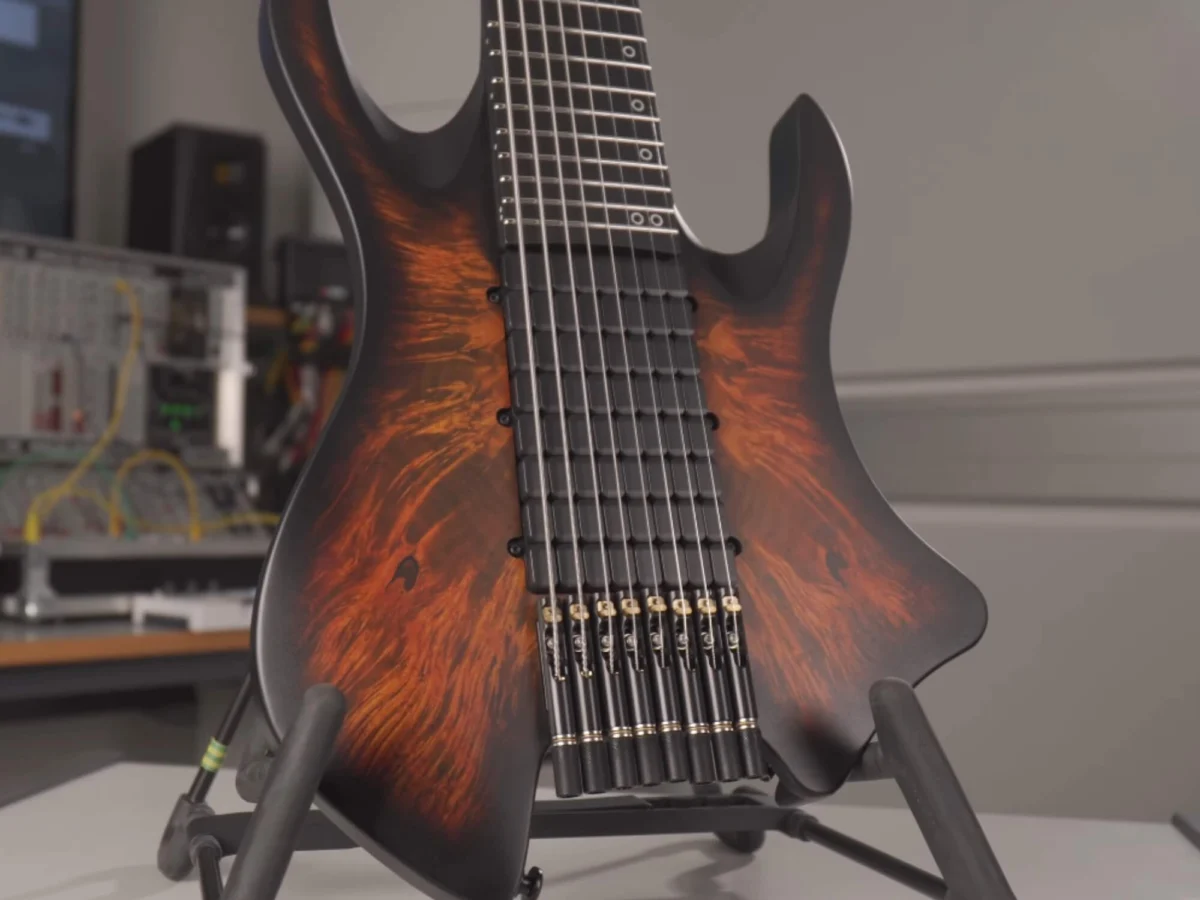
In a significant development for musical instrument technology, David Wieland of Dark Art Guitars has introduced the "Polymap" system, a revolutionary guitar featuring an unprecedented 64 individual pickups. Conceived as part of his master’s thesis in electrical engineering, this innovation pushes the boundaries of how guitar signals are captured, processed, and manipulated, fundamentally altering the post-production workflow for guitarists and sound engineers alike. The Polymap system, integrated into a custom eight-string, headless Alchemist guitar, represents a paradigm shift from traditional signal capture to a highly detailed, multi-faceted data stream, offering unparalleled sonic control.
The Genesis of Polymap: Rethinking Guitar Signal Capture
For decades, the electric guitar’s sound has been defined by a relatively simple mechanism: vibrating strings inducing currents in magnetic coils, or pickups. These pickups, typically two or three per guitar, are positioned at fixed points along the strings’ length—commonly near the neck for warmer tones and near the bridge for brighter, more articulate sounds. The output from these pickups is then blended, either directly or through a switch, into a single, composite analog signal. While this system has formed the bedrock of countless musical genres and iconic sounds, it inherently presents limitations, primarily in the inflexibility of sonic choices once a performance is recorded. The "finished mixed output signal," as Wieland describes it, offers limited opportunities for granular adjustment after the fact, forcing musicians to commit to specific tonal characteristics during the recording phase.
Wieland’s project emerged from a desire to overcome these inherent limitations. His core hypothesis was that by capturing vastly more data about each string’s vibration, a guitar could offer unprecedented flexibility in sound design and post-production. This ambition necessitated a radical departure from conventional pickup design and signal processing. While polyphonic pickups, such as hexaphonic systems (like the Roland GK series or certain MIDI pickups) that provide a separate output for each string, have existed for some time, Polymap takes this concept to an entirely new dimension. Instead of merely isolating each string, Wieland sought to capture multiple perspectives of each string’s vibration, effectively creating a "spatially mapped instrument." This foundational idea underscores the project’s ambition to transform the guitar from a simple signal generator into a sophisticated data-gathering device.
Anatomy of an Innovation: The 64-Pickup Hardware System
The physical embodiment of the Polymap system is an eight-string, headless Alchemist guitar, meticulously chosen and modified to serve as the experimental platform. This instrument features a 26.5-inch scale length, a swamp ash body, and a visually striking maple burl top. However, much of the guitar’s internal structure has been re-engineered, with significant portions of wood carved out to accommodate what Wieland candidly refers to as a "giant hole" dedicated to the intricate network of electronics. This modification was essential to house the sheer volume of components required for the Polymap system.
At the heart of the hardware are the 64 individual pickups. Wieland’s design principle was to deploy eight pickups per string across all eight strings. This configuration creates eight distinct "listening points" along the length of each string, capturing its vibration at different spatial locations. To visualize this, imagine having not just a neck and bridge pickup for each string, but six additional pickups distributed evenly in between, all capturing their unique perspective simultaneously and independently. This array provides a rich tapestry of raw sonic information, far exceeding the capabilities of any standard or even existing polyphonic guitar system. Each of these miniature pickups is a Cycfi Research pickup capsule, renowned for their compact size and precise signal capture, making them ideal for such a high-density application.
The choice of an eight-string guitar further amplifies the system’s potential, catering to modern progressive genres and extended-range playing styles that benefit from detailed sonic manipulation. The headless design contributes to the instrument’s overall stability and ergonomic profile, essential considerations given the complexity of the internal electronics. The physical integration of so many components, from the pickup capsules to the subsequent processing boards, required meticulous engineering and custom fabrication, showcasing the depth of Wieland’s master’s thesis project.
The Digital Revolution Within the Instrument
Capturing 64 independent analog signals simultaneously presents a significant engineering challenge, particularly when the goal is to process them without any pre-mixing or loss of individual data. Wieland’s solution was to digitize these signals inside the guitar itself. This crucial design decision bypasses the limitations of transmitting 64 separate analog lines, which would be impractical and prone to noise interference. To achieve this, the Polymap system incorporates a sophisticated control board that first buffers each of the 64 analog signals. These buffered signals are then fed into 64 individual analogue-to-digital converters (ADCs), each dedicated to a single pickup’s output.
The integration of these ADCs within the guitar effectively transforms the instrument into a high-channel count audio interface. This internal digital conversion means that the guitar outputs a single, consolidated digital signal, typically via a standard connection like USB or optical, directly to a computer or digital audio workstation (DAW). "Because we want to record all 64 pickups simultaneously without mixing them, the only real choice was to digitise them inside of the guitar," Wieland explains. "This means that we essentially built a 64-channel audio interface integrated into the guitar that then sends out one single digital signal to the computer."
Once the digital signal arrives at the computer, it manifests as 64 discrete audio channels within the DAW. To make these channels manageable and musically useful, Wieland developed a custom VSSD (Virtual Studio Sound Design) plugin. This proprietary software acts as the control hub for the Polymap system, allowing users to mix all 64 signals, apply various effects, and ultimately derive a stereo output that can be monitored through regular headphones or studio monitors. This software component is as critical as the hardware, providing the interface through which musicians can unlock the vast potential of the raw data.
Unlocking Unprecedented Post-Production Flexibility
The true power and transformative potential of the Polymap system lie in the unparalleled flexibility it offers in post-production. Traditional guitar recording workflows require musicians to make critical sonic decisions—such as pickup selection, tone control settings, and effect choices—during the initial tracking phase. Once recorded, these decisions are largely immutable. Polymap shatters this constraint by capturing raw, unprocessed string data from multiple points, deferring virtually all sonic shaping to the mixing and mastering stages.
"Now, because we get the raw data into the DAW, this means we are actually recording the raw data and not the mixed output," Wieland states. "So, all of the effects and the choice of which pickups are active can be made after it is recorded." This shift represents a profound liberation for guitarists and producers. Imagine recording a complex guitar part and then, hours or days later, auditioning different "pickup positions" or blends of those positions, adjusting the tonal character of the performance without ever re-recording a note. This capability alone offers a revolutionary degree of creative freedom and error correction.
Beyond basic tone shaping, the 64 discrete channels enable a myriad of advanced sound design possibilities:
- Spatialization: Individual strings, or even different pickup points along a single string, can be spread across the stereo field or even a multi-channel immersive audio setup. This allows for incredibly detailed and dynamic spatial mixing, giving each note or string its own unique presence.
- Multi-Rig Routing: A recording engineer could route the lower, heavier strings (e.g., the low F# and B on an eight-string) to a virtual bass amplifier and cabinet simulation, while simultaneously sending the middle and upper strings to distinct guitar amplifier models. This effectively turns one performance into a multi-instrumental arrangement, all from a single guitar track.
- Physically Grounded Spatial Effects: By blending and delaying signals from different pickup points along the same string, unique and physically plausible spatial effects can be generated. This could range from subtle phasing and chorusing to more dramatic, evolving textures that are intrinsically tied to the string’s physical vibration characteristics rather than abstract digital processing.
- Dynamic Tonal Sculpting: Imagine automating the "pickup blend" or "virtual pickup position" over the course of a phrase, seamlessly transitioning from a bright, bridge-like tone to a warm, neck-like tone within a single sustained note.
- Advanced Sound Design and Synthesis: The raw data could also be used as a source for more experimental sound design, potentially feeding into granular synthesizers or spectral processing tools, opening up avenues for entirely new sonic textures that blur the line between guitar and electronic music.
This level of granular control positions the Polymap not just as an advanced guitar, but as a truly powerful recording and sound design tool, offering an unprecedented degree of sonic malleability.
Broader Implications for Music Production and Sound Design
The Polymap system carries significant implications for the broader music industry, particularly in the realms of recording, production, and sound design. For recording engineers and producers, it offers a dramatic reduction in the pressure of "getting the tone right" during tracking. Instead, the focus can shift entirely to performance, knowing that virtually all tonal and spatial decisions can be refined, experimented with, and even radically altered in post-production. This could streamline workflows, reduce re-tracking sessions, and foster greater creative exploration without the constraints of committing early.
For experimental musicians and sound designers, the Polymap is a potent new instrument. The ability to manipulate 64 channels of raw string data opens up a vast sonic palette for creating textures, atmospheres, and effects that are impossible with conventional guitars. It encourages a new way of thinking about the guitar—not as an instrument with a fixed voice, but as a rich source of raw acoustic data waiting to be sculpted digitally. The concept of the guitar becoming a "spatially mapped instrument" fundamentally changes its role in the creative process, moving it closer to a data sensor than a traditional sound emitter.
While currently a master’s thesis project, the underlying principles of Polymap hint at potential future directions for commercial guitar technology. Challenges for widespread adoption would undoubtedly include cost, complexity, and the need for significant computing power and specialized software. However, as digital audio technology continues to advance and become more accessible, systems like Polymap could inspire modular approaches, simplified versions, or even entirely new product categories. The project also highlights the ongoing convergence of instrument design, electrical engineering, and software development, underscoring a future where musical instruments are increasingly sophisticated digital interfaces.
From Academic Thesis to Potential Industry Paradigm Shift
David Wieland’s Polymap system stands as a testament to the innovative spirit within electrical engineering and music technology. It represents not just an incremental improvement but a fundamental re-imagining of how electric guitars interact with the recording environment. By transforming the guitar into a detailed data acquisition device, Wieland has created a tool that offers unprecedented flexibility and creative control in post-production, potentially reshaping workflows for musicians, producers, and sound designers.
As the music industry continues its evolution towards more personalized and digitally driven creative processes, the Polymap provides a compelling glimpse into a future where the traditional boundaries of instrument design and sonic manipulation are continually challenged and expanded. The project, showcased through Dark Art Guitars, is more than just an academic exercise; it is a working prototype that demonstrates a viable path towards a more versatile and creatively liberating guitar experience. Those interested in experiencing this groundbreaking innovation can find demonstration videos and further details on the Dark Art Guitars website.
