

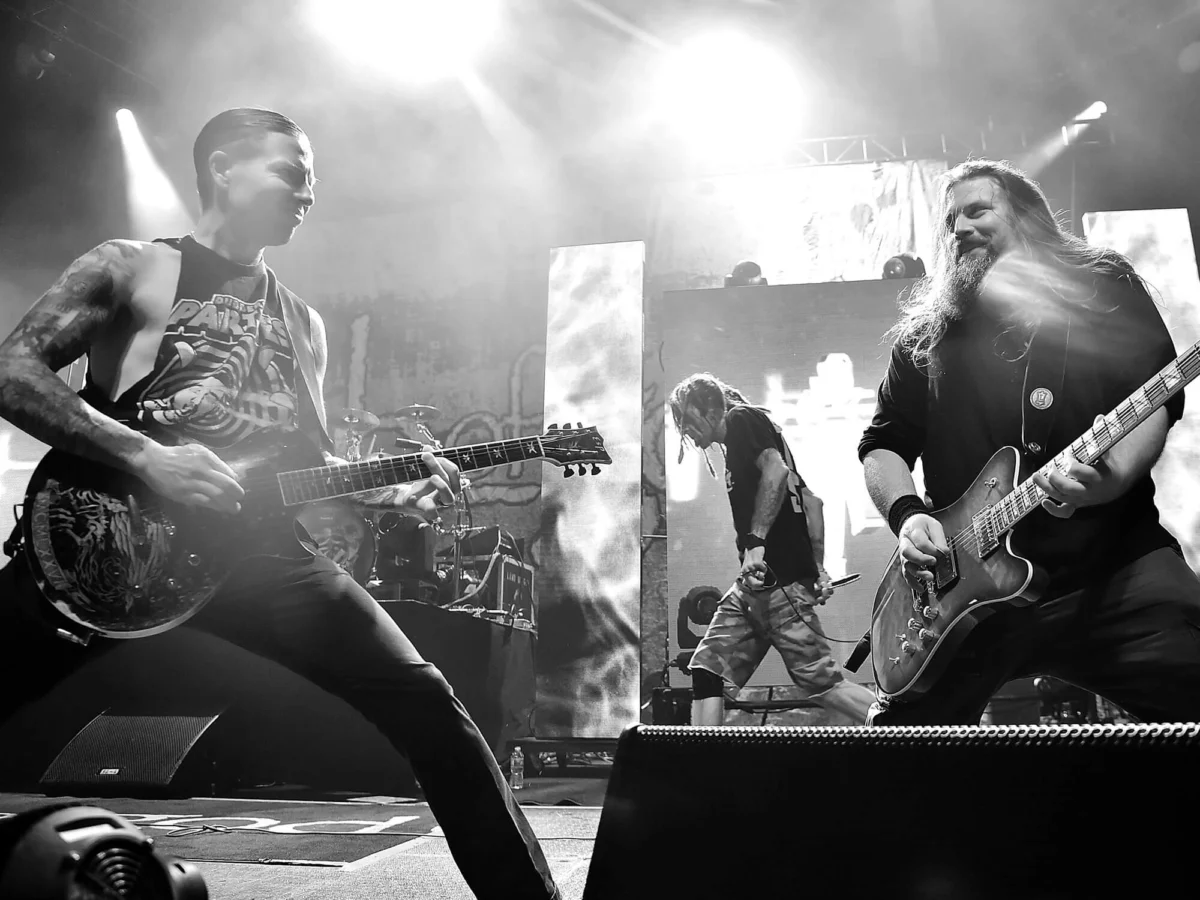
Managing creative differences within a musical ensemble, particularly one with a decades-long history, presents unique challenges that can significantly impact a band’s output and longevity. Mark Morton, the acclaimed guitarist for the Grammy-nominated metal band Lamb of God, recently offered insights into his approach to resolving creative friction with his bandmates, particularly fellow guitarist Willie Adler. These reflections emerge as the band continues to tour in support of their recent album, Into Oblivion, released on March 13, following their critically well-received 2022 offering, Omens. Morton’s philosophy underscores a pragmatic and mature understanding of collaborative artistry, emphasizing strategic deference and the collective good over individual ego.
The Art of Compromise: Morton’s Philosophy on Creative Direction
In a recent interview with Guitar World, Mark Morton elaborated on the intricate dynamics of Lamb of God’s songwriting process, a journey that has seen the band release ten studio albums over more than two decades. Morton candidly acknowledged the inevitability of disagreements among the five band members and their producer during the creation of new material. "We sometimes disagree," Morton stated, articulating a reality familiar to many collaborative artists. However, he quickly transitioned to the learned wisdom derived from years of navigating these creative waters: "But I’ve learned over the years that if you’ve got five guys and a producer in the room, and you’re trying to make everybody happy, you’re going to wind up diluting a piece of music to the point where it’s not going to have an identity."
This statement highlights a critical principle in high-level artistic collaboration: the potential for creative dilution when attempting to appease every individual perspective simultaneously. Morton’s solution is a disciplined approach to leadership and followership within the creative process. He advocates for a clear, albeit fluid, designation of creative direction for individual tracks. "Somebody’s got to be willing to say, ‘I’m not directing this one,’" he explained. This willingness to step back and cede control is central to his strategy. When he finds himself in this position, Morton states, "I fall back and let the people who are the most motivated and the most excited about that particular song steer it." This method prioritizes passion and conviction, recognizing that the strongest proponents of an idea are often best equipped to see it through to its fullest potential.
Morton’s evolution in managing these dynamics is evident in his realization: "When I stopped trying to be in control of everything, I realised the strongest opinion in the room is often the right opinion." This is not an abdication of responsibility but a strategic distribution of creative authority, allowing the most compelling vision to take precedence. He provided a specific example involving his long-time collaborator, Willie Adler: "If I disagree with Willie about something, but he’s so dead set on doing it his way because he thinks it’s way better, then I will defer to him, and vice versa." This reciprocal trust and respect form the bedrock of their working relationship, fostering an environment where individual ideas can flourish without constant contention.
Conversely, Morton also addressed instances where a single individual might cling to an idea despite collective disagreement. In such scenarios, he stressed the importance of direct and honest communication. "If somebody’s clinging to something but everyone else thinks it’s the wrong thing, sometimes you’ve got to have that conversation and go, ‘You know what, man? The whole rest of the room disagrees with you so maybe you should just step away.’" This illustrates a practical approach to maintaining creative momentum and ensuring that the band’s collective vision remains cohesive, preventing a single dissenting voice from derailing the entire process. This balanced strategy – knowing when to lead, when to follow, and when to collectively guide – is a hallmark of Lamb of God’s enduring success.
A Decade-Spanning Partnership: The Morton-Adler Dynamic
The creative synergy between Mark Morton and Willie Adler is a cornerstone of Lamb of God’s distinctive sound, characterized by intricate riffing, crushing breakdowns, and a relentless intensity. Their partnership extends back to the band’s formative years, initially under the name Burn the Priest, before their transformation into Lamb of God in 1999. Over more than two decades, they have co-written the vast majority of the band’s material, developing a unique rapport that transcends typical bandmate interactions.
Willie Adler himself underscored the depth of their creative bond, stating, "Mark and I have such a long history together that we’ve learned how to read each other and work together." This intuitive understanding is invaluable in a creative partnership, allowing for efficient communication and a shared vision that often bypasses the need for explicit verbalization. Adler further emphasized the symbiotic nature of their collaboration: "We feed off each other to such an extent that I’d feel very lost going into a writing session or writing songs without Mark." This sentiment highlights not just a professional partnership but a profound creative reliance, where each guitarist’s input elevates the other’s work.
Crucially, Adler also pointed to the psychological safety net inherent in their relationship: "I can fuck up around Mark. I can woodshed something and sound terrible, but it’s alright because I know I’m going to get there. And Mark knows I’m going to get there." This environment of trust and mutual respect allows for unfiltered experimentation, a vital component of genuine artistic innovation. The ability to explore nascent, unrefined ideas without fear of judgment is a luxury many musicians in collaborative settings do not possess. It permits a deeper dive into creative possibilities, knowing that the rough edges will eventually be smoothed out through shared effort and understanding. This mutual assurance, built on years of shared experience, is a testament to the strength and maturity of their creative partnership, directly contributing to the consistent quality of Lamb of God’s discography.
Lamb of God’s Enduring Legacy: A History of Innovation and Stability
Formed in Richmond, Virginia, in 1994, Lamb of God quickly carved out a niche in the metal scene, evolving from their thrash metal roots into a pioneering force in the groove metal subgenre. Their early albums like New American Gospel (2000) and As the Palaces Burn (2003) laid the groundwork for their signature sound, characterized by heavy, syncopated riffs, aggressive vocals, and a relentless rhythmic drive. However, it was their breakout album, Ashes of the Wake (2004), that propelled them to international prominence, solidifying their status as leaders of the "New Wave of American Heavy Metal."

Over their extensive career, Lamb of God has maintained a remarkably consistent lineup, with Mark Morton, Willie Adler, vocalist Randy Blythe, and bassist John Campbell being constant fixtures for the vast majority of their existence. The only significant lineup change occurred in 2019 when Art Cruz replaced original drummer Chris Adler (Willie’s brother). This stability, rare in the often tumultuous world of metal bands, provides a crucial backdrop to Morton’s discussion of creative dynamics. A consistent lineup fosters deep personal and professional relationships, allowing for the development of the kind of intuitive understanding Morton and Adler describe. Without this foundation, the strategies for managing creative friction would likely be far more challenging to implement effectively.
The band’s discography reflects a continuous evolution while retaining their core identity. Albums like Sacrament (2006), Wrath (2009), and Resolution (2012) earned them multiple Grammy nominations, cementing their critical and commercial success. Their ability to consistently deliver high-quality, impactful music over decades is a direct consequence of their refined creative process and their pragmatic approach to internal collaboration. This sustained output, marked by technical proficiency and thematic depth, stands as empirical evidence of their effective strategies for navigating the inherent complexities of collective artistic creation.
Into Oblivion and Omens: Recent Creative Endeavors
The discussion of creative dynamics gains particular relevance in the context of Lamb of God’s recent output. The band’s tenth studio album, Into Oblivion, released on March 13, arrives just two years after their previous critically acclaimed album, Omens, which debuted on October 7, 2022. The relatively short gap between these releases underscores the band’s ongoing prolificacy and the efficiency of their songwriting process, even amidst extensive touring schedules.
Omens was widely praised for its raw energy and aggressive lyrical themes, often reflecting contemporary societal anxieties and political landscapes. It demonstrated a band still operating at the peak of its powers, unafraid to confront challenging subjects with its characteristic intensity. The positive reception to Omens undoubtedly placed a certain degree of expectation on Into Oblivion. Releasing a tenth album nearly three decades into their career, especially one following a strong predecessor, demands a sophisticated and harmonious creative environment. Morton’s insights into managing disagreements become even more pertinent here; the ability to efficiently resolve creative impasses is crucial for maintaining a consistent release schedule and artistic quality.
The music video for "Into Oblivion," prominently featured and embedded in the original announcement, serves as a direct visual and auditory representation of the band’s current creative output. It showcases the intricate guitar work of Morton and Adler, the powerful rhythm section of Campbell and Cruz, and Blythe’s commanding vocals. The successful execution of such a track, from initial concept to final production, is a testament to the collaborative strategies Morton detailed, where individual contributions coalesce into a unified and impactful artistic statement. These recent albums confirm that Lamb of God’s method for handling creative friction is not merely theoretical but actively implemented and demonstrably effective in producing compelling new music.
The Broader Impact: Sustaining Creativity in Metal
Mark Morton’s reflections offer valuable insights not just for musicians but for any collaborative endeavor where diverse creative voices must coalesce into a unified product. The principles he articulates—strategic deference, prioritizing collective identity over individual ego, recognizing and empowering the most passionate voice, and direct communication when consensus is elusive—are universal. In the highly competitive and often demanding music industry, particularly within the metal genre known for its passionate and opinionated artists, such a mature approach to collaboration is a significant factor in a band’s longevity.
Many bands, even those with immense talent and initial success, have faltered or dissolved due to unresolved creative differences. Lineup changes, internal feuds, and creative stagnation are common pitfalls. Lamb of God’s enduring presence, consistent output, and continued critical acclaim stand as a counter-narrative. Their ability to maintain a strong collective identity while allowing individual members significant creative input speaks to a well-honed professional dynamic. This is particularly true for co-guitarists who often share primary songwriting duties; the potential for rivalry or stylistic clashes is high. The Morton-Adler partnership, as described, exemplifies a model of collaborative success through mutual respect and a shared understanding of the band’s overarching artistic goals.
Furthermore, the role of a producer, as mentioned by Morton, often acts as an external mediator and objective voice in these creative discussions. A skilled producer can help guide the band towards the "strongest opinion" or facilitate the "conversation" when a single member is at odds with the collective. This external perspective adds another layer of professional management to the creative process, ensuring that the band’s artistic vision remains sharp and undiluted.
Conclusion: The Future of Lamb of God’s Sound
As Lamb of God continues its touring cycle in support of Into Oblivion, Mark Morton’s candid revelations about their internal creative process provide a deeper understanding of the mechanisms behind their sustained success. His emphasis on strategic deference, the power of a "strongest opinion," and the critical importance of a trusting, long-standing partnership with Willie Adler, illuminate the often-unseen work that underpins a band’s artistic output.
The band’s journey, from their origins as Burn the Priest to their current status as a global metal powerhouse, is a testament to their resilience, talent, and perhaps most importantly, their evolved understanding of collaborative artistry. In an industry where ego and creative clashes frequently derail promising careers, Lamb of God’s approach offers a compelling model for maintaining artistic integrity and productivity over decades. Their ability to continue releasing potent, relevant music like Omens and Into Oblivion confirms that their internal strategies for managing creative friction are not just philosophical musings but practical, effective tools that ensure the continued vitality and impact of one of modern metal’s most enduring forces. The ongoing tour, with dates available on the official Lamb of God website, serves as a live demonstration of this finely tuned, creatively robust ensemble in action.
