

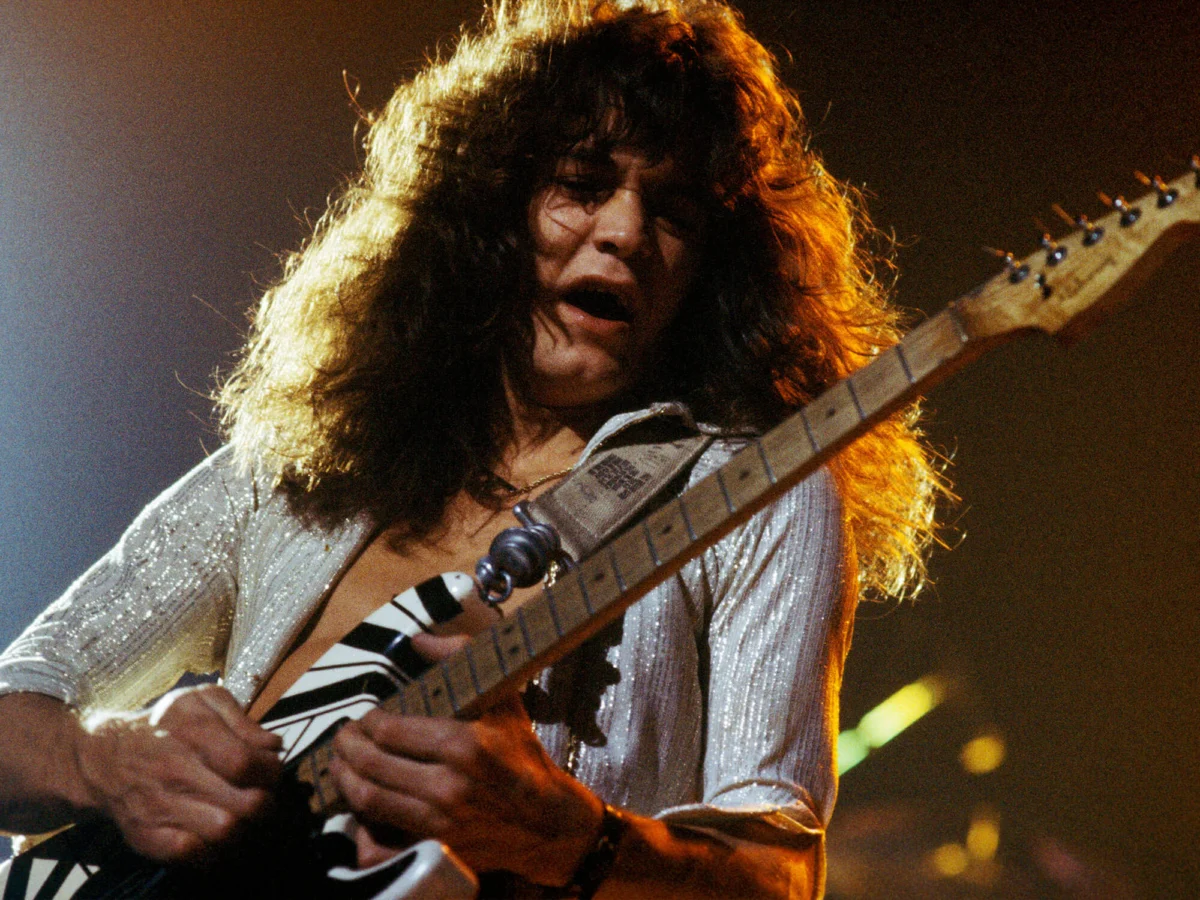
Dokken guitarist George Lynch has offered a vivid recollection of witnessing Eddie Van Halen’s groundbreaking guitar prowess up close in the 1970s, describing an experience so profound it reportedly humbled the formidable English hard rock outfit UFO, whom Van Halen supported during a 1976 concert at the Golden West Ballroom in Norwalk, California. Lynch’s account, shared during a conversation with The Music Zoo owner Tommy Colletti and subsequently reported by Blabbermouth, highlights a pivotal moment in rock history when the emerging talent of Eddie Van Halen began to redefine the landscape of electric guitar playing.
"I saw UFO play with Van Halen at the Golden West Ballroom in Norwalk, California, near where we lived. We played there a lot," Lynch recounted, setting the scene of a local venue familiar to many aspiring musicians of the era. He elaborated on the dramatic nature of the performance: "It was somewhat dramatic, because I don’t know if UFO knew what they were in for. And I love UFO — we all love UFO — but they got their ass kicked. I mean, they came up, and I don’t think they were ready for that." This candid assessment underscores the sheer impact Van Halen had even in their formative years, capable of overshadowing established acts with their raw energy and revolutionary sound.
The Golden West Ballroom: A Crucible for Rock Legends
The Golden West Ballroom, located in Norwalk, California, served as a significant local venue during the 1970s, providing a platform for both burgeoning local acts and touring national and international artists. For many musicians like George Lynch, who frequently performed there, it was a familiar stomping ground. On that particular night in 1976, it became the stage for a musical clash of titans, albeit an unwitting one for the headliners. UFO, a British hard rock band with a growing international reputation, had already established itself with albums like Phenomenon (1974) and Force It (1975), featuring the distinctive guitar work of Michael Schenker. Their sound was characterized by a blend of hard rock riffs, melodic sensibilities, and a blues-rock foundation, earning them a dedicated following and critical acclaim.
Van Halen, on the other hand, was still a local phenomenon, a band that had been tirelessly honing their craft on the Sunset Strip club circuit in Los Angeles since their formation in Pasadena in 1972. Comprising brothers Eddie and Alex Van Halen, vocalist David Lee Roth, and bassist Michael Anthony, the band had built a formidable reputation for their high-energy live shows and Eddie’s unprecedented guitar pyrotechnics. By 1976, word of mouth about this extraordinary guitarist and his band was spreading rapidly throughout Southern California, creating a buzz that predated their signing with Warner Bros. Records in 1977.
A Paradigm Shift: Eddie Van Halen’s Revolutionary Techniques
Lynch specifically highlighted the "paradigm shift" that Eddie Van Halen instigated in hard rock guitar playing, particularly crediting him with spearheading two-handed tapping’s mainstream foray. While two-handed tapping had existed in various forms in classical and jazz music, and even experimented with by rock guitarists like Steve Hackett of Genesis, Eddie Van Halen popularized it with an aggressive, melodic, and visually spectacular approach that captured the imagination of a generation. His innovative technique involved using both hands on the fretboard to tap out notes, creating rapid-fire arpeggios and legato runs that sounded unlike anything heard before in mainstream rock.
"To see it up close and personal as it was happening, in Mammoth [one of Eddie Van Halen’s pre-Van Halen bands, not to be confused with his son Wolfgang’s active band of the same name] and also early Van Halen, it was mind-bending to see that in person. It was just insane," Lynch stated, conveying the visceral impact of witnessing such innovation firsthand. Beyond tapping, Eddie’s arsenal included radical whammy bar dives, articulate harmonics, and a mastery of dynamics and tone that squeezed unprecedented sounds from a relatively simple setup. His unique approach to modifying his guitars, notably his iconic "Frankenstrat" — a parts-caster assembled from various components and famously painted with red, white, and black stripes — also contributed to his distinctive sound and mystique. This DIY ethos extended to his amplification, often involving heavily modified Marshall amplifiers pushed to their limits.
For aspiring guitarists like Lynch, who would go on to become a highly respected virtuoso in his own right with Dokken and Lynch Mob, Eddie’s emergence was a direct call to action. "I mean, I’d just go to my studio or go home and just get on my guitar for eight hours and go, ‘I gotta step up. This is insane.’" This sentiment was echoed by countless guitarists worldwide, who suddenly found themselves re-evaluating their own techniques and pushing their boundaries to emulate or respond to Van Halen’s groundbreaking style.
The Chronology of an Icon: From Local Clubs to Global Stardom
Eddie Van Halen’s journey to becoming a guitar icon was a testament to relentless practice and an insatiable desire for innovation. Born in Amsterdam in 1955, Edward Lodewijk Van Halen moved with his family to Pasadena, California, in 1962. Initially a drummer, Eddie switched to guitar after his brother Alex took up the drums, quickly demonstrating a prodigious natural talent. The brothers formed their first band, The Broken Combs, in 1964, and by the early 1970s, had established a formidable presence in the Southern California club scene.
The band that would become Van Halen was initially known as Mammoth, featuring Eddie on vocals and guitar, Alex on drums, and Mark Stone on bass. David Lee Roth joined later as lead vocalist, with Michael Anthony replacing Stone on bass. It was during this period, from roughly 1972 to 1977, that Eddie’s revolutionary techniques truly crystallized. Their tireless gigging schedule, often playing multiple sets a night at clubs like the Whisky a Go Go, The Starwood, and the aforementioned Golden West Ballroom, allowed them to perfect their stage show and solidify their musical chemistry. The 1976 concert with UFO thus falls squarely within this crucial developmental period, a time when Van Halen was on the cusp of breaking into the mainstream, fueled by the electrifying performances of Eddie Van Halen. Their debut album, Van Halen, released in 1978, would famously capture this raw energy and innovation, launching them to international stardom and forever altering the course of rock music.

Broader Implications: The Van Halen Effect on Guitar Pedagogy and Performance
The "Van Halen effect" extended far beyond individual musicians. His influence permeated guitar pedagogy, inspiring new instructional methods and a shift in emphasis towards technical proficiency. Guitar magazines began to dissect his techniques, publishing tablature and tutorials on tapping, dive bombs, and harmonic squeals. The subsequent explosion of "shred" guitar in the 1980s, characterized by highly technical and fast playing, can be directly traced back to Eddie’s pioneering work. Guitarists like Steve Vai, Joe Satriani, Yngwie Malmsteen, and indeed, George Lynch himself, while developing their unique voices, all operated within a musical landscape irrevocably shaped by Van Halen.
His impact also redefined live performance expectations. Audiences, having witnessed Eddie’s athletic and acrobatic guitar work, began to expect a higher level of showmanship and technical wizardry from rock guitarists. The stage became a laboratory for innovation, and the guitar, an instrument capable of producing an unprecedented array of sounds and textures.
The Enduring Gear Debate: Analog vs. Digital, Authenticity vs. Convenience
Beyond the discussion of technique and impact, the article touches upon a contemporary debate within the guitar community, recently reignited by blues ace Joe Bonamassa. Bonamassa pondered whether Eddie Van Halen’s iconic status would have been as potent had he utilized modern digital amp modelers, such as a Neural DSP Quad Cortex, instead of the vintage analog gear available during Van Halen’s heyday.
"Instead of a 68 plexi with a laydown transformer, a Univox [EC-80A Tape Echo], and MXR Phase 45, a [Marshall] basket weave cabinet, and a Boogie Bodies Strat, imagine if the same Eddie Van Halen showed up with a Neural [Quad Cortex] and a Suhr," Bonamassa posited. He then asked, "Is it as cool? I’m not knocking John Suhr, I’m not knocking Neural… Great invention, but I just pose the question. People hear with their eyes. It’s the whole thing."
Bonamassa’s statement delves into a philosophical aspect of musical perception: the interplay between sound, aesthetics, and the narrative surrounding an artist’s equipment. Eddie Van Halen’s gear was as much a part of his legend as his playing. His "brown sound" — a complex blend of raw power, sustain, and harmonic richness — was achieved through a specific combination of heavily modified Marshall amps, variacs (voltage regulators), and classic stompboxes. The visual of his "Frankenstrat" and the raw, unadorned nature of his rig became synonymous with his rebellious, innovative spirit.
The implication of Bonamassa’s argument is that the tangible, often vintage, nature of analog gear contributes to an artist’s mystique and authenticity. There’s a certain romance associated with the physical components, the tubes glowing in a plexi amplifier, the distinct tactile feel of a classic pedal. Digital modelers, while offering unparalleled versatility, convenience, and sonic accuracy, lack this historical weight and visual "cool factor" for some purists. They represent a paradigm of efficiency and replication, which, while technically advanced, might not evoke the same sense of hands-on, almost alchemical creation.
This debate highlights a broader tension in the music industry: the embrace of technological advancement versus the reverence for tradition and perceived authenticity. While modern digital units can accurately replicate the sounds of virtually any amplifier or effect, Bonamassa suggests that the experience of music, for both the performer and the audience, is not purely auditory. The visual narrative of an artist’s setup, the story behind their tools, and the perceived "struggle" or ingenuity involved in coaxing sounds from vintage equipment all contribute to the overall artistic impression.
Conclusion: Eddie Van Halen’s Enduring Legacy
George Lynch’s vivid recollection serves as a powerful reminder of Eddie Van Halen’s seismic impact on music. His emergence in the mid-1970s was not merely the arrival of another talented guitarist; it was a disruptive force that shattered existing norms and ushered in a new era of technical virtuosity and sonic exploration. The humbling of an established act like UFO, as described by Lynch, symbolizes the moment a new generation’s sound began to eclipse the old, propelled by Eddie’s unparalleled innovation.
His legacy extends beyond specific techniques or gear choices. It is a testament to the power of relentless creativity, fearless experimentation, and an unwavering commitment to pushing the boundaries of what an instrument can do. Whether through a vintage plexi or a modern digital modeler, the spirit of innovation that Eddie Van Halen embodied continues to inspire guitarists across genres, ensuring his influence remains a cornerstone of rock and roll for generations to come. The ongoing discussions, such as Joe Bonamassa’s musings on gear, merely underscore the depth and multifaceted nature of Van Halen’s enduring cultural and musical significance.
