

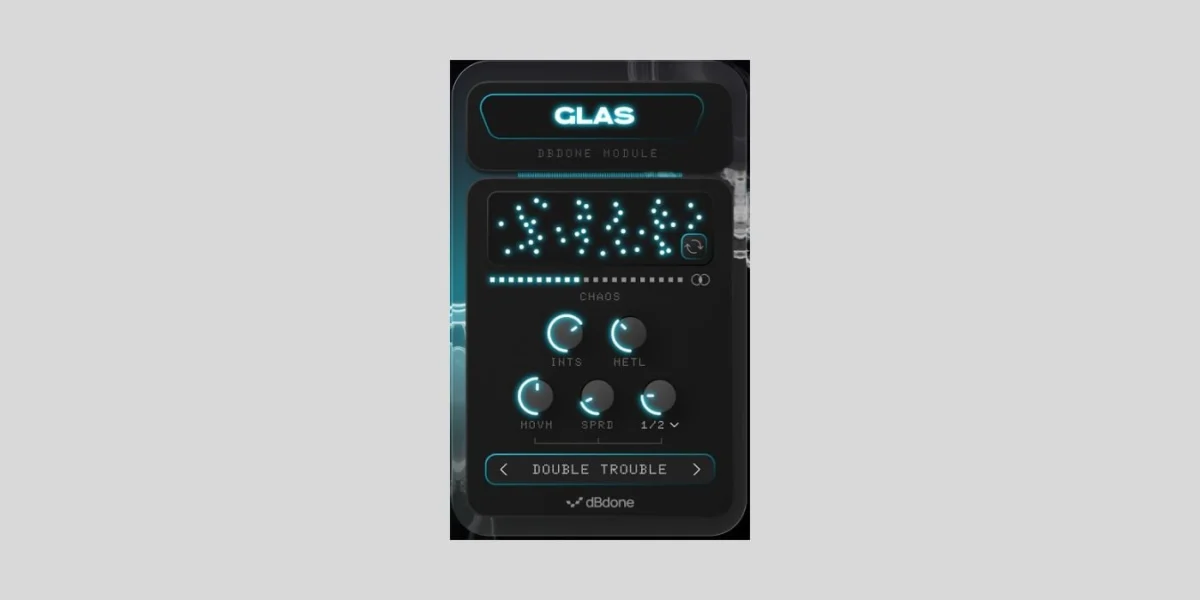
Developer dBdone has officially released Glas, a groundbreaking free spectral chaos engine designed for macOS and Windows operating systems. This latest offering marks another significant milestone in dBdone’s remarkably prolific start to 2026, delivering an innovative audio processing tool available across AU, VST, and AAX plugin formats. Unlike some of its immediate predecessors, Glas is presented as a straightforward free plugin, embodying a "what you see is what you get" philosophy without a parallel paid version. Its core function involves dissecting audio into its constituent frequencies and then reconstructing it in a manner that introduces controlled, yet often radical, sonic transformations, thereby injecting movement and texture into otherwise static sound sources.
dBdone’s Prolific Start to 2026: A Strategic Release Cadence
The release of Glas on March 31, 2026, culminates a period of intense development and strategic product launches for dBdone, firmly establishing the company as a dynamic force in the audio software landscape. This rapid succession of innovative tools highlights a clear commitment to empowering music producers and sound designers with advanced, yet often accessible, technologies. The pattern observed in early 2026 suggests a deliberate strategy to cater to diverse needs within the music production community, ranging from creative texture generation to intelligent compositional aids, and now, to intricate spectral manipulation.
January’s Innovation: Pentimento and the Art of Texture Layering
The year commenced with the January 24th release of Pentimento, a sophisticated texture-layering plugin that immediately captured attention. This project was a notable collaboration with the acclaimed musician and YouTuber TAETRO, known for their distinctive sound design and educational content. Pentimento offered users the ability to intricately layer various textures over existing audio, creating rich, evolving soundscapes and complex timbres. The plugin was launched with both paid and free versions, a model that allowed casual users to explore its capabilities while offering professionals enhanced features and deeper control. The free version provided a taste of its transformative power, often inspiring users to upgrade for the full suite of functionalities. This hybrid approach served to democratize access to advanced sound design techniques while also securing a revenue stream for continued development. TAETRO’s involvement lent significant credibility and visibility to Pentimento, leveraging their extensive reach and respected voice within the producer community to showcase the plugin’s creative potential through tutorials and demonstrations. The plugin quickly became a go-to for producers seeking to add depth, grit, or ethereal qualities to their tracks, from subtle sonic enhancements to complete sound overhauls.
February’s AI Frontier: AI Chords for Generative Music Production
Following swiftly in February, dBdone unveiled AI Chords, a cutting-edge chord-progression generation tool. This release tapped into the burgeoning field of artificial intelligence in music production, offering a solution designed to assist composers and producers in overcoming creative blocks and exploring new harmonic possibilities. AI Chords leveraged sophisticated algorithms to suggest and generate diverse chord progressions, catering to various moods, genres, and complexities. It provided a significant workflow acceleration, allowing users to rapidly experiment with harmonic structures without extensive theoretical knowledge or time-consuming manual entry. Similar to Pentimento, AI Chords adopted a paid and free version model. The free iteration offered a functional introduction to AI-assisted composition, while the paid version typically provided more extensive libraries, advanced customization options, and deeper integration capabilities. This tool underscored dBdone’s vision to integrate intelligent systems into the creative process, making advanced compositional aids more accessible. The feedback from users often highlighted its utility in sparking fresh ideas and providing a solid harmonic foundation upon which to build entire tracks.
The Shift to Freeware: Glas’s Unique Distribution Model
The launch of Glas, exclusively as a free plugin, represents a notable deviation from dBdone’s prior hybrid release strategy. This decision signals a potential recalibration in their market engagement, focusing on maximum accessibility and broad user adoption for this particular tool. While Pentimento and AI Chords utilized free versions as gateways to more comprehensive paid offerings, Glas stands alone as a completely unmonetized product, at least in terms of direct purchase. This approach could be interpreted as a strategic move to significantly expand dBdone’s user base, foster goodwill within the music production community, and potentially serve as a high-profile showcase of their advanced development capabilities. By offering such a powerful and unique tool for free, dBdone likely aims to cultivate a loyal community of users who may then be more inclined to explore their other products, both free and paid, or to subscribe to their communication channels.
Deconstructing Chaos: Inside Glas’s Spectral Engine
The nomenclature "spectral chaos engine" might evoke images of a supervillain’s sonic weapon, but in the context of audio production, it precisely describes Glas’s innovative functionality. At its heart, Glas operates by dismantling an audio signal into its constituent frequency components, akin to a sonic prism. Once disassembled, these spectral elements are then subjected to a series of chaotic algorithms before being reassembled. This process introduces unpredictable yet musically interesting alterations, transforming the original sound in profound ways.
The Core Mechanism: Frequency Disintegration and Reassembly
To understand Glas, imagine a sound as a complex tapestry woven from countless individual threads, each representing a different frequency. Traditional effects often manipulate this tapestry as a whole or apply broad strokes. Glas, however, meticulously unpicks each thread, alters its color, texture, or position according to chaotic rules, and then reweaves them into an entirely new fabric. This allows for a level of granular control over the sonic characteristics that is difficult to achieve with conventional effects. The "chaos" aspect is not arbitrary destruction but rather a system designed to generate unexpected variations, introducing evolving movement, metallic resonances, and spatial diffusion that breathe new life into static sounds. For instance, a sustained pad, which typically maintains a consistent timbre, can be imbued with shimmering, crystalline textures or an aggressive, grinding metallic character that shifts and evolves over time, creating a dynamic soundscape from a simple input.
Intuitive Control: Navigating Glas’s Parameters
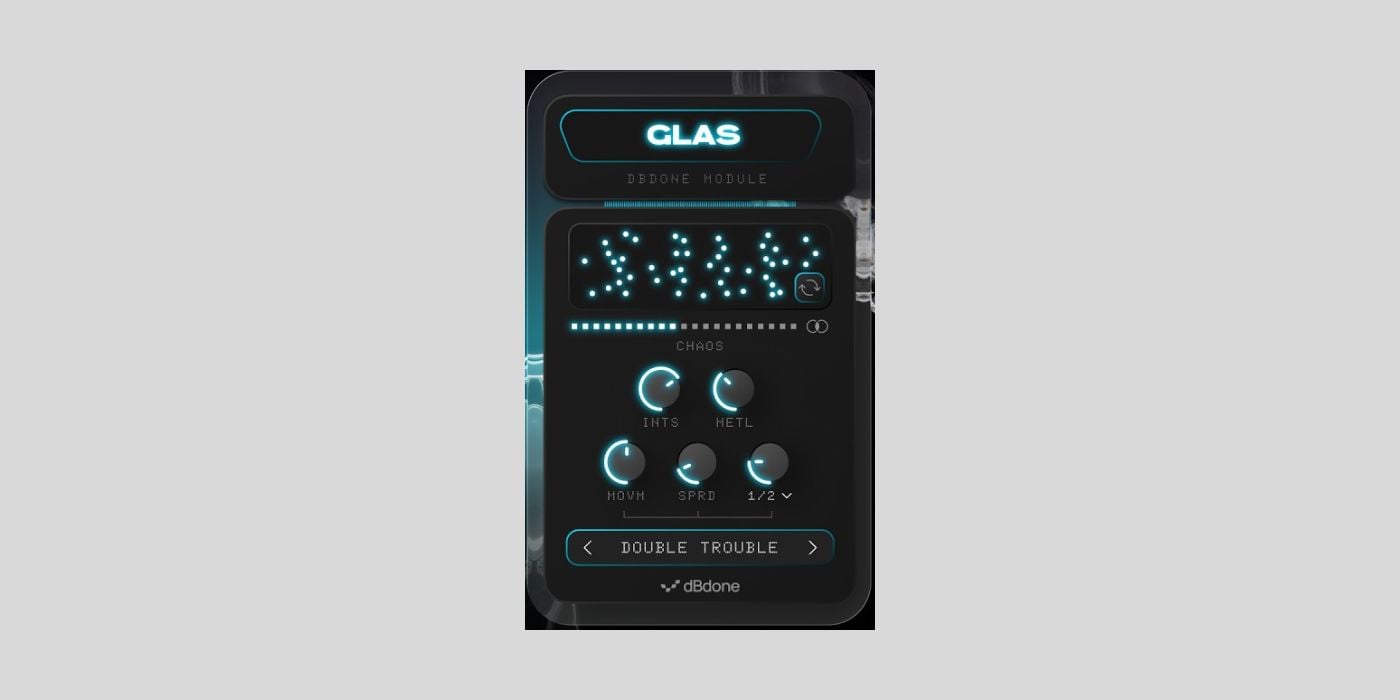
Glas presents a user interface that is both visually engaging and functionally intuitive, featuring a prominent spectral display that visually represents the ongoing transformations. Beneath this display lies a compact yet powerful array of adjustable parameters, allowing users to sculpt the chaotic effects with precision.
The most prominent control is the Chaos slider. This parameter functions much like a wet/dry mix control, determining the blend between the original, unprocessed audio signal and the highly processed output from Glas’s engine. At lower settings, Glas introduces subtle shifts and textures, gradually increasing the intensity and complexity of the chaotic transformations as the slider is pushed higher. This allows for a spectrum of effects, from delicate enhancements to complete sonic overhauls, providing critical control over the degree of intervention.
Below the Chaos slider, five distinct knobs offer granular control over specific aspects of the spectral manipulation:
- Intensity: This knob dictates the overall strength and prominence of the applied effect. Increasing Intensity amplifies the chaotic elements, making them more pronounced and overt, while decreasing it allows for more understated and nuanced textural additions. It acts as a master gain for the processed sound’s character.
- Metallic: As its name suggests, this control specifically adjusts the metallic resonance and quality imparted to the sound. Turning it up can introduce glassy, bell-like harmonics or aggressive, industrial-grade clang and grit. It’s particularly effective for creating sounds that evoke glass, metal, or other resonant materials, adding a distinct sheen or harshness.
- Movement: This parameter is crucial for introducing dynamic evolution into the sound. It dictates the extent to which the processed audio shifts and morphs over time, preventing the effect from becoming static. At zero, the chaotic elements might be present but largely unchanging; as Movement increases, the internal spectral processes begin to undulate and shift, creating a living, breathing texture.
- Spread: Working in conjunction with Movement, the Spread knob controls the stereo width and spatialization of the introduced movement. Low Spread settings keep the chaotic elements more centralized, while higher settings diffuse them across the stereo field, creating a sense of expansive, enveloping sound or intricate, panning textures. This is vital for adding depth and dimension to a mix.
- Speed: The Speed knob dictates the rate at which the Movement parameter manifests its changes. A slow speed will result in gradual, evolving transformations, ideal for ambient soundscapes or slowly building tension. A fast speed, conversely, will create rapid, frenetic shifts and jittery textures, suitable for glitch effects, aggressive synth lines, or percussive elements.
The interplay between Movement, Spread, and Speed is particularly powerful, allowing users to sculpt complex spatial and temporal dynamics. For example, a high Movement setting combined with a wide Spread and moderate Speed can create a vast, shimmering soundscape that slowly sweeps across the stereo image, while a high Movement, low Spread, and very high Speed could generate a tight, pulsating, metallic stutter.
Sonic Frontiers: Applications and Aesthetic Signatures
Glas is not merely an effect; it is a creative tool that opens doors to unique sonic palettes, making it highly valuable across various music production and sound design contexts. Its ability to radically transform source material makes it an indispensable asset for those seeking distinctive textures and evolving soundscapes.
Crafting Modern Textures: From Glassy Shimmers to Industrial Grit
The plugin excels at generating the "glassy or metallic textures" that are a hallmark of modern electronic music, experimental genres, and contemporary film scoring, particularly in industrial or dystopian soundtracks. From ethereal, crystalline shimmers that evoke futuristic landscapes to harsh, grinding metallic resonances that suggest decay and tension, Glas provides a direct pathway to these sought-after sounds. It can take a simple sine wave or a basic synth pad and morph it into something entirely "otherworldly," rich with complex harmonics and dynamic movement.
For electronic music producers, Glas can transform flat pads into evolving atmospheric textures, add aggressive edge to basslines, or create unique percussive elements by processing short transients. In film, television, and game scoring, media composers will find it invaluable for creating unique sound effects, crafting unsettling ambiences, or designing bespoke transition elements that defy conventional synthesis. Imagine a scene requiring a sense of digital decay; Glas could take a human voice and warp it into a glitchy, metallic whisper, perfectly aligning with the visual narrative.
The Art of Subtlety: Beyond Full Chaos
While Glas is certainly capable of extreme sonic transformations, one of its most compelling aspects lies in its capacity for subtlety. The "less-is-more" principle applies profoundly here. By carefully dialing back certain parameters, particularly Intensity and Metallic, and instead focusing on the nuanced interplay of Movement, Spread, and Speed, producers can achieve effects that add depth and texture without overwhelming a mix.
For instance, applying Glas to a piano or Rhodes sample with low Intensity and Metallic, but with moderate Movement, a slight Spread, and a slow Speed, can introduce a beautiful, evolving shimmer that makes the instrument feel alive and ethereal without sounding overtly "processed" or chaotic. This allows the original character of the sound to remain intact while gaining a rich, evolving harmonic undertone and spatial complexity. Such an approach can make a sound much more "playable" and integrate better into busier arrangements, providing subtle character and sonic interest that enhances the overall production rather than dominating it. This controlled chaos can add a sense of organic movement to otherwise static elements, making them breathe and evolve within the mix, contributing to a more dynamic and engaging listening experience.
Inspiration at Your Fingertips: Presets and the Shuffle Function
To facilitate immediate creative exploration, Glas comes equipped with a diverse range of factory presets. These presets serve as excellent starting points, showcasing the plugin’s versatility across various sonic aesthetics, from delicate textures to aggressive distortions. Users can quickly audition different characters and find inspiration without having to build a sound from scratch.
Furthermore, Glas includes an innovative "Shuffle" function. This feature randomly generates unique variations of the plugin’s parameters, offering an endless source of new sounds and textures. For producers and sound designers facing creative blocks or simply seeking fresh ideas, the Shuffle function can be a powerful catalyst, often yielding unexpected and highly usable results that might not have been conceived through manual parameter adjustments. It embodies the "chaos" aspect not just in processing but also in the creative workflow, pushing users beyond their usual sonic habits.
Market Dynamics and Developer Strategy
The release of a high-quality, completely free plugin like Glas is a significant event within the highly competitive audio software market. It reflects not only dBdone’s technical prowess but also a calculated strategic move to solidify its position and expand its influence.
The Freeware Ecosystem: dBdone’s Contribution and Competitive Edge
The freeware plugin ecosystem has flourished in recent years, becoming a vital resource for independent producers, hobbyists, and professionals operating on tight budgets. High-quality free tools lower the barrier to entry for aspiring musicians and allow seasoned veterans to experiment with new sounds without financial commitment. By offering Glas for free, dBdone is contributing a powerful and unique tool to this ecosystem, potentially garnering widespread acclaim and drawing a substantial new user base. This positions dBdone as a developer committed to democratizing advanced sound design, potentially earning them significant goodwill and community loyalty. In a market saturated with options, a truly innovative free offering can create substantial buzz and differentiate a developer from its peers.
The Newsletter Gateway: A Strategic User Acquisition Model
While Glas is free, its acquisition is tied to a specific marketing strategy: users must sign up for the dBdone newsletter to unlock the download button. This is a common and highly effective user acquisition model in the digital age. By requiring an email address, dBdone immediately gains a direct communication channel with potential and existing users. This allows them to:
- Build a direct marketing list: For future product announcements, updates, and promotional offers.
- Gauge interest: The number of newsletter sign-ups directly reflects interest in their products.
- Foster a community: The newsletter can be used to share tips, tutorials, and engage with their user base, building brand loyalty.
- Cross-promote: Users who download Glas for free might be introduced to dBdone’s other products, including the paid versions of Pentimento and AI Chords, creating a funnel for potential future sales.
This model is a win-win: users get a powerful creative tool for free, and dBdone expands its reach and marketing capabilities without upfront costs for the user.
Broader Implications for Music Production
The continuous innovation from developers like dBdone, particularly through accessible tools like Glas, has profound implications for the broader landscape of music production and sound design.
Democratizing Advanced Sound Design
Glas exemplifies the ongoing trend of democratizing advanced audio technologies. What once required expensive hardware or complex modular synthesis setups can now be achieved with a free software plugin. This significantly lowers the barrier to entry for aspiring producers, allowing them to experiment with sophisticated spectral manipulation techniques without a substantial financial investment. This accessibility fosters creativity across a wider demographic, potentially leading to new genres, unique sonic signatures, and a more diverse musical landscape. Students, hobbyists, and professionals alike benefit from having powerful tools readily available, encouraging experimentation and pushing the boundaries of sound.
The Future of Spectral Processing
Glas stands as a testament to the exciting advancements in spectral audio processing. This field, which involves manipulating the individual frequency components of a sound, offers immense creative potential beyond traditional time-domain effects. As computing power increases and algorithms become more sophisticated, we can expect to see even more innovative spectral tools emerge. Glas’s ability to create dynamic, evolving textures from static sources points towards a future where sound design is less about merely adding effects and more about fundamentally reshaping the very fabric of a sound. It encourages producers to think of sound as raw material that can be infinitely sculpted and transformed, opening up new avenues for sonic expression.
Conclusion: dBdone’s Continuing Trajectory
The release of Glas concludes a remarkable first quarter for dBdone in 2026, solidifying its reputation as an innovative and user-centric developer. From the collaborative texture-layering of Pentimento to the intelligent compositional assistance of AI Chords, and now the freely available, transformative power of Glas, dBdone has consistently delivered tools that push creative boundaries. Glas, with its unique spectral chaos engine, provides a powerful and accessible gateway to crafting otherworldly textures and dynamic soundscapes, cementing its place as a valuable addition to any producer’s toolkit. Its free distribution model, strategically linked to newsletter engagement, underscores dBdone’s commitment to expanding its community while showcasing its cutting-edge development capabilities. As the music technology landscape continues to evolve, dBdone’s trajectory suggests a continued focus on blending innovation with accessibility, shaping the future of sound design one plugin at a time.
