

Kanye West’s latest album, Bully, has officially landed at the number two position on the Billboard 200 chart, generating 152,000 equivalent album units in its first week of release. This debut, while significant, marks a deviation from West’s long-standing history of achieving number one solo albums on the prestigious chart. The album’s charting performance is now at the center of a heated dispute, with the distribution company Gamma. contesting Billboard’s official figures and claiming a higher unit count that would have placed Bully at the top. This controversy unfolds against a backdrop of increasing scrutiny surrounding West’s upcoming headlining performances at London’s Wireless Festival, fueled by past antisemitic remarks and leading to significant sponsorship withdrawals.
Billboard 200 Performance and Distribution Discrepancy
According to Billboard’s official report, Bully‘s 152,000 equivalent units are comprised of 96,000 from streaming—translating to approximately 98.43 million on-demand official streams—and 56,000 from traditional sales. This performance was not enough to dethrone the K-Pop group BTS, whose 10th album, ARIRANG, held the number one spot for its second consecutive week with 187,000 equivalent units. BTS’s album had previously debuted at number one with a staggering 641,000 units.
The debut of Bully at number two breaks Kanye West’s impressive 21-year streak of having number one solo albums. This is only the second time in his solo career that an album has not reached the top of the Billboard 200, with his 2004 debut, The College Dropout, also peaking at number two.
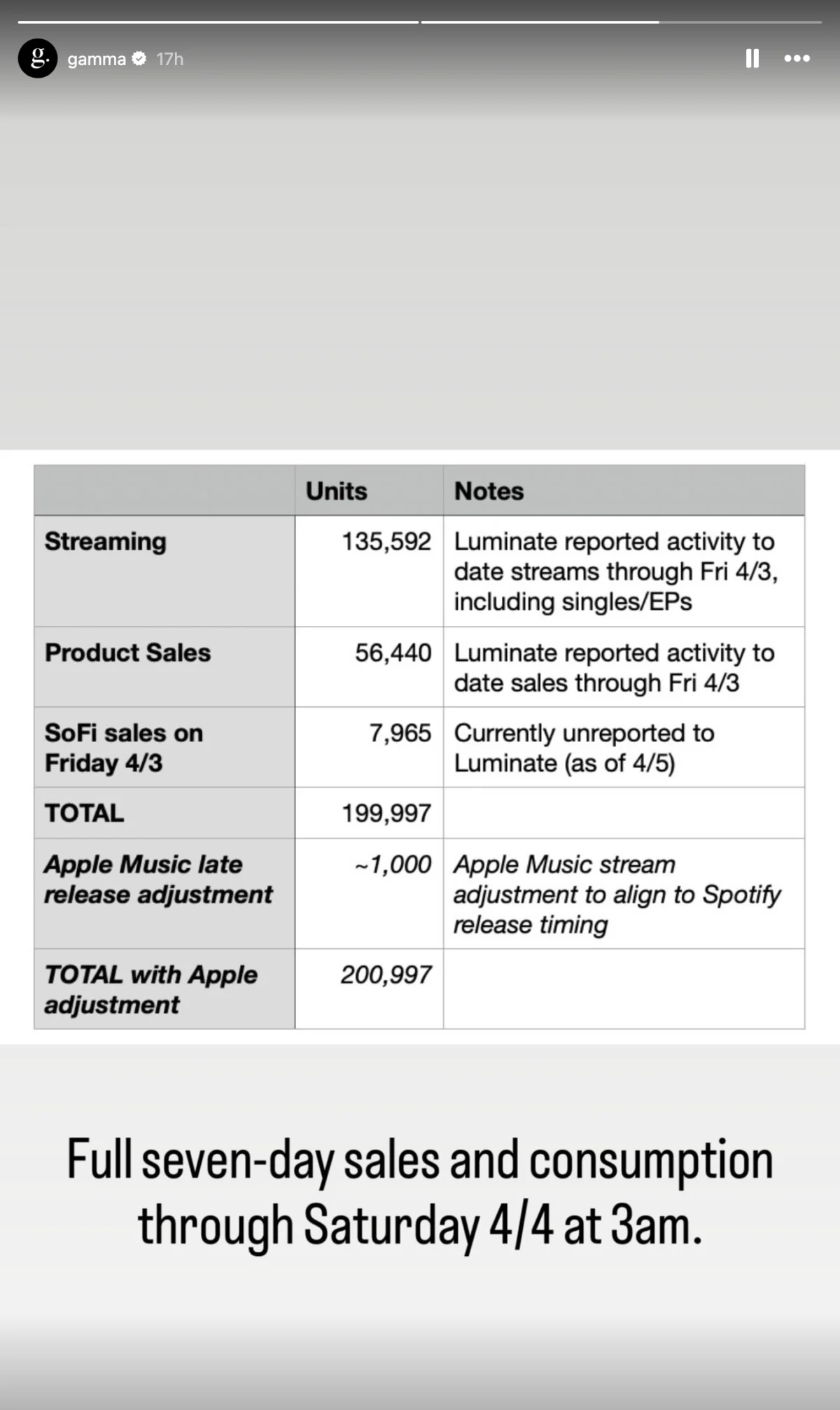
However, a significant divergence in reported sales figures has emerged. Gamma., the distribution company founded by former Apple Music executive Larry Jackson, has publicly challenged Billboard’s data. In a series of Instagram Stories, Gamma. presented what they described as a "full seven-day sales and consumption" breakdown, asserting that Bully actually garnered 200,997 equivalent units. This figure, if validated, would have been sufficient to place Bully above BTS and secure the number one position on the chart.
As of the latest reports, neither Billboard nor Luminate, the data analytics company that provides the data for the Billboard charts, have issued an official response to Gamma.’s claims. The discrepancy raises questions about the methodologies used in calculating album equivalents and the transparency of the charting process.
A Look at the Numbers: Streaming vs. Traditional Sales
The breakdown of Bully‘s reported 152,000 units highlights the continued dominance of streaming in album consumption. With 96,000 units derived from streams, it signifies that the majority of the album’s engagement is occurring through digital platforms. This trend is consistent across the music industry, where music listeners increasingly opt for the convenience and accessibility of streaming services. The 56,000 units from traditional sales, encompassing physical copies like CDs and vinyl, as well as digital downloads, indicate a smaller but still significant portion of the album’s commercial performance.
The potential 200,000+ units claimed by Gamma. would represent a substantial increase, suggesting a possible undercounting of certain sales or streaming metrics by Luminate. The specifics of how Gamma. arrived at their higher figure remain undisclosed, adding to the intrigue surrounding the dispute. Industry analysts will be closely watching for any further statements or clarifications from either Billboard or Gamma. that might shed light on this discrepancy.

A Potential Deluxe Edition on the Horizon
Adding another layer to the release of Bully, Gamma. has also teased the imminent arrival of an expanded edition of the album. In a separate Instagram Story, the company cryptically announced, "Bully deluxe on the way." This suggests that fans can anticipate additional tracks or a revised version of the album in the near future. While no specific release date or details regarding the number of bonus songs have been revealed, this announcement indicates that the creative output associated with Bully is far from over. This strategy of releasing deluxe editions is common in the music industry, often employed to re-engage fans and further boost an album’s commercial performance after its initial release.
Controversy Surrounds Wireless Festival Performances
Beyond the charting and sales discussions, Kanye West’s upcoming headlining performances at London’s Wireless Festival in July are generating significant controversy. His inclusion in the festival lineup has drawn widespread criticism due to his history of antisemitic remarks and other offensive statements. This backlash has prompted a number of major sponsors to withdraw their support from the event.
Prominent brands such as Pepsi, PayPal, and the beverage giant Diageo have announced their decisions to pull out of the festival, citing concerns over the association with West. The repercussions have extended to the political sphere, with both Prime Minister Sir Keir Starmer and London Mayor Sadiq Khan voicing their disapproval. Sir Keir Starmer described the booking as "deeply concerning," particularly given West’s past "antisemitic remarks and celebration of Nazism." Mayor Khan has also expressed his reservations about the rapper’s participation.
Despite these objections and sponsor withdrawals, West is still slated to headline all three nights of the Wireless Festival. This decision by the festival organizers comes shortly after West’s successful, albeit controversial, run of two sold-out shows at Los Angeles’ SoFi Stadium in support of Bully. The dual controversies—one centered on artistic and commercial metrics, the other on ethical and social concerns—cast a long shadow over West’s current public profile.
Broader Implications and Industry Context
The dispute over Bully‘s chart position raises broader questions about the transparency and accuracy of music sales data. In an era where streaming plays a pivotal role, the algorithms and methodologies used by data providers are crucial for determining an artist’s success. Discrepancies, whether due to technical errors, differing interpretations of data, or intentional challenges, can have significant implications for an artist’s legacy, promotional efforts, and future career trajectory.
Furthermore, the controversy surrounding West’s festival appearances highlights the increasing pressure on major cultural events and artists to align with ethical standards and societal values. The withdrawal of significant sponsors demonstrates the power of public opinion and corporate social responsibility in shaping the entertainment landscape. For artists with a history of controversial statements, the consequences are becoming more tangible, impacting not only their public image but also their ability to secure lucrative partnerships and performance opportunities.
The ongoing developments surrounding Kanye West’s Bully offer a compelling case study in the complex interplay of artistic output, commercial performance, data integrity, and public accountability in the contemporary music industry. As the situation with Gamma.’s claims and the Wireless Festival controversy continues to unfold, industry observers will be keen to see how these events ultimately shape the narrative around one of music’s most polarizing figures. The potential for a deluxe edition also suggests a strategic approach to maximizing the album’s lifespan and impact, even amidst the surrounding turbulence.
