

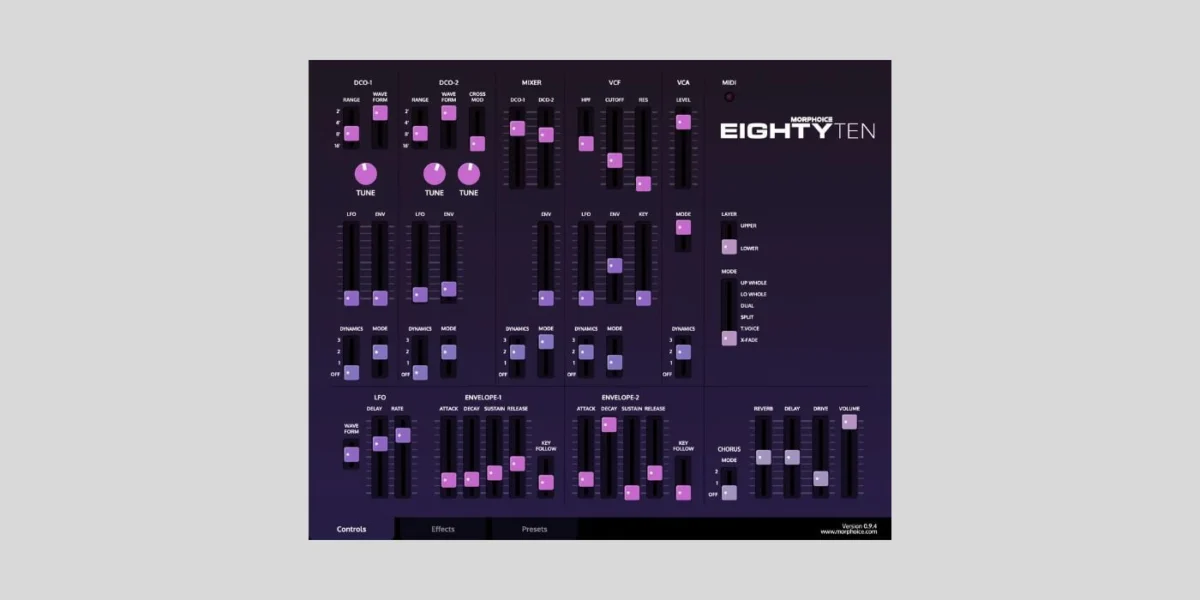
Developer Morphoice has officially unveiled EightyTen, a new software synthesizer plugin that meticulously emulates two iconic vintage Roland synthesizers: the JX-8P and the SuperJX-10/MKS-70. Released as a free beta, EightyTen marks another significant entry in Morphoice’s rapidly expanding catalog of high-fidelity vintage instrument emulations, offering musicians and producers access to classic sounds with modern convenience. The plugin is available in AU, VST, and VST3 formats, ensuring broad compatibility across macOS, Windows, and Linux operating systems.
The release of EightyTen adheres to Morphoice’s established development and distribution model, which has garnered considerable attention within the music production community. This model involves releasing early beta versions of their emulations for free, often with the understanding that future, refined versions may transition to a paid status. To incentivize early adoption and support development, Morphoice offers a lifetime license for EightyTen to users who contribute a donation of $10 or more during this beta phase. This approach allows the developer to gather crucial user feedback while providing an accessible entry point for those eager to experience these classic sounds.
Morphoice’s Expanding Universe of Vintage Emulations: A Chronology
Morphoice has rapidly established itself as a notable player in the competitive field of software synthesizer development, specializing in detailed emulations of revered vintage hardware. The company’s strategy involves tackling some of the most complex and beloved instruments from synthesizer history, bringing their unique sonic characteristics to modern digital audio workstations (DAWs).
The chronological progression of Morphoice’s releases illustrates a clear dedication to capturing diverse facets of synthesizer legacy:
- Unstable (Released February 4, 2025): This marked Morphoice’s ambitious foray into the world of emulation with a rendition of the legendary Yamaha CS-80. The CS-80, known for its immense polyphony (for its time), expressive aftertouch, and rich, organic sound, is widely considered one of the most challenging synthesizers to emulate accurately due due to its intricate architecture and unique sound generation. Unstable’s release signaled Morphoice’s capability to tackle high-fidelity digital recreations of complex analog circuitry.
- EightySix (Released May 26, 2026): Following the CS-80, Morphoice turned its attention to another Roland classic, the Juno-6. The Juno series is celebrated for its warm, stable DCOs, iconic sub-oscillator, and particularly its lush, wide stereo chorus effect. EightySix aimed to capture the Juno-6’s simplicity, immediate playability, and signature sonic character, offering a contrast to the complexity of the CS-80.
- EightyEight (Released June 30, 2026): The Jupiter-8, Roland’s flagship polysynth from the early 1980s, became the subject of EightyEight. The Jupiter-8 is revered for its rich, powerful sound, flexible architecture, cross-modulation capabilities, and robust build. Emulating the Jupiter-8 is a significant undertaking, given its dual-oscillator per voice design, versatile filters, and comprehensive modulation options. EightyEight further solidified Morphoice’s reputation for delivering faithful digital interpretations of high-end vintage hardware.
The introduction of EightyTen on July 17, 2026, continues this trajectory, focusing on another crucial lineage within Roland’s synthesizer history. Each release from Morphoice not only serves as a standalone instrument but also builds upon a consistent brand identity rooted in accessible, high-quality vintage emulation. The phased beta release strategy, coupled with the optional donation model for a lifetime license, has proven effective in fostering a community of engaged users who contribute to the refinement and sustained development of these ambitious projects.
The Original Icons: Roland JX-8P and SuperJX-10/MKS-70
To fully appreciate the significance of EightyTen, it is essential to delve into the history and technical specifications of the original Roland synthesizers it emulates. The JX-8P, released in 1984, and its larger siblings, the SuperJX-10 (also known as JX-10) and the MKS-70 (the rack-mount version of the SuperJX-10), represent a pivotal era for Roland. These instruments were introduced during a period of intense innovation and competition in the synthesizer market, specifically in the wake of Yamaha’s groundbreaking DX7 and the rise of FM synthesis.
The Roland JX-8P (1984): A Bridge to the Digital Age
The JX-8P was Roland’s response to the growing popularity of digital synthesis while retaining a strong foothold in the analog sound. It represented a hybrid architecture, utilizing Digital Controlled Oscillators (DCOs) for excellent pitch stability—a common challenge with purely analog Voltage Controlled Oscillators (VCOs)—paired with genuine analog filters and amplifiers for warmth and character.
- Architecture: The JX-8P featured two DCOs per voice, offering waveforms such as Sawtooth, Pulse, and Noise. These DCOs provided a stable foundation for its sound.
- Polyphony: It offered six-voice polyphony, a respectable number for the mid-1980s, allowing for lush pads and chords.
- Filters: Central to its sound was a 24 dB/octave resonant low-pass filter and a non-resonant high-pass filter. This combination provided significant sound shaping capabilities, allowing for everything from deep basses to shimmering, ethereal textures.
- Envelopes: Two ADSR envelope generators per voice (one for the filter, one for the amplifier) provided dynamic control over the sound’s evolution.
- Modulation: It included LFOs for vibrato and tremolo, and crucially, offered cross-modulation where one DCO could modulate the pitch of the other. This feature was an attempt by Roland to offer some of the complex, metallic timbres associated with FM synthesis, albeit through an analog-hybrid approach.
- Chorus: The JX-8P featured Roland’s signature stereo chorus effect, adding width, depth, and a characteristic sheen to its sounds. This effect became an integral part of the Roland sound aesthetic.
- Interface: While the JX-8P sounded fantastic, its user interface was largely menu-driven, relying on a numerical keypad and an LCD screen. This made real-time sound design somewhat cumbersome. To address this, Roland released the PG-800 programmer, an external hardware controller that provided dedicated sliders and buttons for direct, hands-on control over parameters. The PG-800 became an almost essential companion for JX-8P owners seeking efficient sound editing.
The JX-8P found favor with musicians for its rich pads, evolving textures, and ability to sit well in a mix. It offered a warmer, more traditional "analog" sound compared to the often brighter, more brittle tones of early FM synthesizers, while still benefiting from digital stability.
The SuperJX-10 (JX-10) and MKS-70 (1985/1986): Doubling Down on Power
Building on the success and architecture of the JX-8P, Roland introduced the SuperJX-10 (also known simply as JX-10) in 1985 and its rack-mount equivalent, the MKS-70, in 1986. These instruments were essentially two JX-8P synthesis engines housed within a single unit, significantly expanding their capabilities.
- Polyphony and Bi-Timbrality: The most striking upgrade was the doubling of polyphony to a massive twelve voices. Crucially, these instruments were bi-timbral, meaning they could play two different six-voice patches simultaneously. This allowed for layering sounds in a "Stack" mode, creating incredibly thick, powerful, and complex timbres that were impossible with a single JX-8P.
- Sound Design Potential: The ability to stack two distinct six-voice patches meant that users could combine, for instance, a rich pad with a percussive attack, or layer two different evolving textures to create truly massive and dynamic sounds. This feature made the SuperJX-10 and MKS-70 highly prized for their sound design potential and their ability to produce sounds that filled a sonic landscape.
- MKS-70 Advantage: The MKS-70, being a 2U rack-mount module, offered the same powerful synthesis capabilities as the SuperJX-10 but in a more compact, studio-friendly format. This made it particularly appealing for professional studios and touring musicians who valued space and integration into existing setups. Like the JX-8P, the SuperJX-10 and MKS-70 also benefited immensely from the PG-800 programmer for hands-on control, transforming a potentially menu-heavy experience into an intuitive one.
Both the JX-8P and its SuperJX successors hold a special place in synthesizer history, representing Roland’s sophisticated hybrid approach during a transitional period for electronic music instruments. Their distinct sound, characterized by stable DCOs, warm analog filters, and the iconic Roland chorus, has ensured their enduring appeal.
EightyTen’s Emulative Prowess: Bridging Past and Present
Morphoice’s EightyTen endeavors to not only replicate the core sonic characteristics of these vintage Roland instruments but also to enhance their usability and expand their creative potential for contemporary music producers. The plugin’s design carefully balances authenticity with modern demands.
Core Emulation and Architecture:
At its heart, EightyTen faithfully recreates the dual-engine architecture of the SuperJX-10 and MKS-70. This means it effectively houses two virtual JX-8P synthesis engines, granting users access to:
- Twelve-Voice Polyphony: This enables the creation of complex chords and rich, sustained pads without voice stealing.
- Bi-Timbral Operation: The ability to run two independent six-voice patches simultaneously is a cornerstone of EightyTen. Users can layer these patches in "Stack" mode to forge truly "huge sounds," mirroring the original hardware’s most celebrated feature. This capability allows for intricate sound design, combining different timbres, attack envelopes, and modulation schemes to create a single, powerful super-patch. Alternatively, the bi-timbral nature can be used to assign different sounds to different MIDI channels or keyboard splits, enhancing performance flexibility.
Key Features Deep Dive:
- Cross Modulation (DCO-to-Pitch): One of the most intriguing features of the original JX series, and a highlight of EightyTen, is its cross-modulation capability. This allows the output of one DCO to modulate the pitch of the other. While not true FM synthesis in the Yamaha DX7 sense, this feature enables the creation of metallic, bell-like, and harmonically rich timbres that push the JX sound beyond its typical analog warmth. The article specifically references recreating Chaka Khan’s "I Feel For You" bassline without a DX7. This is a pointed example, as that iconic bass sound was famously created on a Yamaha DX7, showcasing the power of FM synthesis. EightyTen’s cross-modulation offers a compelling alternative for achieving similar timbral complexity within the JX framework, demonstrating its versatility.
- Filters: The plugin meticulously models the original filter section: a 24 dB/octave low-pass filter with resonance, paired with a non-resonant high-pass filter. This combination is crucial to the JX sound, offering both subtractive sculpting (low-pass) and tonal brightening or thinning (high-pass). The character of these filters, known for their smooth sweep and musical response, is a key element of the JX-8P’s warmth and expressiveness.
- Envelope Generators: Two ADSR (Attack, Decay, Sustain, Release) envelope generators per voice are implemented, providing precise control over the amplitude and filter cutoff contours. These envelopes are essential for shaping the dynamics of a sound, from sharp, percussive attacks to long, evolving releases.
- Roland Stereo Chorus: No JX emulation would be complete without Roland’s unmistakable stereo chorus effect. EightyTen includes this iconic effect with both fast and slow settings, faithfully replicating the lush, widening, and shimmering qualities that defined the sound of many 1980s Roland synthesizers. This chorus is often cited as a reason for the Juno and JX series’ enduring popularity.
- Expressive Control: EightyTen is designed to be highly playable and expressive, mirroring the capabilities of the original hardware. It supports velocity response, allowing for dynamic control over volume and timbre based on playing intensity, and aftertouch, which enables real-time modulation of parameters (like vibrato or filter cutoff) by pressing harder on a key after it has been struck. This level of expressive control ensures that performances on EightyTen feel as nuanced and engaging as on a physical instrument.
- PG-800-Style Interface: Recognizing the original JX series’ reliance on the external PG-800 programmer for intuitive sound design, EightyTen presents a "PG-800-style interface." This means the plugin offers a clear, slider-and-knob based graphical user interface that makes programming sounds immediate and enjoyable, eliminating the menu-diving frustrations associated with the original hardware’s front panel. This modern interface significantly enhances workflow and encourages exploration.
Beyond Emulation: Modern Enhancements and Developer Vision
While fidelity to the original hardware is a cornerstone of Morphoice’s philosophy, the developer also embraces the advantages of software by integrating modern enhancements that expand the sonic palette beyond the capabilities of the vintage synths. These additions are not mere afterthoughts but carefully considered tools that align with contemporary music production needs.
- DarkStar Reverb: Drawing inspiration from high-end modern effects, EightyTen features the "DarkStar Reverb," which is explicitly stated to be inspired by the Strymon BigSky. The Strymon BigSky is a highly revered reverb pedal known for its pristine algorithms, vast soundscapes, and lush, atmospheric textures. Incorporating a reverb of this caliber directly into the synthesizer plugin allows users to craft expansive, ethereal sounds without needing external effects. This dramatically enhances the plugin’s versatility, moving beyond simple emulation to become a more complete sound design tool.
- Lo-Fi Tape Delay: To add character, warmth, and a vintage vibe, EightyTen includes a "lo-fi tape delay." Tape delays are celebrated for their organic decay, subtle wow and flutter, and often slightly degraded, warm repeats that contribute significantly to a nostalgic or atmospheric aesthetic. This effect provides another layer of texture and movement that complements the JX series’ inherent warmth.
- HeatBurn Drive and Distortion: Modern music production often demands sounds with grit, aggression, and edge. The "HeatBurn drive and distortion effect" is included to cater to this need. While the original JX synths were known for their clean, polished sounds, HeatBurn allows users to push EightyTen into more saturated, distorted, or even destructive sonic territories, expanding its utility across genres that require more aggressive timbres, such as electronic dance music, rock, or industrial.
These integrated effects exemplify Morphoice’s vision: to provide not just accurate emulations but also versatile instruments tailored for the modern producer. By adding high-quality, relevant effects, EightyTen becomes a more self-contained and powerful sound design workstation, reducing the need for extensive external processing.
Market Context and Broader Implications
The release of EightyTen, particularly under Morphoice’s established beta and donation model, carries significant implications for both the developer and the broader music production landscape.
The Enduring Appeal of Vintage Synthesizers:
The continued demand for vintage synthesizer emulations underscores the timeless appeal of these instruments. Despite decades of technological advancement, the unique character, warmth, and musicality of instruments like the JX-8P and SuperJX-10 remain highly sought after. Factors contributing to this appeal include:
- Sonic Character: Analog and early hybrid circuits often produce sounds with a certain "mojo" or unpredictability that digital-native synths sometimes lack.
- Historical Significance: These instruments shaped genres and defined eras of music, making their sounds instantly recognizable and culturally significant.
- Simplicity and Focus: Many vintage synths, while complex in circuitry, offered a more focused sound design paradigm compared to the sprawling possibilities of modern softsynths, fostering a different kind of creativity.
The Rise of Software Emulation and Accessibility:
Software emulations democratize access to these iconic sounds. Original JX-8Ps, SuperJX-10s, and MKS-70s are increasingly rare, expensive, and require maintenance. Software plugins offer:
- Affordability: Even if EightyTen eventually becomes a paid product, its price will undoubtedly be a fraction of the cost of acquiring and maintaining original hardware.
- Accessibility: Available to anyone with a computer and a DAW, regardless of physical location or budget for hardware.
- Convenience: Seamless integration into DAWs, instant recall of settings, and no need for cables, power supplies, or physical space.
- Reliability: Software doesn’t suffer from aging components, drift, or maintenance issues.
Impact on Music Production and Creative Workflow:
EightyTen, like Morphoice’s previous releases, empowers a new generation of producers to explore classic sounds without financial or logistical barriers. This allows for:
- Creative Exploration: Experimentation with sounds that defined entire musical genres.
- Hybrid Workflows: Integration of classic textures into modern productions, blurring the lines between vintage inspiration and contemporary execution.
- Education: A practical way for aspiring producers to learn about the architecture and sound design principles of historical synthesizers.
The Future of Morphoice’s Business Model:
The free beta with an optional donation for a lifetime license is a shrewd strategy. It allows Morphoice to:
- Build a Community: Attract a large user base willing to provide feedback and bug reports, effectively crowd-sourcing QA.
- Generate Early Revenue: Donations provide immediate funding for ongoing development.
- Test Market Viability: Gauge interest and perceived value before committing to a final pricing structure for a commercial release.
- Brand Loyalty: Foster goodwill by offering high-quality tools for free or at a very low cost, potentially converting beta users into paying customers for future products.
In a crowded VST market, Morphoice distinguishes itself through its focus on deep, accurate vintage emulations, its transparent development process, and its commitment to community engagement through the beta program.
Conclusion
Morphoice’s release of EightyTen is more than just another software synthesizer; it is a continuation of a thoughtful strategy to preserve and modernize the legacy of classic instruments. By bringing the dual-engine power of the Roland JX-8P and SuperJX-10/MKS-70 to contemporary DAWs, EightyTen offers a rich palette of sounds, from warm analog pads to complex FM-like timbres, enhanced by modern effects. Its availability as a free beta with a donation-based lifetime license makes it an accessible and compelling tool for producers across all levels.
EightyTen stands as a testament to Morphoice’s dedication to high-fidelity emulation and intelligent feature expansion, further solidifying their position as a significant developer in the software instrument arena. As the music technology landscape continues to evolve, Morphoice’s commitment to bridging the gap between historical sonic excellence and modern production demands ensures that iconic sounds remain vibrant and creatively relevant for generations to come. Users are encouraged to download the beta and experience the rich legacy of Roland’s JX series through this meticulously crafted software interpretation.
