

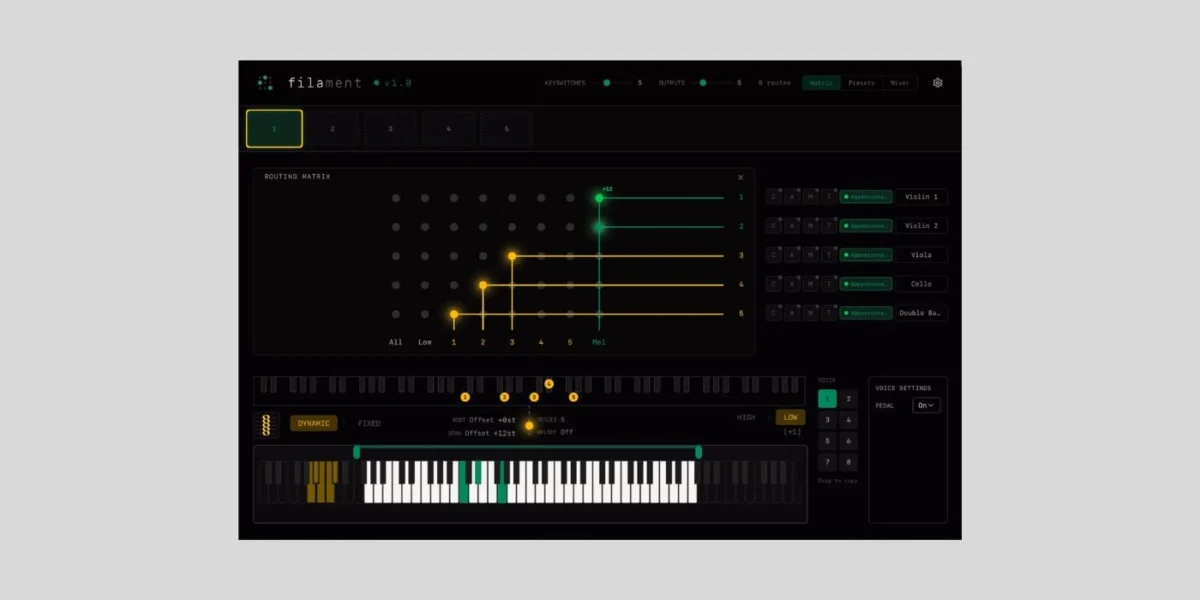
Forma Labs Audio has announced the launch of Filament, a groundbreaking new MIDI orchestration plugin, now available in a free public beta phase. This strategic move allows aspiring and professional composers alike to engage directly with the development process, providing invaluable feedback that will shape the final product. Beta testers are offered the significant incentive of receiving the full v1.0 release of Filament at its official launch, a product anticipated to retail at £149. With beta-tester spots reportedly limited, prospective users are encouraged to apply promptly to secure their involvement and future access to the full version.
Filament is designed for modern digital audio workstations (DAWs) and is compatible with macOS (version 13 or later) and Windows (version 11 or later), supporting both AU and VST3 plugin formats. This broad compatibility ensures that a wide range of music producers and media composers can integrate Filament into their existing workflows. The plugin aims to revolutionize how composers approach orchestral arrangements, offering a sophisticated yet intuitive solution to common challenges encountered in digital music production.
The Evolution and Challenges of MIDI Orchestration
The concept of MIDI orchestration is not novel; experienced media composers are often familiar with dedicated orchestrator tools from established companies such as East West, Vienna Symphonic Library, or Spitfire Audio. These tools have long sought to bridge the gap between a composer’s musical ideas and the often-complex realities of creating realistic orchestral mock-ups. However, the process has historically remained intricate, demanding a deep understanding of instrument ranges, voicings, and performance techniques.
For those less familiar, a MIDI orchestrator functions by taking musical notes input by a user—typically played on a MIDI keyboard—and intelligently assigning them to various virtual instruments in a manner that emulates a real orchestral arrangement. This process aims to overcome the inherent limitations of simply playing an "ensemble strings" or "full orchestra" patch, which often results in a sound that betrays its keyboard origin rather than conveying the distinct characteristics of individual orchestral sections. The challenge lies in distributing notes across instruments in a way that respects their unique timbres, ranges, and performance capabilities, thereby creating a cohesive and authentic orchestral texture.
Traditional methods often involve meticulous manual routing, layering multiple instrument tracks, and adjusting velocities and expressions for each part—a time-consuming endeavor. Even with advanced ensemble patches featuring multiple keyboard zones, composers frequently encounter issues with unrealistic orchestration and chord voicings, leading to a synthetic or "MIDI-like" sound that lacks the organic depth and dynamic realism of a live orchestra. This is particularly critical in professional media scoring for film, television, and video games, where the demand for high-fidelity, emotionally resonant orchestral music is paramount. The global market for music production software, including virtual instruments and plugins, has seen consistent growth, projected to reach billions in the coming years, driven by the increasing accessibility of home studios and the demand for professional-grade audio content.
Filament’s Innovative Approach to Orchestral Realism
Filament directly addresses these longstanding issues with a suite of innovative features designed to streamline and enhance the orchestration process. At its core, Filament allows users to play as they would with a standard ensemble patch, but then intelligently transforms that input into a realistic orchestral arrangement.
One of its standout features is the Chord Revoicer. This intelligent system spreads the notes played by the user to suit the selected instrumentation, effectively re-voicing chords to align with real-world orchestral practice. For less-experienced orchestral arrangers and composers, the Chord Revoicer serves as an invaluable educational tool, offering practical insights into how notes are typically placed within various orchestral contexts. It provides a real-time demonstration of effective voicings, helping users to develop a more intuitive understanding of orchestral texture. For seasoned professionals, it acts as a significant time-saver, automating a complex and often repetitive aspect of the arranging process, allowing them to focus more on creative expression and less on technical minutiae. The underlying algorithms within the Chord Revoicer represent a significant step forward in making sophisticated music theory accessible and actionable within a plugin environment.
Complementing the Chord Revoicer is an easy-to-use routing matrix, which provides a visual and intuitive interface for assigning notes to specific instruments. This matrix allows for granular control over how the played notes are distributed, ensuring that each instrument part is tailored to its natural range and role within the ensemble. This combination of intelligent re-voicing and flexible routing empowers composers to achieve nuanced and authentic orchestral textures with unprecedented ease.
Beyond Basic Orchestration: Advanced Features for Complex Scores
Filament is not limited to small arrangements; it boasts the capacity to load up to 64 instruments inside a single track, offering immense flexibility for creating grand and intricate scores. For projects requiring more than an intimate quartet or quintet sound, complex arrangements often necessitate various layers of rhythmic, harmonic, and melodic elements. Filament caters to these demanding scenarios with several advanced features:
- Built-in Clip Launcher: This feature allows composers to trigger and manage musical phrases or motifs, facilitating the construction of complex layered textures and dynamic shifts within a composition. It provides a non-linear approach to arrangement, akin to a performance environment, enabling rapid experimentation and iteration.
- Integrated Arpeggiator: A powerful tool for generating rhythmic patterns and evolving melodic lines, the arpeggiator is particularly useful for creating ostinatos—those repetitive musical figures that drive a composition and often become iconic, as exemplified in the works of legendary film composers like Hans Zimmer. The ability to quickly generate complex arpeggiated patterns significantly enhances the rhythmic vitality of an orchestral score.
One of the most compelling aspects of Filament, highlighted by early testers, is its ability to tackle multiple complex media-scoring elements concurrently. With its multi-voice architecture, users can assign distinct tasks to each voice, allowing for sophisticated layered performances from a single input. For example, one voice can be dedicated to building an arpeggio, providing rhythmic drive, while a second voice simultaneously creates a harmonic bed, offering foundational support. This multi-tasking capability allows a single performance or chord input to generate both rhythmic and harmonic elements, drastically accelerating the compositional workflow and fostering a more integrated creative process. This approach is reminiscent of advanced modular synthesis, but applied to the realm of orchestral arrangement, offering a high degree of control and creative freedom.
Further enhancing its utility, Filament includes adjustable keyboard zones with a clever overflow/buffer function. This feature provides precise control over instrument mapping across the keyboard, ensuring that notes played outside an instrument’s designated range are intelligently handled rather than simply being cut off or assigned incorrectly. This "deep" functionality speaks to the plugin’s comprehensive design, anticipating and addressing common practical challenges faced by composers.
The Strategic Importance of the Public Beta
The decision by Forma Labs Audio to launch Filament into a free public beta is a strategic one, reflecting a commitment to user-centric development and robust product refinement. Public beta programs are crucial for software developers as they provide real-world testing under diverse operating conditions and by a broad spectrum of users, identifying bugs, performance issues, and usability challenges that might not be apparent during internal testing.
For Forma Labs Audio, this beta phase is an opportunity to gather direct feedback from the music production community, ensuring that Filament meets the practical needs and creative demands of its target audience. By actively involving users in the development cycle, the company can refine features, optimize performance, and tailor the plugin to best serve composers of all skill levels. The limited availability of beta-tester spots underscores the exclusivity of this opportunity and encourages prompt engagement from interested parties. Participants not only get to influence the final design of a potentially industry-changing tool but also secure the full commercial version at no cost, a significant value proposition given the anticipated £149 retail price.
Market Implications and Broader Impact
Filament enters a competitive market, but its unique blend of intuitive design, intelligent re-voicing, and advanced compositional tools positions it as a formidable contender. While established players like East West have deep libraries and extensive features, Filament’s focus on streamlining the orchestration workflow through intelligent algorithms offers a fresh perspective, particularly appealing to a new generation of digital composers. Its emphasis on accessibility for beginners, combined with powerful features for professionals, could democratize high-quality orchestral scoring.
In an era where the demand for original scores in various media—from blockbuster films to independent video games and streaming series—continues to surge, tools that enhance efficiency without compromising quality are invaluable. Filament has the potential to significantly reduce the time spent on the technical aspects of orchestral mock-ups, allowing composers to dedicate more energy to the artistic and emotional dimensions of their music. This could lead to a broader adoption of orchestral elements in diverse musical genres, making sophisticated arrangements more achievable for a wider array of creators.
The ongoing advancements in music technology, particularly in areas like artificial intelligence and machine learning, are continuously reshaping the landscape of music production. Filament’s intelligent Chord Revoicer and multi-voice capabilities hint at a future where creative software plays an even more active role in assisting and inspiring composers, rather than merely acting as passive tools. It represents a convergence of traditional music theory and cutting-edge software engineering, offering a glimpse into the next generation of creative digital instruments.
While some purists might argue for the individual performance of every single orchestral part to capture the most human feel, there is an undeniable and growing need for efficient and powerful orchestration tools. From absolute beginners learning the fundamentals of orchestral writing to AAA game composers under tight deadlines, a well-designed orchestrator plugin like Filament can be an indispensable asset. Its ability to generate realistic and complex arrangements from simpler inputs provides a powerful bridge between musical intention and sonic reality.
The look and workflow of Filament have garnered positive initial reactions, with many expressing excitement for its progression. As Forma Labs Audio continues to gather feedback and refine the plugin, Filament stands poised to become a significant tool in the modern composer’s arsenal, pushing the boundaries of what is achievable in digital orchestral production. The free public beta offers a unique chance to experience this innovation firsthand and contribute to its evolution.
Availability and Further Information
Filament is currently available for free public beta testing, with signup required via the Forma Labs Audio official website. The full v1.0 release is anticipated to launch at a retail price of £149. Composers and producers interested in exploring the capabilities of this new orchestration plugin and contributing to its development are encouraged to visit formalabsaudio.com to apply for the beta program.
