

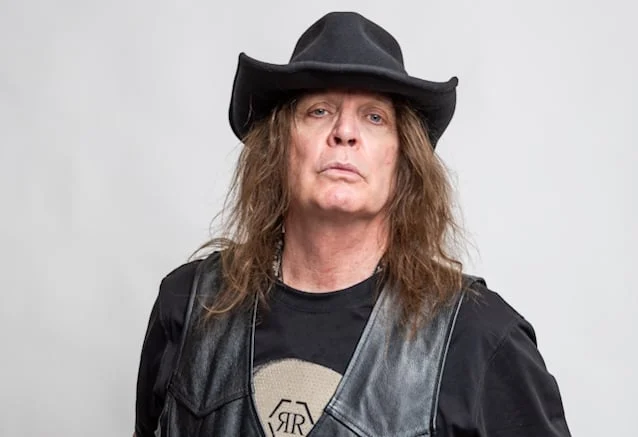
David Reece, the American vocalist who fronted German heavy metal titans ACCEPT during a tumultuous yet significant period in the late 1980s, has expressed a strong desire to participate in special reunion shows celebrating the band’s upcoming 50th anniversary. Reece, whose tenure with ACCEPT culminated in the 1989 album "Eat the Heat," articulated his openness to revisiting this chapter of his career during a recent interview with Nejc Župančič of the YouTube channel PodRaznoKast.
A Controversial Tenure and Lingering Interest
Reece’s recruitment into ACCEPT in 1989 followed the departure of the band’s iconic, gravel-voiced frontman Udo Dirkschneider. Tasked with filling a void left by a vocalist whose distinctive style was inextricably linked to ACCEPT’s identity, Reece brought a higher-pitched vocal delivery that marked a sonic departure from the band’s established sound. This shift, coupled with the overall reception of "Eat the Heat," which met with a mixed critical and commercial response, contributed to a turbulent period for the group. The album’s tour saw tensions escalate, famously culminating in a physical altercation between Reece and bassist Peter Baltes in Chicago, effectively signaling the end of ACCEPT’s initial run by the close of 1989.
Despite the acrimonious conclusion to his time with the band, Reece harbors no ill will and sees the possibility of a 50th-anniversary appearance as a welcome opportunity. He revealed that while he has heard rumors of potential "ACCEPT fests," akin to the collaborative projects undertaken by guitarists like Michael Schenker, he has not received any direct invitations.
"I hear rumors of ‘ACCEPT fest’, like Michael Schenker did," Reece stated, referencing the revolving all-star projects that brought together various vocalists from Schenker’s career. "But I’ve never had any hard contact. I’m really good friends with Udo, I’m good friends with Peter Baltes, but I’ve never been actually approached about it. It wouldn’t surprise me. And I’m okay if they say, ‘Okay, we want you to do a few shows.’ I’ll just ride in a rental car and follow the bus. I don’t care. I would love to do it."
Reece emphasized the profound personal and professional significance of his time with ACCEPT, describing it as his "breakout moment" and the catalyst for his public presence in the music industry. He continues to incorporate songs from the "Eat the Heat" album into his live sets, including "X-T-C," "D-Train," "Generation Clash," and "Hellhammer," demonstrating a continued connection to that material.
"That part of my life is the reason I’m talking to you," Reece elaborated. "That’s what brought me to the forefront publicly in the music business. That was my breakout moment. So I would love to. I mean, I play [‘Eat The Heat’ song] ‘X-T-C,’ I play ‘D-Train,’ I play ‘Generation Clash,’ ‘Hellhammer’ live in my set – even now. I would love to. But it’s up to Wolf. I mean, it’s Wolf’s band now."
The Complexities of a Full-Band Reunion
While open to a celebratory appearance, Reece expressed skepticism regarding the feasibility of a comprehensive reunion involving all former members of ACCEPT. He acknowledged the band’s extensive history, marked by both positive and challenging periods, and suggested that reconciling past differences would present a significant undertaking.
"It would be a massive undertaking, trust me," Reece explained. "There’s so much history with that band, and let’s say good blood and bad blood. I mean, to get everybody to agree to do it would be a really big job. But my door is open. Call me, find me. I’m there."
This sentiment underscores the enduring complexities that often accompany reunions of long-standing bands, where personal relationships and artistic directions can diverge over decades. The potential for such an event to capture the magic of ACCEPT’s legacy while navigating the historical dynamics between its various members remains a delicate balance.
A Deep Respect for Udo Dirkschneider
Beyond his own potential involvement, Reece spoke with immense admiration for Udo Dirkschneider, the original voice of ACCEPT and the frontman for the successful band U.D.O. Reece and Dirkschneider have maintained a close friendship and have collaborated on stage numerous times.
"The man, he’s in his early seventies," Reece said of Dirkschneider. "He’s a Panzer tank. I mean, I did the U.D.O. ‘Steelfactory’ tour, David Reece solo, as a special guest, in 2018, ’19, and I think we played 38 shows together, and it was fabulous. And every night he was the same. He’s not lost a step."
Reece recounted a remarkable instance of Dirkschneider’s dedication to his craft, revealing that the veteran vocalist performed much of a tour using a cane due to a severe bone infection contracted in Spain. Despite medical advice to rest, Dirkschneider refused to cancel shows, a testament to his unwavering commitment.
"But I can tell you this – he had a bone infection that he had contracted in Spain, and the doctors told him, ‘You need to go home and get well.’ And he said, ‘I never cancel.’ So most of the tour I did with him, he used a cane on stage. And it was unbelievable. I mean, I respect that man to no end."
Their camaraderie extends to Dirkschneider’s son, Sven Dirkschneider, who now handles drumming duties for U.D.O. and Dirkschneider’s own projects. Reece’s band, DAMAGED, used to open for Sven’s band in Germany, creating opportunities for the two families to connect and for Udo to attend performances, often generating excitement among fans to see both singers together.
"I’m dear friends with him and his son Sven. Sven’s band DAMAGED used to open for me in Germany. And if Udo was home, he would come to the shows, and, of course, people would go, ‘Oh, David Reece is playing, and Udo’s here.’ So it was kind of an event. People get to see us together."
The "Eat the Heat" Era: A Product of Corporate Influence?
Reece addressed the sonic direction of "Eat the Heat," acknowledging its departure from ACCEPT’s earlier, more traditional heavy metal sound. He suggested that the album’s polished, commercially oriented approach, influenced by record company executives, may have alienated the band’s established fanbase.
"Sometimes I look back in retrospect and think maybe we should have changed the [band] name," Reece admitted. "But again, it goes back to branding. I think the first released single, the video for ‘Generation Clash,’ was a terrible mistake because it’s a heavy metal band. If we released ‘D-Train’ or ‘X-T-C’ as the first single, keep the fans that were devout followers: ‘Oh, they’re still heavy.’ But we came out with kind of the polished American blonde singer Americanized version, which all came from corporate."
He elaborated on the perceived shift in ACCEPT’s trajectory following albums like "Balls to the Wall," "Metal Heart," and "Russian Roulette," suggesting a move towards greater commercial appeal that, in his view, did not align with Udo Dirkschneider’s vocal style.
"’Cause basically the after ‘Balls Of The Wall,’ they started moving in the direction of that sound, like ‘Metal Heart’ and ‘Russian Roulette.’ They started to kind of get more commercialized, and Udo’s voice did not suit that. So the record companies all said, ‘Hey, get a singer that’s got this vibe, and we can break this record into a million seller,’ which was a mistake."
Reece criticized the disconnect between corporate decision-makers and the preferences of the heavy metal fanbase. "I mean, people that wear suits and ties and record companies, they don’t know what fans want. They have no clue. All they think about is money." The album’s less-than-stellar performance, he noted, was a shock to both the band and himself, leaving him with a polarized reception from fans. "And it was a shock for the band that it wasn’t that successful, and a shock for me that I wasn’t taken in and loved – I was either hated or loved – there was no middle."
Cultural Differences and the Search for Identity
Reece also cited cultural differences as a contributing factor to the short-lived nature of his collaboration with ACCEPT. As an American in a predominantly German band, navigating distinct cultural norms and communication styles presented challenges.
"I’m an American. They’re Germans. Number one, you’ve got cultural differences," Reece explained. "One thing I learned from ACCEPT, you go from playing five shows [a week at clubs] to joining a band like ACCEPT – they were the second-largest metal band in Germany, Scorpions being number one – that was a whole different game for me."
He recalled the guidance he received from "Eat the Heat" producer Dieter Dierks, who recognized the need for Reece to discover his own vocal identity within the band’s context. Reece admitted that at the time, he was influenced by a range of established rock vocalists, which may have hindered the development of a distinct sound.
"I was, like, you know, ‘I can do this.’ Well, [‘Eat The Heat’ producer] Dieter [Dierks] said, ‘You’ve got a great voice, but we have to discover what it is. We have to find the identity.’ And I didn’t understand that, but when you’re trying to sing like [Rob] Halford or [Ronnie James] Dio or David Coverdale and doing cover songs, you really don’t have an identity, where Udo, that’s just how he sings. That was the voice when he started the band in 1974. So that’s what it was."
The Audition Process and Fitting In
Reece detailed the intense audition process that led to his membership in ACCEPT, highlighting the pressure and uncertainty he faced. The final audition involved a live performance in Cologne, attended by influential figures whose opinions would weigh heavily on the band’s decision.
"The hardest part of the process was being accepted in the band, no pun intended," Reece stated. "The final audition was a live show in Cologne, and they invited a lot of heavy people there to give their opinion. And there was about a thousand people at the show. I was convinced that that was my last day there, that it won’t work."
Despite his apprehension, the performance was successful, and he received confirmation of his hiring the following morning. He acknowledged the band’s apprehension in making the change, particularly after a previous unsuccessful attempt with an English singer, Rob Armitage.
"It went really well, and we had a guest house and I heard everybody talking in the morning. So I got up and said, ‘Well, I better go say goodbye.’ And I walked into the kitchen and they all said, ‘Welcome to ACCEPT.’ So I was hired. That was pretty terrifying, because I had been there for a long time, and they were really nervous about making the change, because they had a singer before me from England named Rob Armitage for a while, and he didn’t work out. And you never really knew with them what they were thinking. They kept things very much in their private circle. Nobody would say ‘yes’, nobody would say ‘no’. So that was really the final test, if I could fit in the band. And I made it."
A Lasting Impact and Missed Opportunities
Looking back on his tenure with ACCEPT, Reece described it as a period of both extreme highs and lows, but one that irrevocably shaped his career. "Well, I can be blatantly honest – it was super positive and super negative, but I wouldn’t be speaking with you right now if I hadn’t done that album," he reflected. "The doors were opened; the floodgates happened. The critics hated me. Some loved me. But I have to be honest and say that was an opportunity of a lifetime. I did the best I could. I have no animosity towards those guys. I don’t care what they’re doing; they don’t care what I’m doing; but I’m grateful for the opportunity. It speaks volumes as a singer that I was chosen over 50 people to be the guy. It was a difficult job."
The association with ACCEPT also led to a significant opportunity for Reece: a potential audition with JUDAS PRIEST following Rob Halford’s departure. He was considered alongside other prominent vocalists like Ralf Scheepers and Tim "Ripper" Owens, with Owens ultimately being chosen. However, JUDAS PRIEST later reached out to Reece for further discussions, underscoring the positive professional impact of his ACCEPT period.
"The association with ACCEPT landed him a call from JUDAS PRIEST after the latter band parted ways with Rob Halford," the article states. "At that time I could really sing like that," he said. "It was myself, Ralf Scheepers [PRIMAL FEAR] and Ripper Owens; [we] were the top three guys. So they chose Ripper. But they were contacting me six months later: ‘Come over to England and let’s jam.’ So, obviously, it did a lot for me in a positive way."
Despite the criticisms leveled against "Eat the Heat," Reece maintains a fond remembrance of the album. He believes that mature reflection allows for a more objective appreciation of the work, especially considering the personal circumstances surrounding its creation.
"I mean, everybody has an album they regret, but if you regret an album, maybe you’re not thinking clearly about the personal turmoil that was going on during the album," he explained. "That could affect how you think about it. And I’ve gotten to my old, mature state where I can go, ‘That’s pretty damn good.’ I still play ‘X-T-C’ and ‘D-Train’ and ‘Hellhammer’ live, and ‘Generation Clash,’ and people go crazy. So those songs are timeless for people."
Wolf Hoffmann’s Perspective: A "Dark Time"
Guitarist Wolf Hoffmann, the enduring leader of ACCEPT, has previously characterized the "Eat the Heat" era and the 1990s as a "dark time" for the band. In a 2021 interview with Hardrock Haven, Hoffmann expressed his reluctance to dwell on that period, attributing the album’s challenges to a difficult market for traditional heavy metal.
"I would say that all of the ’90s were very difficult and very dark in a way, and I don’t even like to think about it so much," Hoffmann stated. "If only you journalist guys didn’t constantly ask me about it, I would never even think about it. [Laughs] ‘Cause it was just a time when heavy metal was going through a very dark period. The traditional sound was out of style and nobody wanted to listen to it, so it was sort of searching for a new direction – especially in the ’90s. ‘Eat The Heat’ came out at the beginning of that era and it was meant to be a new chapter, but it’s just never panned out because basically everything went wrong with that album."
Hoffmann acknowledged that the album elicits strong, often negative, reactions from many fans, but he also noted that a surprising number have expressed their fondness for it, despite its perceived shortcomings.
"There’s something about this album that rubs a lot of people the wrong way and they have such a strong opinion about it – It’s sometimes laughable," he continued. "In my mind, it had some fantastic songs but it was just never executed properly, and it was not meant to be. But over the years, I’ve met so many fans who said exactly the same thing, ‘Man, I really wanna apologize, but I really like this album… I know nobody likes it, but I think it’s great.’ And I think that’s so bizarre. If you like it, you like it. It’s so strange that people are so opinionated about it."
He concluded his thoughts on the album by emphasizing that music is subjective and that while the period was challenging for him personally, fan opinions, positive or negative, are valid. "It’s just music," Hoffmann explained. "You can like it or not, but it’s not more than that. In any case, it wasn’t the period of time that I like to even think about much, ’cause it was very difficult."
A Legacy Beyond "Eat the Heat"
David Reece’s career extends beyond his stint with ACCEPT. He has also lent his vocal talents to bands such as Bonfire, Bangalore Choir, and Iron Allies, further solidifying his presence in the hard rock and heavy metal landscape. His openness to participating in a 50th-anniversary celebration for ACCEPT, however, speaks to the enduring impact of his brief but memorable chapter with the German metal legends, offering fans a potential glimpse into a unique segment of the band’s storied history. The ultimate decision, as Reece himself pointed out, rests with Wolf Hoffmann and the current iteration of ACCEPT, as they navigate the milestone of half a century in the music industry.
