

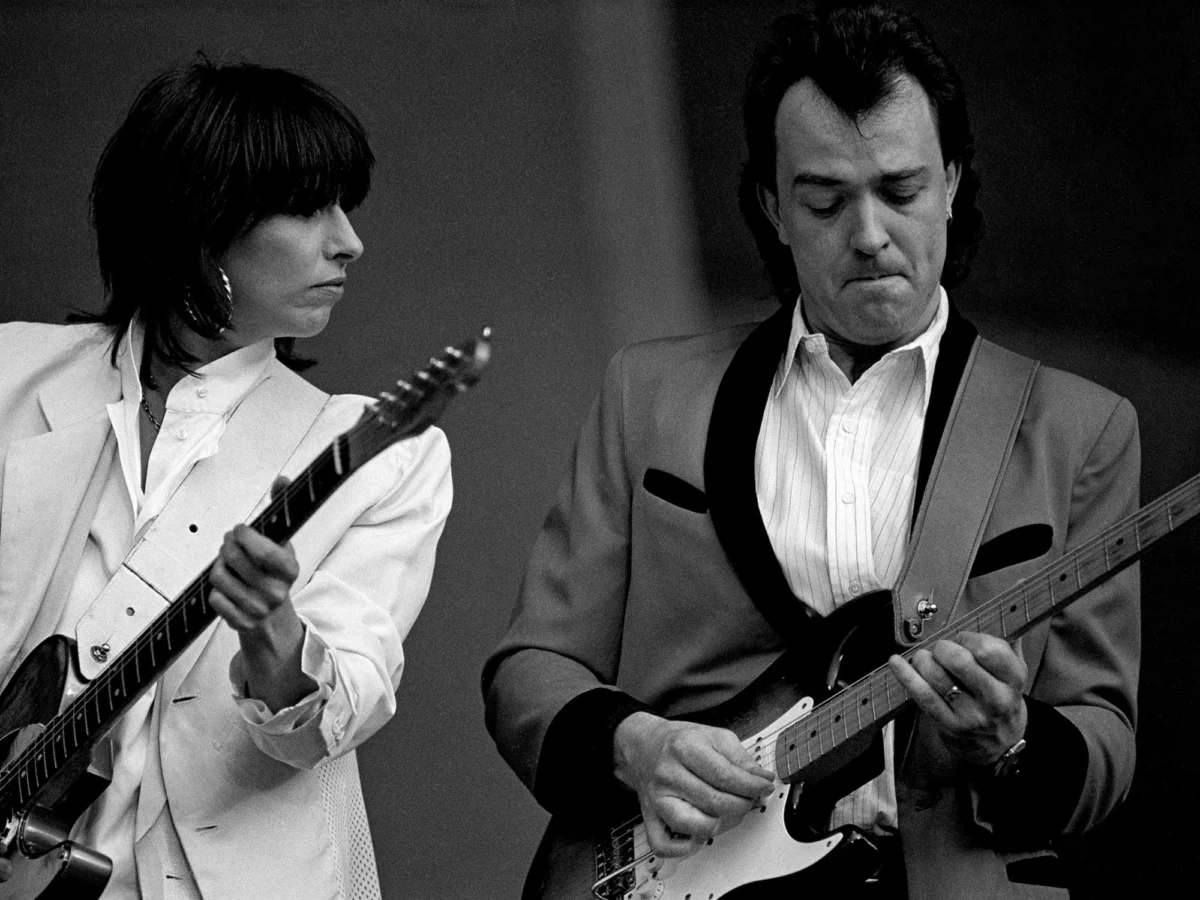
In a recent candid interview with Guitar World, veteran guitarist Robbie McIntosh has offered an illuminating retrospective on his pivotal entry into The Pretenders in 1982, a period marked by profound loss and immense pressure for the iconic rock band. McIntosh’s recollections shed light on the unconventional audition process, his immediate creative synergy with frontwoman Chrissie Hynde, and the nuanced approach he took to shaping the band’s sound in the wake of tragedy, most notably on the acclaimed 1984 album, Learning to Crawl. His narrative provides a valuable historical account of how a band, seemingly on the brink, found new footing through the integration of fresh talent and resilient artistic vision.
The Weight of Expectation: Stepping into a Legendary Role
McIntosh’s arrival in The Pretenders was necessitated by one of rock music’s most heartbreaking chapters. In June 1982, the band’s founding guitarist, James Honeyman-Scott, tragically died at the age of 25. Honeyman-Scott was not merely a band member; he was a foundational pillar of The Pretenders’ distinctive sound, a master of melodic invention and textural subtlety whose playing defined hits like "Brass in Pocket" and "Message of Love." His untimely death sent shockwaves through the music world and left Chrissie Hynde with the daunting task of navigating the band’s future without one of her most crucial creative partners.
The vacuum left by Honeyman-Scott was immense. His innovative approach to guitar, blending new wave precision with a classic rock sensibility, had earned him widespread critical praise and influenced a generation of guitarists. Replacing such an irreplaceable talent was not just a technical challenge but an emotional and artistic one, requiring a musician who could both respect the established legacy and contribute to a new creative direction. It was into this crucible of grief and expectation that Robbie McIntosh stepped, initially unaware of the full scope of the role he was about to inhabit.
The Pretenders’ Formative Years and Early Triumphs
To fully appreciate the significance of McIntosh’s entry, one must understand the meteoric rise and unique identity of The Pretenders prior to 1982. Formed in Hereford, England, in 1978, the band coalesced around the singular vision of American expatriate Chrissie Hynde, a charismatic and uncompromising songwriter and vocalist. Hynde, who had spent years immersed in the London punk scene, finally found her ideal collaborators in James Honeyman-Scott (guitar), Pete Farndon (bass), and Martin Chambers (drums). This original lineup possessed a potent chemistry, blending Hynde’s tough-yet-tender songwriting with a distinctive musicality that defied easy categorization.
Their self-titled debut album, Pretenders, released in 1980, was a critical and commercial sensation. It reached number one on the UK Albums Chart and spawned iconic singles such as "Brass in Pocket," which topped the UK Singles Chart. The album showcased the band’s diverse range, from the raw energy of "Precious" to the melodic sophistication of "Kid." Honeyman-Scott’s guitar work was central to this success; his ability to craft memorable riffs, shimmering arpeggios, and understated yet powerful solos provided the perfect counterpoint to Hynde’s vocals. His playing was often described as elegant and inventive, eschewing flashy theatrics for melodic substance and atmospheric texture.
The follow-up, Pretenders II, released in 1981, continued their success, further solidifying their reputation as one of the most exciting and innovative bands of the era. Tracks like "Message of Love" and "Talk of the Town" demonstrated the band’s consistent quality and the undeniable interplay between Hynde’s songwriting and Honeyman-Scott’s guitar artistry. By early 1982, The Pretenders were at the peak of their powers, poised for even greater global recognition.
Tragedy and Turmoil: A Band at a Crossroads
The band’s promising trajectory was abruptly halted by a series of devastating events. The punk and new wave scenes of the late 1970s and early 1980s, while creatively fertile, were also rife with the perils of drug use. James Honeyman-Scott, despite his prodigious talent, struggled with addiction. On June 16, 1982, he was found dead at his London flat, the cause attributed to heart failure brought on by cocaine intolerance. His death was a profound shock, not only for Hynde but for the entire music community.
Just two days before Honeyman-Scott’s passing, Chrissie Hynde had fired bassist Pete Farndon from the band due to his escalating drug problems. This meant that within a matter of days, two-thirds of the original instrumental lineup was gone, leaving Hynde and drummer Martin Chambers to confront an uncertain future. The emotional toll on Hynde was immense, threatening the very existence of The Pretenders. The band had been scheduled to embark on a major tour, and the sudden void presented an almost insurmountable challenge.
The period immediately following Honeyman-Scott’s death was one of intense grief and reconsideration for Hynde. Many speculated that The Pretenders might disband entirely. However, Hynde, renowned for her resilience and tenacity, resolved to continue, driven by a desire to honor Honeyman-Scott’s legacy and her own artistic commitment. This decision set in motion the search for new musicians who could help her rebuild. The subsequent death of Pete Farndon from a drug overdose in April 1983, shortly after the recording of Learning to Crawl had begun, further underscored the tragic backdrop against which the band was attempting to reform.
The Audition: An Unconventional Path to Membership
It was against this backdrop of sorrow and uncertainty that Robbie McIntosh received the call. Despite being friends with James Honeyman-Scott, McIntosh had never met Chrissie Hynde prior to his audition. This detail underscores the professional, yet somewhat detached, nature of the initial contact, highlighting Hynde’s focus on finding the right musical fit amidst her personal grief.
McIntosh recounts the audition as surprisingly informal, a stark contrast to what one might expect for a band of The Pretenders’ stature, especially given the weight of the circumstances. "We just jammed," he told Guitar World. He played for approximately 20 minutes, not alone, but alongside another esteemed guitarist, Mick Green – a legendary figure known for his work with Johnny Kidd & The Pirates and The Pirates. Green’s presence added another layer of intensity to the experience for McIntosh, who admitted to being "sort of in awe of" him. The rhythm section comprised Martin Chambers on drums, the sole remaining original instrumentalist, and an unnamed bass player, indicating that the band was still in flux regarding its full lineup. Chrissie Hynde and manager Dave Hill observed from in front of the stage, a clear sign that Hynde was directly assessing the chemistry and individual talents on display.
The casual nature of the audition, focusing on improvisation rather than a strict repertoire, suggests Hynde was looking for instinct, feel, and the ability to integrate seamlessly into a dynamic musical environment. McIntosh’s account implies a lack of immediate feedback, leaving him uncertain about his performance. "A few days later, I got the call from Chrissie and she said she wanted me in the band. I didn’t have a clue that I’d passed the audition," he revealed. This surprise highlights Hynde’s decisive nature and her clear internal judgment of musical compatibility, even when the audition felt ambiguous to the participant. McIntosh’s selection was a testament to his innate musicality and his ability to connect with the band’s core without necessarily having to mimic Honeyman-Scott’s style directly.
Crafting a New Chapter: Rehearsals and Studio Sessions

With McIntosh officially joining in September 1982, The Pretenders began the arduous process of rebuilding and defining their sound for a new era. The first actual rehearsal with Hynde provided McIntosh with immediate insights into her musical approach. "I remember she played quite loud, but that didn’t worry me," he recalls. This detail is significant, as Hynde’s rhythm guitar playing is often underestimated; she is a powerful and integral part of The Pretenders’ sonic identity. McIntosh’s response speaks to his professional adaptability: "I was more concerned with how I could complement her and play off what she did." This mindset was crucial. Instead of attempting to fill Honeyman-Scott’s shoes by imitation, McIntosh focused on establishing a new dynamic, creating space, and adding his own voice to Hynde’s established presence.
The band quickly moved into recording sessions for what would become their third studio album, Learning to Crawl. The album title itself was a poignant reflection of the band’s state – a metaphor for regaining stability and momentum after profound loss. These sessions were overseen by Chris Thomas, a renowned producer celebrated for his work with artists like Roxy Music, Sex Pistols, and Pink Floyd. Thomas’s experience in shaping diverse sounds would prove invaluable in helping The Pretenders navigate their new creative landscape.
McIntosh vividly remembers the initial songs they tackled. "I can’t remember whether the first thing we did was 2000 Miles or Middle of the Road. I think it was Middle of the Road." Both tracks would become signature songs for The Pretenders, demonstrating the band’s enduring songwriting quality and McIntosh’s immediate impact on their sound. While 2000 Miles showcased a more atmospheric, melodic side, Middle of the Road presented a driving, rock-oriented sound that provided a perfect canvas for McIntosh’s lead guitar prowess.
The Art of the Solo: Deconstructing "Middle of the Road"
The blistering lead guitar solo on "Middle of the Road" stands as one of Robbie McIntosh’s most iconic contributions to The Pretenders’ catalog and a defining moment on Learning to Crawl. McIntosh’s detailed recollection of its creation offers a fascinating glimpse into the studio process and his approach to guitar improvisation. He reveals that the solo was not a single, spontaneous take but a meticulously constructed piece, assembled from multiple performances.
"In the studio I did maybe three or four solos, all different kinds of things," he explained. "And [producer] Chris Thomas said, ‘I like that bit. We’ll keep the first half.’ I think I dropped in the really fast bit on its own, and I did that thing with the delay at the end of the solo. We worked on it for maybe half an hour." This collaborative approach with Thomas highlights the producer’s role in shaping the final output, extracting the best elements from McIntosh’s various improvisations to create a cohesive and impactful statement. The use of delay at the end of the solo adds a distinctive textural element, extending its sonic footprint.
Reflecting on how his approach differed from James Honeyman-Scott’s style, McIntosh candidly stated, "It was a bit more aggressive and flashy." This observation is key to understanding the evolving sound of The Pretenders. While Honeyman-Scott was celebrated for his melodic restraint and intricate textures, McIntosh brought a more direct, powerful, and technically adventurous edge. This difference was not a detriment but a natural evolution, allowing the band to retain its rock foundation while exploring new dynamic possibilities.
McIntosh also offered insight into the technique behind the solo’s intricate picking, a detail often pondered by guitar enthusiasts. "People always ask me about the picking on that solo," he noted. "I just used my fingers, and the pick was inside my hand. Then if I needed the pick, I’d just pull it out." This "hybrid picking" technique, combining fingerstyle with the option of quickly deploying a pick, allowed him a greater range of articulation and speed, contributing to the solo’s distinctive character and aggressive flair. This technical mastery was clearly recognized by the production team. McIntosh proudly recalls, "Chris Thomas always complimented me on the guitar playing on the album. I saw him a couple of years ago and he said the same thing. He said what a great time he had making that album. I was quite chuffed." Such consistent praise from a respected producer like Chris Thomas underscores the high quality and impact of McIntosh’s contributions.
"Learning to Crawl": A Testament to Resilience
Learning to Crawl, released in January 1984, was more than just another album for The Pretenders; it was a powerful statement of resilience and continuity. The album was largely a commercial and critical success, defying the widespread skepticism that often accompanies major lineup changes, especially those following tragedy. It peaked at number 11 on the Billboard 200 in the United States and reached number 2 in the UK. Singles like "Middle of the Road" and "Back on the Chain Gang" (which was recorded with session guitarists Billy Bremner and Paul Carrack on keyboards before McIntosh fully joined, but was included on the album) became major hits, re-establishing The Pretenders’ presence on radio and charts worldwide.
Robbie McIntosh’s contribution to Learning to Crawl was instrumental in forging this new identity. His guitar work, while different from Honeyman-Scott’s, provided the necessary drive, melody, and texture to complement Hynde’s increasingly personal and introspective songwriting. The album’s themes of motherhood, loss, and perseverance resonated deeply with audiences, and McIntosh’s playing helped translate these emotions into compelling musical narratives. Tracks such as "My City Was Gone" (also featuring Billy Bremner on lead guitar for its iconic riff), "Show Me," and "Thumbelina" showcased a band that had not only survived but had evolved, demonstrating a newfound maturity and strength.
The album’s success reaffirmed Chrissie Hynde’s artistic vision and her unwavering commitment to The Pretenders. It proved that the band could indeed "learn to crawl" again, finding new creative pathways despite immense personal and professional setbacks. McIntosh’s role in stabilizing the instrumental core alongside Martin Chambers was crucial, allowing Hynde the space to lead the band into its next chapter. His ability to blend his own aggressive style with a sensitive understanding of the band’s established sound was a masterstroke, earning him a significant place in The Pretenders’ storied history.
Beyond The Pretenders: A Lasting Musical Impact
Robbie McIntosh’s tenure with The Pretenders was a significant chapter in his illustrious career, but it was by no means his only one. Following his departure from The Pretenders in 1987, McIntosh went on to establish himself as one of the most respected session and touring guitarists in the industry. His diverse musical talents led him to work with a formidable array of artists across various genres, including Paul McCartney, John Mayer, Norah Jones, and Mark Knopfler. His ability to adapt his playing to different styles, from the raw energy of rock to the nuanced textures of blues and pop, speaks volumes about his versatility and musical intelligence.
His work with Paul McCartney, particularly during the Flowers in the Dirt era and subsequent tours, solidified his reputation as a first-call sideman. With John Mayer, McIntosh contributed to the blues-rock sensibilities of the John Mayer Trio, further showcasing his improvisational skills and deep understanding of guitar dynamics. These subsequent collaborations underscore that his impact on Learning to Crawl was not an anomaly but a reflection of a consistently high level of musicianship.
The Pretenders, too, continued their journey, with Chrissie Hynde remaining the sole constant member, guiding the band through various iterations and continuing to release critically acclaimed music. The band’s enduring legacy is a testament to Hynde’s resilience and uncompromising artistic integrity, but also to the contributions of musicians like Robbie McIntosh, who stepped up during critical junctures to help shape the band’s evolving sound.
McIntosh’s recent reflections offer more than just personal anecdotes; they provide invaluable historical context to a pivotal moment in rock history. They highlight the intricate dynamics of band formation, the pressures of artistic legacy, and the collaborative process of music creation. For fans of The Pretenders and students of guitar, these insights offer a deeper appreciation for the talent and perseverance required to navigate the challenging landscape of the music industry, particularly when confronted with profound loss and the expectation of rebirth. His story is a powerful reminder that even in the darkest of times, music finds a way to endure and evolve.
