

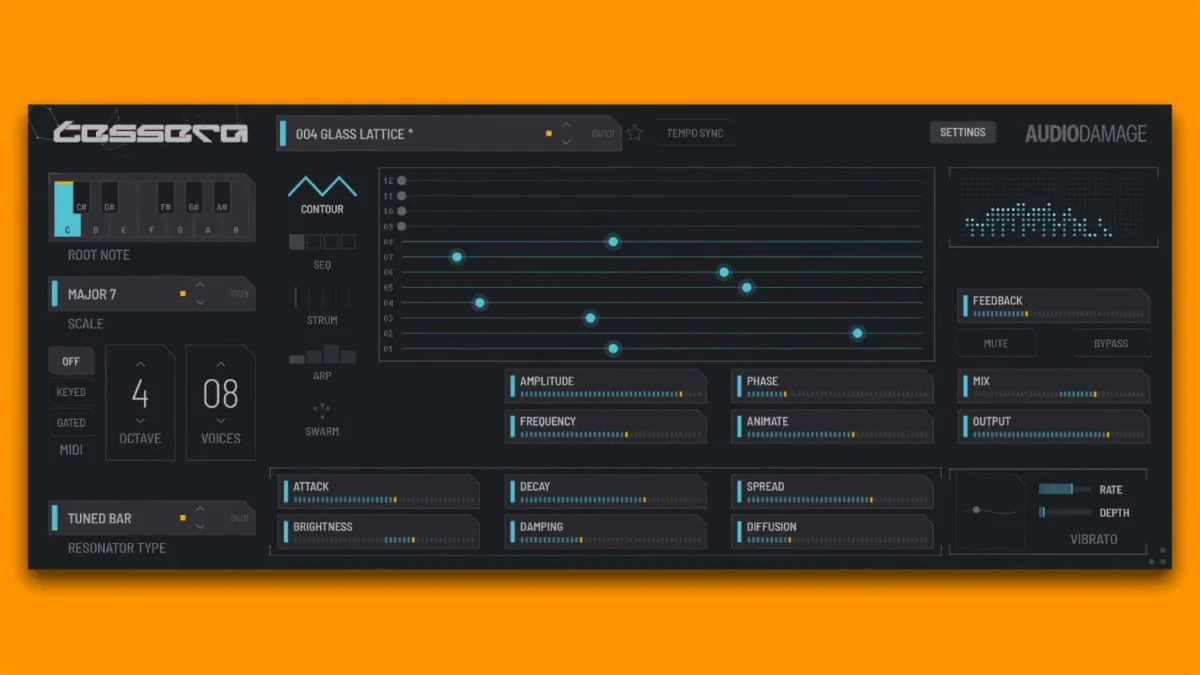
The professional audio software industry has seen a significant shift toward specialized physical modeling tools, and the latest release from Audio Damage, a veteran developer in the digital signal processing (DSP) space, marks a notable entry into this evolving landscape. Tessera is a sophisticated effects plugin designed around twelve parallel resonator voices that are excited by incoming audio signals, offering a departure from traditional time-based or frequency-based processing. By utilizing physical modeling synthesis rather than conventional filtering or convolution-based reverberation, Tessera allows producers and sound designers to transform transient-heavy sounds into lush chords and sustained textures into evolving harmonic soundscapes. The plugin routes source audio through a series of resonators tuned to specific notes within a user-defined chord or scale, effectively turning any input into a tuned, resonant instrument.
Technical Architecture and Processing Engine
At the core of Tessera lies a high-performance processing engine that utilizes eleven distinct physical-model resonator types. Physical modeling is a synthesis method where the waveform of the sound to be generated is computed using a mathematical model—a set of equations and algorithms—to simulate a physical source of sound. In the context of Tessera, these models simulate the acoustic properties of various objects and environments, such as vibrating strings, hollow tubes, metallic plates, and resonant membranes.
When an audio signal enters the plugin, it acts as an "exciter." Unlike a standard synthesizer where an oscillator provides the initial vibration, Tessera uses the incoming audio’s amplitude and frequency content to stimulate its internal resonators. This means that a sharp, percussive sound like a drum hit will result in a plucked or struck resonance, while a smooth, sustained sound like a vocal or a pad will result in a shimmering, bowed, or blown harmonic texture.
The twelve voices are arranged in parallel, allowing for complex polyphonic structures. Users can constrain these voices to specific scales or chords, ensuring that the resulting resonance is always musically coherent with the rest of a production. This functionality bridges the gap between an effect and a musical instrument, as the plugin essentially "re-pitches" the input material based on the selected harmonic framework.
Advanced Modulation and Motion Engines
To prevent the resonant textures from becoming static, Audio Damage has integrated five tempo-syncable motion engines into Tessera’s architecture. These modulation sources are designed to introduce movement and evolution to the internal parameters of the resonators. In modern electronic music production, the ability to synchronize modulation to the host DAW’s (Digital Audio Workstation) tempo is critical for maintaining rhythmic integrity, and Tessera’s engines allow for precise control over how the sound shifts over time.
The plugin provides comprehensive controls for shaping the physical characteristics of the sound. These include:
- Decay: Controls how long the resonance lasts after the exciter signal has ceased.
- Damping: Simulates the absorption of high frequencies within the resonant body, allowing for darker or brighter tonal profiles.
- Brightness: Adjusts the harmonic content of the physical models.
- Stereo Spread: Manages the spatial positioning of the twelve voices across the stereo field, providing a sense of width and immersion.
- Harmonic Behavior: Influences how the resonators react to overtones, allowing for "in-tune" or "inharmonic" experimental results.
These parameters, when combined with the motion engines, allow for the creation of "living" textures that pulse, breathe, and shift in response to both the input audio and the internal modulation cycles.
Chronology of Audio Damage and Product Development
Audio Damage, founded by Chris Randall and Adam Schabtach, has maintained a presence in the plugin market for over two decades. The company’s history is characterized by a transition from hardware-inspired vintage emulations to avant-garde digital tools that push the boundaries of sound manipulation.
In the early 2000s, the company gained a reputation for high-quality, affordable plugins like the "Dubstation" delay and the "Discord" pitch shifter. As the industry moved toward more complex synthesis methods, Audio Damage expanded its portfolio to include granular synthesis (Quanta) and advanced wavetable synthesis. The development of Tessera represents a continuation of this trajectory, focusing on the intersection of physical modeling and creative effects processing.
The release of Tessera follows a period of significant updates to the Audio Damage catalog, including the porting of their desktop plugins to the iOS platform and the adoption of the CLAP (Clever Audio Plugin) format alongside traditional VST3, AU, and AAX standards. This move toward cross-platform compatibility has made their tools accessible to a wider range of creators, from mobile musicians to high-end studio engineers.

Market Context and Pricing Strategy
Tessera enters a market where sound designers are increasingly looking for "intelligent" effects that go beyond basic equalization and compression. Competitors in this space include Ableton’s "Corpus" (based on physical modeling by Applied Acoustics Systems) and Reason Studios’ "Object," yet Tessera distinguishes itself through its twelve-voice parallel architecture and its specific focus on harmonic "re-tuning" of input sources.
The pricing of Tessera follows Audio Damage’s long-standing philosophy of providing professional-grade tools at an accessible price point. The plugin is currently available for macOS, Windows, and Linux at an introductory price of $39 USD, with a standard retail price of $49 USD. This aggressive pricing strategy positions Tessera as an attractive option for independent producers and hobbyists, while its technical depth remains sufficient for professional film scoring and sound design for games.
Furthermore, the company has confirmed that an iOS version is currently in development. The mobile music production market has grown exponentially over the last five years, and the ability to run the same DSP algorithms on an iPad as on a high-end Mac Pro is a significant selling point for the modern "hybrid" producer.
Official Statements and Industry Reception
While formal press tours for niche DSP tools are rare, the developer’s philosophy regarding Tessera emphasizes "musicality through physics." In documentation accompanying the release, the focus is placed on the plugin’s ability to find "the hidden music inside noise." By using noise or non-tonal transients to excite the resonators, Tessera can generate melodic content from sources that previously lacked pitch.
Early reactions from the electronic music community have highlighted the plugin’s utility in ambient and experimental genres. Producers have noted that the "parallel" nature of the voices allows for a level of density that is difficult to achieve with serial processing chains. The inclusion of Linux support has also been praised, as the Linux audio community, though smaller than the Windows or macOS user bases, is often underserved by major plugin manufacturers.
Broader Impact and Implications for Sound Design
The release of Tessera signifies a broader trend in the audio industry toward "generative effects"—plugins that do not just alter a sound, but contribute new musical information to a composition. In traditional mixing, an effect is meant to be transparent or to enhance what is already there. In contrast, Tessera belongs to a class of "transformative" tools that can redefine the fundamental identity of a sound.
For film and game composers, this tool offers a way to create "organic" textures that feel acoustic yet are entirely synthesized. Because physical modeling mimics the behavior of real-world materials, the sounds produced by Tessera often possess a tactile quality that pure electronic oscillators lack. This is particularly useful in creating Foley-inspired musical elements or "otherworldly" atmospheres that still retain a sense of physical presence.
Moreover, the technical efficiency of the plugin is a testament to the maturation of physical modeling algorithms. Historically, simulating twelve simultaneous resonators would have been prohibitively expensive in terms of CPU (Central Processing Unit) usage. However, optimizations in modern DSP coding allow Tessera to run multiple instances within a project without overwhelming the system, making it a viable tool for live performance as well as studio production.
Summary of Specifications and Availability
Tessera is currently available for purchase through the official Audio Damage website. The software supports the following formats:
- macOS: VST3, AU, and AAX (Universal Binary for Intel and Apple Silicon).
- Windows: VST3 and AAX (64-bit).
- Linux: VST3 (64-bit).
- iOS: (Forthcoming, expected to support AUv3).
The plugin features a vector-based user interface that is fully resizable, ensuring clarity on high-resolution displays. It also includes a comprehensive preset manager, allowing users to quickly explore the range of the eleven resonator models and the five motion engines.
As the boundaries between synthesis and effects continue to blur, tools like Tessera provide a glimpse into the future of digital audio. By leveraging the laws of physics to generate harmony from chaos, Audio Damage has provided the modern producer with a versatile and musically inspiring tool that challenges the conventional definitions of signal processing. Whether used to add a subtle "halo" of resonance to a vocal or to turn a simple drum loop into a complex polyphonic arrangement, Tessera stands as a robust example of contemporary DSP innovation.
