

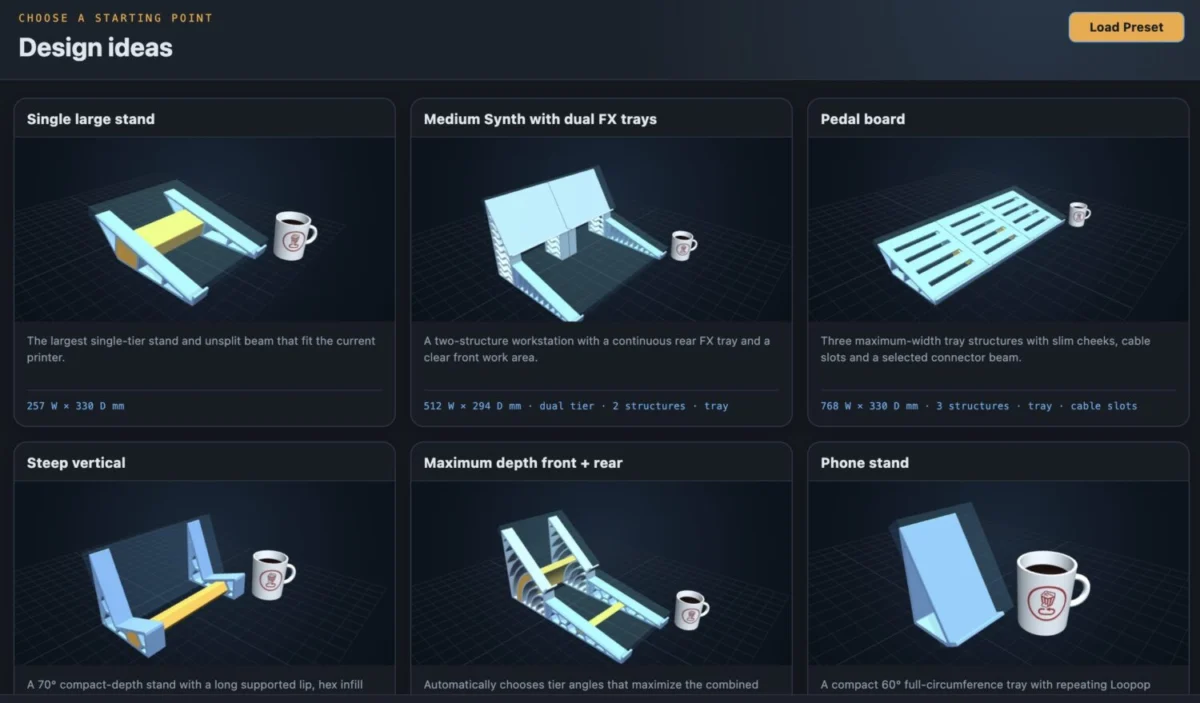
Ziv Eliraz, the creator behind the widely respected music technology channel loopop, has officially released a specialized web-based application titled the Synth Stand and Pedal Board Synthesizer. This innovative tool is designed to provide musicians and studio engineers with a streamlined, parametric interface for creating custom-tailored 3D-printable supports for hardware synthesizers, drum machines, and effects pedals. By bridging the gap between complex Computer-Aided Design (CAD) software and the specific ergonomic needs of electronic musicians, the application allows users to generate precise STL files that can be manufactured via consumer-grade 3D printers or professional fabrication services. The project represents a significant shift in the boutique music accessory market, moving away from standardized, mass-produced plastic stands toward a decentralized, user-defined manufacturing model.
Technical Overview and Functional Capabilities
The Synth Stand and Pedal Board Synthesizer functions as a parametric generator, meaning it uses a set of user-defined variables—such as width, depth, height, and tilt angle—to automatically recalculate the geometry of a 3D model. Unlike traditional 3D modeling where a user must manually manipulate vertices and edges, this "synthesizer" approach utilizes sliders and numerical inputs to adjust the dimensions of the stand. This ensures that the final product will accommodate specific pieces of hardware, ranging from compact boutique modules like the Teenage Engineering OP-Z to larger, heavy-weight desktop units like the Sequential Prophet-6 desktop module.
The application includes features for generating both side-cheeks and full-width stands. Users can specify the thickness of the material to ensure structural integrity based on the weight of their specific instrument. Furthermore, the tool includes options for cable management routing and "lips" or "stoppers" to prevent gear from sliding off the stand at high angles. Once the design is finalized within the web interface, the app generates a standard STL file, which is the industry-standard format for 3D printing "slicing" software.
Chronology of Development and the Maker Movement in Music
The development of this tool follows a multi-year trend within the electronic music community toward the "DIY" (Do-It-Yourself) and "Maker" movements. Ziv Eliraz, known globally for his deep-dive technical reviews of synthesizers, has frequently highlighted the ergonomic challenges faced by "dawless" musicians—those who perform without a computer and rely on multiple small hardware units. The lack of affordable, customizable shelving and racking solutions has been a persistent complaint in the industry for over a decade.
The timeline of this release coincides with the increased accessibility of desktop 3D printing. In 2014, a reliable consumer 3D printer could cost upwards of $2,000; by 2024, entry-level machines capable of printing durable PETG or PLA plastic stands are available for under $200. Recognizing this shift, Eliraz began developing a simplified workflow to allow his audience to solve their own studio organization problems. The current iteration of the web app is the result of extensive testing to ensure that the generated geometries are "manifold" (3D-printable without errors) and structurally sound for the rigors of studio use.
Economic and Market Analysis of Studio Accessories
The introduction of a free, high-quality design tool has immediate implications for the third-party accessory market. Currently, a pair of custom 3D-printed or wooden end-cheeks for a synthesizer typically retails between $30 and $85 on platforms like Etsy or specialized gear sites. While these products offer high build quality, they are often limited to the most popular instruments, such as the Korg Volca series or the Roland Boutique line.
By providing a free generator, Eliraz is democratizing access to custom ergonomics. For a user who owns a 3D printer, the material cost of a medium-sized synth stand is approximately $3 to $7 worth of filament. Even for users without a printer, utilizing an online service like Shapeways or a local "Maker Space" library can significantly reduce the cost compared to purchasing branded accessories. This shift places pressure on traditional accessory manufacturers to innovate beyond simple plastic stands, perhaps focusing more on premium materials like machined aluminum or sustainably sourced hardwoods that cannot be easily replicated at home.
Supporting Data: The Rise of Additive Manufacturing in Audio
Data from the additive manufacturing industry suggests that "functional hobbyist" printing—where users print parts for a specific purpose rather than just ornaments—is the fastest-growing segment of the consumer 3D printing market. In the music sector, 3D printing is already used for:
- Custom fader caps and knobs for mixers.
- Eurorack modular synth panels and cases.
- Specialized mounts for microphones and cameras in streaming setups.
- Replacement parts for vintage gear that is no longer in production.
According to market research, the global 3D printing market is expected to grow at a compound annual growth rate (CAGR) of over 20% through 2030. The music industry’s niche requirements for small-batch, highly specific plastic parts make it a primary candidate for this technology. The Synth Stand and Pedal Board Synthesizer capitalizes on this trend by removing the steepest barrier to entry: the learning curve of CAD software like Fusion 360 or Blender.
Official Statements and Community Response
In his launch announcement, Ziv Eliraz emphasized the accessibility of the project. "It’s a free web app that lets people design their own 3D-printable synth stand or pedalboard," Eliraz stated. He further clarified the future of the platform, noting, "There will always be a free version. Perhaps paid features will be added in the future, but not in the short term."
The community response has been overwhelmingly positive across major synthesis forums and social media platforms. Early adopters have praised the tool for its "no-nonsense" interface and its ability to solve the "odd-sized gear" problem. Professional studio designers have also noted that such tools could be used for rapid prototyping before committing to more expensive materials like laser-cut acrylic or steel.
However, some industry experts have noted that while 3D printing is accessible, it still requires a baseline of technical knowledge regarding "infill" settings and "wall thickness" to ensure that a stand does not collapse under the weight of an expensive synthesizer. The app addresses some of these concerns by providing sensible defaults, but the ultimate responsibility for structural integrity remains with the person performing the print.
Broader Implications for Product Design and Sustainability
The launch of the Synth Stand and Pedal Board Synthesizer also touches upon themes of environmental sustainability and the "Right to Repair" movement. Traditional retail involves shipping bulky plastic items across oceans, involving significant carbon footprints and packaging waste. A decentralized model, where a user downloads a few kilobytes of data and prints the object locally, represents a much leaner supply chain.
Furthermore, this tool encourages the longevity of music hardware. When a musician changes their studio layout, they often find that their old stands no longer fit. Instead of discarding old plastic and buying new sets, they can now design a specific "bridge" or "adapter" to integrate their existing gear into a new configuration. This move toward modularity and user-serviceable studio furniture aligns with a broader consumer shift away from "disposable" tech culture.
Future Outlook and Potential Enhancements
Looking ahead, the potential for expansion within the Synth Stand and Pedal Board Synthesizer is vast. Future updates could include templates for specific "weighted" bases, integrated power supply mounts, and even cable-routing channels that can be toggled on or off. There is also the possibility of a community-driven database where users can upload and share the specific dimensions for hundreds of different instruments, creating a "Wikipedia of synth dimensions" that would make the design process even faster.
As 3D printing materials continue to evolve—including carbon-fiber-reinforced filaments and wood-fill plastics—the aesthetic and structural possibilities for these stands will expand. What began as a project to help musicians organize their desks may evolve into a standard workflow for how studio furniture is conceived and realized.
The release of this tool by loopop is more than just a convenience for his subscribers; it is a proof-of-concept for the future of niche manufacturing. By putting the power of design into the hands of the end-user, Eliraz is fostering a more customizable, affordable, and sustainable ecosystem for music production. As the app continues to grow and more users contribute their designs and feedback, the barrier between a musician’s vision for their workspace and the physical reality of that workspace continues to diminish.
