

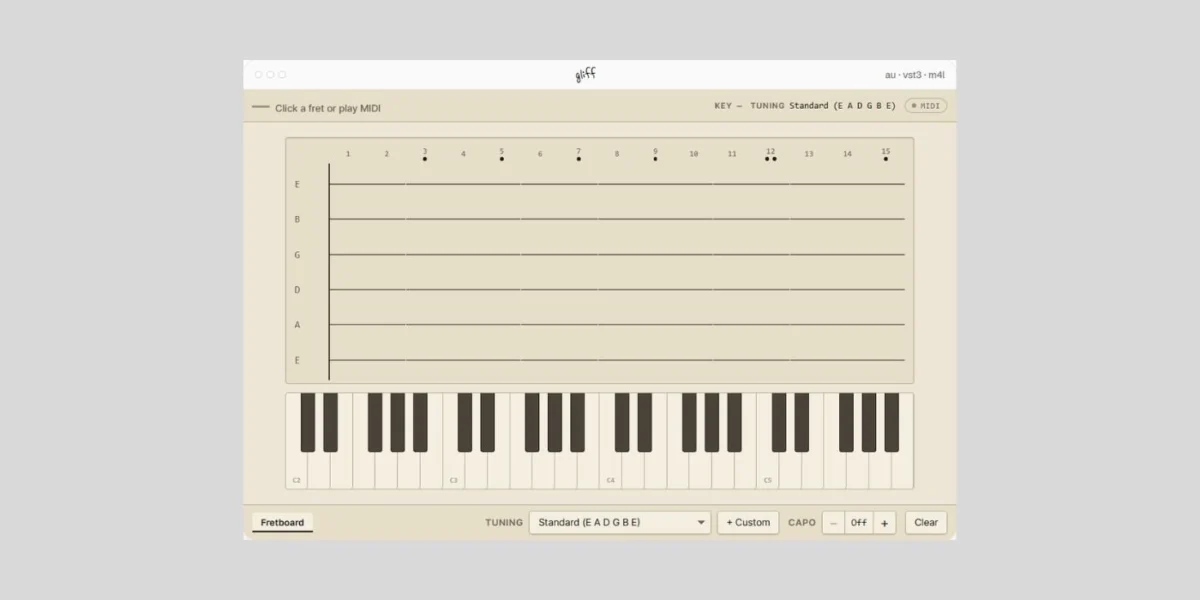
The advent of Gliff marks a significant development in accessible music production tools. At its heart, the plugin serves as a sophisticated MIDI processor, designed with an understanding of how musicians, particularly guitarists, conceive and execute harmonic ideas. It aims to empower creators by allowing them to leverage their existing instrumental comfort zones to produce complex MIDI sequences, which can then be seamlessly integrated into various musical projects. This dual appeal — catering to guitarists who seek to expand their MIDI-based compositions and to keyboardists or producers who desire guitar-specific voicings without needing to master the instrument — underscores its broad utility within the contemporary music landscape.
Understanding Gliff’s Core Mechanics: Two Primary Approaches
Gliff presents two distinct, yet complementary, operational paradigms, each tailored to different user profiles and instrumental setups. These approaches define how users interact with the plugin and harness its powerful MIDI translation capabilities.
1. The Guitarist’s Gateway: Crafting MIDI from MIDI Guitar Input
For guitarists, Gliff offers an intuitive pathway to translate their fingerings and chord shapes directly into digital MIDI data. This approach is particularly appealing to musicians who possess a strong command of their instrument and can effortlessly construct intricate chord progressions on a physical guitar. The primary benefit here is the ability to create nuanced harmonic sequences, perfectly suited for synth tracks, keyboard arrangements, or even orchestral voicings, all while operating within the familiar framework of a guitar fretboard. The comfort and muscle memory associated with guitar playing can be directly leveraged to populate a DAW with rich, polyphonic MIDI information.
However, a crucial clarification is paramount to understanding Gliff’s operation: despite common marketing phrases such as "turns guitar into MIDI" or "guitar in, MIDI out," Gliff does not function as a guitar-to-MIDI audio converter. This distinction is vital, as it addresses a frequent misconception in the realm of music technology. Traditional guitar-to-MIDI converters typically involve an audio input from a standard electric or acoustic guitar, which is then analyzed and transformed into MIDI signals. This process often entails complex pitch detection algorithms and can sometimes suffer from latency or tracking inaccuracies, particularly with polyphonic passages. The technical challenges in reliably converting analog guitar audio to MIDI, especially polyphonically, have historically limited the widespread adoption and consistent performance of such devices. Factors like string bending, vibrato, sustain, and attack transients all contribute to the complexity of accurate real-time audio-to-MIDI conversion.
Gliff, by contrast, operates exclusively on incoming MIDI data. This means that for guitarists wishing to utilize this specific workflow, a MIDI guitar or a guitar controller capable of outputting MIDI directly is a prerequisite. A MIDI guitar is an instrument equipped with specialized pickups or sensors that directly translate the vibrations of strings or the fretboard positions into MIDI messages, bypassing the audio-to-MIDI conversion step entirely. Devices like the Roland GR-55 or various MIDI-enabled guitars and guitar controllers fall into this category. The developers of Gliff have made this technical requirement explicit on their official website, often within FAQ sections, to prevent potential confusion among users who might encounter snippets of information suggesting an audio-to-MIDI capability. The direct MIDI input ensures a clean, precise, and low-latency translation of the guitarist’s performance into a digital format, preserving the exact timing and articulation of the original playing. This directness eliminates the common pitfalls of audio-to-MIDI conversion, providing a reliable and responsive experience.
2. The Universal Translator: Keyboard Input to Guitar Fretboard Shapes
The second, and arguably more universally accessible, method of interacting with Gliff involves using a standard MIDI keyboard or controller to input musical data. This approach opens Gliff’s capabilities to a much broader audience, including keyboardists, producers, and composers who may not play the guitar but wish to incorporate authentic guitar voicings into their compositions. Given that MIDI keyboards are ubiquitous in modern home and professional studios, this method significantly broadens Gliff’s potential user base.
In this scenario, a user plays chords or notes on a MIDI keyboard, and Gliff intelligently translates these MIDI inputs into corresponding guitar fretboard shapes. This is incredibly beneficial for musicians who have a clear harmonic vision—they know precisely what chords they want to play (e.g., a D minor seventh, a G major ninth, or an E flat suspended fourth)—but lack the practical knowledge or dexterity to execute these chords on a guitar. Gliff acts as a visual and practical guide, showing exactly how these chords would be voiced on a standard six-string instrument, complete with finger positions. This feature is particularly valuable for composers looking to write guitar parts without needing a deep understanding of guitar theory or the physical mechanics of playing the instrument.
The utility of this feature extends beyond mere visualization. Gliff takes the incoming MIDI, accurately identifies and names the chords being played, displays the appropriate fretboard shapes, and then outputs clean, polyphonic MIDI data that can be routed to any virtual instrument or external synthesizer within the DAW. This process effectively democratizes guitar-specific chord voicings, making them accessible to anyone with basic MIDI input capabilities. For example, a producer might play a complex jazz chord on a keyboard, and Gliff will not only name it but also present several common guitar voicings for that chord, allowing the producer to choose the most suitable one for their track and then generate the corresponding MIDI notes for a virtual guitar instrument. This eliminates the trial-and-error often associated with translating piano-centric harmonies to guitar.
Advanced Chord Identification and Musical Intelligence
One of Gliff’s most compelling features is its sophisticated chord identification system. Beyond simply translating MIDI notes into fretboard diagrams, the plugin analyzes the incoming harmonic data and provides accurate chord names. This functionality is invaluable for musicians who may instinctively play complex harmonies but struggle with formal chord nomenclature. The example of legendary artist Joni Mitchell, renowned for her intricate and beautiful chord extensions on the piano without necessarily knowing their formal names, perfectly illustrates the practical benefit of such a tool. Gliff empowers users to understand and label the harmonies they create, aiding in transcription, communication with other musicians, and deeper theoretical analysis. This feature also serves as an excellent learning aid for students of music theory, providing immediate feedback on chord structures.
The chord identification goes a step further by offering a "match percentage" and providing context-dependent alternatives. For instance, if a user plays the notes typically associated with a D minor seventh chord, Gliff will not only identify it as such but might also suggest that, in a different harmonic context (e.g., with a G note in the bass), it could be interpreted as a rootless G suspended ninth chord. This level of musical intelligence is crucial for composers and arrangers, as it highlights the inherent ambiguity and multi-functionality of certain chord voicings, opening up new avenues for harmonic exploration and reinterpretation. This feature can be particularly useful when collaborating with other musicians or when trying to chart out a song for session players, ensuring that the harmonic intent is clearly communicated and understood across different instrumental perspectives. It encourages harmonic creativity by revealing hidden relationships between chords.
Beyond MIDI Input: Direct Fretboard Interaction
Recognizing that not all musicians have access to a MIDI guitar or may prefer a more visual, direct interaction, Gliff also provides a unique stringed interface within the plugin itself. If a MIDI guitar is unavailable, or if a user is simply more comfortable thinking in terms of strings and frets rather than piano keys, notes can be written directly onto this virtual fretboard. This feature offers a compelling alternative for those who find traditional piano roll editors less intuitive for guitar-specific part creation.
This direct interaction mode further enhances Gliff’s versatility. Users can virtually strum or pick notes, construct chords, and experiment with different voicings right within the plugin’s interface. Crucially, this mode includes options to change the tuning setup (e.g., standard EADGBe, drop D, open G, DADGAD, or even custom tunings) and to add a virtual capo at any fret. This level of customization allows for extensive experimentation with guitaristic possibilities without ever touching a physical instrument, making it an excellent tool for arrangement, songwriting, and even educational purposes. Composers can quickly audition how a chord progression would sound and feel in various tunings, expanding their creative palette and discovering new sonic textures unique to alternative guitar tunings. This flexibility is invaluable for genres like folk, metal, or world music, which frequently utilize non-standard tunings.
A Brief History of MIDI and Its Impact on Music Production
The emergence of Gliff is best understood within the broader context of MIDI (Musical Instrument Digital Interface) technology, which revolutionized music production upon its introduction in 1983. MIDI is a technical standard that enables electronic musical instruments, computers, and other related devices to connect and communicate with each other. Unlike audio, MIDI data does not contain sound itself; instead, it transmits information about musical events—such as which note was played, when it was played, how hard it was played (velocity), and how long it was held.
Early applications of MIDI primarily focused on sequencing synthesizers and drum machines, allowing musicians to compose and arrange complex pieces with unprecedented control and flexibility. Over the decades, MIDI evolved to control a vast array of virtual instruments, effects, and even lighting systems, becoming the backbone of digital music production. The development of MIDI guitars, while never achieving the widespread adoption of MIDI keyboards, represented an important effort to integrate the unique expressive capabilities of the guitar into the digital workflow. These instruments sought to translate the nuances of string bending, vibrato, and specific voicings into MIDI data, often with varying degrees of success and technical challenges related to tracking accuracy and latency, particularly for polyphonic input. The evolution of MIDI controllers, from simple keyboards to expressive MPE (MIDI Polyphonic Expression) devices, highlights the ongoing drive to capture more nuanced musical performance data.
Gliff leverages the robust and mature MIDI standard but takes a specialized approach, focusing not on raw audio-to-MIDI conversion, but on the intelligent processing and presentation of existing MIDI data through a guitar-centric lens. This positions it as a sophisticated tool for MIDI manipulation and interpretation, rather than a direct input device translator. Its design reflects a growing trend in music software to create smart tools that assist in composition and arrangement, making complex musical concepts more accessible and workflows more efficient. This represents a significant shift from mere sound generation to intelligent musical assistance, a domain increasingly populated by AI-driven tools.
Implications and Broader Impact on Music Production
Gliff’s release carries several significant implications for the music production community and the broader landscape of musical creativity.
1. Enhanced Accessibility and Democratization of Production
As a free plugin, Gliff significantly lowers the barrier to entry for advanced compositional tools. High-quality music production software often comes with substantial price tags, limiting access for hobbyists, students, and aspiring producers. By offering sophisticated chord analysis and MIDI generation capabilities at no cost, Gliff democratizes access to professional-grade features, enabling more individuals to explore complex harmonic ideas and refine their compositions. This aligns with a broader industry trend of making powerful creative tools more widely available, fostering a larger, more diverse community of music creators. The zero-cost barrier ensures that its impact can be felt globally, even in regions where access to expensive software might be limited.
2. Streamlined Compositional Workflow
For both guitarists and non-guitarists, Gliff can dramatically accelerate the songwriting and arrangement process. Guitarists can quickly lay down MIDI progressions without needing to painstakingly program individual notes, while keyboardists can effortlessly generate guitar-specific voicings, saving time and effort. The ability to instantly visualize chords on a fretboard or experiment with different tunings and capos within a single interface reduces the need for constant switching between instruments or consulting external resources. This efficiency allows musicians to stay in their creative flow, focusing on artistic expression rather than technical implementation hurdles. For example, a songwriter might iterate through dozens of chord progressions in minutes, a task that would traditionally take much longer through manual input or physical playing.
3. Educational and Pedagogical Value
Gliff possesses substantial educational potential. For aspiring guitarists, it can serve as an interactive learning tool, helping them understand chord theory, inversions, and how different note combinations translate into playable shapes on the fretboard. For non-guitarists, it offers a window into the unique harmonic language of the guitar, allowing them to grasp voicings and textures that are characteristic of the instrument. The chord identification feature, with its contextual alternatives, can deepen a musician’s understanding of harmonic function and relative chord relationships, fostering a more robust theoretical foundation. Music educators could integrate Gliff into their curricula to demonstrate complex harmonic concepts in a practical, visual manner, making abstract theory tangible through fretboard diagrams. Its interactive nature makes it an engaging supplement to traditional music lessons.
4. Bridging Instrumental Divides
One of Gliff’s most innovative contributions is its ability to act as a bridge between different instrumental mindsets. It allows guitarists to think like keyboardists (by generating MIDI for synth tracks) and keyboardists to think like guitarists (by visualizing fretboard shapes). This cross-pollination of instrumental perspectives can lead to more creative and unexpected musical outcomes, encouraging musicians to step outside their comfort zones and explore new sonic territories. It promotes a holistic approach to arrangement, where the strengths of different instruments can be leveraged more effectively. This can be particularly beneficial in collaborative environments, allowing musicians with different primary instruments to communicate and build upon each other’s ideas more seamlessly.
5. Future of Smart Music Tools
Gliff exemplifies a growing category of "smart" music production tools that go beyond simple effects or virtual instruments. These tools employ musical intelligence to assist, analyze, and inspire, rather than merely replicate. The ability to suggest alternative chord interpretations, for instance, hints at a future where AI and advanced algorithms play an increasingly supportive role in the creative process, offering insights and expanding possibilities for human composers. Gliff’s success could pave the way for more sophisticated, instrument-specific MIDI processors that cater to the unique needs of drummers, bassists, or even orchestral arrangers, further blurring the lines between technical execution and creative ideation. The demand for such intelligent assistants in music creation is steadily growing, reflecting a desire for tools that enhance, rather than replace, human creativity.
Technical Specifications and Availability
Gliff is available as a free download, underscoring its commitment to accessibility. It supports two of the most widely used plugin formats in digital audio workstations: AU (Audio Unit) for macOS users and VST3 (Virtual Studio Technology 3) for both macOS and Windows. This ensures broad compatibility with popular DAWs such as Logic Pro, Ableton Live, Cubase, FL Studio, Studio One, and Reaper, among others. Furthermore, a dedicated Max for Live device is provided for users of Ableton Live, offering seamless integration within that specific ecosystem and potentially enabling deeper customization and control through Max/MSP programming. The inclusion of a Max for Live device caters to a segment of the producer community that values modularity and advanced scripting capabilities, providing an additional layer of flexibility.
The plugin’s availability across these platforms and formats ensures that a vast majority of music producers and composers can integrate Gliff into their existing workflows without encountering compatibility issues. The developers behind Gliff have clearly focused on maximizing reach and utility, making this powerful tool accessible to a global community of musicians. Interested users can download Gliff directly from the official website, getgliff.com.
Conclusion
Gliff represents a thoughtful and highly functional addition to the arsenal of modern music production tools. By intelligently processing MIDI data and presenting it through a guitar-centric lens, it addresses long-standing challenges in translating musical ideas across different instruments and skill sets. Its commitment to being a free resource, combined with its robust feature set—including advanced chord identification, flexible input methods, and a direct fretboard interface—positions it as a significant catalyst for creative exploration and workflow efficiency. As music technology continues to evolve, tools like Gliff highlight the ongoing innovation aimed at making complex musical concepts more approachable and empowering artists to realize their full creative potential, irrespective of their primary instrument or technical proficiency. Its impact is likely to resonate with a wide array of musicians, from seasoned professionals seeking efficiency to aspiring creators looking for intuitive ways to learn and experiment. The plugin is poised to become a valuable staple in many digital studios, offering a fresh perspective on harmonic composition and instrumental translation.
