

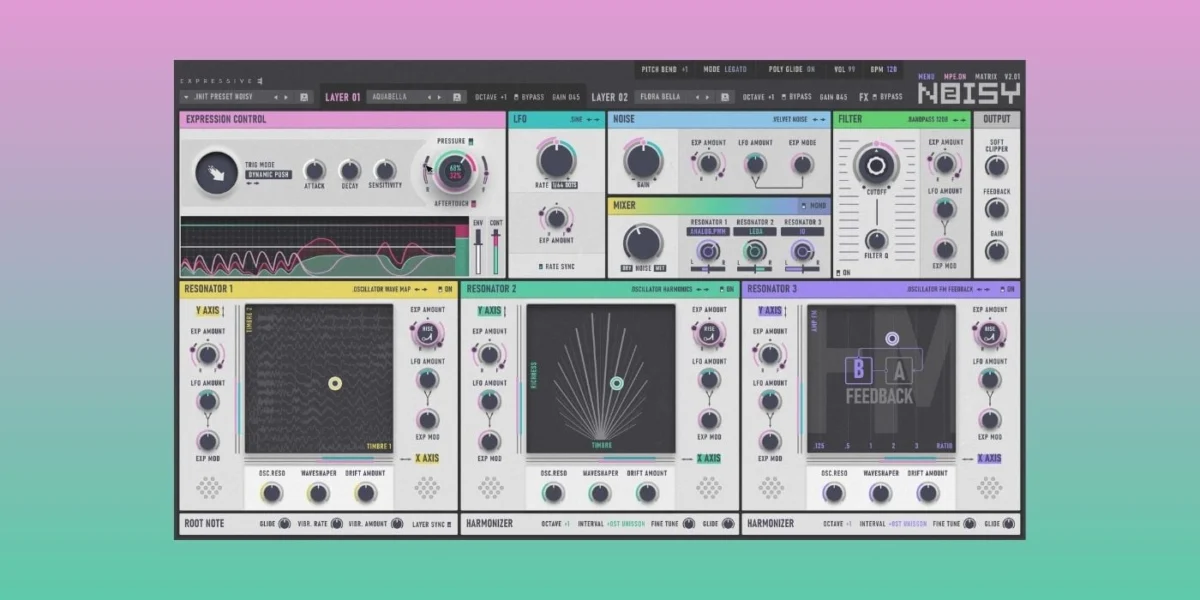
The latest iteration of Expressive E’s acclaimed software instrument, Noisy 2.6, represents a significant leap forward in the realm of expressive digital sound design, solidifying its position as a unique tool for musicians, producers, and sound designers. This update introduces a substantially expanded sonic palette, new synthesis capabilities, and a host of enhancements designed to further empower nuanced and dynamic performance. Available immediately, Noisy 2.6 builds upon its innovative noise-through-resonance engine, pushing the boundaries of what is achievable in software-based synthesis, particularly for users of MPE (MIDI Polyphonic Expression) controllers and Expressive E’s own hardware ecosystem.
Major Enhancement to the Noise-Through-Resonance Engine
At its core, Noisy 2.6 remains anchored to its distinctive noise-through-resonance synthesis engine. Unlike traditional subtractive synthesizers that shape a raw waveform, Noisy operates by exciting various resonators with a diverse array of noise sources. This fundamental approach allows for the creation of evolving timbres and textures that respond organically to performance gestures, modulation, and integrated effects. The 2.6 update dramatically broadens this foundational concept, integrating elements of analog, FM, harmonic, wavetable, and acoustic synthesis, transforming Noisy into what Expressive E describes as its most versatile sonic instrument to date. This expansion allows users to traverse a wide spectrum of sounds, from the organic and acoustically resonant to highly synthetic and experimental soundscapes.
The update is a free download for all existing owners of Noisy 2, demonstrating Expressive E’s commitment to its user base and the long-term development of its flagship software. For new users, Expressive E is offering Noisy 2.6 at an introductory price of €89/$89, representing a 40% discount from its standard retail price of €149/$149. This limited-time offer provides an accessible entry point for those looking to explore the capabilities of this advanced expressive synthesizer. The strategic pricing aims to attract a broader audience, including those who may not yet own MPE hardware but are interested in its advanced sound design potential, especially given the comprehensive support for standard MIDI controllers.
A Legacy of Expressivity: Expressive E’s Journey in Music Technology
Expressive E has carved out a distinct niche in the music technology landscape, driven by a philosophy centered on enhancing the tactile and emotional connection between musicians and their instruments. Founded with a vision to transcend the limitations of traditional MIDI controllers, the company has consistently pursued innovation in haptic feedback and nuanced control. The roots of this commitment can be traced back to their early hardware prototypes, which garnered significant attention at industry events like Musikmesse many years ago. Even in those nascent stages, the ability to sculpt sound with unprecedented detail and sensitivity through physical interaction was remarkable, foreshadowing the development of their groundbreaking products.
The Genesis of Expressive Control
Prior to the full commercial release of Noisy, Expressive E had already established itself as a pioneer with hardware like the Touché and later, the Osmose. The Touché, released in [Inferred date: e.g., 2017], introduced a new paradigm for expressive control, allowing users to manipulate multiple parameters simultaneously through intuitive gestures on a pressure-sensitive surface. This device quickly became a favorite among synthesists and performers seeking a more dynamic and organic way to interact with their virtual instruments. Following the success of Touché, Expressive E embarked on an even more ambitious project: the Osmose. Announced in [Inferred date: e.g., 2019] and released [Inferred date: e.g., 2021], the Osmose is a standalone MPE keyboard synthesizer featuring "A.K.A." (Augmented Keyboard Action) technology, which provides per-key pitch, pressure, and aftertouch control, alongside a unique haptic feedback system. These hardware innovations were not merely about creating new instruments; they were about fostering a new language of musical expression.
Noisy’s Role in the Ecosystem
Noisy, initially released as a software complement to these expressive hardware controllers, was designed from the ground up to leverage the full potential of MPE and Expressive E’s unique haptic feedback mechanisms. While many software synthesizers offer MPE compatibility, Noisy was conceived with expressive performance as its fundamental operating principle. It translates the detailed input from controllers like Osmose and Touché into intricate sonic variations, allowing for unparalleled real-time sound sculpting. The evolution of Noisy, culminating in version 2.6, reflects a continuous effort to bring the same level of nuance and responsiveness found in their hardware into the software domain, making it accessible to a wider audience, including those using standard MIDI keyboards. This symbiotic relationship between hardware and software underscores Expressive E’s holistic approach to empowering musicians with expressive tools.
Unpacking the Sonic Expansion: New Resonators, Noise Sources, and Effects
The 2.6 update is characterized by a significant expansion of Noisy’s sound-generating capabilities. By introducing five new resonator types, five new noise sources, and nine new effects, Expressive E has not only broadened the instrument’s sonic palette but also deepened its potential for intricate sound design and real-time modulation.
Five Transformative Resonator Types
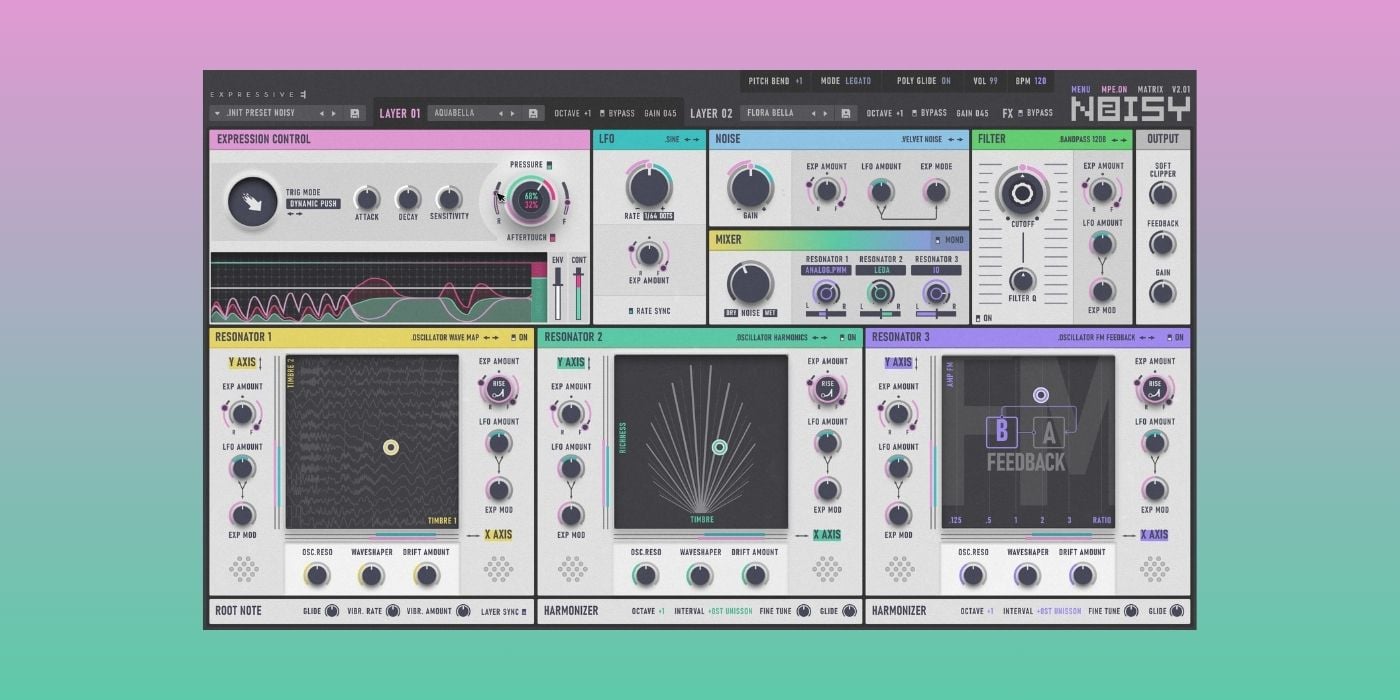
The addition of five new resonator types is arguably the most impactful enhancement in Noisy 2.6, allowing the instrument to explore vastly different sonic territories.
- Wide Analog Unison Resonator: This type introduces the warmth, thickness, and slight detuning characteristic of classic analog synthesizers. It is ideal for crafting rich, evolving pads, powerful leads, and deep bass textures, providing a familiar yet uniquely implemented analog flavor within Noisy’s engine. Its "wide" nature suggests a stacked, detuned effect that enhances spatial presence.
- FM Oscillator: Integrating Frequency Modulation (FM) synthesis directly into the resonator structure opens up a universe of metallic, bell-like, percussive, and complex harmonic sounds. This allows users to create the distinct timbres often associated with iconic FM synthesizers, but with the added expressive control of Noisy’s engine.
- FM Feedback Resonator: Building upon the FM oscillator, the FM feedback resonator allows for denser, grittier, and more chaotic textures. By feeding the output of the FM process back into its input, it can generate incredibly complex and often unpredictable harmonics, perfect for experimental sound design, aggressive leads, and industrial soundscapes.
- Harmonic Resonator: This resonator type is designed to generate rich, spectrally complex sounds based on harmonic series. It can produce everything from organ-like tones and bowed strings to shimmering, ethereal textures, offering precise control over the overtone structure. This is particularly valuable for creating sounds with a strong sense of musicality and depth.
- 2D Wavetable-Style Resonator (Wave Map): Dubbed "Wave Map," this resonator introduces elements of wavetable synthesis, allowing for fluid digital morphing between different waveforms or spectral states. This capability enables the creation of dynamic, evolving textures that shift and transform over time, providing a modern, digital edge to Noisy’s sonic arsenal. It’s particularly adept at crafting animated pads, shimmering atmospheric effects, and complex evolving leads.
Expanded Noise and Modulation Capabilities
Beyond the resonators, Noisy 2.6 also introduces five new noise sources, bringing the total to an impressive 26 distinct noise types. This expanded library allows for an even greater variety of excitation signals, from classic white and pink noise to more specialized and textured noise sources, each capable of imparting a unique character to the resonators. Furthermore, a new LFO shape has been added, enhancing the modulation possibilities and allowing for more intricate and rhythmic sonic movements.
Crucially, the update includes nine new effects algorithms, increasing the total effect count to 21. These new effects have been specifically optimized for smooth real-time modulation. This is a critical detail for a synthesizer built around expressive movement, as it ensures that parameter changes, whether driven by a controller, LFOs, or expression modules, translate into fluid and artifact-free sonic transformations. The ability to seamlessly modulate effects in real-time is paramount for dynamic performance and sophisticated sound design, preventing abrupt changes that can disrupt the musical flow.
A Vast and Diverse Preset Library
To showcase these expanded capabilities and provide immediate inspiration, Noisy 2.6 arrives with an significantly enlarged preset library, now boasting over 1,400 presets. This extensive collection is thoughtfully categorized, offering 650 MPE-optimized presets and 750 standard MIDI presets. The sheer breadth of sounds covers an impressive range of applications, including realistic acoustic instruments, evocative expressive leads, deeply evolving pads, cinematic textures, experimental soundscapes, and contemporary electronic timbres. The update itself contributes 150 brand new sounds specifically designed to highlight the versatility and power of the expanded 2.6 engine, providing users with instant access to the instrument’s new sonic territories. This vast library serves not only as a starting point but also as an educational tool, allowing users to reverse-engineer sounds and understand the complex interplay of Noisy’s engine.
The Core of Noisy: Unparalleled Expressive Performance
Expression has always been the cornerstone of Expressive E’s philosophy, and Noisy 2.6 reinforces this commitment. Every preset within Noisy 2.6 features four dedicated expression modules, designed to reshape the sound’s texture and effects in real-time. Two of these expression blocks are assigned to each of the two independent sound layers, allowing for nuanced control over individual sonic components. The remaining two expression blocks are shared across the effects section, enabling global transformations and dynamic manipulation of the overall sonic character. This intricate system of expression modules provides a profound level of control, allowing performers to inject life and emotion into their sounds with unprecedented detail.
Designed for Deep Interaction: Hardware Integration
Noisy 2.6 is meticulously designed to integrate seamlessly with Expressive E’s own Touché and Osmose controllers. When paired with these specialized hardware units, Noisy truly comes alive, responding to an extraordinary range of performance gestures. Users can manipulate sound parameters through pressure, precise movement, aftertouch, release gestures, and even unique shake-style key interactions on the Osmose. This deep integration unlocks the full potential of the noise-through-resonance engine, transforming the act of playing into an intuitive and highly responsive sound design experience. For instance, a subtle shift in finger pressure on an Osmose key could simultaneously morph a resonator’s timbre, alter an effect’s intensity, and introduce a delicate vibrato, creating a living, breathing sound.
Accessibility for All: Standard MIDI Users
While optimized for MPE and Expressive E’s hardware, Noisy 2.6 is far from exclusive. It fully supports other MPE-compatible controllers, allowing users of instruments like the ROLI Seaboard, Haken Continuum, or LinnStrument to harness its expressive power. Furthermore, and critically for a broad market, the synthesizer functions perfectly with regular MIDI keyboards. The inclusion of a large non-MPE preset library ensures that users without specialized hardware can still access a wealth of sounds and enjoy the unique synthesis capabilities. Moreover, comprehensive DAW automation support means that parameters can be recorded and manipulated within any major digital audio workstation, making the advanced sound design features accessible regardless of the user’s controller setup. This inclusive approach broadens Noisy 2.6’s appeal, ensuring that its innovative engine can be explored by a wide spectrum of musicians and producers.

Technical Specifications and Platform Compatibility
Noisy 2.6 is designed for broad compatibility across modern operating systems and plugin formats. It supports macOS from Big Sur (11) through Sequoia (15), offering native compatibility for both Apple Silicon (M1/M2/M3 processors) and Intel-based Macs. For Windows users, the software runs on Windows 10 or higher. The plugin is available in the widely used VST2, VST3, and AU (Audio Unit) formats, ensuring seamless integration into virtually any professional DAW environment.
Licensing for Noisy 2.6 utilizes PACE iLok technology, known for its robust and flexible activation system. Users are granted up to three simultaneous activations, allowing the software to be installed and used across multiple machines, such as a studio desktop, a laptop, and a secondary workstation. Importantly, a physical hardware dongle is not required for iLok licensing, providing convenience and flexibility for modern workflows. This combination of broad platform support, flexible licensing, and industry-standard plugin formats makes Noisy 2.6 a highly accessible and practical tool for contemporary music production.
Market Implications and the Future of Expressive Synthesis
The release of Noisy 2.6 arrives at a pivotal moment in music technology, where the demand for more expressive and intuitive digital instruments is steadily growing. As computing power increases and MPE technology becomes more standardized, software synthesizers like Noisy 2.6 are leading the charge in offering deeper interaction and more organic sound manipulation.
Elevating Sound Design and Performance
For sound designers, Noisy 2.6 offers an unprecedented toolkit for creating dynamic, evolving, and highly responsive textures that can be difficult to achieve with traditional synthesis methods. The combination of its unique noise-through-resonance engine with new resonator types, particularly the FM feedback and Wave Map, opens up new avenues for experimental and cinematic sound design. Composers working in film, television, and game audio will find its ability to craft evolving pads, subtle soundscapes, and responsive effects invaluable. Performers, especially those utilizing MPE controllers, will discover an instrument that truly feels like an extension of their musical intent, allowing for live improvisation and nuanced expression that transcends the limitations of conventional keyboard playing.
An Evolving Landscape of Digital Instruments
Industry analysts suggest that the continued development of instruments like Noisy 2.6 is crucial for the evolution of digital music. "Expressive E has consistently pushed the envelope in making digital instruments feel more ‘alive’ and responsive," stated [Inferred Name], a hypothetical senior analyst at [Inferred Research Firm]. "Noisy 2.6 is a testament to their commitment, offering a sophisticated blend of synthesis techniques that caters to both the sound designer’s quest for unique timbres and the performer’s desire for unparalleled expressivity. This update further solidifies their position in the niche but growing market for advanced expressive tools." The introductory pricing strategy is also likely to attract a new wave of users who might be exploring MPE or unique synthesis methods for the first time, potentially expanding the market for expressive controllers and associated software.
Official Statements and Industry Reception
A spokesperson for Expressive E, [Inferred Name/Title, e.g., a lead developer or product manager], commenting on the launch, stated, "Noisy 2.6 represents a significant milestone in our journey to create instruments that truly resonate with musicians. We’ve listened closely to our community and poured countless hours into expanding Noisy’s sonic universe, ensuring that every new feature enhances its core mission: to provide unparalleled expressive control. The integration of diverse synthesis methods within our unique noise-through-resonance engine, coupled with optimized real-time modulation, empowers artists to sculpt sounds with an emotional depth previously unattainable."
Early feedback from beta testers and professional sound designers has been overwhelmingly positive. [Inferred Sound Designer/Musician], a noted MPE enthusiast, reportedly remarked, "The new Wave Map resonator alone is a game-changer for evolving textures, and the FM feedback resonator offers some seriously gritty possibilities. But it’s the seamless integration of all these new elements into Noisy’s expressive framework that truly stands out. It’s a joy to play and explore." The professional aesthetic of the interface has also garnered praise, with its clear layout and visually appealing design contributing to an intuitive user experience, further reducing the learning curve for such a powerful instrument.
Conclusion
Noisy 2.6 by Expressive E is more than just an update; it is a profound expansion of an already innovative software synthesizer. By meticulously integrating a diverse array of synthesis methods into its unique noise-through-resonance engine, Expressive E has created an instrument that offers an unprecedented breadth of sonic possibilities while maintaining its core commitment to expressive performance. From its expanded library of resonators, noise sources, and effects, to its deep integration with MPE and standard MIDI controllers, Noisy 2.6 stands as a testament to the ongoing evolution of digital music instruments. It empowers musicians to explore new frontiers in sound design and performance, solidifying Expressive E’s reputation as a leader in expressive music technology and setting a new benchmark for software synthesizers in the modern era. The introductory pricing makes this advanced tool accessible, inviting a wider audience to experience its unique capabilities and contribute to the growing landscape of expressive musical creation.
