

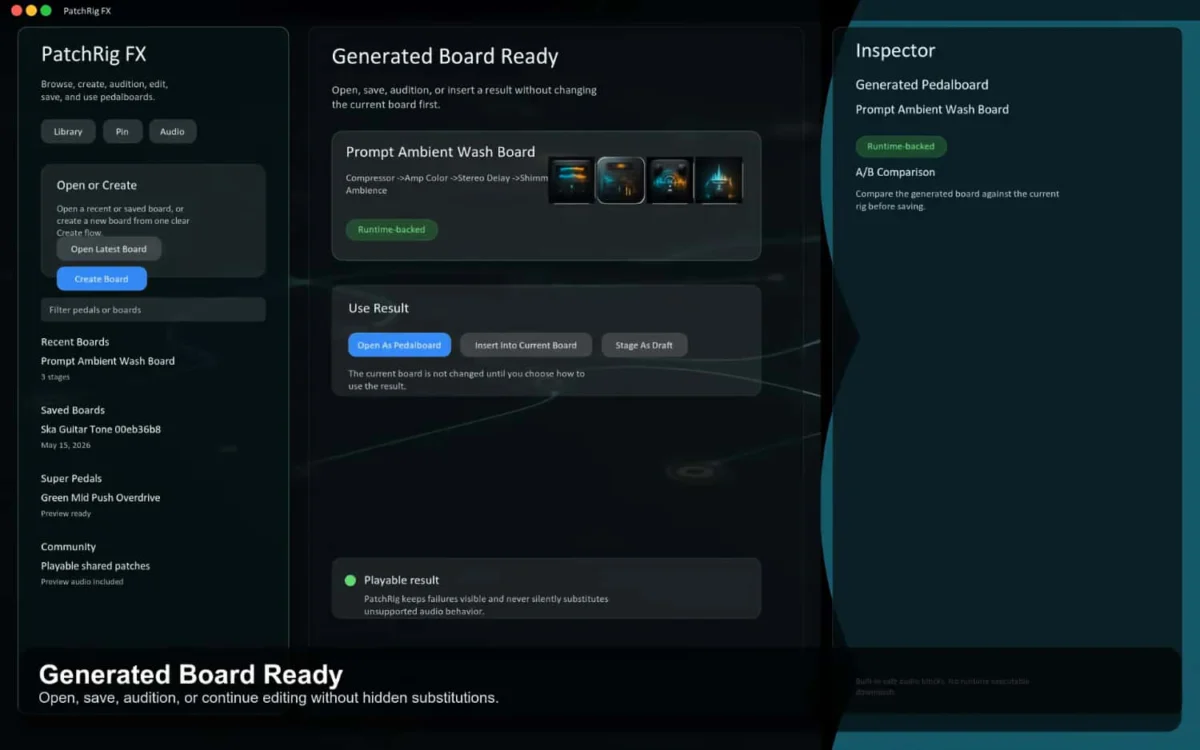
CodeFarmer, a software development firm led by developer Rob Rightmyer, has officially announced the release of PatchRig FX, a comprehensive multi-effects processing environment designed for the Apple ecosystem. The application, which is compatible with iPhone, iPad, and Mac, introduces a novel workflow for musicians and sound designers by utilizing natural language processing to generate complex signal chains. By allowing users to describe a desired sonic characteristic through text prompts, the software automatically assembles a "playable board" from a library of internal audio blocks, marking a significant shift in how digital signal processing (DSP) interfaces are navigated by end-users.
The release of PatchRig FX comes at a time of rapid evolution within the music technology sector, specifically regarding the integration of artificial intelligence (AI) into creative workflows. While traditional multi-effects units—both hardware and software—require manual routing and parameter adjustment, PatchRig FX aims to lower the barrier to entry for sound design without sacrificing the depth required by professional users. The software operates on a modular architecture where individual effects, or "blocks," are interconnected to form a cohesive rig.
The Architecture of Prompt-Based Sound Design
The central innovation of PatchRig FX is its prompt-to-tone engine. This feature allows users to input descriptive phrases—such as "ethereal ambient wash with heavy grit" or "tight 80s lead with chorus and slapback delay"—which the application then interprets to select and configure the appropriate virtual pedals, amplifiers, and utility modules. Unlike "black box" AI systems that generate audio through neural synthesis, PatchRig FX acts as an intelligent orchestrator. It maps the semantic meaning of the user’s prompt to the specific parameters of its built-in DSP blocks.
This approach ensures that the resulting tones remain fully editable. Once the AI has generated a rig, the user retains total control over every component within the signal chain. This transparency is a key design choice by Rightmyer, intended to keep the "limitations visible." By exposing the underlying blocks, the application encourages users to learn the fundamentals of signal routing while using the AI as a starting point for inspiration.
The developer has explicitly stated that PatchRig FX is not intended to function as a cloning tool. In an industry currently saturated with software designed to replicate specific vintage amplifiers, boutique pedals, or famous artist presets via Impulse Responses (IRs) and machine learning snapshots, PatchRig FX takes a divergent path. It focuses on creating "original playable rigs" rather than mimicking existing hardware. This distinction is vital for professionals seeking unique sonic identities rather than digital approximations of analog gear.
Technical Specifications and Ecosystem Integration
PatchRig FX is built to leverage the unified architecture of Apple’s modern hardware. By supporting iPhone, iPad, and Mac, the application provides a consistent experience across mobile and desktop environments. This cross-platform compatibility is facilitated by Apple’s Universal Purchase system, allowing users to access the software on all their devices with a single acquisition.
The application’s technical framework is optimized for low-latency performance, a critical requirement for live musical performance and real-time recording. On macOS and iPadOS, the software is expected to integrate with established digital audio workstations (DAWs) via the AUv3 (Audio Units version 3) standard. This allows PatchRig FX to be used as a plugin within host applications like Logic Pro, GarageBand, and Cubasis, as well as a standalone processor for guitarists or synthesists performing live.
The library of "audio blocks" included in the initial release covers a broad spectrum of processing needs:
- Time-Based Effects: Various delays and reverbs ranging from spring and plate emulations to experimental granular textures.
- Modulation: Choruses, flangers, phasers, and tremolos with adjustable wave shapes.
- Dynamics and Drive: Compressors, limiters, overdrives, and high-gain distortion modules.
- Utility and Routing: EQ modules, noise gates, and signal splitters for parallel processing.
The Evolution of Mobile Music Production
The launch of PatchRig FX represents a milestone in the decade-long journey of iOS as a serious platform for music production. Since the introduction of the Core Audio framework, Apple’s mobile operating system has evolved from a platform for simple "toy" apps to a robust environment capable of running professional-grade DSP.
In the early 2010s, mobile guitar processing was defined by hardware interfaces like the iRig and early versions of IK Multimedia’s AmpliTube. These tools proved that mobile devices had the processing power to handle real-time audio. However, the user interface remained tethered to the metaphor of physical hardware. PatchRig FX moves beyond this by utilizing modern UI/UX principles and AI integration that would have been impossible on earlier generations of mobile hardware.

The shift toward "intelligent" software is backed by industry data. According to recent market analysis in the music production software sector, there is a growing demand for "smart" plugins that utilize machine learning to assist with mixing, mastering, and sound design. While companies like iZotope and Sonible have focused on the utility side of AI (such as automatic EQ and compression), PatchRig FX focuses on the creative side, assisting in the generative phase of tone creation.
Market Context and Competitive Landscape
PatchRig FX enters a competitive market currently dominated by established players. In the realm of guitar-centric multi-effects, software such as Positive Grid’s BIAS FX 2 and Line 6’s Helix Native set the standard for high-fidelity modeling. On the more experimental side, apps like Eventide’s H9000-derived plugins and various boutique AUv3 developers provide specialized textures.
PatchRig FX distinguishes itself through its accessibility and its economic model. By offering the application as a free download with in-app purchases, CodeFarmer allows users to test the core functionality and the AI prompt system before committing to a full license or additional content packs. This "freemium" approach has become the standard for the App Store, enabling a wider reach among hobbyist musicians while providing a professional upgrade path.
Industry analysts suggest that the "non-cloning" philosophy of PatchRig FX may appeal to a specific demographic of musicians who are fatigued by the constant pursuit of "vintage" accuracy. As digital synthesis and processing continue to mature, there is an increasing movement toward "digital-first" sounds—textures that do not attempt to hide their software origins but instead embrace the flexibility and unique artifacts of digital computation.
Strategic Implications for Independent Developers
The development of PatchRig FX by a smaller firm like CodeFarmer highlights the democratization of AI technology. Previously, the implementation of natural language processing and complex DSP orchestration was the domain of large corporations with significant R&D budgets. The availability of robust development frameworks and AI APIs has allowed independent developers to innovate in ways that challenge industry giants.
Rob Rightmyer’s focus on a unified Apple-centric release also points to the increasing viability of the Mac/iPad/iPhone "triad." For independent developers, writing code that runs natively across these three platforms reduces overhead and ensures a larger addressable market. This strategy is particularly effective in the music industry, where a producer might start a project on an iPhone during a commute, refine it on an iPad in a coffee shop, and finalize it on a Mac Studio in a professional facility.
Future Outlook and Community Response
While the initial response from the synthesizer and guitar communities has been focused on the novelty of the AI prompt system, the long-term success of PatchRig FX will likely depend on the expansion of its block library and the refinement of its AI interpretations. As more users interact with the system, the developer will have the opportunity to fine-tune the linguistic mapping, ensuring that the AI better understands the nuances of musical terminology.
There is also potential for future updates to include community-driven features, such as a cloud-based repository where users can share the prompts and rigs they have created. Such a feature would transform PatchRig FX from a tool into a social platform for sound design, further cementing its place in the modern producer’s toolkit.
In conclusion, PatchRig FX is a significant entry into the field of digital audio processing. By combining a modular DSP architecture with an intuitive AI interface, it addresses one of the most persistent hurdles in music technology: the gap between a creative idea and its technical execution. As the software matures, it will serve as a case study for how AI can be used to augment, rather than replace, human creativity in the digital arts.
PatchRig FX is currently available for download on the iOS and macOS App Stores. The base application is free to use, with various in-app purchase options available for users looking to expand their library of effects and features. Consistent with professional audio standards, the app requires modern hardware to ensure optimal performance of its real-time processing engine.
