

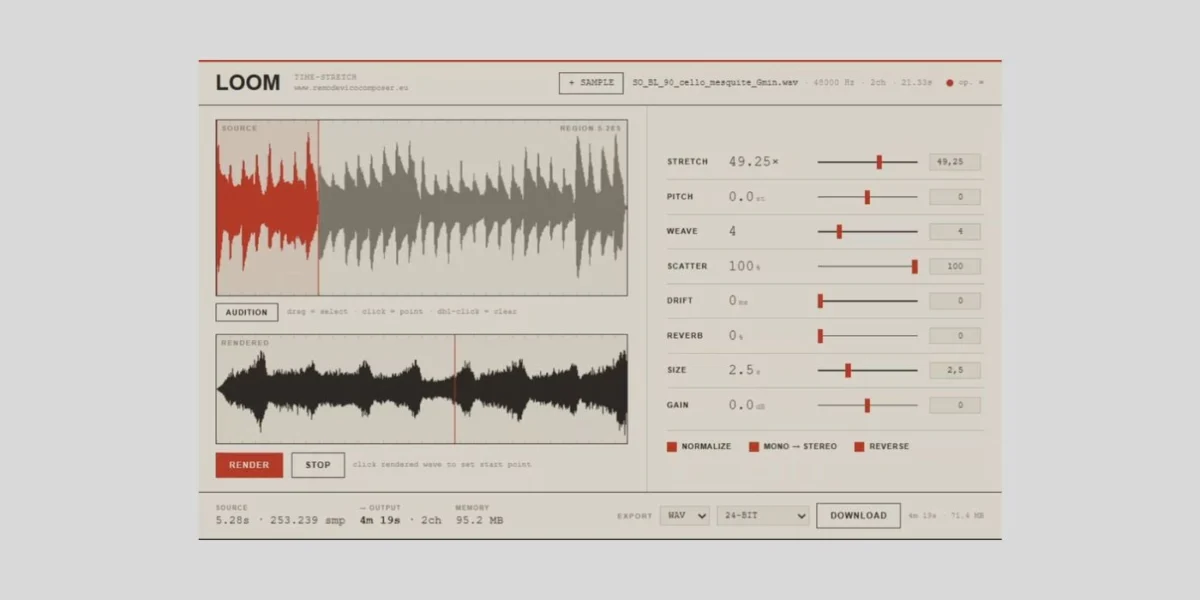
Remo De Vico, an independent developer known for innovative audio tools, has officially released LOOM, a groundbreaking free browser-based instrument designed for extreme time stretching, texture generation, pad creation, and drone synthesis. This release marks a significant contribution to the growing landscape of accessible and powerful sound design utilities, offering musicians, sound designers, and audio enthusiasts a versatile platform to transform conventional audio into otherworldly sonic landscapes. The instrument’s unique combination of a robust stretching engine, intuitive controls, and a browser-native architecture positions it as a notable tool for experimental and cinematic sound production.
The Genesis of LOOM: Bridging Accessibility and Advanced Sound Design
The core concept behind LOOM revolves around the art and science of time stretching—a fundamental audio manipulation technique that alters the duration of a sound event without changing its pitch. This process is invaluable in various facets of audio production, from subtle rhythmic adjustments in music to the dramatic transformation of everyday recordings into evocative soundscapes for film, television, and video games. For years, advanced time stretching often required specialized software or complex plugin chains. LOOM aims to democratize this capability, making sophisticated sound design techniques readily available to a broader audience without the typical barriers of installation or cost.
The developer’s stated intention with LOOM is to enhance the creative potential of time stretching by integrating features that encourage sonic exploration. By introducing parameters such as "Drift" and a built-in reverb, LOOM facilitates the creation of complex, evolving textures and expansive background atmospheres. This focus on intuitive, yet powerful, manipulation sets LOOM apart, allowing users to move beyond simple time adjustments into the realm of truly generative sound. The immediate positive reception from the sound design community underscores the demand for such a tool that prioritizes both functionality and user experience.
Unpacking LOOM’s Core Functionality and Workflow
LOOM operates as a standalone HTML instrument, a crucial distinction from traditional plugins. This means it runs directly within a web browser, eliminating the need for installation and ensuring cross-platform compatibility. Users can download the HTML file and run it offline, providing complete autonomy and flexibility. This architectural choice aligns with a broader trend in software development towards web-native applications, leveraging modern browser capabilities for demanding tasks like real-time audio processing.
The workflow within LOOM is designed for efficiency and creative iteration:
- Sample Loading: Users begin by loading an audio sample. LOOM supports a wide array of popular formats, including WAV, AIFF/AIF, MP3, and FLAC, ensuring compatibility with most existing audio libraries.
- Region Selection: An optional feature allows users to define a specific region within the loaded sample for processing, offering precise control over the source material.
- Audition and Control: The selected audio can be auditioned, and users can then manipulate a suite of controls to sculpt the desired sound.
- Rendering and Export: Once satisfied, the stretched audio is rendered and can be exported in high-quality WAV or AIFF formats, ready for integration into any digital audio workstation (DAW) or multimedia project.
This streamlined process, combined with the immediate feedback from parameter adjustments, fosters a highly experimental and rewarding creative environment.
Key Controls: A Deep Dive into Sonic Manipulation
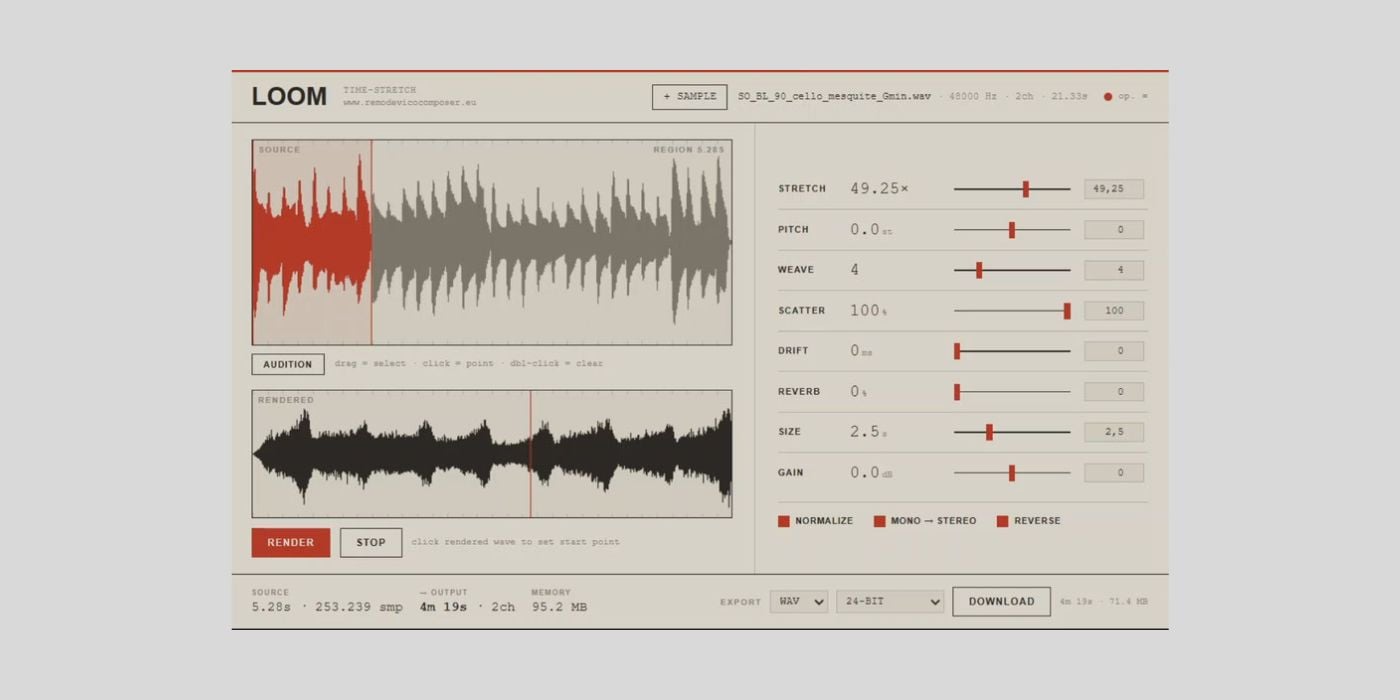
LOOM’s power lies in its meticulously crafted control set, each parameter offering distinct avenues for sonic transformation:
- Stretch: This fundamental control alters the duration of the audio sample without affecting its pitch. LOOM’s engine is optimized for extreme stretching, allowing for dramatic elongations that can turn transient sounds into vast, sustained textures. This is particularly useful for creating cinematic risers, drawn-out impacts, or evolving ambient beds.
- Pitch: Separate from the stretch function, the Pitch control allows for independent transposition of the audio in semitones. This separation ensures that users can precisely tune their stretched textures without compromising the temporal manipulation, offering flexibility for melodic integration or dramatic pitch shifts.
- Weave: Operating on principles akin to granular synthesis, "Weave" dictates the overlap of individual audio grains. At lower settings, it can produce rough, pulsating textures, revealing the underlying granular structure. As "Weave" is increased, the grains blend more seamlessly, resulting in smoother, glassier, and more ethereal sounds. This parameter is critical for transitioning between rhythmic grain-based effects and fluid, sustained pads.
- Scatter: This control influences the amount of "invented" phase information within the stretched audio. In essence, it introduces variability in the timing and distribution of audio grains, adding a sense of organic randomness and complexity. High "Scatter" values can lead to diffuse, shimmering, or even chaotic textures, moving away from the source material’s original character into something entirely new.
- Drift: Perhaps one of LOOM’s most distinctive features, "Drift" allows the reading position of the audio playback to subtly wander over time. This gentle, continuous modulation ensures that the stretched texture is not static but rather breathes and evolves organically. "Drift" is instrumental in creating living, breathing soundscapes and drones that possess inherent movement and unpredictability, mimicking natural sonic phenomena or abstract, alien soundscapes.
- Reverb and Size: Post-rendering, LOOM provides integrated Reverb and Size controls. This intelligent design choice allows users to fine-tune the spatial characteristics of their stretched output without needing to re-render the entire process. The ability to quickly adjust reverb amount and size means immediate sonic gratification and efficient workflow, crucial for dialing in the perfect atmospheric depth.
- Gain and Normalize: Standard audio processing options are included for level management. "Gain" allows for manual amplitude adjustments, while "Normalize" automatically sets the peak amplitude to a predefined level, ensuring consistent loudness and preventing clipping.
- Mono to Stereo: A particularly powerful feature, the "Mono to Stereo" mode transforms a monophonic input into a wide, immersive stereo texture. This is achieved through two independent phase passes, creating a rich spatial spread that can dramatically enhance the perceived width and presence of a sound, making it invaluable for ambient sound design and immersive audio production.
- Reverse: The "Reverse" option plays the stretched audio backward, opening up additional creative possibilities for unusual textures, swells, and backward melodic phrases.
The Technical Advantage: Browser-Based and Beyond
The decision to develop LOOM as an HTML instrument is a strategic one, capitalizing on several key advantages:
- Zero Installation: Users can simply download the HTML file and open it in their preferred web browser, eliminating complex installation processes, administrator privileges, or system dependencies.
- Offline Functionality: Once downloaded, LOOM runs completely offline, ensuring consistent performance regardless of internet connectivity. This is a significant benefit for mobile workflows or environments with limited network access.
- Cross-Platform Compatibility: As an HTML instrument, LOOM is inherently compatible with virtually any operating system that can run a modern web browser, including Windows, macOS, Linux, and even tablets, expanding its reach to a diverse user base.
- Portability: The entire instrument can be stored on a USB drive or cloud service, making it highly portable and accessible from any compatible device.
Beyond its standalone browser functionality, Remo De Vico has also provided "HTML Instruments," a Max for Live device that allows LOOM to be seamlessly integrated directly within Ableton Live. This integration offers the best of both worlds: the no-installation convenience of the HTML instrument combined with the workflow advantages of a DAW-native device. It requires Ableton Live 12 and Max 9, catering to users who prefer a more integrated production environment. For those without Ableton Live or specific Max for Live requirements, LOOM can still be run standalone by opening the HTML file and routing its output through the computer or tablet’s audio system, just like any other virtual instrument.
The Broader Impact: Democratizing Sound Design
LOOM’s release, especially as a free offering, carries significant implications for the sound design and music production communities.
- Increased Accessibility: By removing financial and technical barriers, LOOM empowers aspiring sound designers, students, and hobbyists to experiment with advanced time-stretching techniques that might otherwise be out of reach. This democratization of tools fosters creativity and innovation across a wider demographic.
- Educational Value: The intuitive interface and clear controls make LOOM an excellent educational tool for understanding the principles of granular synthesis and time stretching. Students can actively manipulate parameters and immediately hear the sonic results, facilitating a deeper comprehension of these complex concepts.
- Catalyst for Creativity: For experienced professionals, LOOM offers a fresh, focused environment for generating unique textures and atmospheres. Its specific feature set, particularly "Drift" and "Mono to Stereo," encourages novel approaches to sound sculpting, potentially leading to distinctive sonic signatures in film scores, game audio, and experimental music.
- Validation of Browser-Based Audio: LOOM serves as a testament to the growing power and viability of web audio technologies. Its robust performance and advanced capabilities demonstrate that professional-grade audio tools can indeed thrive within the browser environment, potentially paving the way for more sophisticated web-native instruments and effects in the future.
Conclusion: A New Horizon for Sonic Exploration
Remo De Vico’s LOOM is more than just a free instrument; it represents a forward-thinking approach to audio software development, prioritizing accessibility, innovative features, and a seamless user experience. By delivering a powerful time-stretching engine with unique creative controls in a highly portable, browser-based format, LOOM is poised to become an indispensable tool for anyone looking to push the boundaries of sound design. Its potential to transform mundane audio into captivating sonic art, coupled with its commitment to being a free resource, solidifies its position as a noteworthy release in the ever-evolving world of audio production tools. As creators continue to seek intuitive yet powerful means of expression, instruments like LOOM will undoubtedly play a crucial role in shaping the soundscapes of tomorrow.
