

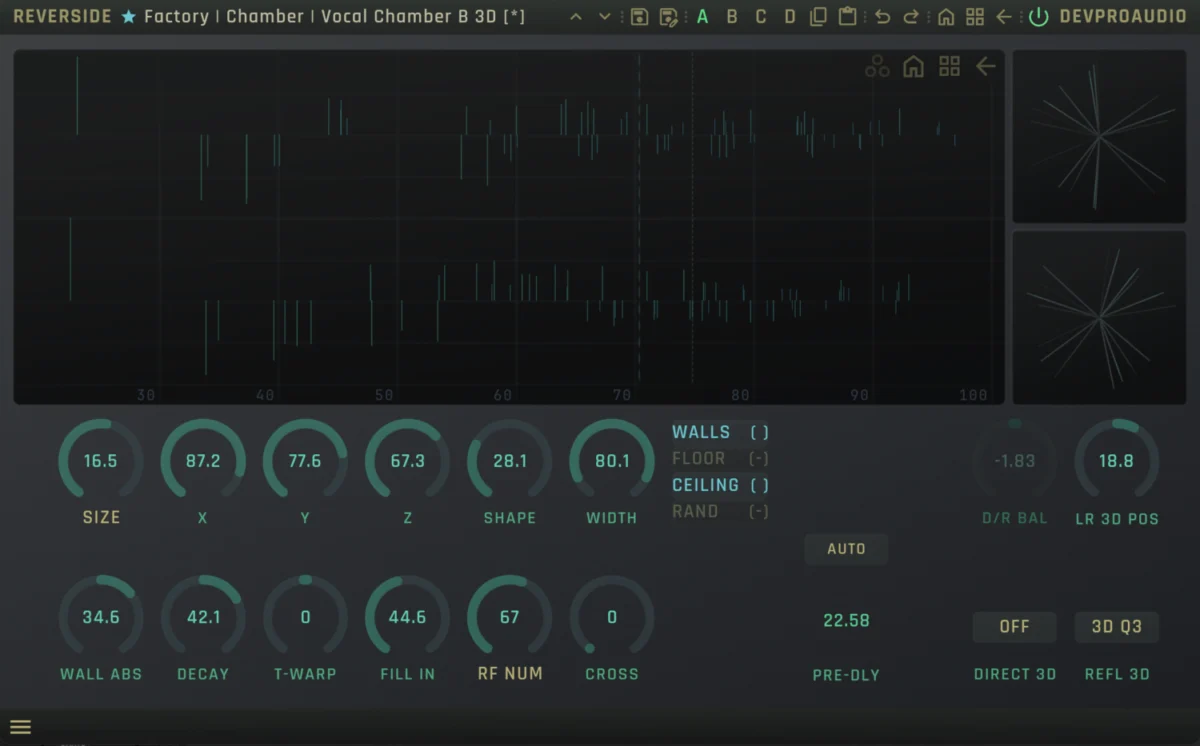
The digital audio workstation (DAW) ecosystem has seen a significant expansion with the official launch of REVERSIDE 1.0.0, a sophisticated dual-engine algorithmic reverb processor developed by DEVPROAUDIO. Designed to meet the rigorous demands of modern music production, cinematic sound design, and experimental audio engineering, REVERSIDE enters the market as a comprehensive solution for spatial processing. The plugin is now available for both macOS and Windows platforms, supporting the VST3, AudioUnit v2, and the increasingly popular CLAP (Clever Audio Plugin) formats. By offering a distinct departure from traditional single-block reverb architectures, REVERSIDE provides users with an unprecedented level of control over the temporal and spectral characteristics of simulated acoustic environments.
Architectural Innovation: The Dual-Engine Approach
At the core of REVERSIDE 1.0.0 is a dual-engine architecture that fundamentally changes how engineers approach the creation of artificial space. Traditional reverb plugins often utilize a unified algorithm where the early reflections and the late reverberation (the tail) are processed through a single set of interconnected parameters. While this approach is computationally efficient, it frequently limits the user’s ability to fine-tune the "size" of a room independently from its "depth" or "texture."
DEVPROAUDIO has addressed this limitation by decoupling the early reflections engine from the reverb tail engine. This separation allows for granular manipulation of the initial sound waves that bounce off nearby surfaces—crucial for defining the perceived size and material of a room—without affecting the lush, decaying wash of the tail. Conversely, the tail engine can be adjusted to create vast, ethereal decays that do not clutter the immediate transients of the dry signal. This dual-engine philosophy ensures that REVERSIDE can simulate everything from the tight, claustrophobic reflections of a vocal booth to the infinite, shimmering textures required for ambient film scores.
Technical Specifications and Platform Compatibility
In an industry where cross-platform stability is paramount, DEVPROAUDIO has ensured that REVERSIDE 1.0.0 is accessible to the widest possible range of producers. The plugin is fully compatible with macOS (Intel and Apple Silicon native) and Windows 10/11. The inclusion of the CLAP format is particularly noteworthy. Developed as an open-source alternative to proprietary standards, the CLAP format offers better multi-core CPU management and more robust automation features, signaling DEVPROAUDIO’s commitment to modern software standards.
The algorithmic nature of the plugin distinguishes it from convolution-based reverbs. While convolution reverbs use Impulse Responses (IRs) to replicate real-world spaces with high accuracy, they are often static and heavy on CPU resources. REVERSIDE’s algorithmic design uses complex mathematical formulas to generate sound, allowing for real-time modulation and a "silky-smooth" quality that is difficult to achieve with static samples. This makes the plugin ideal for sound designers who require a "living" sound that responds dynamically to the input material.
Chronology of Development and Market Entry
The release of REVERSIDE 1.0.0 marks the culmination of an intensive development cycle aimed at bridging the gap between clinical acoustic simulation and creative sound manipulation. Historically, the reverb market has been divided between "clean" reverbs designed for classical mixing and "character" reverbs designed for electronic music. DEVPROAUDIO began the REVERSIDE project with the goal of synthesizing these two worlds.
Following a rigorous beta testing phase involving a select group of mix engineers and electronic music producers, the software underwent several iterations to optimize its user interface (UI). The final version, 1.0.0, features a streamlined workflow that prioritizes visual feedback and intuitive control over complex DSP (Digital Signal Processing) parameters. The launch comes at a time when the demand for high-quality "cinematic" tools is at an all-time high, driven by the growth of home-based scoring and the expansion of the independent gaming industry.
Features and Functional Versatility
REVERSIDE 1.0.0 is equipped with a suite of features designed to provide a comprehensive spatial toolkit. Users can independently adjust the stereo width, tone, and decay of both engines. This allows for creative "hybrid" spaces—for instance, a user could pair the tight, high-frequency early reflections of a tiled bathroom with the long, dark, low-frequency decay of a subterranean cavern.

Key functional highlights include:
- Independent Decay Controls: Precision management of how quickly the sound dissipates in different frequency bands.
- Stereo Imaging Tools: Advanced width controls that allow the reverb to sit "outside" the speakers or be tucked neatly behind the dry signal.
- Tone Shaping: Integrated equalization within the feedback loop to prevent "muddiness" in the low-mids or "harshness" in the high-end.
- Cinematic Presets: A curated library of starting points ranging from natural halls to experimental, non-linear spaces.
The "cinematic" capability mentioned by the developers refers to the plugin’s ability to handle high-density textures without introducing metallic artifacts—a common flaw in lower-quality algorithmic reverbs. This makes it a viable candidate for orchestral layering, where the reverb must add scale without obscuring the intricate details of the instrumentation.
Market Positioning and Pricing Analysis
The retail price of $135 USD positions REVERSIDE 1.0.0 in the mid-to-high tier of the professional plugin market. It competes directly with established industry standards such as Valhalla DSP’s suite, FabFilter Pro-R, and various offerings from Lexicon and Eventide. While the $135 price point is higher than entry-level "budget" plugins, it reflects the professional-grade DSP and the flexibility of the dual-engine system.
Industry analysts suggest that the pricing reflects DEVPROAUDIO’s strategy to target serious hobbyists and professional studios rather than the casual "bedroom producer" market. By pricing the software in this bracket, the company aligns itself with boutique developers who prioritize audio fidelity and unique feature sets over mass-market volume. Furthermore, the perpetual license model—avoiding the controversial subscription-based systems adopted by many larger software houses—is likely to appeal to long-term users seeking stability in their plugin folders.
Industry Implications and Future Outlook
The introduction of REVERSIDE 1.0.0 is expected to have a tangible impact on how spatial processing is integrated into modern workflows. As more producers move toward "in-the-box" (purely digital) production, the need for reverbs that can provide a sense of "expensive" analog air becomes more critical. REVERSIDE’s focus on "silky-smooth long tail decays" addresses a specific need in the market for reverbs that can act as an instrument in their own right, rather than just a utility.
From a technical standpoint, the release reinforces the viability of the CLAP format. As more developers like DEVPROAUDIO adopt this standard, it puts pressure on major DAW developers to provide native support, potentially leading to a more unified and efficient plugin ecosystem.
While DEVPROAUDIO has not yet announced a roadmap for version 1.1 or beyond, the modular nature of the REVERSIDE engine suggests that future updates could include additional algorithms, such as shimmer effects, granular synthesis modules, or expanded modulation options. For now, the 1.0.0 release stands as a robust entry into the competitive world of high-end audio software, offering a balance of technical precision and creative flexibility.
Conclusion
REVERSIDE 1.0.0 by DEVPROAUDIO represents a significant step forward in algorithmic reverb design. By providing separate control over the early and late stages of reverberation, it empowers audio professionals to construct highly specific and evocative acoustic environments. Available now for $135, it offers a sophisticated alternative to traditional reverb units, backed by modern technical standards and a focus on sonic purity. As the audio industry continues to evolve, tools like REVERSIDE demonstrate that there is still significant room for innovation in the simulation of space and depth.
