

The Friday evening soundcheck is underway, with only 90 minutes remaining until the doors open to the public, yet the system is failing to cooperate. A signal crackles intermittently, a primary amplifier shows no network link, and the network administrator—provided one is even part of the touring crew—is buried in switch logs trying to diagnose a bottleneck. This scenario is a recurring nightmare in the world of professional live sound, not because the hardware is inherently flawed, but because standard Ethernet was never designed for the rigorous, real-time demands of high-fidelity audio. Conventional office-grade networks operate on a "best effort" principle, attempting to deliver data packets as quickly as possible but offering no guarantees regarding timing or successful arrival. While this architecture is perfectly suitable for emails and web browsing, it represents a fundamental deficiency for sample-accurate audio synchronization across a complex line-array system.
To address these shortcomings, Layer 3 protocols such as Dante or AES67/Ravenna have historically relied on network isolation, small buffers, and intensive manual management. However, many proponents of the Milan protocol argue that this approach is essentially "plastering over" an unsuitable foundation. The IEEE, the governing body for Ethernet standards, proposed a different path: bypassing Layer 3 for real-time applications entirely. This resulted in Audio Video Bridging (AVB), a set of standards designed to make the network deterministic. Rather than relying on massive bandwidth headroom to avoid collisions, AVB integrates traffic management into the hardware itself. Since 2012, these standards have evolved into Time-Sensitive Networking (TSN), a technology now utilized in automotive manufacturing, industrial automation, and telecommunications to ensure that critical data arrives exactly when required.
The Evolution of Milan: From AVB to a Unified Specification
The initial rollout of AVB in the professional AV industry was not without friction. Early implementations often suffered from interoperability issues, as different manufacturers utilized varying options and parameters within the broad IEEE framework. Milan was conceived to bridge this gap. Rather than being a completely new protocol, Milan acts as an application profile—a strictly defined selection of open IEEE TSN standards that dictates exactly how hardware must behave to ensure seamless cross-manufacturer compatibility.
In the contemporary landscape, this technical rigor has translated into a tangible operational advantage, particularly when paired with self-powered Power over Ethernet (PoE) loudspeakers, such as the d&b audiotechnik U-Series. Through a single CAT6 cable, technicians can now deliver high-resolution audio, comprehensive system control via software like d&b R1, and the necessary electrical power simultaneously. This is no longer a theoretical marketing promise but a measurable shift in how professional audio systems are deployed and maintained.
Technical Foundations: Why Determinism is Not a Buzzword
The superiority of Milan rests on three core technical mechanisms that separate it from "best effort" networking. The first is the Stream Reservation Protocol (SRP). In a Milan environment, end devices actively and automatically reserve the necessary bandwidth within the network before a single audio frame is even transmitted. AVB-capable switches recognize these reservations and guarantee the bandwidth, protecting the audio streams from being interrupted by other network traffic. Typically, up to 75 percent of the total capacity is reserved for AVB streams, while the remaining 25 percent is allocated for "best effort" traffic, such as control data or IT services. This eliminates the need for over-provisioning and prevents packet drops.
The second mechanism is the Credit-Based Traffic Shaper. This feature manages the flow of data by breaking down large packets so they do not block time-critical audio traffic. By smoothing out data bursts, the shaper ensures consistent network utilization. Interestingly, other protocols like Dante or AES67 running on the same physical network can actually benefit from this traffic shaping, as it prevents the sudden spikes in traffic that often lead to jitter in non-deterministic systems.
The third and perhaps most critical component is gPTP (Generalized Precision Time Protocol, IEEE 802.1AS). This modern iteration of the Precision Time Protocol ensures that the internal clocks of every node in the network are synchronized to within a few nanoseconds. In professional sound reinforcement, particularly with line arrays, even a sub-microsecond timing error can cause the perceived sound source to "drift," creating phase cancellations and comb-filtering effects. Milan sets a fixed network latency—known as the Presentation Time Offset (PTO)—typically between 0.25ms and 2ms depending on the number of switches. This ensures that every speaker in the system reproduces the signal at the exact same microsecond, regardless of network load.
Comparative Analysis: Milan vs. Layer 3 Solutions
While Dante can achieve high levels of precision, it often requires conditions that are outside the direct control of the end-user. If a network becomes congested to the point where Quality of Service (QoS) can no longer prioritize packets effectively, the system may experience dropouts. To mitigate this risk, Dante users frequently deploy a third, separate network just for control data. In contrast, Milan’s guarantee of exact micro-timing is a mandatory part of the specification, not an optional configuration.
Data from field tests suggests that this deterministic nature significantly reduces the "hidden" labor of network engineering. System technicians have reported that in traditional setups, up to 50 percent of their time is spent on IT-related tasks like IGMP snooping, VLAN configuration, and IP management. Milan’s plug-and-play discovery mechanism automates much of this, allowing technicians to refocus on the acoustic performance of the venue.
Practical Applications of the Single-Cable Workflow
The integration of Milan and PoE is most transformative in three specific scenarios:
1. Architectural Integration and Fixed Installations
In traditional installations—such as corporate headquarters, houses of worship, or transit hubs—each loudspeaker usually requires three separate cable runs: XLR for audio, Ethernet for control, and a mains power cable. In a project involving 50 speakers, this results in 150 termination points and 150 potential points of failure. By consolidating these into a single CAT6 line, firms can achieve massive savings in material costs, labor hours, and cable tray space.
2. Immersive and Spatial Audio
For 3D audio environments in museums or theaters, cabling is often the primary bottleneck due to the sheer number of speaker positions. The d&b U-Series allows for daisy-chaining, where each speaker passes the Milan stream to the next. When integrated with the DS100M Signal Engine, the system can distribute object-based audio across a complex network topology without requiring massive amplifier racks in every zone.
3. Rapid Deployment in Live Touring
The automated discovery and bandwidth reservation of Milan make it ideal for "pop-up" events where time is at a premium. Because Milan supports multiple media clocks—such as 48 kHz and 44.1 kHz—simultaneously on the same cable without conflict, it provides a level of flexibility that was previously difficult to achieve without complex clocking hardware.
Addressing the Ecosystem Gap and Industry Challenges
Despite its technical advantages, Milan faces a significant hurdle in market share. As of mid-2026, Dante remains the industry leader, boasting over 4,000 compatible products from more than 600 manufacturers. Milan’s ecosystem is considerably smaller, meaning many users will inevitably operate in hybrid environments.
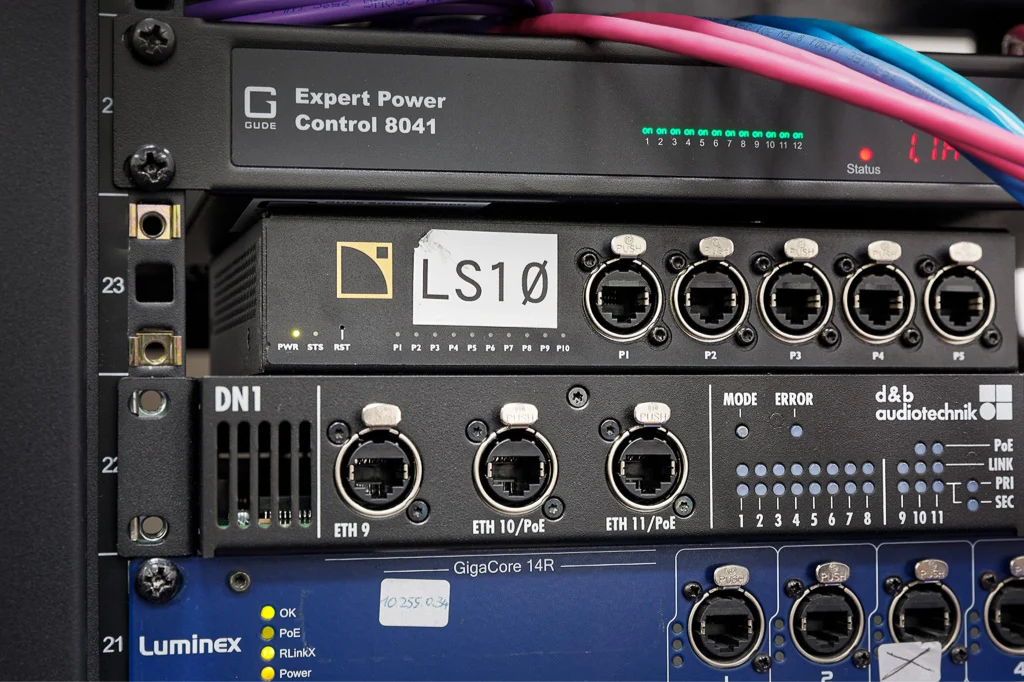
To address this, d&b audiotechnik introduced the DN1 switch, designed to act as a bridge. The DN1 supports Milan-AVB, Dante, AES67, and AES70 concurrently, allowing users to integrate legacy Dante gear into a Milan-based backbone. Furthermore, the lack of a centralized routing tool—long a criticism of AVB—was resolved in June 2024 with the launch of the Milan Manager. This software, developed through a collaboration between d&b and L-Acoustics under the "Central Point Solutions" initiative, provides a unified interface for discovery, routing, and diagnostics across different brands.
Another limitation is Milan’s reliance on Layer 2 networking. Because it does not pass through standard Layer 3 routers, Milan is not suitable for Wide Area Network (WAN) applications, such as distributing audio between two different cities over the internet. For these specific use cases, Layer 3 protocols like Dante or Ravenna remain the superior choice. However, Milan proponents argue that this is a deliberate design choice to prioritize maximum reliability within the local production environment.
Economic and Strategic Implications
The argument that AVB-capable switches are prohibitively expensive is increasingly becoming a myth. Matthias Christner, Head of R&D at d&b audiotechnik, notes that the price gap has largely closed when comparing "enterprise-grade" Dante hardware with Milan-certified switches. "When you factor in the cost of hiring a specialized network engineer to manage a complex Dante setup, the Milan infrastructure often proves more cost-effective in the long run," Christner explained.
Furthermore, as an open standard based on IEEE specifications, Milan offers a degree of "future-proofing" that proprietary systems cannot match. The global semiconductor shortage following the pandemic highlighted the risks of relying on a single chip provider. Because Milan is built on open standards, manufacturers can source TSN-compatible silicon from multiple vendors, ensuring a more resilient supply chain.
The Broader Horizon: TSN Beyond Pro-Audio
The long-term viability of Milan is bolstered by its roots in the broader TSN movement. As of 2025, an active IEEE task group has been working to implement TSN standards in military and commercial aviation, as well as in maritime and space exploration. These industries demand a level of reliability and determinism that far exceeds the requirements of a rock concert. The fact that professional audio is "piggybacking" on a technology used for mission-critical flight systems provides a level of confidence in the protocol’s longevity.
Redundancy is also baked into the Milan architecture. When a system is configured with primary and secondary networks, the protocol handles seamless failover for both the audio stream and the clock synchronization. The d&b DN1 switch, for instance, provides clear visual indicators if a port is misconfigured, further reducing the likelihood of human error during high-pressure setups.
Conclusion: Is Milan the Right Choice?
As of mid-2026, the decision to adopt Milan depends largely on the specific needs of the project. It is clearly the superior choice for new installations requiring extreme timing precision, such as high-density line arrays or immersive soundscapes. For teams looking to reduce IT complexity and leverage the "single-cable" efficiency of PoE, Milan offers a level of stability that "best effort" networks cannot replicate.
However, for those heavily invested in legacy Dante hardware or those requiring inter-site connectivity over WAN, a hybrid approach remains the most pragmatic path. The consensus among industry leaders, including d&b, L-Acoustics, Adamson, and Meyer Sound, is that Milan has moved past the experimental phase and is now a mature, production-ready standard. For the professional audio industry, the shift toward deterministic networking is not just a technical upgrade; it is a necessary evolution toward a more reliable and efficient future.
