

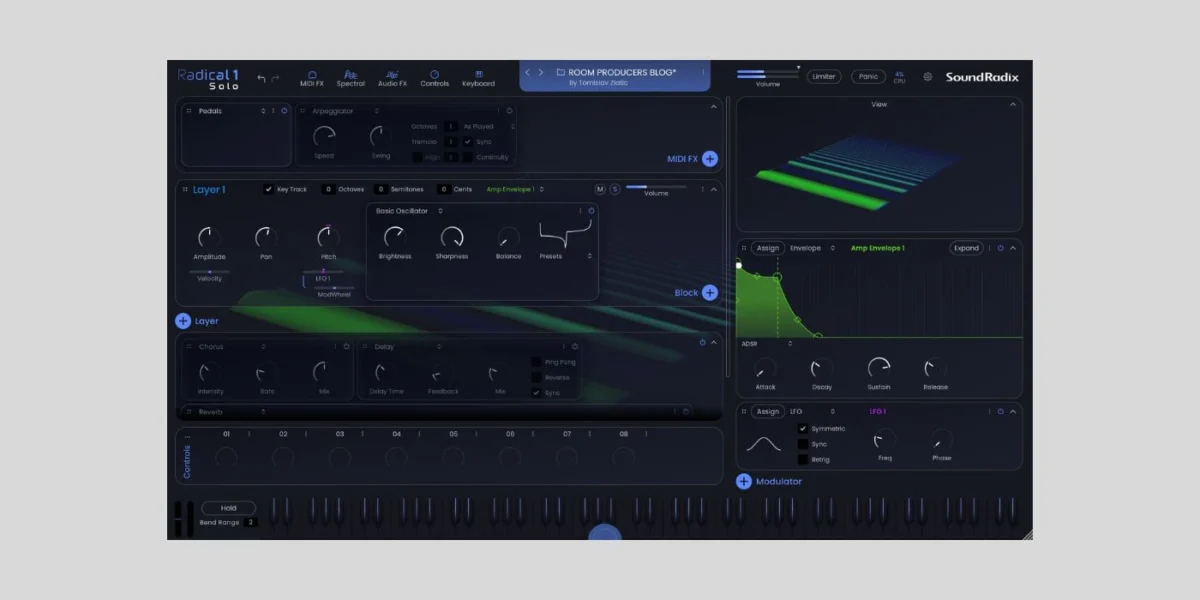
Sound Radix, a company renowned for its innovative audio processing tools, has officially launched Radical1 Solo, a complimentary monophonic additive synthesizer plugin now available for both macOS and Windows operating systems. This release marks a significant expansion of the company’s product portfolio, offering a powerful entry point into the advanced synthesis capabilities of their premium Radical1 instrument. The introduction of a free, fully-featured subset of their flagship synthesizer signals a strategic move to democratize access to sophisticated sound design techniques, particularly for those interested in additive synthesis.
Sound Radix: A Legacy of Innovation in Audio Software
To fully appreciate the significance of Radical1 Solo, it is crucial to understand Sound Radix’s established reputation within the professional audio community. Founded on a commitment to solving common challenges faced by audio engineers and producers, Sound Radix has consistently delivered ground-breaking plugins that blend technical ingenuity with practical application. Their early contributions, such as the 32 Lives plugin, became indispensable tools during a critical juncture in digital audio workstation (DAW) evolution.
Around 2015, the music production industry underwent a significant transition from 32-bit to 64-bit computing architectures. This shift, while enhancing processing power and memory access, rendered many legacy 32-bit Audio Units and VST plugins incompatible with newer 64-bit DAWs. This presented a substantial hurdle for producers who relied on specific older plugins for their signature sounds or existing projects. Sound Radix’s 32 Lives emerged as a crucial adapter, effectively bridging the gap and allowing cherished 32-bit plugins to operate seamlessly within modern 64-bit environments. This product alone cemented Sound Radix’s standing as a problem-solver dedicated to supporting the creative community, a reputation that continues to precede their new product introductions. Other notable offerings, such as SurferEQ, which allows for dynamic frequency shifting with melodic content, and Auto-Align, designed to correct phase issues between multi-miked signals, further illustrate their innovative approach to complex audio problems. Their foray into virtual instruments with Radical1, therefore, is not merely a diversification but an application of their engineering prowess to the creative heart of music production.
Understanding Additive Synthesis: The Foundation of Radical1
Radical1 Solo and its full counterpart are built upon the principles of additive synthesis, a method of sound generation that stands apart from more commonly encountered techniques like subtractive or frequency modulation (FM) synthesis. While subtractive synthesis begins with a harmonically rich waveform and filters out unwanted frequencies, and FM synthesis creates complex timbres by modulating one oscillator’s frequency with another, additive synthesis works by constructing sounds from the ground up. It generates sound by combining multiple pure sine waves, known as partials or harmonics, each with its own amplitude, frequency, and phase characteristics.
This approach offers unparalleled control over a sound’s timbre and evolution. By individually manipulating hundreds, or even thousands, of these harmonic components, sound designers can sculpt incredibly precise and dynamic sounds. Historically, additive synthesis has been challenging to implement effectively due to its intensive computational requirements and the complexity of managing numerous parameters. Early additive synthesizers, often hardware-based, were cumbersome and expensive. However, advancements in computing power and sophisticated software algorithms have made additive synthesis more accessible and powerful in recent years. Sound Radix’s implementation in Radical1 aims to harness this power while providing an intuitive workflow, allowing users to delve into the intricate world of harmonic manipulation without being overwhelmed by technical minutiae. The promise of additive synthesis lies in its ability to create sounds with unique spectral characteristics, from glassy, evolving pads to sharply defined, metallic percussive elements, offering a sonic palette distinct from other synthesis methods.
A Phased Rollout: The Radical1 Chronology
The release of Radical1 Solo is the latest step in a carefully planned rollout strategy for Sound Radix’s first instrument plugin. The journey began in late 2025 with the introduction of the full Radical1 into early access for macOS users. This "early access" model is a common practice in software development, particularly for complex instruments, allowing developers to gather invaluable user feedback, identify bugs, and refine features in a real-world production environment before a final, stable release. This iterative development approach ensures that the final product is robust, user-friendly, and meets the demands of professional users.
Following the initial macOS early access period, Sound Radix extended compatibility to Windows users in early 2026, broadening the potential user base significantly. This cross-platform support is crucial for a plugin aiming for widespread adoption in diverse studio environments. The current public pre-release of Radical1 Solo, marked by version 0.9.6 dated August 4, 2026, represents a pivotal moment in this timeline. It signifies Sound Radix’s confidence in the core synthesis engine and their decision to offer a foundational version of the instrument to a wider audience, free of charge. This strategic release allows potential users to experience the unique sound and workflow of Radical1, fostering a community around the instrument and providing a clear upgrade path to the full, polyphonic version.
Radical1 Solo: A Gateway to Advanced Synthesis
The core appeal of Radical1 Solo lies in its generous offering: a free, monophonic additive synthesizer built entirely upon the comprehensive Radical1 synthesis engine. Unlike many "demo" versions that are time-limited or severely feature-restricted, Sound Radix explicitly states that Solo is not a temporary trial. It provides permanent access to the same high-quality oscillators, robust modulation system, versatile filters, and integrated effects found in the paid version. This commitment to a fully functional free product underscores a belief in the instrument’s intrinsic value and a desire to cultivate a broad user base.
The primary distinction of Solo is its monophonic, single-layer architecture. While this means it cannot produce complex chords or layered, evolving textures characteristic of polyphonic instruments, it is perfectly optimized for specific sound design tasks. Its monophonic nature makes it exceptionally well-suited for crafting powerful basslines, cutting lead melodies, and intricate arpeggiated sequences. For these applications, the depth and precision of the additive engine truly shine, allowing users to sculpt sounds with unique harmonic characteristics and dynamic movement. Industry analysts suggest that this "freemium" model is an effective strategy for market penetration, allowing users to experience a substantial portion of the premium product’s capabilities without financial commitment, thereby reducing the barrier to entry and demonstrating the core value proposition. A significant advantage for users is the forward compatibility: any sounds or presets created within Radical1 Solo will seamlessly transfer and function within the full, paid version of Radical1, ensuring that creative work is never lost and encouraging a smooth upgrade path.
The Advanced Synthesis Engine of Radical1
At the heart of both Radical1 Solo and its polyphonic counterpart lies a sophisticated additive synthesis engine packed with innovative features designed to offer unparalleled sonic sculpting capabilities. These features collectively contribute to Sound Radix’s "What You See Is What You Hear" workflow, aiming to make complex spectral manipulation intuitive and visually informative.
One of the standout features is the Morphing Fluid Oscillators. This implies a dynamic and continuously variable sound source, allowing for smooth transitions between different timbres or harmonic structures, rather than discrete steps. Such fluidity is crucial for creating evolving pads, organic textures, and expressive leads that shift and breathe over time.
Direct Spectrum Drawing offers a highly visual and direct method of sound design. Instead of manipulating abstract parameters, users can literally draw in the harmonic content of their sound, shaping its spectral fingerprint directly on a graphical interface. This intuitive approach empowers users to create entirely unique timbres that might be difficult or impossible to achieve with traditional synthesis methods.
Spectral Sample Resynthesis is another powerful tool, allowing users to analyze existing audio samples and resynthesize them using the additive engine. This process can transform conventional sounds into entirely new spectral landscapes, offering creative avenues for granular synthesis, soundscaping, and radical timbral alteration. Imagine taking a drum hit and stretching its harmonic content into a pad, or morphing a vocal snippet into an ethereal texture – the possibilities are extensive.
Further enhancing the engine are a suite of spectral shaping tools and harmonic modifiers. These provide granular control over the overtone series, allowing users to emphasize, de-emphasize, or entirely reshape specific harmonics. This can lead to sounds that are bright and metallic, warm and woody, or dark and resonant, all within the same fundamental framework. The integration of a real-time spectral display is critical here, providing immediate visual feedback on how adjustments to harmonics and spectral tools are affecting the sound, reinforcing the "What You See Is What You Hear" philosophy and aiding in the learning process for additive synthesis.
The overall workflow is designed to be highly interactive, displaying layers, modules, blocks, and modulation paths as they directly influence the sound. Essential parameters can be "starred" to keep them readily accessible on the main interface, while deeper sound-design tools remain available underneath, maintaining a clean and focused user experience without sacrificing depth.
The Full Radical1: Expanding Sonic Horizons
While Radical1 Solo offers a robust introduction, the full Radical1 unlocks the complete potential of Sound Radix’s additive synthesis engine, transforming it into a versatile and expansive sound design environment. The upgrade primarily introduces full polyphony, a crucial feature for creating rich pads, complex chords, and intricate melodic arrangements that require multiple voices to play simultaneously. This immediately broadens the instrument’s application from monophonic lines to full harmonic landscapes.
Beyond polyphony, the paid version supports unlimited layers and modulation sources, limited only by the host CPU’s processing capabilities. This modularity allows for the creation of incredibly deep and evolving sounds, where multiple distinct timbres can be stacked, blended, and modulated independently or interactively. The capacity for vast modulation options means that almost any parameter within the synthesizer can be animated, bringing sounds to life with subtle movements or dramatic transformations.
A particularly powerful feature for advanced users is the inclusion of Formula Blocks for custom DSP code. This grants users the ability to write their own digital signal processing algorithms, effectively extending the synthesizer’s capabilities beyond its factory offerings. This level of customization is rare in software synthesizers and caters to sound designers who wish to push the boundaries of sonic creation, potentially developing unique effects or modulation behaviors tailored to their specific needs.
Furthermore, the full Radical1 integrates built-in MIDI effects, time-domain audio effects, and spectral block effects. MIDI effects can manipulate incoming MIDI data to create arpeggios, chords, or specific note patterns. Time-domain audio effects include traditional effects like delay, reverb, chorus, and distortion, which process the audio signal over time. Spectral block effects, on the other hand, operate directly on the harmonic content, offering advanced manipulation possibilities within the spectral domain, further differentiating Radical1 from other instruments.
The full Radical1 is currently available in an Early Access phase, priced at $129, a significant reduction from its planned full price of $199. This pricing strategy encourages early adoption and provides a financial incentive for users to invest in the developing platform, while also offering a free trial for those who wish to experience its full capabilities before committing to a purchase.
Recent Developments and System Requirements
Sound Radix continues to actively develop and refine the Radical1 platform, as evidenced by the latest 0.9.6 update. This update, coinciding with the Solo release, brings several key improvements and additions to the entire Radical1 ecosystem. Enhancements to the Blocks and Samples Browser improve workflow and content management, making it easier for users to organize and access their sound design elements. New modulation capabilities include a Route modulator and a Quantize modulator effect, offering more precise control over parameter automation and rhythmic manipulation. Improvements to the distortion algorithms provide a wider range of sonic aggression and character.
Crucially, the update also introduces expanded MIDI settings for MPE routing and pitch bend range. MPE (MIDI Polyphonic Expression) is a modern MIDI specification that allows for multi-dimensional control over individual notes, enabling highly expressive performances with compatible controllers. Its inclusion in Radical1 underscores Sound Radix’s commitment to cutting-edge performance capabilities. Finally, the update includes new and revised factory presets, providing users with fresh starting points and showcasing the instrument’s expanded sonic potential.
Radical1 Solo is designed for broad compatibility, available in AAX, AU, and VST3 formats to integrate seamlessly with most major DAWs on both macOS and Windows. Specific system requirements include macOS 10.14 or higher, compatible with both Apple Silicon and 64-bit Intel Macs, or Windows 10 or higher on a 64-bit Intel/AMD system. A minimum of 8GB RAM is recommended for optimal performance. While an iLok account is required for license management, users will be pleased to note that a physical USB iLok dongle is not necessary; software-based authorization is fully supported. To download the free Solo version, users simply need to sign up for a free Sound Radix user account on their official website.
Market Implications and Broader Impact
The release of Radical1 Solo, a free and powerful additive synthesizer, carries significant implications for Sound Radix, the virtual instrument market, and the broader community of music producers and sound designers.
For Sound Radix, this move represents a strategic diversification from their historically utility-focused plugin offerings. It positions them as a serious contender in the competitive virtual instrument space, leveraging their reputation for high-quality engineering and innovative problem-solving. The freemium model of Solo serves as a powerful marketing tool, lowering the barrier to entry and allowing a vast number of users to experience the unique capabilities of Radical1 firsthand. This approach can drive adoption, build a loyal user base, and ultimately convert a percentage of Solo users into purchasers of the full version. It also demonstrates confidence in their product, allowing the quality of the instrument to speak for itself without upfront financial commitment.
For the virtual instrument market, the release reinforces the growing trend of high-quality free plugins that serve as gateways to more comprehensive paid versions. This model has proven effective for many developers in fostering community engagement and providing accessible tools to a wider audience. Furthermore, the focus on additive synthesis by a reputable developer like Sound Radix signals a continued resurgence of interest in this powerful, albeit complex, synthesis method. As computing power increases, the historical challenges associated with additive synthesis become less prohibitive, opening doors for more sophisticated and user-friendly implementations.
For music producers and sound designers, Radical1 Solo offers an invaluable resource. It democratizes access to advanced additive synthesis, allowing bedroom producers, students, and professionals alike to experiment with spectral sound design without any financial investment. This accessibility can inspire new creative approaches, foster skill development in complex synthesis techniques, and introduce users to a unique sonic palette. For those already familiar with additive synthesis, Solo provides a high-quality, free tool for specific monophonic tasks, while offering a clear and attractive upgrade path to a full-featured, polyphonic instrument. The forward compatibility of presets ensures that any creative effort invested in Solo is preserved and can be expanded upon in the full version.
In conclusion, Sound Radix’s Radical1 Solo is more than just a free plugin; it is a meticulously crafted entry point into a sophisticated additive synthesis ecosystem. It embodies Sound Radix’s legacy of innovation and commitment to empowering audio creators, offering a powerful tool that is both accessible and deeply capable. As the sound design landscape continues to evolve, Radical1 Solo stands out as a significant release, promising to enrich the sonic possibilities for countless musicians and producers worldwide.
