

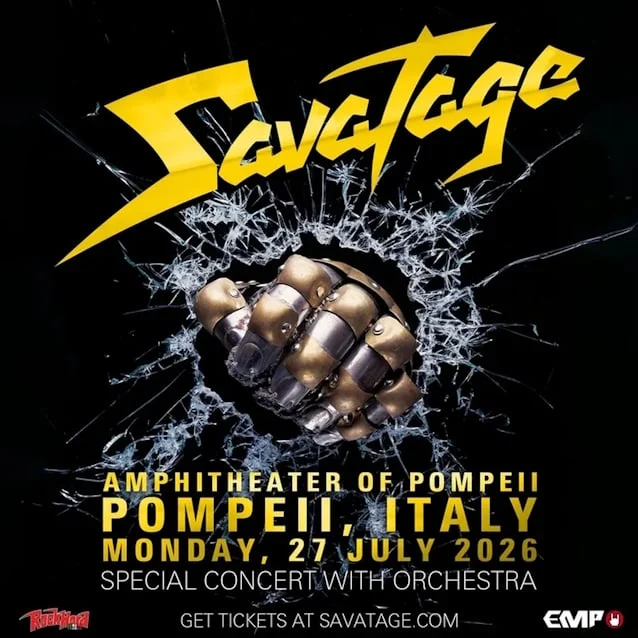
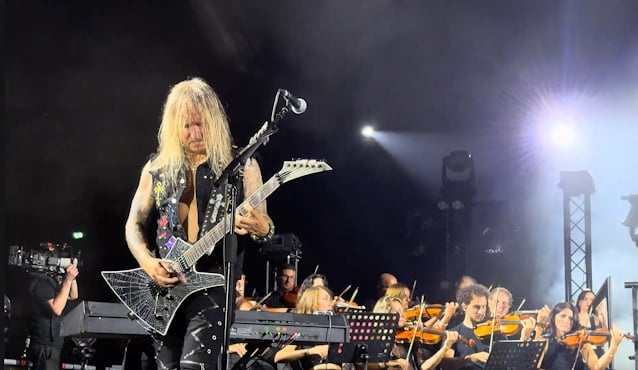
On July 27th, progressive metal titans Savatage delivered a performance for the ages at the iconic Amphitheater of Pompeii, a testament to their enduring legacy and innovative spirit. This historic concert, set against the backdrop of one of the world’s most remarkably preserved Roman amphitheaters, was elevated to an unprecedented level of grandeur by the live accompaniment of a full orchestra. The fusion of Savatage’s complex musical arrangements with the powerful resonance of orchestral instrumentation created an atmosphere of unparalleled spectacle, etching this event into the memories of all who were present.
The significance of this performance was palpable, as detailed in a recent interview with Moshpit Passion, where Savatage guitarist Chris Caffery shared his profound reflections on the experience. "You get there and you know the setting and you know where you are and you know what you have to do that night, and we were filming," Caffery explained. "So I think there was an overwhelming amount of things going on at once. We had a lot of friends and fans and press people and business people and everybody that we knew that were showing up too, and then we had the orchestra playing with the band. So there was an extremely large amount of people around that were all experiencing it at once." This confluence of historical significance, the band’s momentous return to the stage, the presence of a large entourage, and the ambitious orchestral collaboration undoubtedly contributed to the heightened emotional and sensory experience of the evening.
Caffery further elaborated on the unique pressures and eventual catharsis of the performance. "I think for me it was a relief to be on the stage because there was so much tension… Not tension, but so much chaos going on. It was creative chaos, so it’s a good chaos, but once you got on stage, you were just able to go do what you did," he stated. "And then it was fun to just be up there and play in that environment and on that location and live that moment without all the extra chaos around you." This sentiment highlights the band’s professional dedication and their ability to channel external pressures into a focused and impactful performance, transforming potential distractions into a dynamic backdrop for their artistry.
The logistical and creative challenges of integrating a live orchestra with a seasoned rock band were significant. When questioned about rehearsals with the orchestral ensemble, Caffery revealed the sophisticated pre-planning that ensured a seamless integration. "Not with the orchestra with us," he clarified. "They had had the sheet music, and we’d actually had one of the musical directors from TSO [Trans-Siberian Orchestra] went to see them the day before. And [Savatage guitarist and Trans-Siberian Orchestra music director] Al [Pitrelli] and Jon [Oliva, Savatage mastermind] had worked on the arrangements of the string section stuff, and they had had it and they knew what they were gonna play and we knew what they were gonna be playing." This meticulous preparation, involving detailed arrangement work and communication facilitated by figures deeply connected to both Savatage and the Trans-Siberian Orchestra, was crucial. "So we rehearsed with that in mind in advance. So we were working around it before we saw them, they were working around it before they saw us, and then we basically just had a soundcheck." This methodical approach underscores the professionalism and dedication of all involved, ensuring that the historic performance could proceed with the highest degree of musical integrity.
A Setlist Weaving Through Savatage’s Rich Tapestry
The setlist curated for the Pompeii concert was a masterclass in retrospective performance, drawing from across Savatage’s expansive and influential discography. According to data compiled by Setlist.fm, the band delivered a comprehensive 22-song main set, interspersed with three powerful encore tracks. The program included several songs performed live for the first time in years, adding an element of rare delight for long-time followers.
The evening commenced with "Overture," a piece not heard live since 1996, immediately setting a grand and evocative tone. This was followed by an instrumental intro to "Morphine Child," before launching into the powerful anthem "Dead Winter Dead." The setlist strategically wove through different eras of the band, featuring fan favorites like "Jesus Saves," "The Wake of Magellan," and "Miles Away." The inclusion of "Sirens," an early classic, and the more introspective "Another Way" demonstrated the breadth of their sonic evolution.
A particularly poignant moment arrived with the inclusion of "Adagio In G Minor," a cover of Tomaso Albinoni & Remo Giazotto, performed as an excerpt by bassist Johnny Lee Middleton with the orchestra. This instrumental interlude showcased the band’s ability to embrace diverse musical styles while maintaining their distinctive power. The setlist also featured "Christmas Eve (Sarajevo 12/24)," a track not performed live since 2015, and "Not What You See," which saw vocalist Zak Stevens performing with the orchestra only, marking its first live rendition since 1999.
The latter half of the main set saw the band delve into more anthemic territory with "Handful Of Rain," "Lights Out," and "Tonight He Grins Again," before building towards the epic "The Hourglass" and the powerful closer "Edge Of Thorns." The encore was a fitting culmination, featuring "Temptation Revelation," "Power Of The Night," and concluding with the iconic "Hall Of The Mountain King," a track that has become synonymous with Savatage’s legacy. The strategic inclusion of these less frequently played gems underscored the band’s commitment to offering a unique and deeply satisfying experience for their dedicated fanbase.
The "Prelude To Madness" Tour and Shifting Lineups
The Pompeii performance is a key highlight of Savatage’s ongoing "Prelude To Madness" European tour, a significant undertaking that marks their substantial return to live performances after extended periods. This tour, scheduled for spring/summer 2026, has seen some notable adjustments in the band’s lineup, primarily concerning the drummer’s position.
In early June, prior to the Pompeii concert, Savatage played two festival shows in Sweden and France with drummer Blas Elias. Elias, a seasoned musician with a resume including stints with Trans-Siberian Orchestra, Slaughter, and Stephen Pearcy of Ratt, stepped in to fill the shoes of longtime drummer Jeff Plate. Plate was temporarily sidelined from the initial two dates of the tour due to medical reasons. However, the current lineup for the majority of the "Prelude To Madness" tour, including the Pompeii performance, features the core established group: vocalist Zak Stevens, guitarists Al Pitrelli and Chris Caffery, bassist Johnny Lee Middleton, and the returning Jeff Plate on drums. The inclusion of touring keyboardists Paulo Cuevas and Shawn McNair further bolstered the band’s sonic capabilities for these extensive shows.
A Legacy Forged in Tampa and Tempered by Tragedy
Savatage’s remarkable journey began in Tampa, Florida, founded by brothers Jon and Criss Oliva. Their career, spanning over four decades, is a narrative rich with creative triumphs and profound personal loss. Early in their development, the band established themselves as pioneers of the progressive metal genre, pushing sonic boundaries with groundbreaking albums. Seminal works such as the 1987 release "Hall Of The Mountain King" and the critically acclaimed 1991 rock opera "Streets" solidified their reputation and continue to be revered by fans worldwide.
The untimely death of guitarist Criss Oliva in a car accident following the success of the 1993 album "Edge Of Thorns" represented a devastating blow to the band and the music world. Despite this immense tragedy, Savatage demonstrated extraordinary resilience, persevering with a renewed sense of purpose. This period of introspection and determination culminated in the transformative 1995 album "Dead Winter Dead," a record that resonated deeply with audiences and critics alike, showcasing the band’s enduring artistic strength.
The Unwavering Devotion of "The Legion"
Throughout their distinguished career, Savatage has cultivated an exceptionally passionate and loyal fanbase, often referred to as "The Legion." This dedicated following remained steadfast even during the band’s nearly 20-year hiatus from touring, consistently campaigning for their return. This unwavering support culminated in a triumphant reunion performance at Germany’s Wacken Open Air festival in 2015. This electrifying appearance captivated an audience of 80,000, reaffirming Savatage’s legendary status and the profound connection they share with their devotees.
The momentum generated by the 2015 Wacken performance propelled Savatage back into the international spotlight in 2025. They made headlines with their first headline shows since 2002, embarking on a series of European dates that successfully united multiple generations of fans. Longtime adherents, often referred to as "The Legion," experienced long-awaited performances, while newer fans discovered the raw power and intricate artistry of the band for the first time. This successful resurgence demonstrated the enduring appeal and timeless quality of Savatage’s music.
Further expanding their reach, Savatage played four shows in South America in April 2025, followed by ten dates across Europe in June 2025. These European appearances included prestigious festival slots at France’s Hellfest and Belgium’s Graspop Metal Meeting, underscoring their prominent position in the global metal landscape. The band’s first non-festival headlining concert in over two decades took place on April 21, 2025, at the Espaço Unimed in São Paulo, Brazil, two days after their performance at the Monsters of Rock festival at Allianz Parque in the same city.
Evolving Lineups and the Jon Oliva/Zak Stevens Dynamic
The vocal contributions to Savatage have seen a notable evolution throughout their history, with two prominent figures defining different eras: Jon Oliva and Zak Stevens. Jon Oliva, a founding member and the band’s initial frontman, is renowned for his powerful and versatile vocal performances. He rejoined Savatage as lead vocalist for their 2001 album "Poets and Madmen" after Zak Stevens’ departure.
Zak Stevens joined Savatage in 1992, stepping in to replace Jon Oliva, who transitioned to a more prominent role in songwriting and keyboards. Stevens lent his distinctive voice to four significant albums: "Edge of Thorns" (1993), "Handful of Rain" (1994), "Dead Winter Dead" (1995), and "The Wake of Magellan" (1997). He departed the band in 2000, citing family reasons, which paved the way for Jon Oliva’s return to the lead vocal position. Both Jon Oliva and Zak Stevens participated in Savatage’s momentous 2015 reunion performance at Wacken Open Air, symbolizing a harmonious convergence of their contributions to the band’s legacy.
The period surrounding the "Poets and Madmen" album release in 2001 was marked by further lineup shifts. Al Pitrelli, a guitarist who had become an integral part of Savatage’s sound, departed the band in 2000 to accept an offer to join Megadeth. Despite his departure, Pitrelli did contribute guitar solos to some tracks on "Poets and Madmen." A limited US tour followed, with Fates Warning and Nevermore providing support on different legs of the tour. Around this time, Jon Oliva chose Damond Jiniya (Diet of Worms) as Zak’s replacement. Jiniya performed Zak’s vocal parts on tour, with Jon Oliva taking on an expanded vocal role in the performances.
Jon Oliva’s Enduring Influence and Trans-Siberian Orchestra
Beyond his pivotal role in Savatage, Jon Oliva is widely recognized for his co-creation of the Trans-Siberian Orchestra (TSO). This highly successful project, which masterfully blends classical music with progressive rock, pyro, and theatrical elements, was conceived alongside the project’s founder, Paul O’Neill. Even after O’Neill’s untimely death in April 2017, Jon Oliva has reportedly remained actively involved in TSO’s ongoing activities, continuing to shape the direction of this unique musical endeavor. The collaborative spirit and innovative approach that defined Savatage are clearly echoed in Oliva’s continued contributions to the music world through TSO, further solidifying his status as a visionary artist.
The concert at the Amphitheater of Pompeii represents not just a single performance but a continuation of Savatage’s storied narrative. It underscores their ability to transcend time, performing within an ancient setting that speaks to enduring human creativity, while simultaneously pushing their musical boundaries with the integration of orchestral power. This event serves as a potent reminder of Savatage’s significant contributions to progressive metal and their unwavering connection with a global fanbase that continues to champion their unique and powerful sound. The "Prelude To Madness" tour, with its historic Pompeii stop, solidifies Savatage’s place as a band whose influence and artistry continue to resonate profoundly.
