

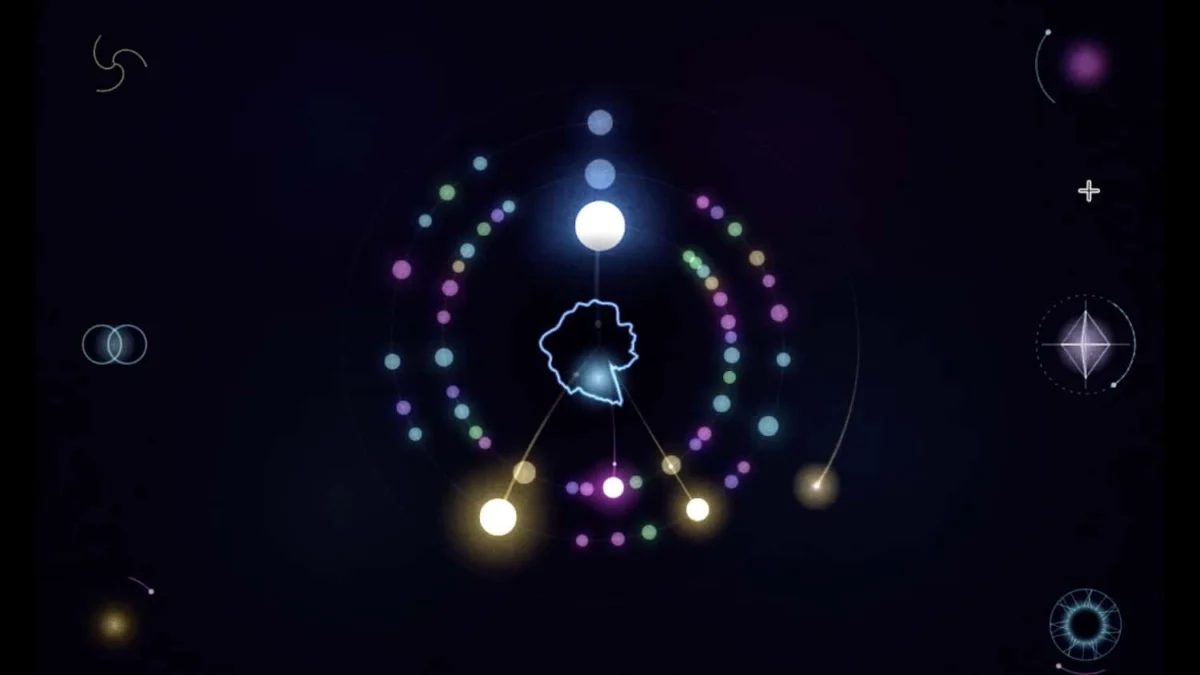
KHÔRA represents a significant departure from conventional digital signal processing (DSP) tools, arriving as a drone-based harmonic instrument specifically designed for the macOS environment. Developed by the experimental studio Laboratory0, the software introduces a paradigm shift in how composers and sound designers interact with harmonic structures. By eschewing traditional sliders, knobs, and numerical input fields, KHÔRA utilizes a unique, abstract interface where every control is a living geometric object. This design philosophy aims to move the user away from clinical parameter manipulation and toward an intuitive, tactile exploration of microtonal space. At its core, the instrument functions as a map of just-intonation pitches, visualized through a "ring of stars" where the physical properties of the shapes—such as size and color—denote consonance and harmonic categorization.
The Evolution of Harmonic Interfaces and the Philosophy of KHÔRA
The history of electronic music synthesis has largely been defined by the emulation of physical hardware. From the early modular systems of the 1960s to the contemporary digital audio workstations (DAWs) of the 2020s, the visual language of synthesis has relied heavily on the "skeuomorphic" recreation of potentiometers and patch cables. KHÔRA challenges this lineage by adopting a non-representational UI. The developer’s decision to remove labels and traditional menus is a deliberate attempt to foster a "flow state" in the user. In this environment, the star-based map serves as a cartographic tool for navigating the "Tonnetz" or harmonic web.
In KHÔRA, the size of a star is not a decorative choice but a data-driven representation of consonance. Larger stars indicate simpler mathematical ratios between frequencies—intervals that the human ear typically perceives as stable or "pure." Conversely, the color coding represents harmonic families, allowing users to identify related tones within a complex microtonal field without needing a deep background in music theory or mathematics. This approach democratizes microtonal music, which has historically been gated by rigorous academic requirements and complex tuning software.
Technical Analysis of the Five Chord Generation Engines
KHÔRA is powered by five distinct algorithmic generators, each designed to handle the transition of harmonic states in different ways. These generators allow the software to function as both a performance instrument and a generative soundscape tool.
1. Genesis: The Foundational Harmonic Seed
The Genesis mode serves as the primary engine for creating new just-intonation chords. It is programmed to favor simple, consonant intervals, ensuring that even in a microtonal context, the resulting textures remain sonically grounded. A critical technical feature of Genesis is its adherence to the root note; while the upper voices may shift into experimental territories, the fundamental frequency remains constant, providing a tether for the listener and preventing the soundscape from becoming untethered from its harmonic center.
2. Metabole: Continuity through Shared Frequencies
The Metabole engine is an exercise in "common tone" synthesis. In traditional music theory, a common tone is a pitch that remains the same between two different chords. Metabole automates this process by preserving specific voices from the current chord while regenerating others. This creates a sense of organic evolution rather than abrupt change. For sound designers working on cinematic underscores or ambient installations, this mode provides a bridge between stasis and motion, allowing for a gradual shifting of the "harmonic weather."
3. Topos: Structural Transposition in Just-Intonation Space
Topos addresses one of the most difficult challenges in microtonal music: transposition. Because just-intonation is based on fixed mathematical ratios rather than the equal division of the octave, moving a chord structure up or down is not as simple as shifting it on a piano keyboard. Topos moves the entire chordal structure through just-intonation space while preserving the internal ratios between the notes. This allows the user to discover "distant" microtonal colors that would be impossible to find in standard 12-tone tuning, all while maintaining the structural integrity of the original voicing.
4. Skia: The Hidden Modal Darkroom
The Skia engine is one of the software’s "hidden" modes, accessible through specific interactions within the geometric interface. It focuses on dark, modal harmonies layered over a fixed, unmoving drone. Skia utilizes spacious minor voicings and follows a generational logic where the harmony returns to the "home chord" every fourth iteration. This cyclical nature mimics the tension-and-release patterns found in classical modal music but applies them to a drone-based, microtonal context.
5. Helios: The Bridge to Modern Equal Temperament
While the majority of KHÔRA is dedicated to the exploration of non-standard tuning, the Helios mode offers a point of contact with contemporary Western music. It is the only engine based on 12-tone equal temperament (12-EDO). Helios is characterized by modern "color harmony" and smooth bass motion. Like Skia, it follows a four-generation cycle, returning to its point of origin to provide a sense of resolution. This mode is particularly useful for producers who wish to blend the ethereal quality of KHÔRA’s drone synthesis with standard orchestral or electronic instruments.
Historical Context: Just Intonation and the Digital Microtonal Revolution
To understand the impact of KHÔRA, one must look at the historical tension between Just Intonation (JI) and Equal Temperament. For the last several centuries, Western music has been dominated by 12-tone equal temperament, a tuning system that compromises the "purity" of intervals to allow instruments to play in every key. While practical, this system sacrifices the natural harmonic resonance found in the physics of vibrating strings and air columns.
Just Intonation, the system KHÔRA prioritizes, uses whole-number ratios (such as 3:2 for a perfect fifth or 5:4 for a major third). These intervals resonate with a clarity that equal temperament cannot achieve. However, JI has always been difficult to implement on physical instruments like pianos. The rise of digital synthesis in the late 20th century, pioneered by figures like Wendy Carlos and La Monte Young, began to break these barriers. KHÔRA follows in the footsteps of software like Max/MSP and SuperCollider, which have long been used by experimentalists to create microtonal music, but it does so with a level of accessibility and visual elegance previously unseen in the field.
Chronology of Development and Release
The development of KHÔRA reflects a growing trend in the "boutique" software market, where small independent developers create highly specialized tools for niche audiences.
- Conceptual Phase: The project began as an exploration into how geometric shapes could represent harmonic relationships, moving away from the "spreadsheet" style of microtonal tuning common in early 2000s software.
- Beta Testing: Throughout the early months of 2024, the instrument underwent private testing among ambient musicians and sound artists to refine the "no labels" interface, ensuring that the lack of text did not hinder the creative process.
- Public Launch: In mid-2024, Laboratory0 officially released KHÔRA via the Gumroad platform.
- Distribution Model: The release adopted a "Name a Fair Price" model. This strategy has become increasingly popular in the independent music software community, allowing students and hobbyists to access professional-grade tools while enabling established professionals to support the developer with higher contributions.
Market Implications and Professional Utility
The release of KHÔRA arrives at a time when the demand for unique, "non-digital" sounding textures is at an all-time high in the film and television scoring industry. Composers for high-end streaming content often seek out tools that provide a "signature sound" that cannot be easily replicated with standard library presets.
KHÔRA’s ability to generate infinite, evolving drones makes it a candidate for several specific use cases:
- Cinematic Underscoring: Creating tension or atmosphere that feels "organic" and "unsettling" due to the microtonal intervals.
- Installation Art: The generative nature of the Metabole and Skia modes allows for long-form soundscapes that never repeat exactly.
- Therapeutic Audio: The use of Just Intonation is frequently cited in the field of psychoacoustics for its perceived calming effects compared to the "beating" or dissonance inherent in equal temperament.
Conclusion: The Future of Abstract Synthesis
KHÔRA – Microtonal Soundscape Synthesizer is more than just a musical instrument; it is a statement on the future of human-computer interaction in the arts. By removing the traditional barriers of music theory and technical labeling, it invites a broader range of creators to explore the complex beauty of microtonality. As the software gains traction within the macOS community, it is expected to influence a new wave of interface design that prioritizes intuition and visual feedback over numerical precision.
The success of the "fair price" model for such a sophisticated tool also highlights a shift in the economic landscape of music technology, suggesting that there is a sustainable path for experimental developers to thrive outside the traditional corporate plugin ecosystem. KHÔRA stands as a testament to the idea that in the world of digital sound, sometimes the most profound discoveries are made when we stop looking at the numbers and start looking at the stars.
