

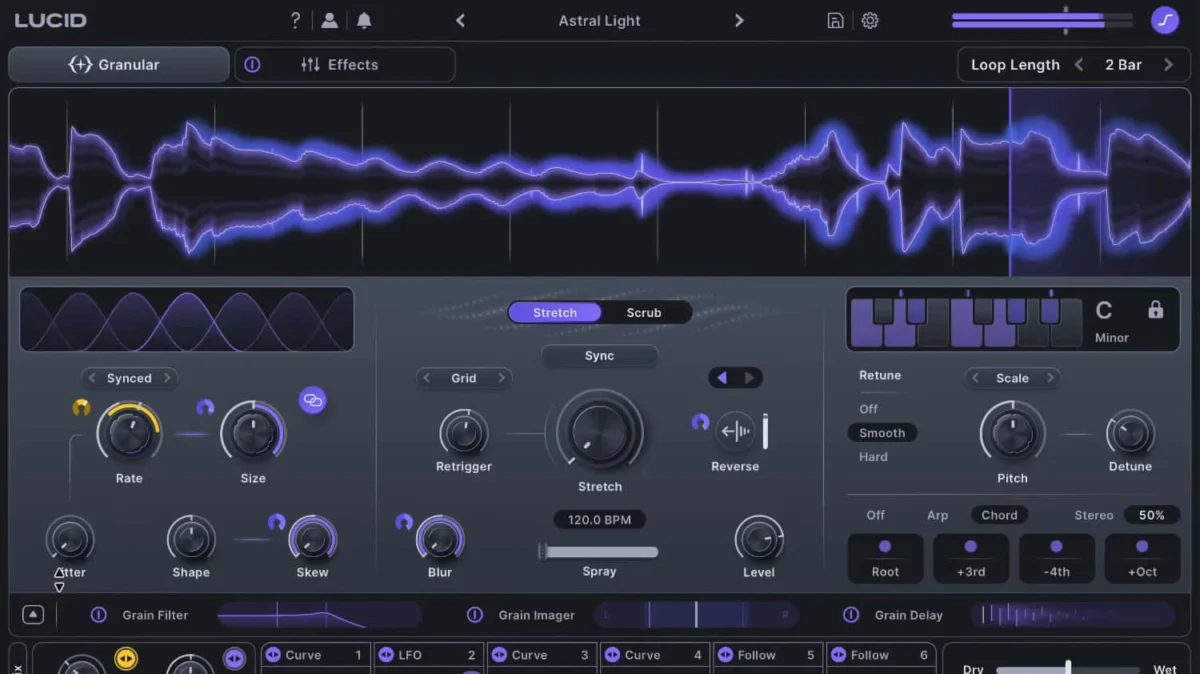
Minimal Audio has officially announced the release of Lucid, a sophisticated granular audio effect plugin designed to provide music producers and sound designers with a powerful tool for transforming static audio into complex, evolving textures. Available for both macOS and Windows platforms, Lucid represents the latest advancement in the company’s portfolio of high-end digital signal processing (DSP) tools. The plugin enters a competitive market for granular synthesis, offering a specialized interface that prioritizes both creative flexibility and technical precision. By slicing incoming audio into microscopic "grains" and reassembling them in real-time, Lucid allows users to manipulate the fundamental temporal and tonal characteristics of sound, effectively turning any input source into a lush atmospheric pad, a rhythmic glitch sequence, or a distorted sonic landscape.
Technical Architecture and Granular Mechanics
At its core, Lucid operates on the principles of granular synthesis, a method of sound generation that dates back to the theoretical work of physicist Dennis Gabor and the musical explorations of composer Iannis Xenakis. Lucid implements this technology as a real-time audio effect, meaning it processes incoming signals from a Digital Audio Workstation (DAW) rather than acting solely as a standalone synthesizer.
The plugin’s engine functions by capturing audio into a temporary buffer and then extracting short segments, or grains, which typically range from 10 to several hundred milliseconds in length. Lucid provides users with granular control over several key parameters that define the behavior of these grains:
- Grain Position and Timing: Users can determine exactly where in the audio buffer the grains are pulled from. This can be static, or it can be modulated to "scan" through the audio, creating time-stretching effects without altering pitch.
- Pitch and Transposition: Lucid allows for the independent manipulation of grain pitch. This enables the creation of multi-octave textures or subtle detuning that adds thickness to the sound.
- Grain Character and Shape: The plugin includes controls for the "windowing" or envelope of each grain. By softening the attack and decay of individual grains, users can create smooth, cloud-like textures. Conversely, sharper grain shapes result in more percussive, rhythmic artifacts.
- Density and Overlap: The engine can generate a high density of overlapping grains to create a continuous wall of sound, or sparse distributions for more fragmented, "pointillistic" audio effects.
Integrated Modulation and Effects Suite
Beyond its primary granular engine, Lucid features a robust modulation system that is a hallmark of Minimal Audio’s design philosophy. The plugin includes a variety of internal modulation sources, such as Low-Frequency Oscillators (LFOs), envelope followers, and randomized functions. These sources can be mapped to almost any parameter within the plugin, allowing for the creation of movement that responds dynamically to the input signal.
For instance, a user can map an envelope follower to the grain density, causing the texture to become more complex as the input volume increases. Alternatively, a randomized LFO can be applied to the grain position to create unpredictable, jittery movements that are highly sought after in experimental electronic music and cinematic sound design.
Lucid also incorporates a dedicated effects section designed to complement its granular output. While granular synthesis often produces harmonically rich but sometimes chaotic results, the onboard filters, delays, and reverbs allow users to sculpt the final output into a polished professional sound. The inclusion of "Character" controls suggests a proprietary approach to saturation and tonal shaping, ensuring that the processed audio retains a high level of fidelity and musicality regardless of how extreme the settings are.
The Evolution of Minimal Audio: A Brief History
The launch of Lucid marks another milestone for Minimal Audio, a developer that has rapidly gained a reputation for creating high-impact tools with modern aesthetics. Based in the United States, the company first made waves in the industry with the release of Rift, a bipolar distortion plugin that challenged traditional views on saturation. This was followed by the release of Current, a flagship synthesizer that integrated their various technologies into a single platform.
The development of Lucid follows a clear trajectory of focusing on "transformative" audio. While many plugins aim to subtly enhance a sound, Minimal Audio’s suite is largely built around the idea of radical reconfiguration. The company’s timeline shows a consistent focus on UI/UX clarity, often employing high-resolution visualizers that show the user exactly how the audio is being manipulated. In Lucid, this manifests as a real-time display of grain distribution and buffer status, providing essential visual feedback for a synthesis method that can often feel abstract.
Historical Context and Industry Significance
Granular synthesis has undergone a significant evolution since its inception. In the 1970s and 80s, it was the domain of academic researchers and composers using mainframe computers or expensive specialized hardware like the Synclavier. By the 1990s and early 2000s, software like Max/MSP and early VSTs began to bring granular tools to the desktop musician.
In the current market, Lucid enters a space occupied by established favorites such as Output’s Portal, Arturia’s Efx FRAGMENTS, and Quanta by Audio Damage. However, Lucid distinguishes itself through Minimal Audio’s specific DSP "flavor"—often characterized by a clean, modern high-end and aggressive modulation capabilities.
The industry has seen a resurgence in granular processing due to the rising popularity of genres like ambient, IDM (Intelligent Dance Music), and modern cinematic scoring. Composers for film and games frequently use granular tools to turn organic recordings—such as a cello or a field recording of wind—into otherworldly textures that retain an organic "soul" while sounding entirely synthetic. Lucid is positioned to serve this growing demographic by offering a workflow that is faster and more intuitive than traditional modular granular setups.
Official Positioning and Pricing Strategy
Minimal Audio has launched Lucid with an introductory price of $79 USD, representing a significant discount from its standard retail price of $129 USD. This pricing strategy is common in the plugin industry, intended to build an initial user base and generate momentum through social media and community forums.
In statements regarding their product philosophy, Minimal Audio has emphasized the balance between complexity and usability. While granular synthesis is technically complex, the interface of Lucid is designed to be accessible to those who may not have a background in signal processing theory. The plugin includes a curated library of presets that demonstrate its range, from subtle spatial enhancements to total sonic deconstruction.
"Lucid is designed to be a bridge between the familiar and the experimental," a spokesperson for the company might suggest based on their established branding. "It takes the complexity of granular synthesis and puts it into a package where every knob movement yields a musical result."
Broader Impact on Music Production Workflows
The introduction of Lucid is expected to have a tangible impact on how producers approach texture and atmosphere. In contemporary music production, the "layering" of sounds is a standard practice. Lucid simplifies the process of creating "ear candy"—subtle, shifting background elements that add depth to a mix.
Furthermore, the plugin’s ability to work in real-time makes it a viable tool for live performance. Performers using Ableton Live or Bitwig Studio can feed live instruments through Lucid, using MIDI controllers to manipulate the grain parameters on the fly. This turns a static instrument into a dynamic, improvisational sound source.
From a technical standpoint, the efficiency of the Lucid engine is also a point of interest. Granular synthesis can be CPU-intensive, as the computer must manage hundreds of simultaneous audio voices. Minimal Audio has optimized the plugin to ensure that it can run multiple instances in a modern project without taxing the processor to the point of instability.
System Requirements and Availability
Lucid is available for immediate download via the Minimal Audio website. It supports a wide range of systems, ensuring compatibility with the vast majority of modern production environments:
- Operating Systems: macOS 10.9 or higher (including native support for Apple Silicon) and Windows 10 or higher.
- Formats: VST, VST3, AU, and AAX, making it compatible with Pro Tools, Logic Pro, Ableton Live, FL Studio, Cubase, and other major DAWs.
- Authorization: The plugin uses a standard license key system, allowing for activation on multiple machines owned by the user.
Analysis of Future Implications
As the digital audio workstation environment becomes increasingly saturated with "me-too" products, the success of tools like Lucid depends on their ability to offer a unique sonic signature. Minimal Audio’s decision to focus on the "Character" and "Evolution" of sound suggests they are looking beyond simple utility.
Looking forward, we can expect to see Lucid integrated into the broader Minimal Audio ecosystem. The company has a history of cross-pollinating their technologies; for example, the distortion algorithms from Rift often find their way into their other tools. It is likely that the granular engine developed for Lucid will eventually see integration into their Current synthesizer or perhaps as a module in a future multi-effect platform.
In conclusion, Minimal Audio’s Lucid is more than just a new granular delay. It is a specialized instrument for the manipulation of time and timbre. By providing a high degree of control over the microscopic elements of sound, combined with a powerful modulation matrix and a streamlined user interface, Lucid provides a professional-grade solution for one of the most evocative forms of synthesis available today. As the plugin finds its way into the toolkits of top-tier producers and hobbyists alike, its influence on the soundscapes of modern music and media is likely to be significant and long-lasting.
