

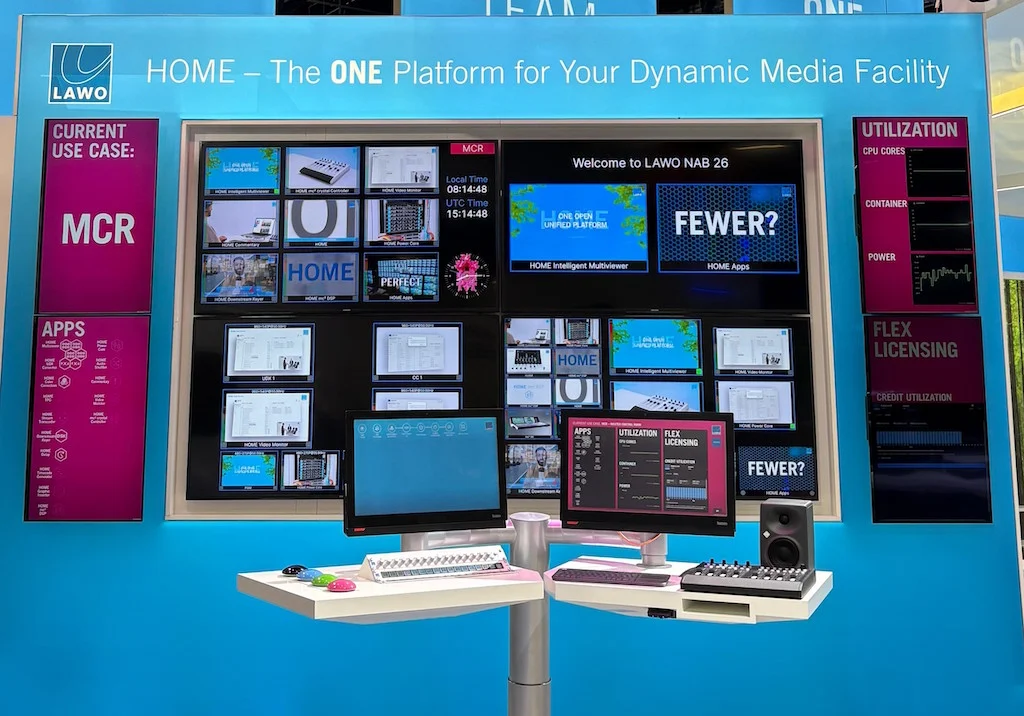
As the global broadcast and media industry converges on Amsterdam for the IBC 2026 exhibition, Lawo is poised to demonstrate that the long-anticipated shift toward software-defined production environments has transitioned from a visionary concept to a functional, operational reality. Occupying Stand 8.B90, the German technology pioneer is showcasing a comprehensive suite of innovations designed to decouple media processing from proprietary hardware, centered around the continued evolution of its HOME ecosystem. The exhibition serves as the backdrop for the European premiere of Edge One, a versatile IP-native connectivity platform, alongside significant software updates for the mc² console family and the Power Core processing engine. Following the conclusion of the Amsterdam event, Lawo will maintain its momentum by participating in the LEAT con in Hamburg, where the company will be represented in Hall 1.
The central theme of Lawo’s presence at IBC 2026 is the maturity of the Dynamic Media Facility (DMF) approach. This architectural philosophy emphasizes flexibility, scalability, and the efficient use of resources across distributed locations. By leveraging the HOME management and orchestration platform, broadcasters can now manage IP-based media infrastructures with the same level of intuitive control formerly reserved for traditional, localized hardware setups. The demonstration at Stand 8.B90 illustrates how HOME facilitates automatic device discovery, robust authentication, and centralized security protocols, creating a "plug-and-play" experience within the complex landscape of SMPTE ST 2110 and NMOS-based networks.
The Evolution of the HOME Ecosystem and Microservices
At the heart of Lawo’s strategy is the HOME platform, which has evolved from a discovery and registration tool into a comprehensive orchestration layer. The IBC 2026 showcase highlights the expanding portfolio of HOME Apps—server-based processing microservices that run on standard high-performance servers. This transition allows media organizations to move away from fixed-function hardware, instead deploying processing power dynamically where and when it is needed. Whether a production requires a multiviewer, a stream transcoder, or a graphic inserter, these functions can be instantiated as software instances.
A significant addition to the ecosystem being debuted in Amsterdam involves two new HOME Apps specifically designed for graphics workflows. These applications represent Lawo’s first foray into dedicated graphics processing within the HOME environment. Designed for live production and high-pressure broadcast environments, these apps provide tools for branding, graphics compositing, and real-time visual elements. By consolidating these functions onto a unified platform, operators can achieve a higher degree of workflow efficiency, reducing the latency and complexity associated with routing signals to external, third-party graphics engines.
The European Premiere of Edge One: A Unified Connectivity Solution
One of the most anticipated highlights of the event is the European trade show debut of Edge One. Positioned as a "Swiss Army knife" for modern media connectivity, Edge One is designed to bridge the gap between legacy formats and the IP-centric future. The platform integrates video, audio, network, and processing capabilities into a single, compact unit, significantly reducing the physical footprint and cabling requirements in machine rooms and mobile production units.
Technically, Edge One is a native SMPTE ST 2110 platform capable of supporting network bandwidths up to 25 Gbit/s. Its hardware versatility is a key selling point, featuring bi-directional SDI interfaces, HDMI, MADI, and USB-C audio, alongside GPIO and synchronization ports. A modular internal architecture allows for user-replaceable audio I/O modules, ensuring the device can be tailored to specific production needs.
Beyond its physical connectivity, Edge One utilizes the Lawo Flex licensing model. This allows users to choose between audio-centric, video-centric, or combined audio-video configurations. Furthermore, advanced processing features such as JPEG-XS encoding and decoding, frame synchronization, and mc²-level Digital Signal Processing (DSP) can be activated via software licenses. This "pay-as-you-grow" approach reflects the industry’s broader shift toward OpEx-based financial models, where hardware is purchased once and its capabilities are expanded via software as project requirements evolve.
Strategic Collaboration and Industry Standardization
The IBC 2026 presentation also shines a spotlight on the deepening technology cooperation between Lawo and Grass Valley. This partnership focuses on the seamless integration of orchestration and control between Grass Valley’s AMPP (Agile Media Processing Platform) and Lawo’s HOME. By enabling the transparent exchange of media data and control parameters between these two industry-leading platforms, the companies are addressing the "silo" problem that has historically plagued multi-vendor IP deployments.
Both platforms adhere to an open-system philosophy, aligning with the goals of the European Broadcasting Union (EBU) and its Dynamic Media Facility initiative. The demonstration shows how resources managed in HOME can be utilized within the AMPP environment and vice versa, providing a unified operational interface for production teams. This level of interoperability is seen by industry analysts as a critical requirement for the next generation of cloud-hybrid production facilities, where workloads are split between on-premise hardware, private data centers, and public cloud providers.
Advancements in Audio: mc² Series and Power Core Updates
In the realm of professional audio, Lawo is introducing mc² Software Release 12.4. This update brings a host of user-centric features designed to streamline the mixing process in high-stakes live environments. A notable addition is the integrated Real-Time Analyzer (RTA), which provides engineers with immediate visual feedback for signal analysis directly on the console screens. To improve ergonomics on touch-sensitive surfaces, the software now includes "Zoom-Module" pop-ups, allowing for more precise control of parameters without requiring a mouse or physical encoders.
Release 12.4 also enhances third-party integration through a new HOME data model, which allows the mc² consoles to control the input stages (preamps) of non-Lawo hardware more effectively. Security has also been bolstered with API-key-based authentication for MCX-HOME connectivity, ensuring that only authorized users can modify critical system configurations.
Looking toward the near future, Lawo is providing a preview of Release 12.6. This upcoming version will introduce a revolutionary dynamic mapping system, where physical control surfaces can be assigned to different control systems on the fly via HOME. This will be complemented by a browser-based version of the mxGUI, enabling remote operation of mc² systems through a standard web browser—a feature highly requested for remote production and "at-home" workflows.
The Power Core, Lawo’s versatile AoIP (Audio over IP) engine, also receives a significant software boost. The latest version supports the Lawo OnAir Designer and introduces a sophisticated five-band equalizer. This EQ includes four fully parametric bands and an additional filter band, providing the surgical precision required for high-end radio and television production. These tools are available both in the physical Power Core hardware and the virtualized HOME Power Core App, ensuring parity between hardware-based and software-based mixing environments.
Chronology and Context: The Path to Amsterdam
The innovations showcased at IBC 2026 are the result of a multi-year development cycle that began shortly after the pandemic-era shift toward remote production. In 2024 and 2025, Lawo focused on stabilizing the HOME platform and expanding its "Apps" strategy. The current year, 2026, marks the point where these disparate technologies have been synthesized into a cohesive ecosystem capable of handling the world’s largest sporting and entertainment events.
The effectiveness of this software-based approach was recently proven during major international summer sports broadcasts, where Lawo’s DMF approach allowed broadcasters to share processing resources across multiple venues and continents. This resulted in a documented reduction in shipping costs, energy consumption, and on-site technical staffing, contributing to more sustainable production practices.
Broader Industry Impact and Future Implications
The transition to software-defined production, as demonstrated by Lawo at IBC 2026, has profound implications for the economics of broadcasting. By moving processing to the "edge" with devices like Edge One and utilizing centralized server clusters for core processing, media organizations can achieve significant Capital Expenditure (CapEx) savings. The ability to reconfigure a facility from a news studio to a sports production hub in minutes, rather than days, represents a massive leap in operational agility.
Furthermore, the emphasis on open standards like ST 2110 and the cooperation with competitors like Grass Valley signal a maturing industry. The "walled gardens" of the past are being replaced by interoperable ecosystems that prioritize the user experience and the reliability of the signal chain.
As the industry moves forward, the data gathered from the IBC 2026 demonstrations will likely influence the next phase of development for the LEAT con in Hamburg. At LEAT con, the focus will shift slightly toward the "Live, Entertainment, and Technology" sectors, showing how these high-end broadcast tools can be applied to theater, corporate events, and large-scale touring.
In conclusion, Lawo’s presence at IBC 2026 serves as a definitive statement on the state of the industry. The combination of the HOME ecosystem’s orchestration, the flexible connectivity of Edge One, and the refined control of the mc² series provides a blueprint for the future of media production—one where software provides the intelligence, and the network provides the backbone for a truly dynamic media facility.
