

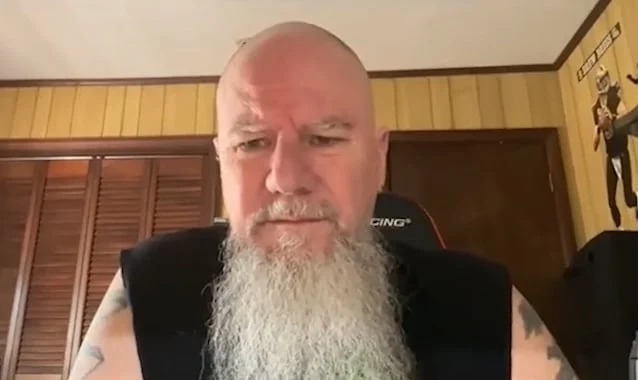
In a candid interview with Capital Chaos TV on September 1, 2026, Kyle Thomas, the formidable frontman of the pioneering thrash metal band EXHORDER, shared his perspective on the increasingly prevalent use of artificial intelligence (AI) in artistic creation. As fellow musicians begin to openly incorporate AI-generated content for album artwork, promotional materials, and even musical compositions, Thomas articulated a nuanced stance that champions human artistry while acknowledging the technological shift. His comments provide a critical lens through which to examine the evolving landscape of creative industries grappling with the implications of AI.
"I don’t have a really strong feeling against it, but I don’t have a strong desire to use it," Thomas stated, as transcribed by BLABBERMOUTH.NET. He elaborated on his viewpoint, likening the approach to personal preference and accessibility, suggesting, "So, the way I see it is if you’re over 21 and it’s available, then you use it; I don’t care." However, for his own creative endeavors, Thomas expressed a clear preference for human collaboration. "But for me, I would rather outsource my work to an artist to do my album artwork." This sentiment underscores a deep-seated appreciation for the tangible skill and vision of human artists, a value he sees threatened by the proliferation of AI.
The Human Touch: Valuing Artist Collaboration
Thomas pointed to the artwork for EXHORDER’s 2024 album, "Defectum Omnium," as a prime example of his preferred creative process. The striking cover art was crafted by Travis Smith, a renowned artist whose portfolio includes work for bands like Katatonia and Opeth. "The artwork for [EXHORDER’s 2024 album] ‘Defectum Omnium’ was done by Travis Smith," Thomas confirmed. "And I’m sure Travis uses a lot of computer graphics while he makes his art, but he’s making the art. And to me, that’s fine." This distinction is crucial: while acknowledging the integration of digital tools, Thomas emphasizes that the creative direction and execution remain firmly in the hands of a human artist.
He further emphasized this point by highlighting the work of his high school friend, Scott Guion, a celebrated artist whose career has seen him contribute to significant cultural touchstones. "But my buddy Scott Guion that I went to high school with, he’s an amazing artist. I played in PITTS VS. PREPS with him over the years, but he just most recently did the CORROSION OF CONFORMITY album cover. He’s also done murals in Hard Rock Café and House Of Blues, and he’s done the last handful of Jazz Fest posters for the New Orleans Jazz Fest." Thomas’s admiration for Guion’s diverse and impactful body of work serves as a personal testament to the value of human talent. "He’s an amazing artist. I’d rather see a guy or a girl — doesn’t matter, just an artist — I’d rather see a person, a human, get that contract, get that job." This preference is rooted in a desire to support individual livelihoods and the preservation of artistic careers.
The Mechanics and Morality of AI Art Generation
Thomas delved into his understanding of how AI generates art, articulating concerns about its underlying mechanisms and ethical implications. "Basically, AI, as far as I can tell, and I’m no expert, but it’s just kind of a method of electronically picking the brains out of every piece of art or music that’s ever been done before and cherry-picking it and putting something together on its own that’s kind of like just lifting off everything else," he explained. This description highlights the derivative nature of current AI art models, which are trained on vast datasets of existing human-created works.
A significant ethical concern for Thomas lies in the economic impact on artists. "But the person responsible for directing the AI doesn’t have to pay out any royalty to the persons that were the actual catalyst for the artwork to be created. So I think that’s problematic. That could really put a lot of people out of work." He drew a parallel to the introduction of self-checkout lanes in grocery stores, illustrating how automation can displace human workers. "Just like the checkout line at the grocery store when they’ve got a self-service counter. Well, that’s a job they took away from somebody. I’d rather sit in line and let somebody do it for me than have to do it myself. And sometimes it’s convenient — if I got four or five things and I’m just throwing it in the bag and going — but I’d rather see a person get that job. I really would." This analogy effectively communicates the societal impact of technological advancements that prioritize efficiency over human employment.
EXHORDER’s Recent History and Band Dynamics
The discussion of AI arises amidst a period of significant evolution for EXHORDER. The band’s recent history has been marked by personnel changes and the release of their fourth full-length album. In March 2026, drummer Sasha Horn departed the band to "focus on his personal life." This departure led to Corey Pierce of GOD FORBID fame temporarily filling the drum position on the road during the spring of that year. As of the interview, a permanent replacement for Horn had not yet been announced, indicating an ongoing phase of adaptation for the group.
EXHORDER’s latest album, "Defectum Omnium," was released in March 2024 by Nuclear Blast Records. This 12-track offering featured the aforementioned cover art by Travis Smith and followed the band’s critically acclaimed 2019 release, "Mourn The Southern Skies." The recording of "Defectum Omnium" involved sessions at Fat Track Studio in Cincinnati, Ohio, with engineer Rob Nadler. Notably, this album marked the first outing for former CANNIBAL CORPSE guitarist Pat O’Brien, who made his live debut with EXHORDER at the 2022 Maryland Deathfest.
This live appearance at Maryland Deathfest occurred three months after guitarist Marzi Montazeri announced his departure from EXHORDER. Montazeri stated at the time that he "decided to no longer be a part of it," signaling a creative divergence. Following Montazeri’s exit, the remaining members – Thomas, bassist Jason VieBrooks, and drummer Sasha Horn – released a joint statement acknowledging that they and Montazeri had been "moving in different directions" and expressed confidence in the band’s future, assuring fans they would "continue to thrive."
A Legacy of Innovation and Enduring Influence
Kyle Thomas stands as the sole remaining founding member of EXHORDER, a band that emerged in 1990 with its debut album, "Slaughter In The Vatican." The band’s early history also saw significant lineup shifts, including the departure of original guitarist Vinnie LaBella in February 2020. LaBella had been instrumental in writing much of the material for "Mourn The Southern Skies." The remaining members at that time affirmed their commitment to fulfilling their "touring and recording obligations for 2020 and beyond."
EXHORDER’s initial run in the early 1990s produced two seminal albums through the Roadrunner label: "Slaughter In The Vatican" and its 1992 follow-up, "The Law." After the band’s initial breakup, Kyle Thomas pursued other musical avenues, forming FLOODGATE and briefly serving as the live vocalist for TROUBLE, a band he would later join on a full-time basis and with which he remains a member.
The enduring impact of EXHORDER’s early work is undeniable. The band is widely credited as a progenitor of the riff-heavy, power-groove approach that later became a hallmark of bands like PANTERA. This influence highlights EXHORDER’s foundational role in shaping the sound of modern metal. The band’s contribution to the genre underscores the importance of their artistic legacy, a legacy that Thomas is actively safeguarding by advocating for human creativity in the face of technological disruption.
Broader Implications for the Music and Art Industries
Thomas’s reflections on AI in art generation resonate across a broader spectrum of creative fields. The ease with which AI can synthesize existing styles and imagery presents both opportunities for novel aesthetic exploration and significant challenges to established economic models for artists. The current legal and ethical frameworks surrounding AI-generated content are still in their nascent stages, leading to debates about copyright, ownership, and the definition of authorship.
The music industry, in particular, faces a complex future. While AI can assist in songwriting, composition, and production, the question of whether an AI can truly imbue music with the emotional depth and personal experience that resonates with audiences remains a subject of ongoing discussion. The potential for AI to democratize music creation by lowering barriers to entry is significant, but it also raises concerns about the devaluation of professional musicianship and the potential for market saturation with derivative content.
The parallel drawn to the self-checkout at grocery stores is a potent reminder of the societal trade-offs inherent in technological progress. While efficiency and convenience are often touted as primary benefits, the impact on human employment and the erosion of traditional skill sets cannot be ignored. For artists, the prospect of AI-generated work supplanting human commissions represents a direct threat to their livelihoods, challenging the very foundation of their careers.
As the conversation around AI in the arts continues to evolve, voices like Kyle Thomas’s are crucial. They highlight not only the technical capabilities of AI but also the profound human values – creativity, originality, and the dignity of labor – that are at stake. The future of art and music will likely involve a complex interplay between human ingenuity and artificial intelligence, but the emphasis on preserving the role and economic viability of human artists, as advocated by Thomas, will be paramount in shaping a sustainable and ethically sound creative ecosystem. The ongoing evolution of EXHORDER, a band with a storied past and a commitment to its artistic integrity, serves as a tangible example of how established artists navigate these new frontiers, seeking to balance innovation with the preservation of genuine human expression.
