

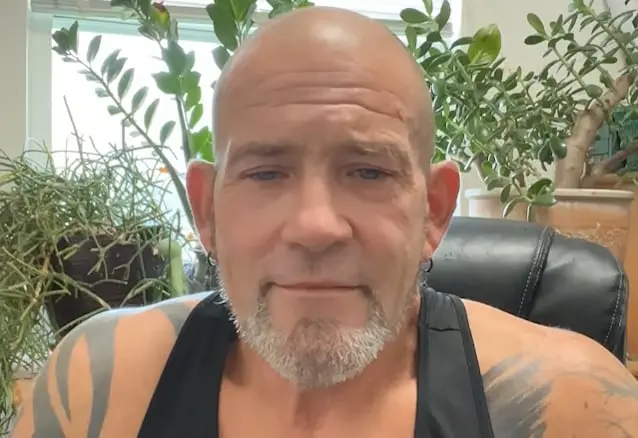
In a candid and expansive interview with Will McLeod of the Minnesota Music Note podcast, Anders Colsefni, the original vocalist for the seminal nu-metal act Slipknot, offered a deeply personal and insightful look into his experiences with the band’s formative years, his recent resurgence performing their early material, and his complex relationship with their debut release, "Mate. Feed. Kill. Repeat." Colsefni, whose raw, aggressive vocals defined the sound of that initial, unpolished offering, detailed the physical and emotional toll of revisiting these aggressive sonic landscapes, the evolving fan reception to his early work, and his profound disappointment with a recent, digitally-driven reinterpretation of the album.
The Physical and Emotional Demands of Reliving the Past
Colsefni admitted that stepping back onto the stage to perform songs from "Mate. Feed. Kill. Repeat." has been an exhilarating, albeit demanding, endeavor. "It’s pretty incredible," he stated. "It took me a little while. I had to research some of my lyrics, especially to ‘The Crowz’ songs." These "Crowz" tracks, a collection of demo recordings that emerged after "Mate. Feed. Kill. Repeat." and featured both Colsefni and current Slipknot vocalist Corey Taylor, presented a particular challenge. Colsefni lamented the loss of his original lyric notebooks, speculating they may have been sold or misplaced over the years.
Beyond lyrical recall, the physical performance itself has been a significant undertaking. "My God, I couldn’t remember just how difficult it was to do also," Colsefni confessed. He vividly described the multi-faceted performance requirements: "Beat on drums, scream, yell, sing, rap, growl some more, sing some more, beat on drums, kegs, trying to dodge something flying at my head from the Clown across the stage, stuff like that." The rigorous nature of these performances has necessitated a renewed focus on physical fitness. "I’ve really had to work to keep my old ass in shape in order to do this," he stated with a chuckle.
When asked if any particular tracks from "Mate. Feed. Kill. Repeat." resonated differently now, Colsefni pointed to the enduring favorites among fans. "Nowadays, I’m gonna say—I think it’s pretty much all the same favorites people had back then," he explained. "’Slipknot,’ the song ‘Slipknot,’ just because it’s such a stark difference from what it turned into. They wanna hear ‘Gently,’ and they love ‘Do Nothing’ and ‘Bitchslap.’ They just love that." He also noted the surprising popularity of "Killers Are Quiet," a track that, in his current live interpretations, can be extended into lengthy, improvisational "drone fests."
A New Generation Discovers the "Maggot" Roots
A particularly heartwarming aspect of Colsefni’s recent live performances has been the discovery of his early Slipknot work by younger audiences. He expressed his delight at seeing "little kids, I saw teenagers, I saw old country fans" attending his shows. The diversity of the audience, many of whom were brought along by family members or friends, has been striking. "Every one of them came up to me and said, ‘I’m a country fan, but that was cool.’"
Colsefni observed that the live experience offered a broader spectrum of emotions than some might anticipate from a band often associated with pure aggression. "It wasn’t all just angry, screaming, yelling, pissed off," he clarified. He humorously pointed to his use of a tambourine during the set as evidence that not every moment is steeped in unadulterated rage. "You can only derive so much hatred from a tambourine during a heavy show." He characterized the atmosphere as "funner," albeit "a little more hectic, chaotic and scattered about."
The "Mate. Feed. Kill. Repeat." Digital Debacle
A significant point of contention for Colsefni has been the 2024 re-recorded version of "Mate. Feed. Kill. Repeat.," which was completed with the New Zealand nu-metal outfit KAOSIS. Colsefni publicly disavowed this iteration, describing it as "a poor representation" of the original material. He detailed a breakdown in communication regarding the recording process. "I made it very clear that I needed actual live musicians playing the songs. They could not just be digitized and done through a program," he asserted.
Colsefni explained that he re-recorded his vocals in his son’s home studio, expressing satisfaction with his own performance. However, the final product fell far short of his expectations. "The entity in question made some business decisions for money-wise purposes, so he didn’t have people play live. They pretty much just did it all on the computer, and thus came out with this really horrible rendition of what was already a really good-sounding album." He lamented that the re-recording "did not improve upon it and did not do anything new. It just made it kind of dreadful." He expressed regret that this situation strained his prior good relationships with some of the individuals involved. Colsefni emphasized that this was not a decision he endorsed, and he has spent considerable time clarifying this to fans who mistakenly attributed the release to his direction.
For fans seeking the authentic "Mate. Feed. Kill. Repeat." experience, Colsefni directed them to YouTube. "You can find the original ‘MFKR’ on YouTube," he advised. "Don’t go to the one that is all bright and green, and just go to the one that has the album cover on it, the actual ‘MFKR’ album cover on it. You can’t go wrong."
Genesis of the Beast: Writing in a Des Moines Basement
Colsefni also shed light on the creative origins of "Mate. Feed. Kill. Repeat." In a previous interview with The Phase Remains The Same, he recounted the band’s early writing sessions. "In my basement, basement of a duplex right in the middle of Des Moines, with my upstairs neighbor constantly pissed off ’cause of the noise," he recalled. The cramped and rudimentary conditions—a "grungy, little, tiny basement with everybody crammed in tightly, with carpet hanging all over the place, try to dampen the sound"—were the crucible in which Slipknot’s initial sound was forged.
Defining "Mate. Feed. Kill. Repeat.": Demo or Debut?
The classification of "Mate. Feed. Kill. Repeat." as either a demo or a full-fledged album remains a point of discussion. Colsefni offered his perspective, stating, "Well, that all just depends on how you view things." He acknowledged the common industry practice where a band’s first signed album might be considered a demo, but he countered this by highlighting the significant investment of time and resources poured into "Mate. Feed. Kill. Repeat." "With as much time and money we spent on that first one, it might as well have been an album," he argued. The recording process, which spanned over a year and was fraught with creative disagreements, solidified his view. "So I myself call it a full album. It’s a full-length deal. It was recorded and engineered well, produced well, and mixed well, and comes out sounding really, really good. As far as I’m concerned, it’s a full album." However, he remained pragmatic, stating, "But it doesn’t really bother me one way or the other if anybody says it’s just a demo."
The Limited Run of a Groundbreaking Release
The scarcity of original "Mate. Feed. Kill. Repeat." copies is a point of interest for collectors and fans. Colsefni estimated the initial pressing to be 1,000 units. He also mentioned a subsequent pressing of another 1,000 copies, facilitated by Shawn "Clown" Crahan and -ismist Records, though he emphasized his personal lack of involvement in that process. "So it might be 2,000 total that were made, but I’m not going to actually claim that’s what it is. That’s just what I think was done."
The Dream of a Definitive Re-Recording
Colsefni expressed a strong desire to re-record "Mate. Feed. Kill. Repeat." with a modern, live-instrumentation approach. However, legal complexities surrounding Slipknot’s catalog, which was sold to a different company, present a significant hurdle. "We are looking right now to see what our legal options are with that, obviously," he confirmed. His vision involves collaborating with the musicians he has been performing with in his recent shows, aiming to create a recording that is "as close to the original as possible, a new recording of it." While he doesn’t anticipate significant financial returns from such a project, the primary goal is to make a properly realized version of the album available to fans.
"Mate. Feed. Kill. Repeat." as a Sonic Experiment
Reflecting on the album’s legacy, Colsefni reiterated his surprise at its enduring significance. "It blows my mind that this album that I was on is such a big, big deal, even at this time." He acknowledged its "demo" nature in the context of the band’s sonic evolution. "We were still all trying to figure out what our overall sound was gonna be." He noted the divergence between "Mate. Feed. Kill. Repeat." and the subsequent "Crowz" demos, which began to explore a more accessible, radio-friendly direction. Despite the passage of time and his periods of deliberate avoidance of the music, Colsefni now views these early works with a deeper understanding and appreciation. "Just three years ago, everything got reawakened in me, and all of this stuff, at my age now, all makes a lot more sense than it might have done back when I was 24."
The "Crowz" Sessions: A Collaborative, Yet Compromised, Beginning
Colsefni clarified the circumstances surrounding the "Crowz" recordings, which featured both his and Corey Taylor’s vocals. He emphasized that these were not collaborative sessions in the traditional sense. Following the submission of "Mate. Feed. Kill. Repeat." to Roadrunner Records, the label sought to gauge the band’s future direction. "The ‘Crowz’ songs were us writing our next stuff," Colsefni explained, listing tracks like "Me Inside," "Prosthetics," and "Scissors." The inclusion of Taylor’s vocals occurred during a period when Colsefni was away visiting family. "They brought him in while I was gone for a weekend… and had him come in and record vocals over mine or with mine."
The rationale presented to Colsefni upon his return was that Taylor’s vocals would serve as lead, with Colsefni providing background, a compromise he accepted. "They needed somebody out front with a mic that’s not beating on something else," he stated. He acknowledged that these "Crowz" tracks were initially conceived with his voice as the primary element, but the decision to bring in Taylor was made to secure a record deal. "And so, really, the ‘Crowz’ songs were really me first, and then they brought Corey in to redo them, and then sold it to Roadrunner so that they could get their record deal. And I have no regrets about it."
A Death Metal Heart and a Radio-Friendly Compromise
Colsefni identified himself as a "death metal singer by heart," recognizing that his initial vocal style was not conducive to radio play. He understood that Slipknot’s eventual mainstream success necessitated a shift in vocal approach. "I already knew that," he stated. While the band’s trajectory initially "crushed my spirit for a little while," he came to terms with his role as an original singer who wasn’t part of the band’s ultimate fame. He drew parallels to other bands with original vocalists who were replaced.
Despite the financial realities of the music industry, Colsefni continues to work a demanding full-time job, balancing his musical aspirations with everyday life. This perspective, he believes, is shared by the majority of musicians.
The Enduring Legacy of Paeface and the Road Ahead
Colsefni also touched upon his post-Slipknot endeavors, including the band PAIFACE, which he formed in 1998. After a hiatus and a name change to ON A PALE HORSE, he revived PAIFACE in 2010. The band is slated to release new singles, "Welcome, Mother Of Death" and "Temple," in 2025.
The catalyst for PAIFACE’s renewed creative output, Colsefni explained, was his 2021 tour in Australia and New Zealand performing "Mate. Feed. Kill. Repeat." This experience, he revealed, revitalized him during a period of deep depression following personal health challenges. "I was at a point, deep depression. I’ve had a couple surgeries, things that have really affected me personally, and for a while it was, like, ‘I’m just done. I’m done trying to make anything work.’"
Upon returning from New Zealand, he was inundated with messages from fans eager to connect with his early work. This surge of interest led him to form the "MFKR Committee," a group of individuals dedicated to managing "MFKR" related projects, recognizing that the endeavor had surpassed his individual capacity. This collective spirit then extended to the revival of PAIFACE, initially for a birthday party performance. The band has since undergone lineup changes and is focused on a "new death metal" sound characterized by groove and power. They are currently working on new material, with plans to release it in pairs until a full album is ready. Colsefni expressed a pragmatic approach to the modern music industry, emphasizing the importance of releasing music promptly, often independently.
A Legacy of Impact and Artistic Evolution
Colsefni’s reflections underscore the complex and often challenging journey of an artist whose early contributions laid the groundwork for a global phenomenon. His willingness to revisit the raw intensity of "Mate. Feed. Kill. Repeat." and engage with a new generation of fans speaks to a deep-seated passion for his craft. His critiques of the digitally re-recorded album highlight a commitment to authenticity and the integrity of the original artistic vision. As he navigates the legal and creative landscape, his aspirations for a definitive re-recording of Slipknot’s debut and the continued evolution of his own musical projects suggest a future where his indelible mark on metal history will continue to be explored and appreciated.
