

The intersection of professional event technology and radical political activism has found a new, mobile manifestation in the Adenauer SRP+, a vehicle described by its creators as the "most aggressive roadshow in Germany." Developed by the Center for Political Beauty (Zentrum für Politische Schönheit, or ZPS), the project represents a departure from traditional political campaigning, utilizing the sophisticated logistics and engineering usually reserved for high-budget corporate product launches to demand a ban on the Alternative for Germany (AfD) party. Since its launch in January 2025, the vehicle has transitioned from a temporary campaign tool into a permanent, technologically evolving "command post of civil society," challenging both legal boundaries and the technical standards of the event industry.
Historical Context and the SRP Precedent
The nomenclature of the Adenauer SRP+ is rooted in a significant chapter of German constitutional history. The "SRP" refers to the Sozialistische Reichspartei (Socialist Reich Party), a neo-Nazi organization that became the first political party to be banned by the Federal Constitutional Court of West Germany in 1952. Under the administration of Chancellor Konrad Adenauer, the proceedings were concluded in just ten days, establishing a precedent for "fortified democracy" (wehrhafte Demokratie).
By appending "Adenauer" and "SRP+" to the project, the ZPS explicitly calls for a modern application of Article 21 of the Basic Law, which allows for the prohibition of parties that seek to undermine or abolish the free democratic basic order. The campaign argues that the current evidence against the AfD mirrors the constitutional threats posed by the SRP seven decades ago. To support this, the ZPS launched a digital archive (www.afd-verbot.de) containing thousands of documented instances of alleged unconstitutional behavior, which serves as the intellectual foundation for the roadshow’s messaging.
Technical Engineering: A Masterpiece of Sonderbau
What distinguishes the Adenauer SRP+ from typical protest vehicles is the caliber of its engineering. The base vehicle, a repurposed French school bus, underwent a six-week intensive conversion phase to become a mobile stage, broadcasting studio, and interactive exhibition space. The ZPS leveraged the expertise of professional event planners, creative directors, and specialized engineers to create a vehicle that complies with strict German road safety regulations (StVZO) while housing high-end AV equipment.
Audio and Acoustic Power
The acoustic strategy of the Adenauer SRP+ is designed for maximum "penetration" in public spaces. The vehicle features top-tier audio components from Lambda Lab, including top-side speakers mounted on a pneumatic system. This allows the equipment to remain within the four-meter height limit during transit and extend into a functional array during "action mode."
The system is versatile: top-side units can be oriented to provide 360-degree coverage or stacked vertically to focus sound toward a specific rally or festival audience. To augment the low-end frequencies, the team integrated custom-built subwoofers into the lateral luggage compartments of the bus—spaces originally designed by Mercedes-Benz for passenger baggage. Looking toward 2026, the ZPS has announced the development of a "bass trailer" featuring twelve double-18-inch subwoofers to further amplify the vehicle’s presence at large-scale demonstrations.
Lighting and Visual Projection
Visual impact is achieved through a combination of high-intensity projection and LED technology. One of the project’s most notable technical acquisitions is the Robert Juliat Aramis, a high-output followspot typically found in stadiums and large theaters. The ZPS utilizes the Aramis as a gobo projector, capable of casting crisp, high-contrast political messages onto buildings from significant distances.
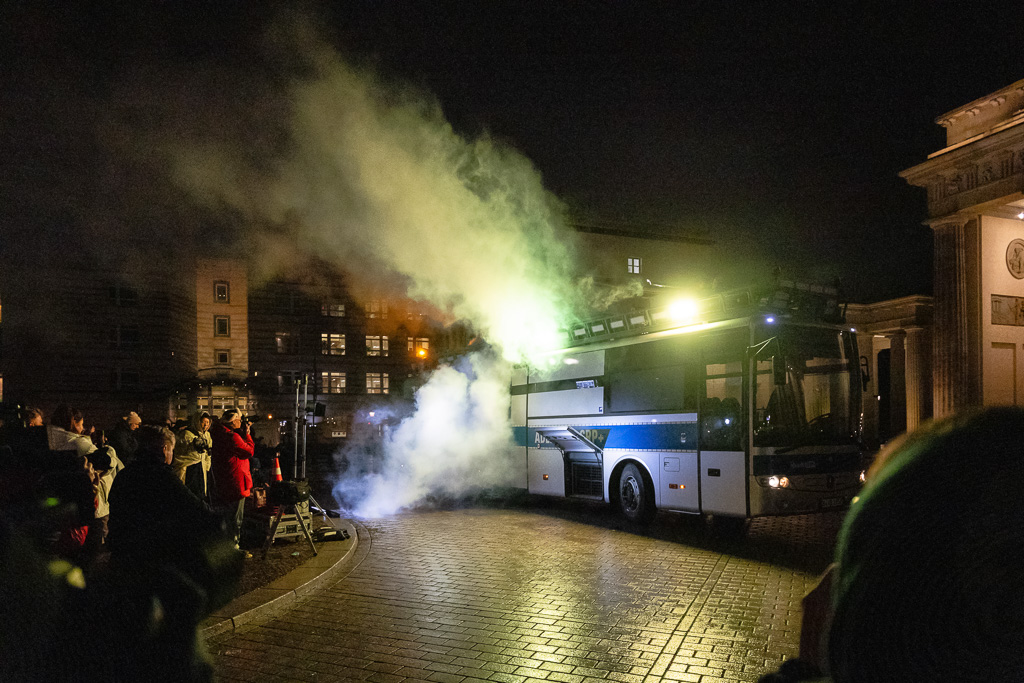
The vehicle also features an integrated LED wall and motor-controlled floodlights. To ensure the safety of the equipment and compliance with transit laws, all roof-mounted lighting is designed to be retracted and electronically disconnected while the bus is in motion. This "modular" approach allows the crew to transform the vehicle from a standard-looking bus into a "catastrophe scenario" stage—complete with blue lights and fog effects—within minutes.
Chronology of the 2025-2026 Campaign
The operational history of the Adenauer SRP+ is marked by high-stakes public appearances and frequent friction with law enforcement.
- January 10, 2025: The vehicle is unveiled at the Brandenburg Gate in Berlin. The premiere utilized a "disaster atmosphere" aesthetic, blending sirens, Nazi-era marches, and contemporary political quotes to create a jarring historical parallel.
- January 11, 2025: The bus travels to Riesa for an AfD party congress. Following a three-hour police inspection, the vehicle was "immobilized" in an industrial area. In a maneuver described by the ZPS as "civil disobedience," the bus managed to bypass police cordons and intentionally "broke down" on the main access road to the congress, delaying the start of the political event and ensuring the campaign’s siren was heard across a 20-kilometer radius.
- Late 2025: The tour visits Gießen, where the team tests new projection techniques. This period marked the decision to move from rented equipment to permanent, custom-engineered lighting solutions.
- July 2026: Following a successful crowdfunding campaign involving over 10,000 "investors," the ZPS announces the permanent extension of the tour. The focus shifts to upgrading the vehicle for long-term "all-weather" operations, including the installation of specialized water tanks and high-pressure systems.
Legal Friction and Regulatory Compliance
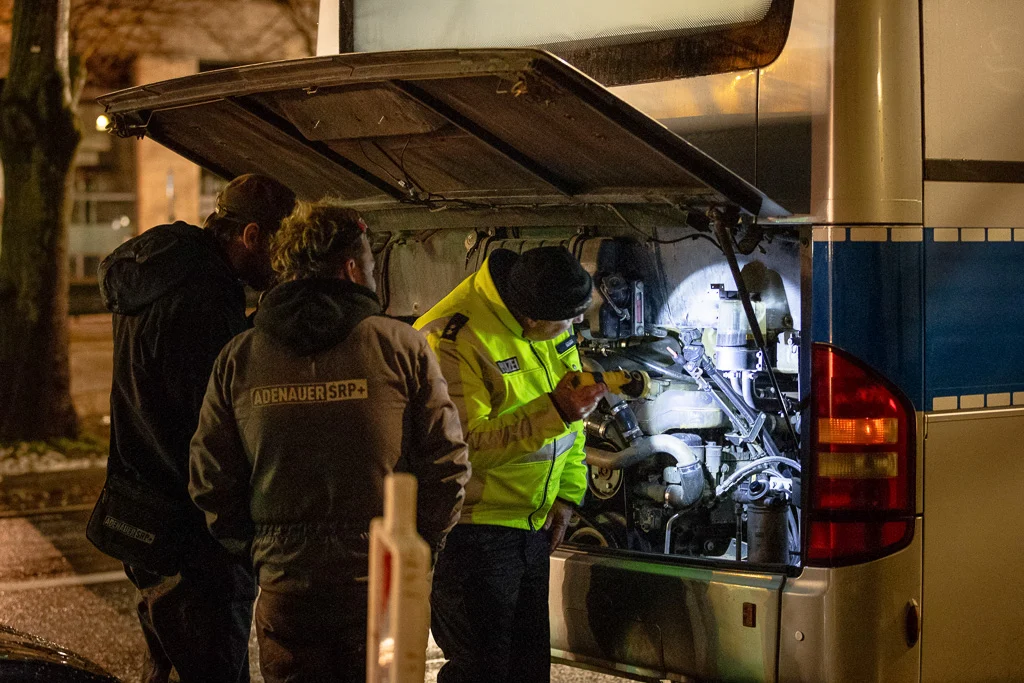
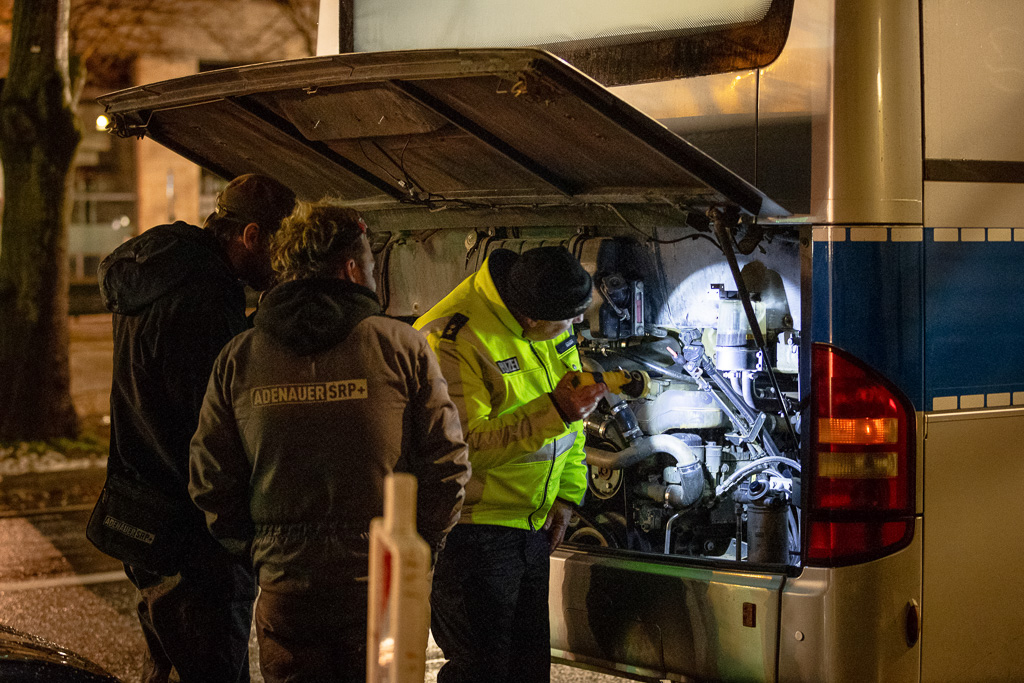
The Adenauer SRP+ has faced an unprecedented level of scrutiny from German traffic authorities and police. In its first six weeks of operation, the vehicle was subjected to over 20 police checks, towed twice, and confiscated once. During one incident in Berlin, a window was shattered during a police intervention.
The ZPS alleges that the frequency of these checks constitutes a "planned prevention of protest." However, the technical robustness of the vehicle has served as its primary defense. To date, five full "Vollgutachten" (comprehensive technical inspections) have been conducted by organizations such as Dekra. The fifth inspection was a high-profile event attended by parliamentary observers and media representatives to ensure transparency. In every instance, the vehicle was deemed roadworthy, with only minor, non-critical defects noted.
This legal tug-of-war has highlighted a unique aspect of the project: the use of "Sonderbau" (special construction) laws. By classifying the roof-mounted equipment as "load" (Ladung) rather than permanent fixtures, the ZPS navigated complex regulations that often stifle creative engineering in the corporate event sector.
Operational Logic: The Interior as Storytelling
The interior of the Adenauer SRP+ is designed to function as a "prisoner transporter," a grim aesthetic choice intended to evoke the transportation of high-profile extremist defendants, such as Beate Zschäpe of the NSU. While the base is a school bus, the interior has been meticulously modified by theater painters and prop masters to create a convincing illusion of a high-security cell block.
Despite the rugged appearance, the interior is a high-tech hub. It houses:
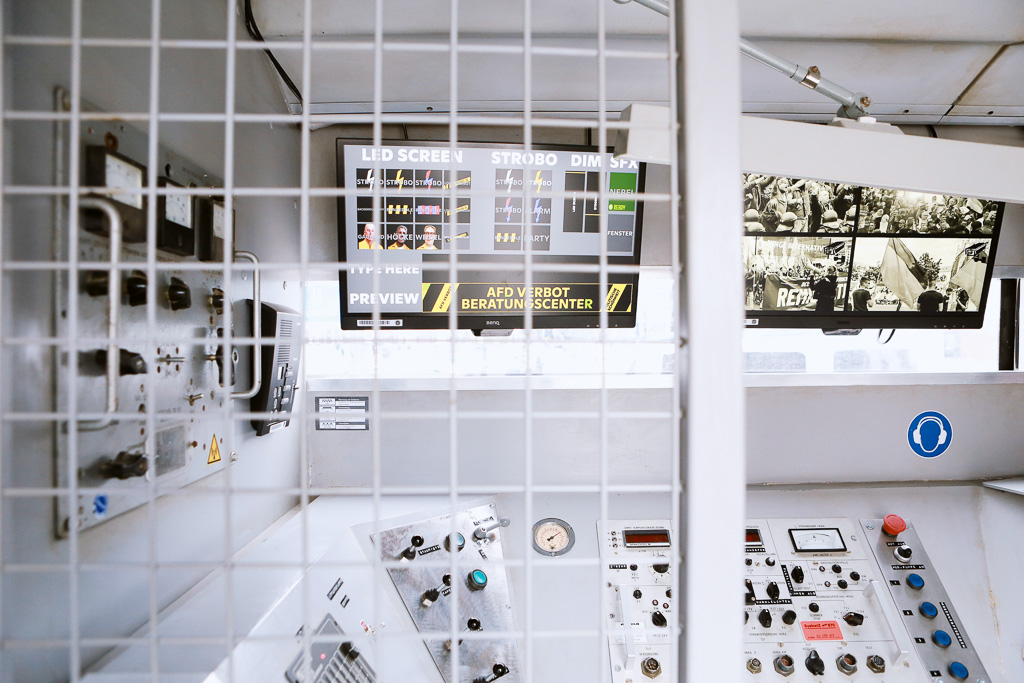
- A Mobile Studio: Used for recording podcasts, television documentaries, and live-streaming media interviews.
- The Control Center: Lighting consoles and audio mixers are integrated directly into the "cell walls," allowing the crew to manage the external show without leaving the safety of the vehicle.
- The "Alcohol Interlock" Paradox: A technical quirk of the original French school bus requires the driver to pass a breathalyzer test before the engine will start. This feature occasionally caused "unplanned" stops when the system required a re-test, adding a layer of unpredictable realism to the vehicle’s public "breakdowns."
Broader Implications for the Event Industry
The Adenauer SRP+ serves as a provocative case study for the professional event industry. Arne Heyen, a creative director and key figure in the project, suggests that the "professionalism of the Fusion Festival meets corporate event standards" demonstrated by the ZPS team offers valuable lessons in agility and purpose-driven engineering.
The project demonstrates that the tools of high-end communication—precision audio, powerful optics, and complex automation—can be decoupled from brand marketing and applied to constitutional debate. The ZPS’s ability to move from concept to a TUV-certified, high-tech vehicle in six weeks challenges the often slow and overly cautious timelines of traditional corporate "Sonderbau" projects.
Conclusion and Future Outlook
As the Adenauer SRP+ continues its tour through 2026, it remains a polarizing symbol of "artistic activism." For its supporters, it is a necessary, technologically empowered alarm bell for a democracy under threat. For its critics, it is an aggressive provocation that tests the limits of the right to assembly and traffic safety laws.
Regardless of the political outcome regarding the AfD ban, the Adenauer SRP+ has already succeeded in shifting the landscape of political communication. It has proven that in an era of digital saturation, physical, high-tech presence—backed by rigorous engineering and historical symbolism—remains a potent tool for capturing public and media attention. The project’s transition into a permanent installation suggests that the "Gefechtsstand der Zivilgesellschaft" (command post of civil society) will remain a fixture of the German political landscape for the foreseeable future.
