

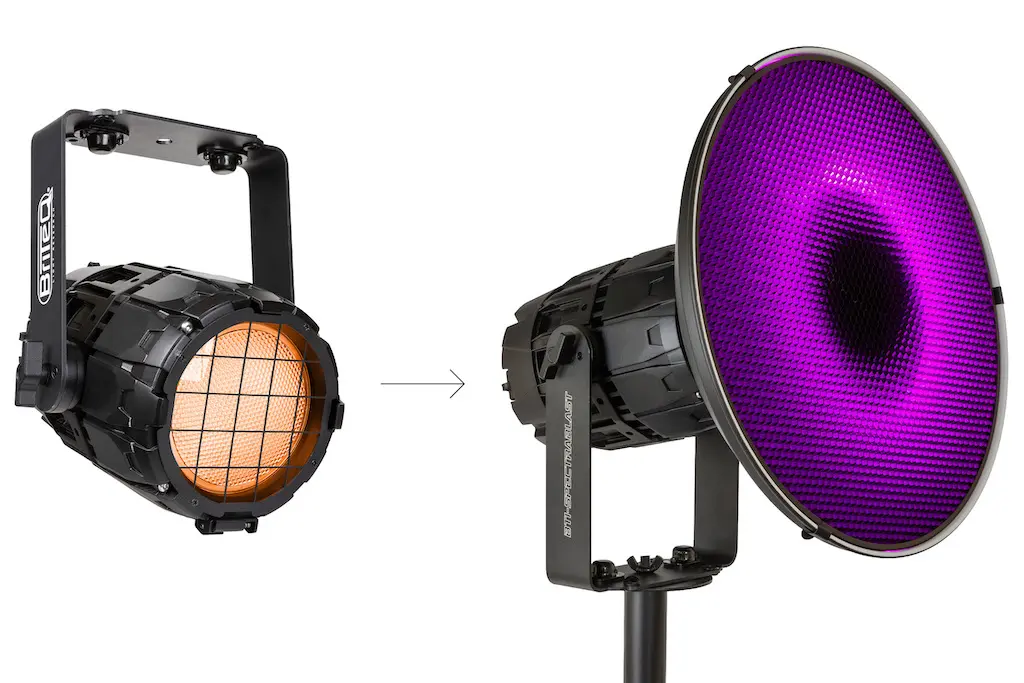
The professional lighting industry has witnessed a significant shift toward energy-efficient, high-output solutions that do not compromise the aesthetic warmth of traditional tungsten sources, and the introduction of the Briteq BTI-Spectrablast represents a pivotal moment in this technological evolution. Distributed in Germany by MR Products Ton- und Lichttechnik GmbH, the BTI-Spectrablast is not merely a replacement for the classic audience blinder; it is a multi-functional lighting tool designed to meet the rigorous demands of modern concert touring, outdoor festivals, and high-end architectural installations. By integrating a sophisticated 380-watt RGBALC LED engine with an innovative modular mechanical design, Briteq has addressed the long-standing industry challenge of achieving perfect color rendering and halogen-style dimming within a rugged, weather-resistant chassis.
The Evolution of the Audience Blinder: From Tungsten to RGBALC
For decades, the "audience blinder"—often referred to by the industry standard DWE (Daylight White Electric) lamps—has been a staple of live performance. These fixtures were prized for their intense output and the characteristic "amber shift" that occurs as the filament cools during dimming. However, traditional blinders are notoriously inefficient, generating immense heat and requiring frequent lamp replacements. The BTI-Spectrablast enters the market as a sustainable alternative that replicates these classic characteristics while expanding the creative palette for lighting designers.
At the heart of the BTI-Spectrablast is a 380-W RGBALC LED light source. Unlike standard RGB or RGBW fixtures, the inclusion of Amber, Lime, and Cyan (ALC) chips allows for a significantly broader color gamut and a much higher Color Rendering Index (CRI). The Lime and Cyan chips fill the spectral gaps often found in LED sources, enabling the fixture to produce rich, saturated colors and nuanced pastels that were previously difficult to achieve. Furthermore, this six-color engine allows for a variable color temperature range spanning from a warm 1,500 K to a crisp, daylight-balanced 8,500 K, making it as suitable for theatrical key lighting as it is for high-energy strobe effects.
Mimicking the Halogen Legacy: The Amber-Drift Effect
One of the primary criticisms of early LED blinders was their "clinical" dimming curve. Traditional halogen lamps have a thermal lag; as they dim, the color temperature drops into the deep oranges and reds. Briteq has engineered the BTI-Spectrablast with a sophisticated "Amber-drift" emulation. This software-driven feature adjusts the color mix in real-time as the intensity decreases, perfectly mimicking the warming glow of a cooling filament.
For lighting designers working on rock-and-roll or acoustic sets, this feature is essential for maintaining the emotional "vibe" of a performance. The ability to transition from a blinding white flash to a soft, sunset-orange glow allows the Spectrablast to function both as an aggressive effect light and a subtle mood-setting tool. This dual-purpose capability significantly increases the return on investment for rental houses, as a single fixture can now perform the roles of a blinder, a wash light, and a strobe.
Modular Engineering and the Bowens Adapter Innovation
A standout feature of the BTI-Spectrablast that distinguishes it from its competitors is its mechanical versatility. Briteq has implemented an optional Bowens-mount adapter, a standard widely used in the professional photography and cinematography industries. This allows the Spectrablast to be outfitted with a vast array of light-shaping tools, including softboxes, beauty dishes, reflectors, and snoots.
This crossover functionality is particularly relevant in the era of hybrid events and high-definition concert filming. When a production requires a high-output light source for a broadcast segment or a backstage interview, the Spectrablast can be quickly converted from a stage blinder into a soft, diffused studio light.
Beyond its optical versatility, the physical chassis of the fixture is designed for rapid deployment. Through the use of optional "Splice" and "Clamp" connectors, technicians can lock multiple units together with precision. This modularity enables the creation of complex geometric shapes, such as vertical light columns, circular arrays, or massive square grids of light. In a touring environment where "load-in" and "load-out" times are critical, the ability to pre-rig these clusters into stable blocks is a significant logistical advantage.
Built for the Elements: IP65 Rating and Thermal Management
The BTI-Spectrablast is housed in a robust die-cast aluminum casing, providing both physical durability and efficient heat dissipation. Recognizing that the modern festival season often subjects equipment to unpredictable weather, Briteq has ensured the fixture carries an IP65 rating. This "Ingress Protection" certification signifies that the unit is dust-tight and protected against water jets from any angle, making it fully qualified for outdoor use in rain or high-humidity environments without the need for additional protective "rain hats" or domes.
Despite its high power output, the thermal management system is designed to be whisper-quiet. This makes the BTI-Spectrablast an ideal candidate for noise-sensitive environments such as television studios or theaters, where the hum of cooling fans can interfere with audio recordings or the intimacy of a performance.
Technical Specifications and Data Analysis
To understand the impact of the BTI-Spectrablast, one must look at the data that defines its performance:
- Power Consumption: 380 Watts at full output, significantly lower than the 1,300-2,600 Watts required by traditional 2-lite or 4-lite DWE blinders.
- Light Source: RGBALC LED Engine (Red, Green, Blue, Amber, Lime, Cyan).
- Color Temperature: Adjustable from 1,500 K to 8,500 K.
- Control Protocols: DMX512, RDM (Remote Device Management) for easy configuration from a console.
- Dimming Curves: Multiple selectable curves (Linear, Square, Inverse Square, S-Curve) to match existing rigs.
- Housing: IP65-rated die-cast aluminum.
- Weight and Dimensions: Optimized for high-density truck packing.
From an economic perspective, the reduction in power consumption allows production companies to run more fixtures on a single power circuit. For an average outdoor stage, replacing 40 traditional blinders with BTI-Spectrablasts could reduce the required power draw by over 60,000 Watts, leading to smaller generator requirements and lower fuel costs.
Market Reception and Professional Implications
Industry experts and distributors, including the team at MR Products Ton- und Lichttechnik GmbH, have noted that the market is currently demanding fixtures that offer more than a "one-trick pony" utility. As touring budgets are scrutinized, the demand for "hybrid" fixtures—those that can act as blinders, strobes, and high-CRI wash lights—has surged.

"The BTI-Spectrablast represents the next step in the democratization of high-end lighting technology," suggests a technical analysis of the product’s release. "By providing the RGBALC spectrum at this price point and build quality, Briteq is enabling mid-sized production companies to achieve the same visual fidelity that was previously reserved for stadium-level tours."
The German market, known for its strict safety standards and preference for high-quality engineering, is expected to be a primary territory for the Spectrablast. MR Products has emphasized the fixture’s compliance with European safety regulations and its readiness for the "green" mandates being adopted by many European venues and municipalities.
Timeline of Development and Future Outlook
The launch of the BTI-Spectrablast follows several years of research and development into LED color mixing. The transition from RGB to RGBW, and now to RGBALC, marks a decade of progress in semiconductor technology. Briteq’s decision to launch the Spectrablast in late 2026 aligns with the broader industry trend of phasing out incandescent lamps entirely, as many halogen bulbs become increasingly difficult to source due to environmental legislation.
Looking forward, the success of the BTI-Spectrablast is likely to spark further innovations in modular lighting. The integration of the Bowens mount suggests a future where the lines between stage lighting, studio lighting, and architectural illumination continue to blur.
Conclusion: A New Standard for the Industry
The Briteq BTI-Spectrablast is a testament to how far LED technology has come in replicating—and then exceeding—the capabilities of traditional lighting. By combining the emotional warmth of the "Amber-drift" with the technical precision of the RGBALC engine and the ruggedness of an IP65-rated chassis, Briteq has provided a tool that serves the artist, the technician, and the accountant alike.
As it begins to appear on gear lists for the 2027 festival season and beyond, the BTI-Spectrablast is poised to become a ubiquitous sight on stages across Europe. It offers a compelling argument that the era of the tungsten blinder has finally reached its twilight, replaced by a smarter, more colorful, and infinitely more versatile successor. Whether used to bathe an audience in a warm sunset glow or to create a strobing geometric masterpiece, the Spectrablast is engineered to perform under the most demanding conditions, solidifying Briteq’s position as a leader in the mid-to-high-tier professional lighting market.
