

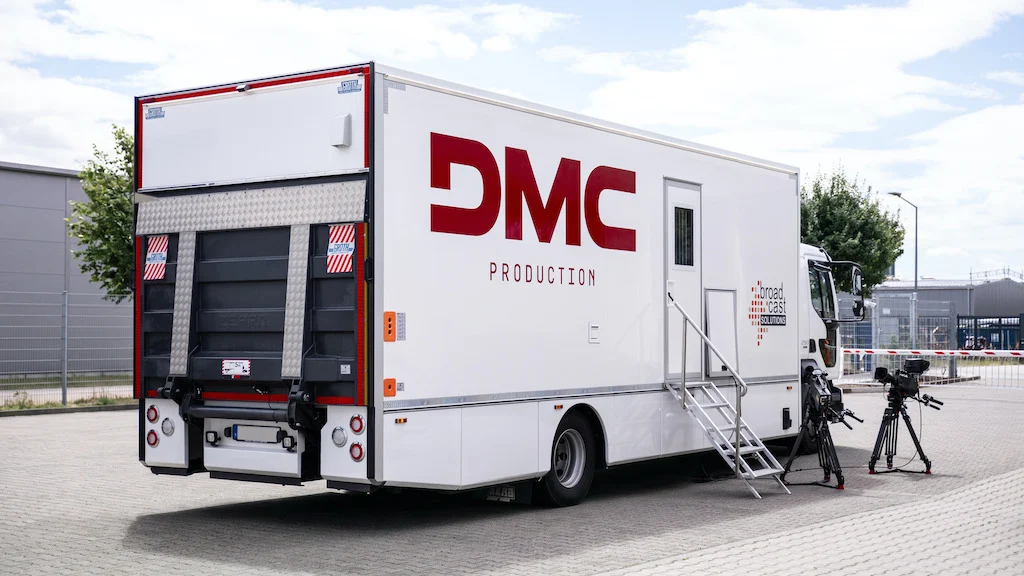
The global broadcast industry is witnessing a fundamental shift in how live sports and entertainment are captured and distributed, marked by the recent delivery of two high-performance outside broadcast (OB) vans from Broadcast Solutions to the remote production specialist DMC Production. These vehicles represent a departure from traditional mobile production architecture, utilizing a "Reverse-Remote" concept that leverages the Grass Valley Agile Media Processing Platform (AMPP) to centralize processing while decentralizing control. This technological leap addresses the long-standing challenges of bandwidth consumption, latency, and environmental sustainability that have historically hindered the full-scale adoption of remote production workflows. By integrating software-defined processing directly within a compact vehicle footprint, DMC and Broadcast Solutions have established a new benchmark for efficiency in the coverage of Tier 2 and Tier 3 sporting events, such as Germany’s 3. Liga and ATP tennis tournaments in Sweden.
The Evolution of the Reverse-Remote Production Concept
For over a decade, the broadcast industry has pursued "Remote Integration" (REMI) or "At-Home" production as a means to reduce costs and improve the quality of life for technical crews. In a traditional REMI setup, multiple raw camera feeds are transmitted from the venue via high-capacity fiber-optic links to a centralized production hub. While effective, this model requires massive, stable bandwidth—often exceeding several gigabits per second—and is highly susceptible to any fluctuations in network latency.
DMC Production, a leader in European remote workflows, identified these constraints as a barrier to scaling operations. Their "Reverse-Remote" concept flips the traditional model on its head. Instead of sending raw signals to a central hub for processing, the signals are processed, switched, and mixed locally within the OB van parked at the venue. However, the human interface—the vision mixers, replay operators, and directors—remains at the central production center. Only the control data and low-latency monitoring streams travel across the internet.
Jens Envall, Chief Innovation Officer at DMC Production, emphasizes that this approach solves the "bandwidth bottleneck." By keeping the heavy lifting of signal processing on-site but the creative control remote, the system requires only a fraction of the internet capacity typically associated with high-end remote production. This allows DMC to produce high-quality broadcasts from locations where high-speed fiber infrastructure might be unavailable or prohibitively expensive.
Technical Architecture and Software-Defined Workflows
The heart of these new units is the Grass Valley AMPP environment, a cloud-native, microservices-based platform that allows for unprecedented flexibility. Unlike traditional OB vans, which are built around a fixed hardware router and a physical vision mixer, these software-defined vehicles utilize "AMPP Edge" servers.
Each vehicle is equipped with two AMPP Edge servers powered by Nvidia Blackwell GPUs. These high-performance graphics processors are capable of handling intensive computational tasks, such as real-time video encoding, decoding, and effects rendering. The use of Nvidia Blackwell architecture ensures that the vehicles are future-proofed for the next generation of AI-driven broadcast tools and high-dynamic-range (HDR) processing.
The technical specifications of the vehicles include:
- Camera Support: Each unit supports up to 16 Grass Valley LDX98 cameras, connected via standard stage boxes and field termination panels.
- Signal Standards: The vehicles currently operate in native 1080p with full support for both Standard Dynamic Range (SDR) and High Dynamic Range (HDR). Crucially, the infrastructure is UHD-ready, allowing for a seamless transition to 4K production as client demands evolve.
- Storage and Replay: With 11 terabytes of local high-speed storage per server, the units handle all replay and super-slow-motion functions locally, ensuring that high-frame-rate video does not need to be streamed over the internet for editing.
- Audio Infrastructure: Audio mixing is managed by the Calrec Argo M36 console, a modern IP-native platform that integrates perfectly with the software-defined core of the van.
- Networking: Redundant Cisco switches form the backbone of the internal network, utilizing the GRID (MXL) network protocol to ensure ultra-low latency within the vehicle’s ecosystem.
Bandwidth Efficiency and Connectivity Breakthroughs
One of the most striking achievements of the Reverse-Remote concept is its minimal reliance on external network infrastructure. Traditional remote productions often require dedicated 10 Gbps or 1 Gbps lines to ensure signal integrity. In contrast, the DMC units can operate at full capacity with a standard internet connection of just 100 Mb/s.
The bandwidth is meticulously allocated to ensure operational stability:
- Control Data: Approximately 25 Mb/s is dedicated to control signals, ensuring that when a director at the hub pushes a button, the action occurs on-site with imperceptible latency.
- Monitoring: Another 25 Mb/s is used for WebRTC-based multiviewer streams, providing the remote crew with a real-time view of all camera angles.
- Program Output: The final program feed is typically transmitted back to the broadcast center as a Secure Reliable Transport (SRT) stream at 25 Mb/s, offering high-quality video that is resilient to public internet jitter.
This efficiency allows DMC to utilize diverse connectivity options, including bonded cellular or Starlink satellite links, in areas where traditional fiber is absent.
Environmental Sustainability and Operational Logistics
The shift toward software-defined OB vans carries significant environmental implications. Traditional outside broadcasting often involves "convoy logistics," where large 40-ton articulated trailers are accompanied by support trucks and tender vehicles. These convoys have a massive carbon footprint due to fuel consumption and the logistical complexity of moving large crews to and from remote sites.
The new DMC units are housed in compact, agile vehicle frames. By replacing one or two full-sized semi-trailers with a single compact van, the carbon emissions associated with transport are drastically reduced. Furthermore, because the majority of the production crew—including directors, producers, and replay operators—remain at their home base, the need for air travel and hotel accommodations is nearly eliminated.
This "Green" approach is not merely a marketing tool; it is a response to the increasing demand from sports federations and broadcasters for more sustainable production solutions. The compact design also provides a tactical advantage, allowing the vehicles to access tight urban locations or historic venues where large trailers simply cannot fit.
Real-World Application: From 3. Liga to ATP Tennis
The operational viability of these vehicles has already been proven in high-stakes environments. In Germany, the units are being deployed for the 3. Liga, the third division of professional football. These matches require high production values—multiple camera angles, replays, and professional graphics—but often operate on tighter budgets than the Bundesliga. The Reverse-Remote model provides the perfect balance of quality and cost-efficiency for this tier of sport.
Similarly, in Sweden, the vehicles are utilized for ATP tennis tournaments. Tennis is a sport that benefits immensely from remote production due to the long duration of matches and the need for specialized operators who can now manage multiple matches across different venues from a single central hub.
The flexibility of the design also allows for "hybrid" operations. If a specific production requires the director to be on-site, the vehicle includes a small production area. This ensures that the technology adapts to the creative needs of the client rather than forcing the client to adapt to the technology.
Industry Perspectives and Collaboration
The successful delivery of these units is the result of a deep collaborative partnership between DMC Production and Broadcast Solutions. As one of Europe’s largest system integrators, Broadcast Solutions brought its expertise in vehicle engineering and IP infrastructure to realize DMC’s vision.

Zlatan Gavran, COO of Broadcast Solutions, noted that the project represents a milestone in "Software-First" vehicle design. He emphasized that while the technology is cutting-edge, the user experience remains familiar. "We have created a software-defined OB van that delivers the highest quality and can be controlled from anywhere in the world," Gavran stated. "But it is built in a form that is familiar to engineers and directors, ensuring that they can step into this new workflow without a steep learning curve."
This sentiment is echoed throughout the industry as broadcasters look for ways to modernize aging hardware fleets. The move toward software-defined architectures allows for faster updates, easier scaling, and a longer equipment lifecycle, as features can be added via software patches rather than hardware replacements.
Broader Implications for the Future of Broadcasting
The "Reverse-Remote" model pioneered by DMC and Broadcast Solutions is likely to serve as a blueprint for the future of the industry. As 5G networks become more ubiquitous and GPU processing power continues to follow Moore’s Law, the capability of these compact units will only grow.
Analysts predict that the market for remote production will continue to expand at a double-digit compound annual growth rate (CAGR) through 2030. Innovations like those found in the DMC vans are the primary drivers of this growth. By lowering the entry barrier for high-quality live production, more sports, niche events, and corporate productions can achieve a professional broadcast look without the traditional overhead.
Furthermore, the integration of AI within the AMPP and Nvidia Blackwell ecosystem opens doors for automated highlight generation, real-time language translation, and advanced player tracking—all processed at the edge, within the van, before being sent to the world.
Conclusion and Upcoming Showcases
The delivery of these two software-defined OB vans marks a definitive moment in the transition from hardware-centric to software-centric broadcasting. By successfully implementing the Reverse-Remote concept, DMC Production and Broadcast Solutions have proven that it is possible to achieve high-end production results with reduced bandwidth, lower costs, and a smaller environmental footprint.
Industry professionals will have the opportunity to see these innovations firsthand. One of the new DMC Reverse-Remote units will be on display at IBC 2026 in Amsterdam, located at stand 0.A03 in the outdoor exhibit area. Additionally, Broadcast Solutions will showcase its latest developments at LEAT CON 26 in Hamburg from October 6–8, located in Hall A4. These events will provide a platform for the industry to discuss the ongoing evolution of live production and the pivotal role that software-defined infrastructure will play in the years to come.
