

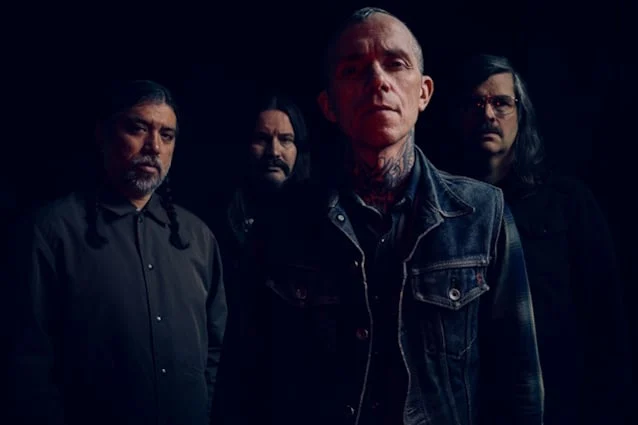
In an unprecedented creative surge, the seminal metalcore band Converge has announced the simultaneous release of two full-length albums in 2026: "Hum Of Hurt" and "Love Is Not Enough." This ambitious undertaking, distributed through Deathwish and Epitaph, marks a significant moment in the band’s storied career, reflecting a period of intense productivity and a desire to fully document their current artistic output. Vocalist and lyricist Jacob Bannon, in a recent interview with "The Pit" on Minnesota’s 93X radio station, shed light on the motivations and creative process behind this dual release.
Bannon articulated the band’s long-standing commitment to forward momentum and productivity, acknowledging that recent years, while challenging, have paradoxically fueled their creative output. "We’ve been a band for a long time, and we like forward movement. We like being productive," Bannon stated. He referenced the band’s recent activities, including extensive touring, the release of the "Bloodmoon: I" album, and the deluxe edition of a prior record, as efforts to "make up for a lot of lost time after COVID in terms of touring and just sort of refilling our schedule." This period of recalibration and renewed engagement with live performance and recording laid the groundwork for the current expansive project.
The genesis of two distinct albums, rather than a single cohesive work, emerged organically during the studio sessions. "We didn’t really have a goal to make two albums specifically; we just wanted to document what we had," Bannon explained. "And as we started creating the material and getting it down on tape, it started to kind of become two albums on its own." The process involved grouping songs based on sonic or thematic connections, or even technical considerations like song sequencing. "You started grouping songs together that you feel are sonically or thematically kind of tied. It could be a technical thing, a tuning issue, or we think that song A should go into song C. And eventually, it started working itself out naturally to just become two albums, and so we just went for it." This approach underscores a commitment to artistic integrity, allowing the material to dictate its own form.
The decision to release both albums concurrently or in close proximity, rather than staggering them, stems from a philosophy of seizing opportunities and maximizing creative impact. "In terms of the timing, doing them all at once, why not? Life’s short," Bannon mused. "You only have so much time to do stuff, and I wanna make sure that when I am no longer able to do what I do physically that I gave it everything I had when I could. And that’s my mentality, and I think that’s our collective mentality as a band." This sentiment reflects a profound awareness of mortality and a drive to leave an indelible mark while still at the peak of their creative powers.
Distinguishing "Hum Of Hurt" and "Love Is Not Enough"
While both albums are products of the same creative crucible, Bannon emphasized that they are distinct artistic statements, rather than direct sequels or companion pieces in a conventional sense. "They’re statements on their own," he clarified. "They’re companion pieces to one another just as much as our entire catalog is a companion piece to each other, effort that we’ve put in, in a recorded effort. So they’re all related. They’re all personal stories. They’re all personal reflections of our lives. With that said, that’s no different than anything else that we’ve ever done. They just happen to be four months apart." This perspective suggests a nuanced relationship where each album possesses its own identity while contributing to the overarching narrative of Converge’s discography.
Further elaborating on the individual character of each album, Bannon provided initial insights into their sonic and thematic leanings. "Hum Of Hurt" was initially conceived with a "noise rock album" in mind, though Bannon noted it evolved beyond that initial descriptor. He characterized it as leaning more towards an "emotional hardcore album," while "Love Is Not Enough" is perceived as having a "metal leaning album." This distinction suggests a deliberate exploration of different facets of Converge’s sound, catering to diverse aspects of their established sonic palette. "In the end, we simply gave creative birth to another CONVERGE record with its own unique identity and character," he concluded.
"Hum Of Hurt": A Deep Dive into Creation and Artistry
"Hum Of Hurt," the first of the two releases, was meticulously crafted and recorded by Kurt Ballou at GodCity in Salem, Massachusetts, with engineering assistance from Zach Weeks. The album’s striking artwork is a collaborative effort between Bannon and renowned U.K. artist Thomas Hooper. Bannon detailed his vision for the cover, which served as a powerful visual metaphor for the album’s themes.
"For the cover, I had a vision of an EKG signal fusing with some kind of volatile seismography," Bannon explained. "This amalgamation represents the conditions that would theoretically create a ‘Hum.’ Specifically the heart skips beats before dissolving into static. The signal is then interrupted by a seismic event at the center point of the cover." This evocative imagery speaks to themes of internal disruption, emotional volatility, and the unpredictable forces that shape human experience.
Bannon’s collaboration with Hooper proved instrumental in translating this vision into a tangible artwork. "In conversation, I shared some of these ideas with artist Thomas Hooper, who offered to illustrate them using scientific diagrams as a source of inspiration," he said. Bannon himself contributed significantly to the interior artwork, creating a mixed-media piece that further enriches the album’s conceptual depth.
"I then spent months creating a mixed media piece for the interior. The figures represent the five elements of our planet, or ‘Pancha Bhuta’: Prithvi (Earth), Ap (Water), Agni (Fire), Vayu (Air), and Akasha (Aether)," Bannon revealed. "I present them in the throws of chaos, as if the elements themselves are entangled in the Hum Of Hurt." This incorporation of ancient philosophical concepts into the visual narrative of the album adds layers of complexity and suggests a connection between personal turmoil and the broader elemental forces of existence.
The photographic credit for the album’s visual presentation goes to Jason Zucco, underscoring the multi-disciplinary approach Converge consistently employs in their releases.
Context and Chronology of Converge’s Recent Output
Converge’s prolificacy in 2026 is not an isolated phenomenon but rather the culmination of a sustained period of creative output and recalibration. The band, formed in 1990, has consistently pushed the boundaries of heavy music, evolving from their early hardcore roots to incorporate elements of metal, mathcore, and experimental noise. Their discography is marked by a commitment to sonic evolution and lyrical introspection.
The intervening years between major studio albums have often seen the band engage in significant touring, collaborations, and the release of EPs and split records. The "Bloodmoon: I" album, a collaboration with artists like Chelsea Wolfe, Stephen Brodsky, and Ben Koller, released in late 2021, represented a significant departure, showcasing a more atmospheric and experimental side of the band. This project, along with subsequent touring and the deluxe edition of a previous album, provided a valuable period of creative gestation and performance experience.
The period following the COVID-19 pandemic presented both challenges and opportunities for musicians worldwide. Many artists faced disruptions to touring and recording schedules, leading to a backlog of creative work. Converge, like many of their peers, adapted by focusing on studio output and, when possible, a return to live performances. Bannon’s statement about "refilling our schedule" after COVID highlights a common sentiment within the music industry – a desire to reconnect with audiences and re-establish the rhythm of creative release.
The decision to record extensively and then allow the material to coalesce into two distinct albums suggests a sophisticated understanding of songcraft and a willingness to embrace the organic nature of the creative process. This contrasts with a more rigid, pre-determined approach to album construction.
Supporting Data and Industry Implications
The release of two full-length albums from a band of Converge’s stature is a noteworthy event in the music industry, particularly within the heavy music genre. In an era where the attention span of listeners can be fragmented and the music market is saturated, a dual release demands significant promotional effort and a dedicated fan base.
Converge’s consistent touring history and their dedicated following across decades indicate a strong market for their material. The band has historically been a formidable live act, drawing substantial crowds at festivals and club dates worldwide. Their consistent presence on festival lineups and their ability to draw dedicated audiences have been key factors in their enduring success.
The partnership with Deathwish and Epitaph is also significant. Deathwish, co-founded by Jacob Bannon himself, has been a crucial independent label in the hardcore and metal scenes, known for its commitment to artist development and a strong aesthetic. Epitaph Records, a larger, established independent label with a diverse roster, provides a broader distribution and marketing reach. This dual-label approach suggests a strategy to cater to both their core underground audience and a wider demographic.
The financial implications of releasing two albums concurrently are also considerable. Production, mixing, mastering, artwork, and marketing costs are amplified. However, the potential for increased revenue through album sales, streaming royalties, merchandise, and the potential for both albums to chart well could offer a substantial return on investment. For bands like Converge, who have built a sustainable career through consistent output and touring, this kind of ambitious release can serve to re-energize their fan base and attract new listeners.
Broader Impact and Analysis
Converge’s decision to release two albums in 2026 can be interpreted as a bold statement about artistic ambition and the enduring power of a dedicated creative unit. It challenges the conventional wisdom of staggering releases for maximum market impact, opting instead for a powerful, concentrated burst of creativity. This approach may inspire other artists to re-evaluate their release strategies and embrace more ambitious creative endeavors.
The thematic resonance of "Hum Of Hurt" and "Love Is Not Enough," as suggested by Bannon’s descriptions, points to a continued exploration of complex human emotions and existential themes that have long characterized Converge’s lyrical content. Their ability to weave together visceral sonic aggression with profound lyrical depth has been a hallmark of their appeal.
The sustained relevance and creative vitality of Converge, a band that has been active for over three decades, serve as an inspiration within the music community. Their continued willingness to experiment, evolve, and push their own creative boundaries demonstrates a commitment to artistry that transcends fleeting trends. The dual album release in 2026 is not merely an event for fans of Converge; it is a testament to the enduring power of passion, dedication, and a relentless pursuit of artistic expression in the ever-evolving landscape of modern music.
