

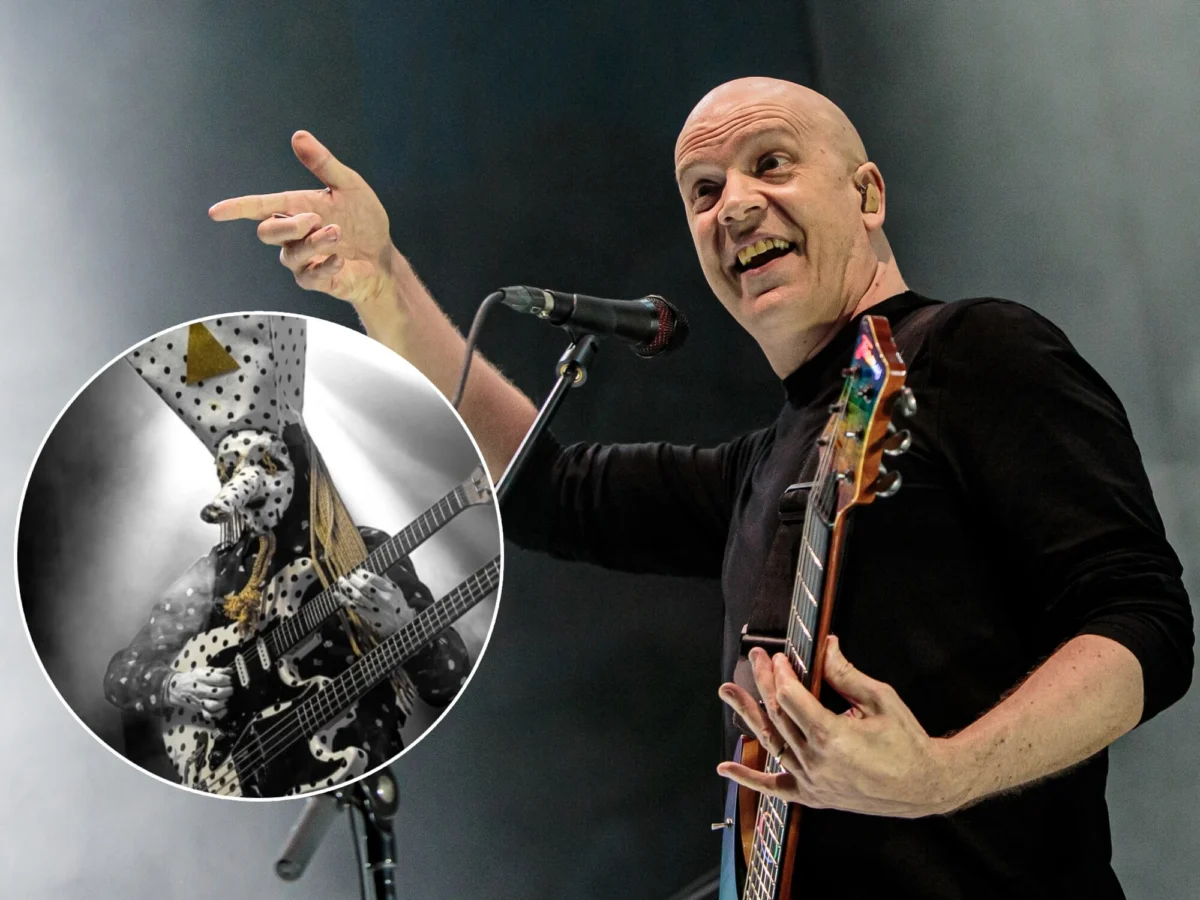
The enigmatic Quebecois math rock duo, Angine de Poitrine, has emerged as one of the most significant and debated phenomena in the global guitar community this year. Having rapidly garnered a fervent following and critical acclaim from figures as diverse as Foo Fighters frontman Dave Grohl and millions of KEXP viewers, their unique blend of intricate musicianship and striking visual identity has undeniably captured widespread attention. However, not everyone within the progressive music landscape is entirely convinced by the narrative surrounding their sudden ascent. Veteran Canadian musician and producer Devin Townsend, known for his prolific and eclectic career spanning extreme metal to ambient soundscapes, has publicly expressed a degree of skepticism regarding the duo’s remarkable rise to prominence, particularly questioning the role their distinctive paper-mâché masks play in their appeal.
Speaking candidly on Jorge Botas’ Metal Global podcast, Townsend, who earlier this year released his latest album, The Moth, articulated his observations on the Angine de Poitrine phenomenon. His comments did not primarily focus on the intrinsic musical quality of the band, but rather on the overwhelming buzz that has coalesced around their visual presentation. "It just makes me crazy because it’s the mask thing," Townsend stated, pinpointing the masks, particularly the one featuring a prominent polka-dot nose, as the central element driving public fascination. He elaborated, "It’s like he’s got a big polka dot nose and so everybody really likes it." This statement encapsulates a broader discussion within the music industry concerning the interplay between artistic substance and the power of visual branding in an increasingly saturated and visually driven media landscape.
Townsend, a highly respected figure celebrated for his innovative musical output and often theatrical stage presence, was careful to qualify his remarks. He explicitly stated that his critique was not a dismissal of Angine de Poitrine’s music itself, acknowledging that he had not dedicated sufficient time to form a comprehensive musical assessment. "Okay, first off, I haven’t listened to it enough to give an accurate musical assessment of it," he clarified. His core inquiry revolved around a thought-provoking hypothetical: "It’s not to say that they’re not cool, but would they have that same attention if they weren’t wearing big clown noses?" This question delves into the perennial debate about what truly propels artists to fame in the modern era – whether it is purely musical innovation, compelling narrative, or an instantly recognizable aesthetic.
Ironically, Townsend admitted that the sheer volume of hype surrounding Angine de Poitrine had produced an almost counter-intuitive effect on him, fostering a reluctance to engage with their material despite numerous recommendations. "I mean, I should listen to them. I had so many people send them to me. At the same time I just refuse to listen to it," he confessed. This sentiment highlights the potential for viral phenomena to create an echo chamber effect, sometimes leading to an oversaturation that can deter even curious listeners. Townsend, ever self-aware, acknowledged the subjective nature of his current perspective: "My perspective on it is only that I’ve been irritated by it so far. But there are people in my life who are close to me who say it’s very good. So please take my assessment of it with a grain of salt." This adds a layer of humility and personal context to his critique, positioning it as an observation rather than an definitive judgment.
The Rise of Angine de Poitrine: A Viral Phenomenon
Angine de Poitrine, comprised of guitarist Khn and drummer Klek, rocketed into the global consciousness in February of this year following their electrifying performance on KEXP. The session, which quickly amassed millions of views across various platforms, showcased their distinctive sound characterized by "knotty microtonal riffs" and complex rhythmic structures, hallmarks of the math rock genre. Math rock itself is a subgenre of progressive and indie rock characterized by complex, atypical rhythmic structures, angular melodies, and frequent changes in time signature. The addition of microtonal elements – notes existing between the standard semitones of Western music – further distinguishes Angine de Poitrine, pushing the boundaries of conventional tonality and creating a sound that is both challenging and captivating.
Beyond their intricate musicianship, it was undoubtedly their visually striking aesthetic that cemented their viral status. The duo performs encased in elaborate, often whimsical, paper-mâché masks that obscure their identities. This anonymity, coupled with the unique visual spectacle, has created an aura of mystery and intrigue that has proven highly effective in capturing and retaining audience attention. In an era where authenticity and connection are often emphasized, Angine de Poitrine’s deliberate obfuscation of identity presents a fascinating counter-narrative, proving that mystery can be a powerful tool for engagement. The KEXP platform, known for its discerning curation and ability to elevate emerging artists, played a pivotal role in amplifying their reach, exposing them to a global audience hungry for innovative and visually compelling acts. Their rapid ascent serves as a modern case study in how a combination of musical originality and strong visual branding can lead to explosive, widespread recognition in the digital age.
A Historical Context: Image vs. Substance in Music
Devin Townsend’s comments on Angine de Poitrine tap into a long-standing and often contentious debate within the music industry: the delicate balance between an artist’s musical output and their visual presentation. Throughout music history, countless artists have leveraged visual elements – costumes, stage props, makeup, or indeed, masks – to enhance their artistic identity, create a unique persona, or simply to stand out. From the theatrical shock rock of Alice Cooper and Kiss in the 1970s, where elaborate makeup and pyrotechnics were integral to the experience, to the masked anonymity of The Residents and Daft Punk, who used their enigmatic personas to focus attention squarely on their art rather than their individual identities, the use of visual spectacle is a well-trodden path.
Bands like Slipknot and GWAR have built entire careers around their elaborate masks and grotesque imagery, crafting immersive universes that blend music with performance art. In these instances, the visual element is not merely a gimmick but an inseparable component of their artistic expression, enhancing the thematic content of their music and fostering a deeper connection with their audience. The debate then becomes whether such visual elements are a genuine extension of the music or a clever marketing tool designed to compensate for perceived musical deficiencies. Townsend’s query, "would they have that same attention if they weren’t wearing big clown noses?", directly challenges the perceived weight of Angine de Poitrine’s visual aesthetic against their musical merit. It forces a consideration of whether the masks merely draw initial curiosity or fundamentally contribute to the enduring appeal of their "knotty microtonal riffs."
In the current digital landscape, where social media platforms prioritize visual content and short-form video, an instantly recognizable visual identity can be a crucial differentiator. A striking image or a viral video clip can cut through the noise of millions of aspiring artists, providing the initial hook that draws listeners in. For Angine de Poitrine, their masks likely served as that initial, potent visual hook, prompting curious viewers to click on their KEXP session and then discover their complex musicality. The question Townsend raises is whether this initial hook can sustain long-term engagement if the underlying music, in his hypothetical, were less compelling.
Devin Townsend’s Artistic Philosophy and Context
To fully appreciate Townsend’s perspective, it is useful to consider his own artistic journey. Devin Townsend is renowned for an unparalleled discography that defies easy categorization. From the aggressive, industrial extreme metal of Strapping Young Lad to the symphonic, progressive, and often humorous solo works, his career is a testament to artistic fearlessness and a relentless pursuit of creative expression. He has frequently incorporated theatrical elements, humor, and diverse personas into his own work, often blurring the lines between serious artistic intent and playful absurdity. His live shows are known for their immersive, often comedic, and always technically brilliant performances.
However, Townsend’s theatricality has consistently been rooted in a deeper artistic and emotional intent. His humor often serves as a coping mechanism or a way to deliver profound messages, and his diverse musical styles reflect an ongoing exploration of his own psyche and the human condition. This background suggests that his skepticism towards Angine de Poitrine’s masks might stem from a concern that the visual might overshadow, or even replace, the depth of musicality, particularly if the masks are perceived as a primary driver of fame rather than an organic extension of their art. For an artist who has spent decades meticulously crafting intricate musical landscapes and deeply personal narratives, the idea that a simple visual gimmick could garner such widespread attention might understandably cause a degree of "irritation," as he put it. His latest album, The Moth, continues his tradition of introspective and sonically rich compositions, underscoring his commitment to musical evolution and substance.
Broader Implications for the Music Industry
The debate sparked by Townsend’s comments carries significant implications for the broader music industry, particularly concerning the dynamics of viral success and audience engagement in the digital age. The KEXP platform, with its global reach and reputation for showcasing diverse talent, has become an invaluable launchpad for many artists. The ability of a single performance to generate millions of views underscores the power of curated content and organic discovery in an era dominated by streaming algorithms.
However, viral success, while exhilarating, also presents challenges. The rapid surge in popularity can create immense pressure on artists to maintain momentum and translate fleeting attention into sustained careers. It also fuels a constant industry discussion about the metrics of success: Is it album sales, streaming numbers, tour attendance, or social media engagement? And how much of each is truly indicative of an artist’s long-term artistic impact? Townsend’s comments highlight the ongoing tension between these metrics and the perceived authenticity of an artist’s craft.
For emerging artists, the Angine de Poitrine phenomenon, and the subsequent discussion, offers a dual lesson. On one hand, it demonstrates the undeniable power of a unique visual identity to cut through the noise and capture global attention. On the other hand, Townsend’s critique serves as a reminder that for many discerning listeners and established artists, musical substance remains paramount. The challenge for artists like Angine de Poitrine, once the initial viral wave subsides, will be to prove that their music can stand on its own, transcending the initial allure of their masks and securing a lasting place in the musical canon.
As Devin Townsend embarks on a solo tour in support of The Moth, his comments on Angine de Poitrine serve as a timely catalyst for reflection within the music community. They invite listeners, critics, and artists alike to reconsider the factors that contribute to an artist’s success and the ever-evolving interplay between sound and spectacle in the modern music landscape. Whether Angine de Poitrine’s masks are merely a captivating visual or an integral part of a profound artistic statement, their emergence, and the discussions it has provoked, underscore the complex and multifaceted nature of contemporary musical artistry.
