

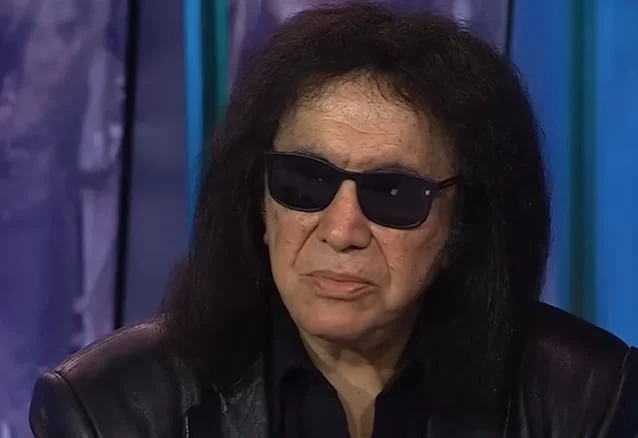
KISS bassist and vocalist Gene Simmons, a figure known for his flamboyant stage persona and, increasingly, his outspoken political commentary, recently sat down with Andrew Gold for an in-depth discussion on the "Heretics" podcast. The interview, which delved into a range of controversial and unconventional topics, saw Simmons address his prior assertion that he had faced professional repercussions for refusing to speak negatively about former U.S. President Donald Trump. This claim, first publicly made in June on Bill O’Reilly’s "We’ll Do It LIVE," has sparked considerable interest and debate regarding the intersection of celebrity, politics, and artistic expression.
The Trump Controversy and the Respect for Office
During his conversation with Gold, Simmons sought to clarify the circumstances surrounding his alleged lost performances. He stated that he never explicitly said Trump was "okay," but rather articulated a principle of respecting the office of the presidency, regardless of personal feelings about the individual holding the office.
"I argue with everybody about all kinds of things," Simmons explained, as transcribed by BLABBERMOUTH.NET. "But you can agree on certain things that Donald J. Trump was duly elected by more than half the population of the United States voting. He’s the president of the United States, so if you don’t like the man, you have to respect the office."
Simmons drew a parallel to the democratic process itself, emphasizing that American democracy is founded on the ability to vote out any leader every four years, with term limits serving as a further check on power. He referenced the historical precedent of Franklin Delano Roosevelt serving four terms, noting that subsequent term limit legislation was a response from the "loyal opposition" to prevent the concentration of power, a sentiment he personally does not necessarily endorse but acknowledges as a product of the democratic will.
This stance on respecting the office, even amidst political disagreement, has been a recurring theme in Simmons’ public statements. In a prior appearance on "We’ll Do It LIVE," he articulated a similar point, stating, "It is fine to love or hate Trump, but you have to recognize the fact that ‘of the people, for the people, by the people’ means that the people have spoken. He won the election by millions, and the electoral college as well. End of story. You don’t like it, you can wait until the next election and vote your conscience." This was further contextualized by election data, indicating that Donald Trump secured 77,302,580 votes, or 49.8 percent of the total votes cast in the 2024 U.S. presidential election, while Kamala Harris received 75,017,613 votes, or 48.3 percent.
A Shifting Political Landscape: From Liberal Youth to Conservative Leanings
Simmons also elaborated on a significant evolution in his political ideology over the decades. He described his youth as being "very liberal," a common characteristic of individuals who have not yet fully navigated the realities of independent living and financial responsibility. He drew a sharp contrast between this youthful idealism and the pragmatism born from personal experience.
"You don’t know that there’s a thing called gravity and you gotta work for a living, ’cause you’re living in your mother’s basement," Simmons stated, reflecting on his early political leanings. He used the example of protestors against Wall Street, who he noted often utilized technology funded by the very institutions they sought to dismantle while being financially supported by their parents. "Once you’re out on your own, you go, ‘Oh, fuck, this is hard. I’ve gotta go, every day, whether I want to or not, and try to make money so I can buy food and all this stuff.’"
This personal journey led him away from the Democratic Party, which he now associates with "socialist Democrat" ideologies. He specifically pointed to New York City Mayor Zohran Mamdani as an example of a political figure whose policies he finds to be a "disaster" from a business perspective, despite acknowledging him as an "ethically good guy."
Simmons’ commentary on the economic performance of different states has also drawn attention. He contrasted the perceived success of Texas and Florida, citing low crime rates and strong economic activity, with the struggles he believes are evident in California and New York. This perspective, however, is contested by official data. A July 2026 analysis from the office of California Governor Gavin Newsom, utilizing U.S. Bureau of Economic Analysis data, indicated that California’s economy grew at a 3.7% annualized pace in the first quarter of 2026, significantly outpacing Texas (0.9%) and Florida (1.6%). Furthermore, FBI data for 2025 showed California reporting the largest volume of violent crimes (157,828 offenses), followed by Texas (103,827) and New York (69,274), though California’s violent crime rate per 100,000 residents was 402.6, compared to 331.3 in Texas and 383.4 in New York.
The Appeal of Socialism and the "Woke" Movement
When asked about the popularity of socialist policies among those on the left, Simmons offered a critical perspective. He suggested that proponents of these policies were struggling to understand their electoral defeats, particularly in the face of Donald Trump’s success.
"I think they’re trying to figure out why they had their asses handed to them by Donald J. Trump. Couldn’t figure it out," he remarked.
Simmons also voiced his concerns about what he perceives as a shift within the Democratic Party towards more progressive, even socialist, ideologies. He expressed a desire for a return to more traditional values, emphasizing the enduring significance of the nuclear family as a cornerstone of ethics and morality in America. He articulated a nuanced view on evolving social identities, stating, "There are other lifestyles. There’s they, them. There are men that believe they can give birth and all that. And I say, ‘God bless. Good luck.’ Just have to figure out whether it comes through a little pee hole or the backside. ‘Cause other than cutting yourself, I don’t know how you’re gonna give birth. But I’m all for it. I think you should go for it. I don’t think anybody should go to your face and criticize you. I might think you’re out of your fucking mind, but I’m not gonna go to your face and say that. It’s unkind."
This perspective contrasts with broader societal discussions around gender identity and reproductive rights, highlighting a generational and ideological divide.
The Entertainment Industry’s Political Monolith
Simmons also addressed the perception of a political monolith within the entertainment industry, a point previously raised by Bill O’Reilly. He agreed that performers, in particular, tend to lean towards progressive viewpoints, though he suggested this might not be as prevalent among the audience.
"On the performers, not the audience," he stated.
He further elaborated on the idea of "cancel culture," acknowledging that his outspokenness and willingness to express views that deviate from prevailing industry norms have, at times, cost him work.
"Yeah. There’s such a thing as being canceled," Simmons confirmed. He recounted instances where he was asked about the president during local interviews. His response, emphasizing respect for the office and the legitimacy of Trump’s election, was met with professional consequences. "I lost those two or three shows," he admitted.
This echoes a sentiment expressed in a separate interview with Newsmax’s "Ed Henry The Big Take," where Simmons urged celebrities to refrain from lecturing their fans on political matters. He argued that celebrities, unlike politicians or military leaders, lack the specialized knowledge to offer meaningful political commentary.
"Basically, shut your pie hole. We don’t care," he stated, illustrating his point with a hypothetical scenario involving Kylie Jenner and the Joint Chiefs of Staff discussing foreign policy.
A Consistent, Though Evolving, Political Identity
Despite his critiques of certain political factions and the perceived political leanings of the entertainment industry, Simmons maintained that he is not beholden to any single political party. He positions himself as a "free thinker" who focuses on issues rather than strict party lines.
"I’m about issues, which is why I have friends from every area," he explained. "I do business with all kinds of people. If I only did business with people who are Republicans and so on, it wouldn’t make financial sense because people of all political beliefs do business."
He cited his support for building a wall on the U.S.-Mexico border as an example of an issue where he aligns with a conservative policy, drawing a parallel to the security measures employed by the Vatican. He believes in border security through legal channels, not necessarily in absolute exclusion.
Simmons’ relationship with Donald Trump has a documented history, dating back to their shared appearance on the first season of "Celebrity Apprentice" in 2008. In 2016, Simmons described Trump as a "true political animal" and "good for the political system" in an interview with Rolling Stone, praising his unscripted style and undeniable stage presence. However, by May 2022, his assessment of Trump’s first term had become more critical in an interview with Spin magazine. He voiced concern about the polarization and the emboldening of extreme views that he felt Trump’s presidency facilitated.
"Look what that gentleman did to this country and the polarization – got all the cockroaches to rise to the top," Simmons said at the time. "Once upon a time, you were embarrassed to be publicly racist and out there with conspiracy theories. Now it’s all out in the open because he allowed it."
He differentiated the responsibilities of a television personality from those of a head of state, noting that presidential decisions carry life-and-death consequences, a weight he felt Trump did not adequately bear. Simmons concluded that Trump, in his view, operates primarily out of self-interest, a characteristic that resonated with a significant portion of the electorate.
The ongoing public discourse surrounding Gene Simmons’ political commentary highlights the complex interplay between celebrity, ideology, and the evolving American political landscape. His willingness to engage in these discussions, often with a contrarian edge, continues to provoke thought and, at times, controversy.
