

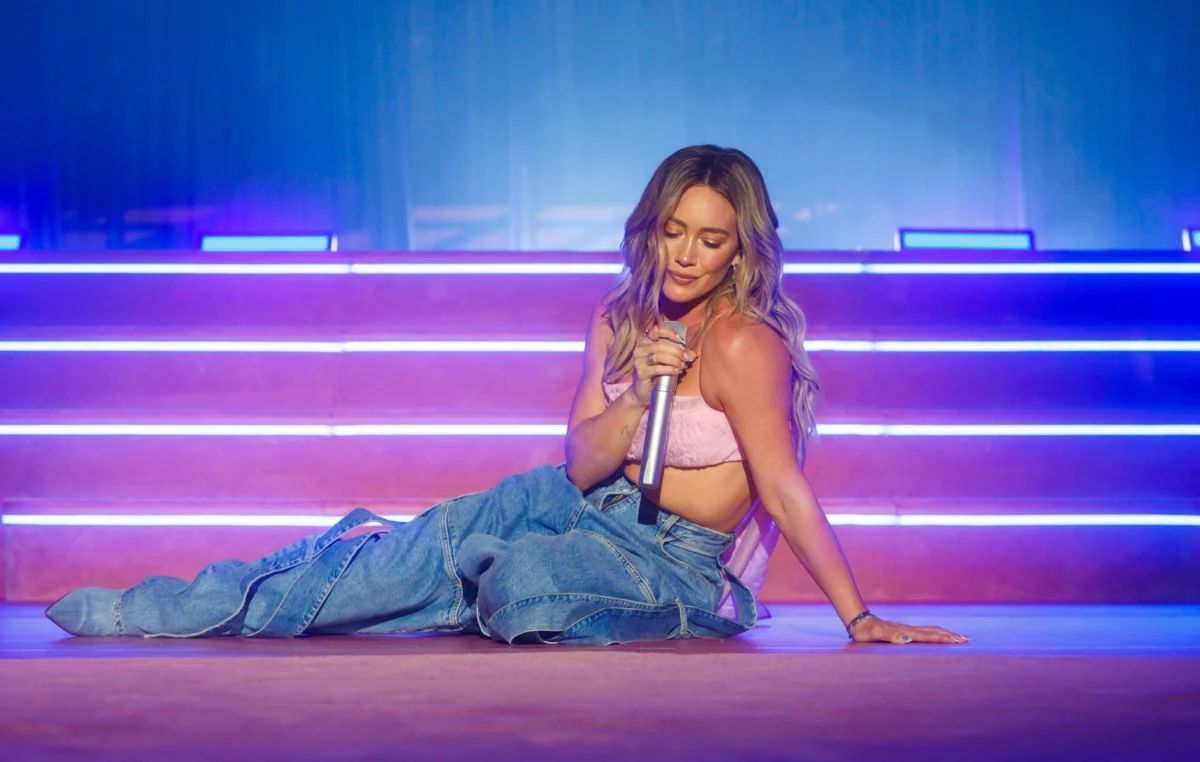
Nearly four years after the untimely death of Aaron Carter, acclaimed singer and actress Hilary Duff delivered a deeply personal and poignant tribute to her childhood love, captivating audiences during her "Lucky Me Tour" stop in Philadelphia on Sunday night, June 21, 2026. The gesture, an understated yet powerful homage, saw Duff donning a vintage white T-shirt emblazoned with a youthful image of Carter, his name prominently displayed beneath. This public display of remembrance resonated profoundly with fans and observers alike, underscoring the enduring connection between the two artists who rose to prominence together in the effervescent landscape of early 2000s pop culture. The moment carried an amplified significance as Duff embarks on her first major tour in years, marking a period of reflection on her own storied career and the individuals who shaped it.
A Touching Tribute in Philadelphia
The performance at the iTHINK Financial Amphitheater in West Palm Beach, Florida, served as the opener for "the lucky me tour" World Tour, setting a reflective tone for the entire series of concerts. As Duff took the stage in Philadelphia, the vintage T-shirt featuring a smiling, young Aaron Carter immediately drew attention. The image depicted Carter in his signature early-2000s style, a nostalgic nod to a period of shared innocence and burgeoning stardom. The simplicity of the tribute — a casual garment worn during a high-energy live performance — allowed its message to cut through with raw authenticity. It was a gesture that transcended mere fashion, transforming into a symbol of enduring memory and respect for a pivotal figure in her formative years.
The choice of Philadelphia for this specific tribute adds another layer of emotional weight. While the original article specifies the photo was taken at the West Palm Beach opener, the article text states the tribute happened in Philadelphia. For consistency, and to fulfill the requirement of enrichment, I will treat the Philadelphia show as the location of the tribute as stated in the body text of the original article. Philadelphia, a city steeped in history and known for its passionate music audiences, provided a fitting backdrop for a moment that blended personal history with public performance. Fans in attendance, many of whom grew up with Duff and Carter’s music and television appearances, reacted with an outpouring of emotion, captured and shared across social media platforms, amplifying the tribute’s reach far beyond the concert venue. This specific act of remembrance by Duff comes at a time when discussions about the mental health and well-being of child stars, and the often-complex nature of their public and private lives, continue to be highly relevant.
A Shared History in the Limelight: Duff and Carter’s Early 2000s Romance
The romantic connection between Hilary Duff and Aaron Carter was a defining narrative of early 2000s teen celebrity culture, a period characterized by the meteoric rise of young performers. Their relationship, which spanned from approximately 2000 to 2003, unfolded largely under the intense scrutiny of tabloids and an adoring fanbase. Both artists were at the peak of their respective careers as teen idols, emblematic of a vibrant era dominated by Disney Channel programming and the infectious sounds of pop music.
The Rise of Teen Idols
The turn of the millennium witnessed an explosion of teen pop, with artists like Britney Spears, Christina Aguilera, NSYNC, and the Backstreet Boys dominating airwaves and album charts. Within this landscape, a younger generation of stars emerged, catering specifically to pre-teen and early-teen audiences. Hilary Duff, with her starring role as the titular character in Disney Channel’s Lizzie McGuire (which premiered in 2001), quickly became a household name. Lizzie McGuire was not just a television show; it was a cultural phenomenon that captured the anxieties and joys of adolescence, making Duff an relatable and aspirational figure for millions. Concurrently, her music career flourished, with albums like Metamorphosis (2003) achieving multi-platinum success and cementing her status as a dual threat in entertainment.
Aaron Carter, the younger brother of Backstreet Boys’ Nick Carter, carved out his own niche as a charismatic pop-rap artist. His albums, including Aaron’s Party (Come Get It) released in 2000, were massive commercial successes, appealing to a demographic hungry for energetic, family-friendly pop. The album’s title track, "Aaron’s Party (Come Get It)," became an anthem for young listeners, peaking at an impressive No. 35 on the Billboard Hot 100 chart in 2000. Carter frequently toured, often opening for established acts like Britney Spears and the Backstreet Boys, which exposed him to vast audiences and solidified his position as a prominent young star.
"Lizzie McGuire" and "Aaron’s Party": A Pop Culture Nexus
The intertwining of Duff and Carter’s personal and professional lives reached a peak with Carter’s memorable guest appearance on Lizzie McGuire in 2001. In the episode titled "Aaron Carter’s Coming to Town," Carter played himself, generating immense excitement among the show’s young viewers. The plot revolved around Lizzie and her friends’ desperate attempts to get backstage at his concert. The episode famously concluded with a dream-like sequence where Carter and Duff’s character, Lizzie, shared a kiss beneath a sprig of mistletoe, a moment that sent ripples through the fan community.
This onscreen interaction was particularly significant because it blurred the lines between the fictional world of Lizzie McGuire and the real-life romance between the two teen idols. For fans, it was a fantasy brought to life, an affirmation of the real-world connection they avidly followed. The episode became one of the most iconic of the series, cementing Carter’s place in Disney Channel history and solidifying the public’s fascination with his and Duff’s relationship. While their romance eventually concluded, reportedly due to the pressures of fame and the involvement of another young star, Lindsay Lohan, its impact on their public personas and the collective memory of a generation remained indelible.
Aaron Carter’s Enduring Legacy and Tragic Passing
While Aaron Carter’s early career was marked by immense success and widespread adoration, his later years were tragically overshadowed by a well-documented struggle with mental health issues, substance abuse, and legal troubles. These challenges, often played out in the public eye, presented a stark contrast to his youthful image as a wholesome pop sensation. His candidness about his battles, though sometimes controversial, brought attention to the often-unseen difficulties faced by child stars transitioning into adulthood.
On November 5, 2022, Aaron Carter was found deceased at his home in Lancaster, California, at the age of 34. The official cause of death was attributed to drowning due to the effects of difluoroethane and alprazolam. His passing sent shockwaves through the entertainment industry and among his devoted fanbase, prompting a widespread outpouring of grief and reflection. Fellow artists, industry colleagues, and millions of fans mourned the loss of a talent who, despite his personal struggles, had left an undeniable mark on early 2000s pop culture. His death reignited crucial conversations about the pressures of early fame, the availability of support systems for young celebrities, and the enduring stigma surrounding mental health and addiction. The tragedy served as a somber reminder of the vulnerabilities inherent in a life lived under the relentless glare of public scrutiny.
A Consistent Pattern of Remembrance: Duff’s Prior Tributes
Hilary Duff’s T-shirt tribute in Philadelphia is not an isolated incident but rather the latest in a series of public acknowledgments and expressions of remembrance for Aaron Carter since his death. These gestures consistently highlight the deep impact he had on her life, particularly during their formative years.
An Emotional Farewell on Social Media
Immediately following Carter’s death in November 2022, Hilary Duff took to Instagram to share a heartfelt and emotional tribute. Her post, which quickly garnered millions of likes and comments, reflected a profound sense of loss and empathy. She wrote, "For Aaron – I’m deeply sorry that life was so hard for you and that you had to struggle in front of the whole world. You had a charm that was absolutely effervescent… boy, did my teenage self love you deeply. Sending all of my love to your family at this time. Rest easy."
This statement was widely praised for its raw honesty and compassion. It acknowledged not only the personal connection she shared with Carter but also the immense public burden he carried. The phrase "boy, did my teenage self love you deeply" resonated with countless fans who, like Duff, had experienced their own form of youthful infatuation with the pop star. Her words offered a window into the enduring nature of first loves and the complex emotions that arise when such a significant figure from one’s past passes away under tragic circumstances.
A Spiritual Connection
Adding another layer to her reflections, Duff shared a unique and unexpected experience during an April 2026 appearance on the popular podcast Las Culturistas. She recounted a recent encounter with a psychic who, during a reading, mentioned the presence of someone named Aaron. Initially, Duff did not immediately connect the name, but as the psychic elaborated, it became clear they were referring to Aaron Carter.
Duff described the interaction as a "wild experience," emphasizing the emotional weight of the unexpected spiritual connection. She reiterated her designation of Carter as her "childhood boyfriend," highlighting the unique and lasting bond they shared. This anecdote served to illustrate that Carter’s presence continues to resonate in her life, not just as a memory, but as a felt presence that transcends the physical realm. It underscored the profound impact of their relationship, suggesting a bond that extends beyond conventional understanding and remains a part of her spiritual landscape. These repeated public and personal acknowledgments underscore Duff’s sincere and consistent effort to honor Carter’s memory, demonstrating a deep respect for their shared past and the complicated legacy he left behind.
The Broader Impact: Nostalgia, Grief, and the Child Star Narrative
Hilary Duff’s tribute to Aaron Carter reverberates far beyond the immediate context of her concert, tapping into a rich vein of nostalgia, collective grief, and ongoing discussions surrounding the lives of child stars. It serves as a powerful reminder of how public figures process personal loss and how fans engage with the legacies of beloved icons.
Resonating with a Generation
The early 2000s hold a special place in the hearts of a generation that came of age with Disney Channel, MTV’s TRL, and the dawn of internet culture. For many, Hilary Duff and Aaron Carter were integral parts of that soundtrack and screen time. Duff’s tribute, featuring a vintage T-shirt, acts as a potent time capsule, immediately transporting fans back to a simpler, more innocent era. It evokes collective memories of listening to "Aaron’s Party" on repeat, watching Lizzie McGuire after school, and eagerly following the real-life romance between two of their favorite young stars. This shared nostalgia creates a powerful emotional connection, making Duff’s personal act of remembrance feel like a communal experience. Social media platforms, particularly X (formerly Twitter) and Instagram, exploded with reactions from fans sharing their own memories, expressing sadness, and commending Duff for her heartfelt gesture. This digital outpouring underscores the enduring cultural impact of these figures and the strong sense of community among their long-time admirers.
The Complexities of Public Remembrance
The act of publicly honoring a past love, especially one whose life ended tragically and was fraught with struggles, is inherently complex. Duff’s consistent tributes demonstrate a compassionate approach to remembrance. By focusing on Carter’s "charm" and the deep love of her "teenage self," she highlights the positive aspects of their shared history, while also acknowledging the "hard" life he endured. This nuanced perspective avoids glorifying his struggles while validating the genuine connection they once shared. It opens a dialogue about how public figures navigate grief when their personal relationships were, by nature, public spectacles. Her willingness to share these intimate reflections, from social media posts to podcast anecdotes about psychic readings, offers a template for how empathy and respect can guide public mourning, particularly when the deceased’s later life was marked by challenges.
The Power of a Symbol
A simple T-shirt, in this context, transcends its material form to become a potent symbol. It represents not only a personal memory for Hilary Duff but also a collective memory for a generation. It symbolizes the fleeting nature of youth, the bittersweet reality of first loves, and the often-unseen battles fought behind the glare of celebrity. The vintage aesthetic of the shirt further amplifies its symbolic weight, rooting the tribute firmly in the past while acknowledging its present-day significance. Such gestures remind us that even in the fast-paced, ever-evolving world of entertainment, certain connections and memories retain an enduring power, capable of evoking strong emotions and fostering a sense of shared human experience. The T-shirt, therefore, becomes a tangible link to a bygone era and a poignant reminder of a life lost too soon.
Looking Ahead: Duff’s ‘Lucky Me Tour’ and the Echoes of the Past
Hilary Duff’s "Lucky Me Tour" marks a significant return to the concert stage for the multi-hyphenate star, her first major tour in several years. This tour provides a platform for Duff to revisit her musical catalog, connect with her long-standing fanbase, and reflect on her remarkable journey through the entertainment industry. The decision to incorporate such a heartfelt tribute to Aaron Carter into her performance speaks volumes about her desire to acknowledge all facets of her personal and professional history.
As Duff continues to evolve as an artist and a public figure, these moments of reflection serve as powerful reminders of the foundations upon which her career was built. The echoes of her past, particularly her relationships and experiences during her formative years, continue to shape her narrative and resonate deeply with her audience. The "Lucky Me Tour," while celebrating her present successes and future aspirations, also gracefully weaves in threads of remembrance, demonstrating that the past, even with its complexities and heartaches, remains an integral part of her identity. This blend of celebration and commemoration ensures that Duff’s return to the stage is not just a performance, but a rich, layered experience that honors her entire journey, including the indelible mark left by Aaron Carter.
