

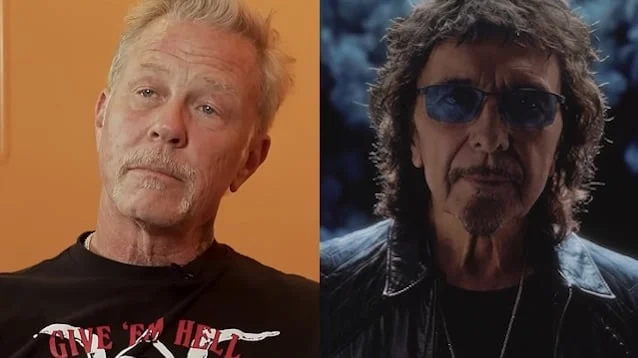
In a recent installment of his SiriusXM show, "James Hetfield’s Riff Life" on Maximum Metallica, the iconic frontman of Metallica, James Hetfield, unequivocally declared Black Sabbath guitarist Tony Iommi as "the riff lord" and the most influential guitarist on his own rhythm guitar playing and songwriting. Hetfield’s impassioned tribute, broadcast on SiriusXM’s dedicated channel, further cemented the profound and enduring legacy of Black Sabbath, a band whose sonic innovations laid the groundwork for much of modern heavy music.
Hetfield’s Tribute to a Guitar Hero
During the episode, Hetfield delved into the specific impact of Iommi’s work, highlighting the opening riff of Black Sabbath’s seminal track "Children of the Grave." He described how Iommi masterfully builds upon this core riff, incorporating powerful, expansive chords that dramatically shape the song’s structure. Hetfield also lauded the band’s innovative use of drum overdubs to enhance the percussive impact of the riff and the evocative, "ghostly guitar sounds" that punctuate the track’s conclusion. This detailed analysis underscores Hetfield’s deep understanding and appreciation for the intricate craft of riff construction, a skill for which he is himself widely celebrated.
"James Hetfield’s Riff Life" serves as a platform for the Metallica vocalist and guitarist to share the artists, riffs, and bands that have shaped his illustrious career. The program, broadcast on SiriusXM’s Maximum Metallica channel, offers listeners an intimate glimpse into the inspirations behind one of heavy music’s most significant figures. New episodes are scheduled to air regularly, with the latest broadcast available on the SiriusXM app for on-demand listening.
A Lifelong Devotion to the Sound of Doom
Hetfield’s admiration for Black Sabbath is not a recent development. In a 1992 interview with Guitar World magazine, he recounted his early discovery of the band through his older brother’s record collection. He described being immediately captivated by the band’s album covers, which piqued his curiosity. Upon listening, he was struck by the sheer weight and power of their sound, famously stating, "It was, like, ‘Whoa! Heavy as shit.’" Hetfield contrasted Black Sabbath’s dark, potent sound with the prevailing musical trends of the 1960s, which he found largely unappealing. He expressed a particular aversion to bands like The Beatles, Jethro Tull, and Love, characterizing their music as overly "happy."
This early disillusionment with the prevailing "hippie" culture and its musical expressions found a resonant counterpoint in the grim, unvarnished sonic landscape crafted by Black Sabbath. This formative experience highlights a critical juncture in Hetfield’s musical development, where he sought out music that reflected a different, perhaps more profound, emotional spectrum.
A Grateful Homage at the Rock and Roll Hall of Fame
The depth of Hetfield’s reverence for Black Sabbath was powerfully evident during the 2006 Rock and Roll Hall of Fame induction ceremony. In an interview with Rolling Stone magazine two decades ago, Hetfield revealed the emotional toll the event took on him. Dressed in his characteristic black jeans and shirt amidst a sea of formal attire, he visibly struggled to contain his emotions as he spoke about his childhood fascination with Black Sabbath. He recalled being a nine-year-old boy, surreptitiously borrowing his older brother’s Sabbath records.
Hetfield described how the "monstrous riffs" of Black Sabbath resonated deeply within him, articulating feelings he was unable to express verbally. He spoke of the "chills of inspiration" the music provided, helping him "crack the shell he was stuck in." He even added a touch of youthful defiance, noting that "scaring his mom and sister was an extra bonus." Reflecting on his adult self, a seasoned musician, he stated with profound sincerity, "I realize that without their defining sound, there would be no Metallica, especially with one James Hetfield." He unequivocally labeled Black Sabbath as "the most timeless and influential band," whose "wonderful disease" has spread through generations of musicians and continues to inspire heavy bands to this day. He concluded by asserting their status as "loved and highly respected as the fathers of heavy music."
The profound emotional impact of the occasion was further underscored by Hetfield’s subsequent remarks to Rolling Stone. "It was like, ‘Oh, no, I’m going to start crying,’" he admitted. "I’d never known it until I had to access all those emotions in front of that crowd, but it just goes to show how much Sabbath mean." This candid admission speaks volumes about the deeply personal and transformative connection Hetfield forged with Black Sabbath’s music from a young age.
Metallica’s Performance and Ulrich’s Definitive Statement
In addition to Hetfield’s induction speech, Metallica performed a powerful medley of Black Sabbath songs, "Hole in the Sky" and "Iron Man," during the ceremony. This musical tribute served as a tangible demonstration of their gratitude and artistic debt.
The significance of Black Sabbath’s influence was also articulated with characteristic force by Metallica drummer Lars Ulrich in his own induction speech. Ulrich left no room for ambiguity regarding the band’s foundational role in heavy metal. "Bill, Geezer, Ozzy and Tony, if it weren’t for you, we wouldn’t be here," he declared. "Obviously if there was no Black Sabbath, there would be no Metallica." He went on to assert that "hard rock and heavy metal as we know it today would look, sound and be shaped very, very differently." Ulrich even humorously speculated that without Black Sabbath, he might still be a newspaper delivery boy, lamenting the potential lack of "fun." He expressed profound gratitude for their meeting, their connection, and their decision to form a band.
Ulrich, known for his outspoken nature, emphatically stated, "I hereby not only acknowledge but scream from every fucking rooftop that Black Sabbath is and always will be synonymous with the term ‘heavy metal.’" He positioned Black Sabbath alongside an elite group of artists synonymous with their genres, such as Bob Marley with reggae, Bob Dylan with folk, and Johnny Cash with country. He argued that while other bands like Blue Cheer, Led Zeppelin, Deep Purple, and Steppenwolf were admired, Black Sabbath stood alone in defining the genre of heavy metal. He meticulously deconstructed their sonic formula, noting how they blended blues, rock, and soul with "darkness and street cred," infused with an indefinable "X factor" to create something "unheard, unexperienced, unique and utterly groundbreaking." He concluded by labeling them "pioneers of all things heavy," whose influence continues to permeate every facet of metal music. Ulrich pointed to their origin – "four kids in their late teens from the black country of Birmingham who named their band after a 1963 Italian horror movie starring Boris Karloff" – as the genesis of a revolution that would forever "invigorate and elevate" the entire lineage of heavy music.
A Continual Celebration of a Shared Legacy
The enduring bond between Metallica and Black Sabbath was further evidenced in more recent times. On July 5, 2025, Metallica performed a six-song set at Black Sabbath’s "Back To The Beginning" charity event. The setlist itself was a testament to their shared musical heritage, opening with the Black Sabbath classic "Hole in the Sky" before transitioning into Metallica’s own "Creeping Death" and "For Whom the Bell Tolls." The band then returned to paying homage to their idols by covering Sabbath’s "Johnny Blade" from the "Never Say Die!" album, concluding their performance with their own iconic tracks "Battery" and "Master of Puppets." This performance, occurring nearly two decades after the Rock Hall induction, demonstrates that the inspiration drawn from Black Sabbath remains a vibrant and active force within Metallica’s artistic output.
The continuous flow of tributes, analyses, and performances underscores a significant trend in music history: the foundational role of Black Sabbath in shaping the sonic identity of heavy metal. James Hetfield’s pronouncements, amplified by his platform on SiriusXM and echoed by his bandmate Lars Ulrich’s powerful pronouncements, serve not merely as personal accolades but as definitive historical statements. They solidify Black Sabbath’s position not just as pioneers, but as the very architects of a musical genre that has captivated millions worldwide. The "monstrous riffs" that once inspired a young Hetfield continue to resonate, a testament to the timeless power and enduring influence of Tony Iommi and his legendary band. The implications of this ongoing dialogue are clear: understanding the evolution of heavy music is incomplete without a deep appreciation for the dark, powerful, and utterly groundbreaking sound of Black Sabbath, a sound that continues to inspire and define generations of musicians.
