

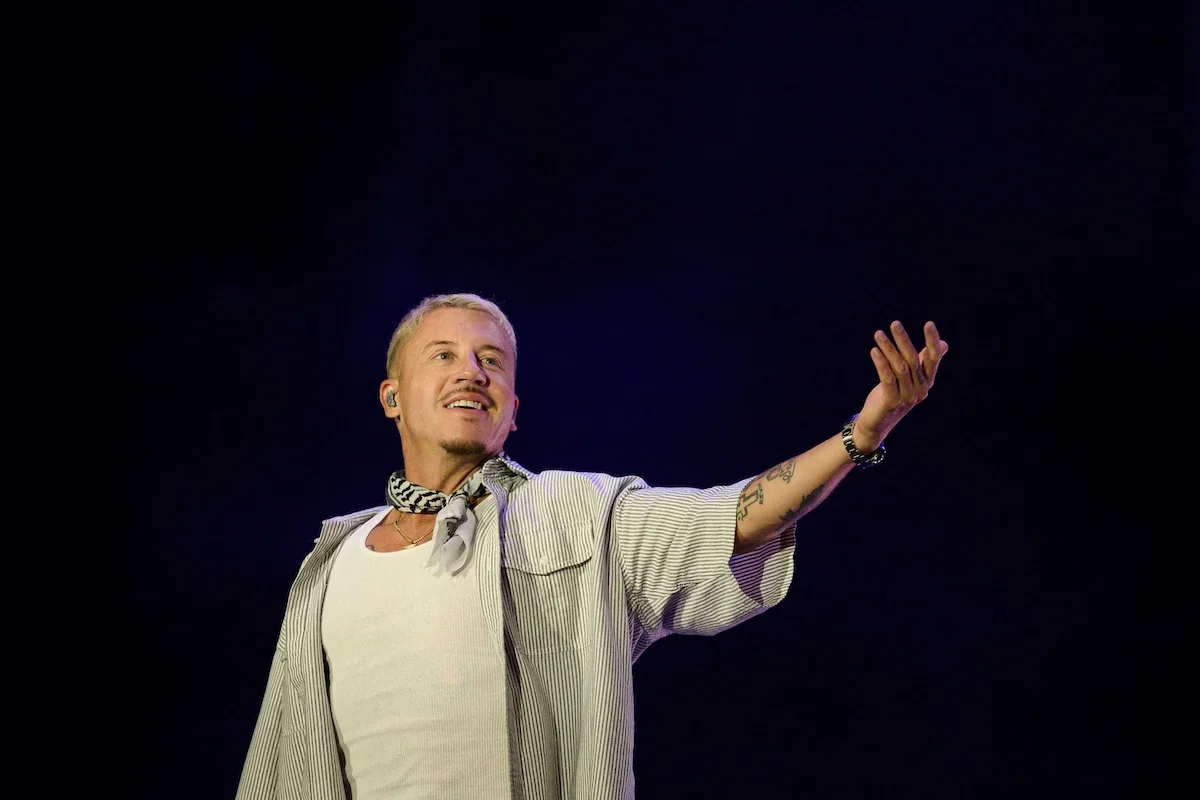
Seattle-based rapper Macklemore has announced a significant philanthropic gesture, pledging the entirety of his $1 million net earnings from Ed Sheeran’s recently concluded ‘The Loop Tour’ to six organizations dedicated to supporting the Palestinian people. This announcement, made via a heartfelt statement shared on his social media, follows a tumultuous period that saw the artist dropped from the high-profile tour due to his vocal advocacy for Palestine. The controversy escalated with Ed Sheeran’s subsequent statement disavowing complicity, the departure of other opening acts and Sheeran’s backing band in solidarity, and a subsequent matching donation from Robert Kraft, owner of the New England Patriots, and an alleged similar donation from Sheeran himself.
Chronology of a Contentious Departure
The events unfolded rapidly, beginning on Monday, September 14, when news broke that Macklemore, whose given name is Benjamin Hammond Haggerty, had been removed from the North American leg of Ed Sheeran’s ‘The Loop Tour.’ Sources indicated that the decision stemmed directly from Macklemore’s outspoken support for Palestine, a stance he has increasingly emphasized amidst ongoing geopolitical tensions in the region. His advocacy, which includes public statements and social media posts, has positioned him as a prominent voice in a highly polarized global discussion.
Following Macklemore’s removal, Ed Sheeran issued a statement addressing the unfolding situation. In his remarks, Sheeran asserted that he was "not complicit" in the decision to drop Macklemore, attributing the action solely to the tour promoter. While Sheeran did not explicitly name the promoter, such decisions are typically made by concert promotion companies, often in consultation with management teams, who weigh various factors including potential political ramifications, audience reception, and sponsor sensitivities. Sheeran’s statement aimed to distance himself from the controversy, emphasizing that the decision was outside his direct control.
The situation took another dramatic turn when other scheduled opening acts for ‘The Loop Tour,’ along with members of Ed Sheeran’s own backing band, reportedly quit the tour in a show of solidarity. This collective action underscored the depth of feeling among artists and musicians regarding the Palestinian cause, demonstrating a willingness to sacrifice professional engagements to stand with their colleague and express their views. The departure of multiple acts and band members presented significant logistical challenges for the tour, necessitating swift replacements and potential adjustments to the performance schedule.
Macklemore’s Powerful Statement and Philanthropic Pledge
In the wake of these developments, Macklemore shared his own comprehensive statement, redirecting the narrative back to the humanitarian crisis in Palestine and announcing his substantial donation. "With everything that has happened over the last 48 hours, I want to bring the conversation back to where it belongs: to the Palestinian people who are still being killed, still living under military occupation, and still fighting for their freedom," his statement began, setting a clear tone for his intentions.
He elaborated on his decision to donate his entire $1 million net earnings from the tour, specifying that the funds would go to "six organizations working directly to support the Palestinian people." While the specific names of these organizations were not detailed in his public statement, such groups typically focus on humanitarian aid, medical support, legal assistance, and advocacy for human rights in Palestinian territories. Macklemore framed this act not merely as philanthropy but as a direct form of solidarity, acknowledging it as "one of the least costly forms of solidarity available to me."
Beyond the financial contribution, Macklemore issued a direct challenge to Robert Kraft, the billionaire owner of the New England Patriots, urging him to match the donation. "And I invite Robert Kraft to match my donation. Whatever we disagree about, perhaps we can agree on this: Palestinian lives are worth protecting. A Palestinian life is no less valuable than any other life on this earth," Macklemore wrote. This direct appeal highlighted a common ground of humanitarianism amidst potential political differences, emphasizing the universal value of human life.
Macklemore’s statement meticulously outlined his motivations, asserting, "That is what this has always been about. Not me. Not a tour. Not the headlines or the controversy. It is about Palestinians right to freedom, dignity and safety in their own homeland." He sought to humanize the conflict, centering the narrative on the suffering of civilians: "I want to center the parents carrying their children into hospitals without the basic resources to treat them, and the physicians, paramedics, journalists and aid workers who keep going back in. I want to center the organizers and activists who have paid real costs for standing with Palestine. Their risk is of a far different order than mine."
He tragically underscored the human cost by citing recent casualties: "Just yesterday, 15 year old Muhammad al Zinati was killed in an Israeli strike while rushing to help aid worker Sherif Lubbad, who had already been injured. He was a child. Both were murdered. Both should be alive." This specific example served to bring a tangible, personal dimension to the broader conflict, illustrating the devastating impact on individuals and families.
The rapper also articulated a broader call for systemic change, stating, "But aid alone cannot address the conditions that make it necessary. This is a manmade injustice, and I believe it requires immediate political change. Palestinians have lived for decades without basic rights and should not have to wait another day to be free." This position reflects a common sentiment among advocates that humanitarian aid, while crucial, must be complemented by sustained political efforts to address the root causes of the conflict. He concluded his statement with a powerful call to action: "When the news cycle moves on, which it will, don’t move with it. Free Palestine."
Responses from Related Parties and Broader Impact
In a significant development following Macklemore’s challenge, Robert Kraft announced that he would be donating $2 million, effectively matching and exceeding Macklemore’s initial pledge. This donation, reportedly also matched by Ed Sheeran, brought the total philanthropic response to a substantial sum aimed at supporting humanitarian efforts. While Kraft’s philanthropic endeavors are well-documented, often through the Kraft Family Foundation with a focus on various causes including healthcare, education, and combating antisemitism, his response to Macklemore’s call highlights the complex intersection of philanthropy, celebrity, and geopolitics. The decision by Kraft, a prominent Jewish businessman, to contribute to aid for Palestinians, even when presented as a general humanitarian gesture, carries significant symbolic weight within the context of the Israeli-Palestinian conflict.
The actions of the other opening acts and Sheeran’s backing band in quitting the tour represent a powerful form of artistic solidarity. In an industry often characterized by contractual obligations and career considerations, such a collective stand is rare and speaks volumes about the conviction of those involved. Their departure not only impacted the immediate tour logistics but also sent a clear message that artists are increasingly willing to leverage their platforms, even at personal and professional cost, to support causes they believe in.
The tour promoter, who was not publicly identified in Sheeran’s statement, likely faced considerable pressure in making the decision to remove Macklemore. Promoters navigate a complex landscape of artist relations, venue agreements, sponsorship deals, and public sentiment. In highly sensitive political situations, promoters may choose to avoid controversy to ensure the smooth running of events, protect their brand, and maintain relationships with various stakeholders, including sponsors who may have specific geopolitical leanings or sensitivities.
Background Context: The Israel-Palestine Conflict
Macklemore’s advocacy is rooted in the long-standing and deeply complex Israeli-Palestinian conflict, a geopolitical struggle marked by competing claims to land, historical grievances, and ongoing violence. The conflict, which traces its modern origins to the late 19th and early 20th centuries, intensified after the 1948 Arab-Israeli War and the establishment of the State of Israel. Subsequent wars, occupations, and peace efforts have shaped a reality where millions of Palestinians live under Israeli military occupation in the West Bank and East Jerusalem, and under a blockade in Gaza.
Humanitarian concerns frequently cited by advocates for Palestine include issues such as displacement, restrictions on movement, access to basic services like healthcare and education, and civilian casualties resulting from military operations. International bodies and human rights organizations have frequently raised concerns about the impact of the conflict on Palestinian civilians, often highlighting issues of self-determination, human rights, and the rule of international law. The conflict is characterized by deeply entrenched narratives on both sides, making public discourse highly contentious and emotionally charged. Macklemore’s decision to speak out reflects a growing trend among public figures to engage with this sensitive topic, often drawing both fervent support and strong criticism.
Broader Implications and the Role of Artist Activism
This series of events underscores several significant implications for the music industry, celebrity activism, and public discourse. Firstly, it highlights the increasing expectation for artists to take a stand on social and political issues. In an age of heightened social awareness and accessible information, fans and the public often look to influential figures to articulate positions on pressing global concerns. Macklemore’s actions, and the solidarity shown by other musicians, exemplify this trend, showcasing artists not just as entertainers but as active participants in political dialogue.
Secondly, the incident brings into sharp focus the concept of "consequence culture" versus "cancel culture." While some might view Macklemore’s removal as a form of "cancellation," his subsequent actions—donating his earnings and continuing his advocacy—reframe the narrative around an artist facing consequences for their views and choosing to double down on their convictions. The departure of other artists in solidarity further complicates this, demonstrating a collective rejection of what they perceived as an unfair consequence.
Thirdly, the economic and logistical implications for major tours are significant. The sudden departure of opening acts and band members can lead to substantial financial losses, reputational damage, and operational headaches for tour organizers and headliners. It forces a reevaluation of the balance between artistic freedom, political expression, and commercial viability in large-scale entertainment ventures.
Finally, the philanthropic response from Macklemore, Kraft, and Sheeran illustrates how humanitarian aid can become intertwined with political statements. While direct aid is undoubtedly vital, Macklemore’s explicit call for "immediate political change" and his challenge to Kraft highlight how such donations are often seen not just as charity but as part of a broader advocacy strategy. This incident serves as a potent reminder of the complex and often challenging intersection of music, activism, and global geopolitics, pushing conversations about human rights and justice into mainstream cultural spaces. As Macklemore urged, the call to "Free Palestine" and the focus on the Palestinian people are intended to persist long after the immediate news cycle fades.
