

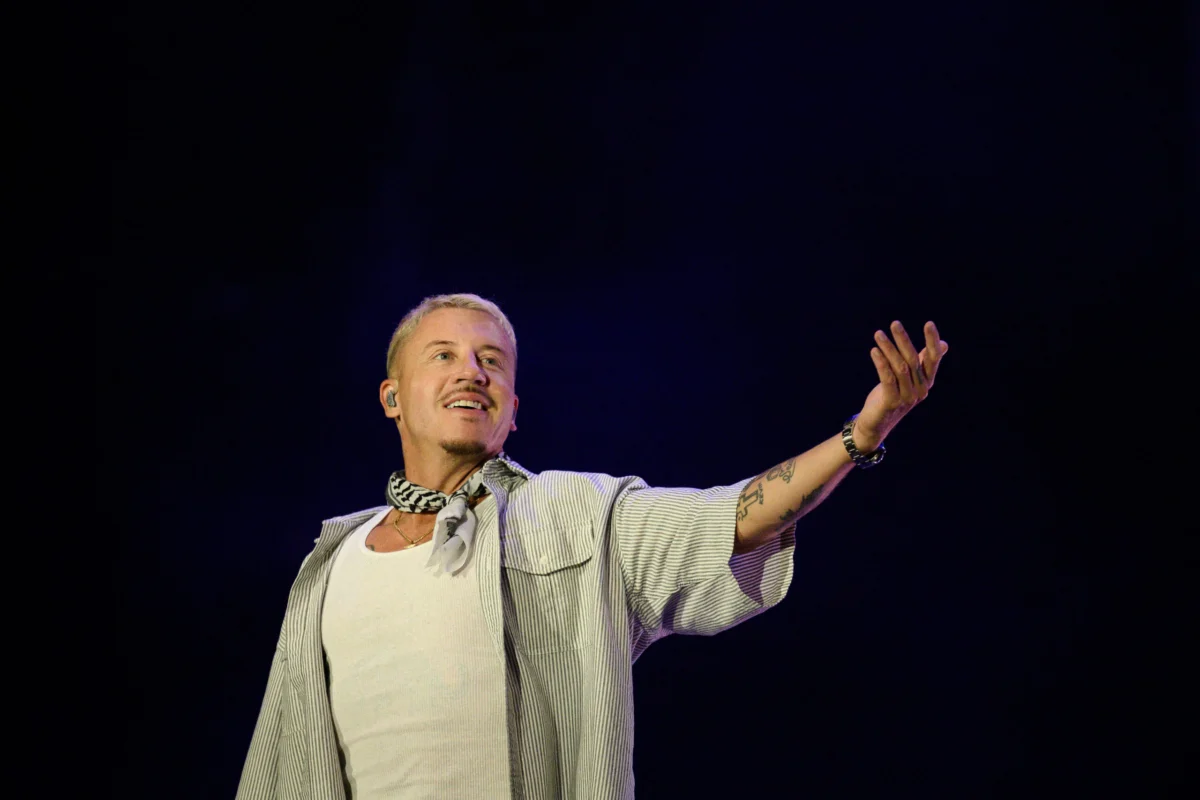
Seattle rapper Macklemore has ignited a significant controversy during his opening performances for Ed Sheeran’s North American stadium tour, utilizing the high-profile platform to vocally advocate for an end to what he describes as "Israel’s genocide in Gaza" and to champion a "Free Palestine." His impassioned speeches and performances have drawn both fervent support from long-time fans and new audiences, alongside sharp criticism and a formal petition for his removal from the tour, particularly from pro-Israel groups and some concertgoers. The unfolding events have thrust the intersection of music, celebrity, and geopolitical activism into the spotlight, prompting discussions about artistic freedom, platform responsibility, and the expectations of a concert audience.
The Catalyst: A Speech at MetLife Stadium
The latest chapter in this developing story unfolded on Friday at MetLife Stadium in New Jersey, where Macklemore delivered a version of a speech he has been giving consistently throughout the tour. Halfway through his opening set, he addressed the massive crowd, later sharing video footage of his address on Instagram, ensuring its message reached an even wider global audience. His remarks were direct and unequivocal. "I’ve been trying to figure out a way to say this all day," Macklemore began, articulating his motivation for joining the tour. "One of the reasons why I wanted to come on this tour was because I wanted to stand up here on stages in stadiums across America and say two words that are very near and dear to my heart: ‘Free Palestine.’ I said, ‘Free Palestine!’ I want those words to be loud and clear so that people from Gaza, all the way to the occupied West Bank know that we have not forgotten them."
Following this declaration, Macklemore explicitly connected his advocacy to the recent wave of student activism across the United States. He dedicated his subsequent song to the students of Columbia University, whose encampment movement, he stated, "mobilized the entire world. Opened up hearts, myself included." He expressed gratitude to these students, acknowledging the risks they undertook, including jeopardizing their diplomas, tuition, and scholarships, for standing up against perceived injustices. He specifically named student groups such as CUAD (Columbia University Apartheid Divest), Students For Justice In Palestine (SJP), and Jewish Voices For Peace (JVP), highlighting the multi-faceted nature of the protest movement.
Macklemore also took care to differentiate his criticism of the Israeli government from criticism of Jewish people, a distinction central to many pro-Palestinian advocacy efforts. "To all of my Jewish brothers and sisters: Criticism of Israel, criticism of apartheid, being against genocide in no way is a criticism of you," he asserted. "My message is for peace. Love. For all human beings to be treated with dignity, respect, and equality." He then expanded his message of solidarity beyond Palestine, declaring, "So I say free Palestine. I say free Lebanon. I say free Cuba. I say free Congo, free Sudan, free all people in America living in fear over this terrorist organization ICE. None of us will be free until we are all free." This broader call for liberation underscored his stance as a vocal advocate for various human rights causes, framing the Palestinian struggle within a wider context of global injustices.
The Performance of "Hind’s Hall" and its Context
Immediately following his powerful speech, Macklemore performed "Hind’s Hall," a protest song he originally released two years prior. The song itself is a direct and poignant tribute to Hind Rajab, a six-year-old Palestinian girl who was tragically killed alongside her family in Gaza. The title "Hind’s Hall" references the renaming of Columbia University’s Hamilton Hall by student protestors who occupied the building, transforming it into a symbol of solidarity with Palestinian suffering and resistance. The song quickly became an anthem for the student protest movement, encapsulating the anger, frustration, and defiance felt by many regarding the ongoing conflict and the perceived lack of accountability for civilian casualties in Gaza. Its performance on a stadium stage, reaching tens of thousands of attendees, served as a potent reiteration of its message and a direct challenge to the commercial neutrality often expected at mainstream music events.
The protests at Columbia University, which served as a significant inspiration for Macklemore’s song, involved a series of actions including encampments, building occupations, and disruptions to university operations. These actions drew widespread national attention, sparking a fierce debate about freedom of speech, academic environments, and the limits of protest. Supporters viewed the students’ actions as courageous and necessary civil disobedience in the face of humanitarian crisis, while critics condemned them as unlawful, disruptive, and, in some cases, antisemitic. The choice to perform "Hind’s Hall" during such a high-profile tour placed Macklemore squarely within this contentious national conversation.
The Counter-Response: A Petition for Removal and Calls for Refunds
Macklemore’s outspoken advocacy and the performance of "Hind’s Hall" did not go unanswered. The Israeli American Council (IAC), a prominent pro-Israel organization, swiftly launched an online petition calling for Ed Sheeran to remove Macklemore from the tour. The petition, provocatively headlined "Ed Sheeran – Your Show. Your Stage. Your Responsibility!", argues that Macklemore’s actions crossed a line from musical performance to political activism, which they deemed inappropriate for a mainstream concert setting.
The IAC petition’s text explicitly states: "This was an Ed Sheeran concert – not a political rally, not a protest, and not an activist event." It further elaborates on its concerns, asserting, "The issue is not whether Macklemore has the right to hold political views. The question is where the line should be drawn when an opening act uses a global concert platform to advance a one-sided political agenda." The petition criticizes Macklemore’s message as relying on "selective imagery, biased messaging, and disputed claims presented to a massive audience as fact, without context or complexity." It specifically targets the performance of "Hind’s Hall," noting its explicit support for campus protest movements and its naming after the occupied Hamilton Hall. The IAC highlights that "Some of those protests involved trespassing, building occupations, vandalism, disruption of university operations, and violations of the law – conduct that stands in direct conflict with core American values, including the rule of law, open discourse, respect for institutions, and shared civic space." Beyond calling for Macklemore’s removal, the petition also urges "tour leadership to clarify whether Macklemore’s political speech, visual content, and performance of Hind’s Hall were approved in advance, and to establish clear boundaries for the use of the tour stage to promote political messaging." The petition’s current number of signatories is not publicly displayed, but its existence signifies a structured and organized opposition to Macklemore’s stance.
Further amplifying the backlash, pop superstar P!nk reshared a post from the account "stop_antisemitism," which strongly criticized Macklemore’s performance. The shared post claimed that assertions of genocide were "false" and demanded apologies and refunds for concertgoers. Its caption read: "Awful – Jewish fans bought tickets to see Ed Sheeran sing last night in NJ, not to be ambushed by Macklemore’s anti-Israel propaganda. Instead, Macklemore walked onstage in a keffiyeh, shouted ‘Free Palestine,’ accused Israel of a false ‘genocide,’ and turned a mainstream event into a political nightmare against the Jewish state. Concert goers are owed apologies and refunds @teddysphotos – this is unacceptable." This public statement from another high-profile artist added significant weight to the criticism, drawing more attention to the controversy and putting additional pressure on Ed Sheeran and the tour organizers.
A History of Activism and Controversy
Macklemore’s current stance is not an isolated incident but rather the latest in a series of highly visible and often controversial acts of political speech. He has been a vocal advocate for various social justice causes for years, but his intensified focus on the Israeli-Palestinian conflict, particularly since the escalation of violence in Gaza, has placed him at the center of a charged global debate.
In 2024, Macklemore faced significant repercussions for his political commentary. He was dropped from the lineup of the Neon City festival in Las Vegas after a performance in his hometown of Seattle where he unveiled a sequel song, "Hind’s Hall 2," and controversially declared, "Fuck America," onstage during a pro-Palestine concert. The "Fuck America" comment, while delivered in a context he later clarified as a critique of specific U.S. foreign policy decisions rather than the nation itself, led to immediate and widespread condemnation. Macklemore subsequently released a statement providing further context on his stance, explaining his frustration with what he perceived as the U.S. government’s complicity in the humanitarian crisis in Gaza. Despite his clarification, several Seattle sports teams, including the Mariners, Sounders, and Storm, announced they were reevaluating their relationships with the artist in light of his comments, indicating the severe impact such statements can have on an artist’s professional ties and public image. In 2025, he continued his output of protest music with the release of another track, "Fucked Up," further solidifying his commitment to using his artistry as a vehicle for political commentary.
Broader Implications and the Role of Artists
The ongoing controversy surrounding Macklemore’s performances on the Ed Sheeran tour highlights several critical dynamics in contemporary culture and the music industry. Firstly, it underscores the increasing expectation for public figures, including musicians, to take stances on complex geopolitical issues, particularly those with significant humanitarian implications. In an era of constant information flow and heightened social consciousness, silence can often be interpreted as complicity, pushing artists to use their platforms.
Secondly, the situation reignites the perennial debate about the boundaries of artistic expression within commercial entertainment. While many defend an artist’s right to free speech, tour organizers and headliners like Ed Sheeran face the challenge of balancing this right with the expectations of a diverse audience and the commercial realities of a large-scale tour. Concerts are often viewed as spaces for escape and entertainment, and the introduction of overtly political messages can alienate segments of the audience, potentially leading to financial repercussions or reputational damage. The petition’s demand for tour leadership to clarify whether Macklemore’s speech was pre-approved speaks directly to this tension.
Thirdly, the incident reflects the deeply polarized nature of the Israeli-Palestinian conflict globally. Opinions are often entrenched, and any public statement, particularly from a celebrity, is likely to elicit strong reactions from both sides. The rapid mobilization of the Israeli American Council and the public intervention by P!nk demonstrate the organized efforts to counter narratives perceived as anti-Israel, while Macklemore’s persistent advocacy showcases the unwavering commitment of pro-Palestinian voices in the cultural sphere.
As of this report, Ed Sheeran has not publicly commented on the controversy surrounding his opening act. His silence, whether strategic or simply a delay in response, is a significant element in this unfolding narrative. The decision to either support Macklemore, distance himself, or remain neutral carries considerable weight, given the global reach of his tour and his own status as a major international artist. The future of Macklemore’s participation in the tour, and the broader implications for artists using their platforms for political advocacy, remains a subject of intense public and industry scrutiny. The MetLife Stadium speech, far from being an isolated incident, has become a flashpoint in a larger cultural and political battle, demonstrating the potent influence of music and celebrity in shaping public discourse on some of the world’s most contentious issues.
