

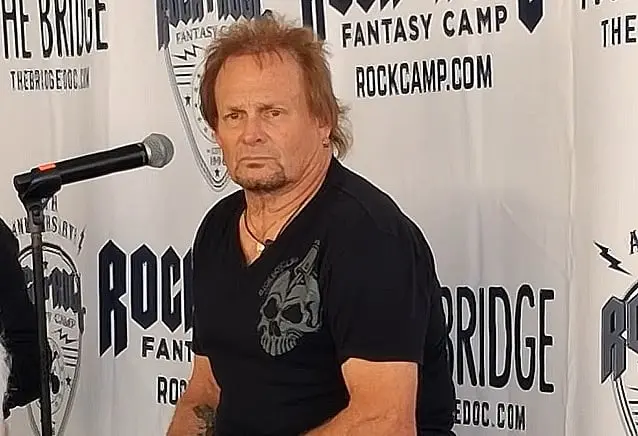
During a candid question-and-answer session at the November 15th installment of the Rock ‘N’ Roll Fantasy Camp in Hollywood, California, former Van Halen bassist Michael Anthony provided definitive insights into a long-standing rumor that has circulated within rock music circles for decades. Anthony, a foundational member of the iconic band, directly addressed the persistent speculation that Sammy Hagar was not the initial choice to step into the frontman role after David Lee Roth’s departure in 1985. The rumor posits that guitarist Eddie Van Halen had, in fact, approached Patty Smyth, the charismatic lead singer of the popular 1980s band Scandal, to join Van Halen first. Anthony’s confirmation not only validates this piece of rock history but also offers a deeper look into the turbulent period following Roth’s exit and the band’s subsequent search for a new voice.
The Rock ‘N’ Roll Fantasy Camp, a recurring event that allows aspiring musicians and dedicated fans to interact with rock legends, served as the stage for Anthony’s revelations. Attendees had the opportunity to engage directly with the bassist, who has been a pivotal figure in Van Halen’s sonic identity for a significant portion of their career. The setting, steeped in the lore of rock and roll, provided a fitting backdrop for Anthony to delve into the band’s inner workings during a critical juncture.
The Van Halen Transition: A Band in Flux
Anthony, when pressed about the veracity of the proposed Smyth/Van Halen pairing, navigated the sensitive topic with a measured tone, describing the situation as entering "kind of a gray area." He then elaborated, stating, "Patty Smyth actually was considered at one point. And this was Eddie." The guitarist’s active involvement in seeking a replacement is a key takeaway from Anthony’s account.
The departure of David Lee Roth in 1985 was a seismic event for Van Halen, a band that had achieved stratospheric success with Roth’s flamboyant stage presence and distinctive vocal delivery. Anthony vividly recalled the immediate aftermath: "When Dave left, it kind of threw us all in a bit of a tailspin." This period of uncertainty was compounded by pressure from their record label, Warner Brothers. "Our record label, Warner Brothers, they wanted us to change the name of the band right away, hoping that one day Dave would come back, and we could resume the Van Halen thing," Anthony explained. This strategic suggestion from the label underscores the immense brand equity associated with the Van Halen name and their desire to preserve it for a potential future reunion with Roth.
However, for the band members, the feeling was that the original magic had dissipated. "But it was kind of like the fairy tale was over, the initial success that we had with the band," Anthony mused. Eddie Van Halen, the band’s visionary guitarist and principal songwriter, was reportedly feeling the strain of this transition. "And Ed, he was kind of freaking out a bit," Anthony revealed.
Exploring Vocal Avenues: Patty Smyth and Beyond
The band’s search for a new vocalist was not a straightforward process. Anthony indicated that numerous individuals were considered. "And there were quite a few people that either jammed with us or Ed had spoken to, so we really didn’t know." This suggests a period of extensive auditioning and exploration, a common practice for bands undergoing such a significant personnel change.
Regarding the specific consideration of Patty Smyth, Anthony offered a reason for why the potential collaboration ultimately did not materialize. "We all kind of decided [in the end that] we didn’t need Patty Smyth to come in, having a girl come in singing songs about girls. It wasn’t gonna fit." This statement reflects the band’s internal deliberations and their assessment of how a female vocalist might be perceived in the context of their established sound and lyrical themes. The implication is that while Smyth was a talented vocalist, the perceived thematic mismatch with the band’s existing material played a role in the decision-making process.
Mitch Malloy: Another Near-Miss in the Van Halen Vocalist Saga
The discussion at the Rock ‘N’ Roll Fantasy Camp extended beyond the Patty Smyth rumor, as Anthony was also queried about other singers who were considered for the Van Halen frontman position throughout the band’s history. This opened the door to another significant, albeit less publicized, candidate: Mitch Malloy.
Anthony recalled an encounter with Malloy at the eighth annual Vegas Rocks! Magazine Music Awards, which took place on September 20, 2026, at The Orleans Showroom in Las Vegas. "There’s a guy by the name of Mitch Malloy. Anybody remember him?" Anthony posed to the audience. He elaborated on how he recently shared the stage with Malloy at this event, performing Van Halen’s classic "Ain’t Talkin’ ‘Bout Love."
Malloy, a singer who had gained some recognition in the late 1980s and early 1990s, had indeed been in discussions with the Van Halen brothers. "And he had actually met with Ed and Al [Van Halen drummer Alex Van Halen]," Anthony confirmed. "He sang on some stuff that Ed had written, but it was kind of a real short-lived deal." This suggests that Malloy was given an opportunity to showcase his vocal abilities with material composed by Eddie Van Halen.
However, the situation with Malloy also ended without him joining the band. Anthony described it as "kind of a weird type of deal." He added, "He thought that he was gonna be in the band, and then all of a sudden Gary Cherone… It was kind of a weird type of deal." This cryptic remark hints at the complex and sometimes unpredictable nature of band negotiations and personnel changes. The mention of Gary Cherone, who eventually became Van Halen’s frontman for a period in the late 1990s, further contextualizes the ongoing search and the various individuals who were considered or briefly involved.
Patty Smyth’s Perspective: Regret and Realism
Patty Smyth herself has previously addressed the Van Halen offer, providing her own reasons for declining the opportunity. In a July 2020 interview with Stereogum, she recounted her conversation with Eddie Van Halen. "They were heavy drinkers. I don’t drink," Smyth stated, highlighting a significant lifestyle difference as an initial concern. Furthermore, her strong ties to New York contrasted with the band’s base in Los Angeles. "I never saw myself living in L.A. I was, like, ‘I’m from New York. We don’t move to L.A.’"
Smyth clarified that the offer was somewhat ambiguous regarding the extent of her commitment. "It’s all semantics because if [Eddie] had said to me, ‘Let’s make a record,’ then I would have said yes to that. But joining the band – to me then, ‘Oh god, they fight all the time, him and his brother, and I don’t want to get into a volatile situation.’" She also alluded to her mental state at the time, being eight months pregnant, which influenced her priorities: "And I was probably heavily hormoned out because I was eight months pregnant, so there was a state of mind that I was in of how I need to take care of myself."
Despite these reasons, Smyth admitted to experiencing regret over the decision. "But I regretted turning him down. For a long time, I regretted it. When you start to have regrets, I was, like, ‘Oh, man. I would’ve made so much money.’" This financial consideration, coupled with the potential for a different career trajectory, clearly weighed on her.
Smyth also acknowledged that her prior experiences within a group dynamic might have contributed to her hesitation. "Yeah, that definitely has something to do with it. I’m sure." She reiterated her reluctance to move to Los Angeles, suggesting that a more defined offer focused on recording rather than a full band commitment might have been more palatable. "It was such a weird conversation. But if he had said to me, ‘Look, just come out for a few months and make a record. Have the baby, come out and let’s make a record.’ That to me would’ve been more doable."
Furthermore, Smyth revealed that Eddie Van Halen had requested her discretion regarding the offer to avoid undermining Sammy Hagar’s position. "And I never said anything about it for years. I got a call from Ed, and he was, like, ‘Look, I’m not saying that I asked you to join because I don’t want Sammy Hagar to look like [he was] second choice,’ and I was, like, ‘Okay.’ So I never spoke about it after that. I’m, like, all right I don’t need to tell people. If someone asked me, I didn’t lie but I didn’t really talk about it that much." This exchange highlights the delicate nature of band politics and the importance of managing public perception.
The Van Halen Vocalist Lineage: A Chronology of Change
The narrative of Van Halen’s vocalists is a complex one, marked by significant shifts and prolonged periods of stability with different frontmen.
- 1974-1985: David Lee Roth serves as the original frontman, defining the band’s early image and sound. This era produced seminal albums like "Van Halen," "Van Halen II," "Women and Children First," "Fair Warning," "Diver Down," and "1984."
- 1985: David Lee Roth departs to pursue a solo career. This marks the beginning of an extensive search for a new vocalist.
- Mid-1985: Patty Smyth is reportedly approached by Eddie Van Halen to join the band. The offer is ultimately declined by Smyth.
- Mid-to-Late 1985: Various singers are considered and auditioned. Mitch Malloy has discussions with Eddie and Alex Van Halen and records some material. This opportunity ultimately does not lead to him joining the band.
- 1985-1996: Sammy Hagar joins Van Halen, bringing a different vocal style and lyrical sensibility. He contributes to four studio albums: "5150" (1986), "OU818" (1988), "For Unlawful Carnal Knowledge" (1991), and "Balance" (1995). This period is marked by significant commercial success, including the chart-topping "5150."
- 1996: Sammy Hagar leaves Van Halen.
- 1996-1999: Gary Cherone, formerly of the band Extreme, becomes Van Halen’s frontman. He records one studio album with the band, "Van Halen III" (1998).
- 2004: Sammy Hagar briefly reunites with Van Halen for a reunion tour.
- 2007-2020: David Lee Roth rejoins Van Halen for a highly successful world tour and subsequent performances, marking his definitive return to the band until Eddie Van Halen’s passing in 2020.
Broader Implications and Legacy
Michael Anthony’s revelations offer a valuable historical footnote to the rich and often dramatic saga of Van Halen. The confirmation that Patty Smyth was indeed a contender, however brief, adds another layer to the "what ifs" of rock history. It also highlights the significant influence and desirability of the Van Halen frontman position, attracting interest from established artists.
The decision not to proceed with Smyth, as explained by Anthony, also speaks to the internal dynamics and creative vision of the band at that specific moment. While the reasoning might seem pragmatic, it also underscores the challenges of integrating a new voice into an established musical identity. Similarly, the brief involvement of Mitch Malloy illustrates the often-unseen efforts and near misses that characterize the search for band members.
The fact that these discussions are still being had and explored years later at events like the Rock ‘N’ Roll Fantasy Camp speaks to the enduring legacy of Van Halen and the fascination with their creative process. Michael Anthony, as a consistent presence throughout much of the band’s most celebrated periods, remains a crucial source for understanding these pivotal moments. His willingness to share these details, even decades later, enriches the historical record and provides fans with a more nuanced appreciation of the band’s journey. The confirmation of these past considerations also serves to validate the importance of Sammy Hagar’s tenure, solidifying his place as a key figure in the band’s evolution, even if he wasn’t the very first choice in the immediate aftermath of David Lee Roth’s initial departure. The complex tapestry of Van Halen’s vocal history continues to be a subject of interest, and Anthony’s insights offer a significant thread in that ongoing narrative.
