

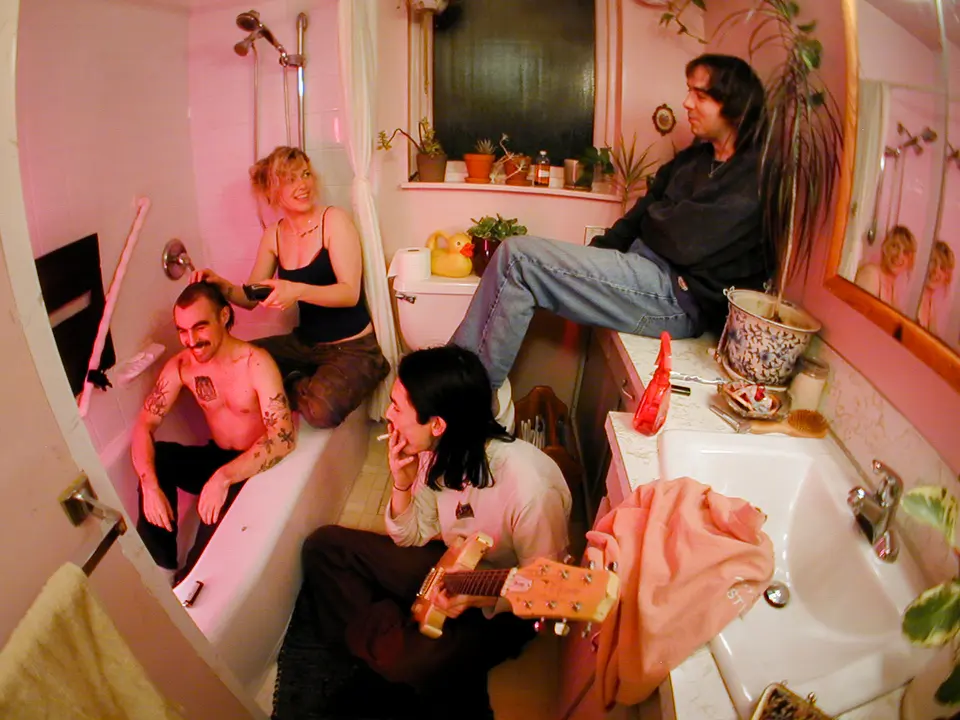
Vancouver quartet PISS—comprised of vocalist/lyricist Taylor Zantingh, guitarist Tyler Patterson, bassist Gavin Moya, and drummer Garreth Roberts—has released their highly anticipated debut album, you made me / skin on linen, on October 30 via Sub Pop. The album stands as an intense and challenging artistic statement, delving deep into themes of sexual violence, trauma, societal complicity, and the complex journey of personal autonomy. Far from a mere collection of songs, it is an assemblage of raw emotion, piercing intellect, and abrasive sound, designed to provoke introspection and confront uncomfortable truths.
Thematic Depth: A Confrontation with Violence and Trauma
you made me / skin on linen is not an easy listen, nor is it intended to be. From its explicit content warning for sexual violence, sexual assault, and discussions of trauma, the album prepares its audience for an unflinching encounter with pain. Across just over 30 minutes, PISS constructs a sonic landscape marked by guttural yells, grating guitars, grueling basslines, and unyielding drums, all interwoven with engrossing poetry and meticulously selected samples from influential feminist thinkers and activists. This formidable sonic architecture serves as the vehicle for articulating the harrowing evolution of personhood within a world seemingly permissive of sexual violence, dissecting the societal norms that have perpetuated such injustices throughout history, and examining the often-conflicting viewpoints on how to move forward and prevent their continuation.
The album opens with a stark contrast: the innocent aspirations of children’s voices expressing their future dreams. This quickly dissolves into the track "i wanted to be a singer," where Zantingh delivers a potent line that encapsulates the album’s core message: "I wanted to write romance novels/ Now I need perfect control over my victim narrative/ The story of a girl who was silent and powerless/ But it’s cliche to write about being powerless as a girl." This lyric immediately establishes the album’s central tension—the shattering of innocence and the struggle to reclaim agency and narrative control in the wake of abhorrent actions. The juxtaposition of past aspirations with present realities underscores the profound and irreversible impact of trauma on an individual’s life trajectory.
The Art of Assemblage: Voices of Dissent and Reflection
PISS masterfully employs a "collage" or "assemblage" technique, integrating diverse audio samples that function as "doorways to some new level of both understanding and unraveling." These samples are not mere embellishments; they are integral narrative components, bringing academic and activist voices into direct conversation with the band’s raw musical expression. Featured voices include:
- Andrea Dworkin: A radical feminist writer and activist known for her staunch critique of pornography, arguing it constitutes a human rights violation. Her inclusion underscores the album’s critical examination of cultural representations of sex and power.
- Manon Garcia: A French philosopher whose work often explores feminist issues, including sexual violence and its systemic nature. Her discussion of cases like the Gisèle Pelicot case highlights the vast and pervasive reality of sexual violence.
- Toni Morrison: The Nobel laureate author, whose profound insights into morality, self-forgiveness, and grace offer a counterpoint of resilience and reflection amidst the album’s exploration of harm.
The careful selection and arrangement of these samples create a complex dialogue, exposing the multifaceted ways individuals cope with pain and injustice. This intellectual framework elevates the album beyond mere noise, transforming it into a violent sound about violence inflicted—on a body, a person, a future, a life. It becomes a piece steeped in contradiction and tension, mirroring how life itself navigates constant friction to move forward.
PISS’s Journey: From Underground to Sub Pop
The path to you made me / skin on linen has been a deliberate and evolving one. For two years prior to its recording, PISS performed the same set live, meticulously honing their sound and narrative. This prolonged incubation period allowed the band to deeply embed their artistic vision before committing it to record. The album’s eventual release through Sub Pop marks a significant milestone. Sub Pop, an iconic independent label synonymous with grunge and alternative music, has historically been a launchpad for influential artists like Nirvana and Soundgarden. Their decision to sign PISS not only validates the band’s artistic merit but also signals a broader industry recognition of challenging, conceptually rich, and politically charged music. What began as a project born from a specific artistic impulse has thus transcended its origins, evolving into a potent contribution to wider cultural conversations about personal autonomy and systemic violence.
In a recent interview, Taylor Zantingh reflected on the upcoming tour, acknowledging the physical demands of her vocal style. "I love being on tour, but it’s a constant state of hyper vigilance concerning… I’m always listening to everyone’s breathing, like oh, someone’s sniffling. If I hear someone cough, I’m just like, ‘Ahhhh!’" This highlights the immense vocal athleticism required for her performance and the precarious balance between artistic expression and physical well-being. Zantingh’s background, rooted in intuitive vocal exploration since her teenage years in punk bands and refined through an undergraduate degree in creative writing, underscores her unique approach. "There’s not a lot of thought that goes into delivery. The thought goes into everything else, so that I don’t have to think that much about voice," she explains, revealing a creative process where intellectual rigor underpins spontaneous, visceral vocalization.
The Performer’s Body and Voice: A Site of Tension
The album’s creation and performance embody a profound tension between the mind and the body. Zantingh describes her voice as both a tool for empowerment, unlocking a life of expression and connection, and a source of profound humility. The vulnerability of losing her voice, the constant need for vocal warm-ups, cool-downs, physiotherapy, massage therapy, and even regular therapy, illustrates the holistic demands of her craft. This intimate relationship with her body as an instrument forms a powerful parallel to the album’s themes of physical violation and the reclamation of bodily autonomy.
The band’s live performances are characterized by "controlled chaos." Zantingh notes the deliberate effort to ensure the music is "dialed in" and that technical difficulties rarely halt a song. This commitment to structural integrity provides a secure environment for her to enter a flow state, allowing for an energetic connection with the audience. Paradoxically, within this controlled environment, moments of deliberate vulnerability emerge. Zantingh describes removing her earplugs during certain intense parts of the set, acknowledging, "it’s an important part of the set for people to watch me hurting—which sounds fucked up to say, but that’s what people like about it, you know?" This intentional exposure highlights the raw, confrontational nature of PISS’s art, challenging the audience to engage directly with the performer’s enacted pain.
Navigating Difficult Art: Consumption and Creation
The band members themselves grapple with the complexities of creating and consuming such emotionally charged art. The conversation turns to albums that are profoundly important but difficult for everyday listening, citing Mount Eerie’s A Crow Looked At Me (documenting the artist’s grief after his wife’s death) and Sufjan Stevens’ Carrie & Lowell (exploring themes of family, faith, and loss). Zantingh particularly identifies with Mount Eerie’s refusal to let his experience "become an object for somebody else," a sentiment that deeply inspired her in the making of you made me / skin on linen. This perspective underscores PISS’s intention to create art that demands active engagement rather than passive consumption, forcing listeners to confront the gravity of the subject matter rather than simply commodifying it as entertainment.
The process of revisiting personal trauma as a touring musician presents unique challenges. Zantingh describes a necessary detachment, a "constant state of dissociation" required to function within the demanding touring schedule. This leads to a complex emotional landscape, oscillating between joy and gratitude in moments of success, and profound stress and anxiety before tours. The parallels between communicating a deeply personal, traumatic story on stage and the criticism of art are stark, forcing Zantingh to confront the difficulty of relinquishing control over how her experience is received. "Letting go of control," she admits, "is very hard for people who have experienced trauma." Somatic therapy, she explains, has become crucial in allowing her to "sit in a feeling without constantly needing to be like, ‘Oh, what does this mean?’" This ongoing, organic process of creation and healing is essential for her ability to function and continue to make art.
Creative Philosophy: Collage, Contradiction, and Ongoing Evolution
The band’s embrace of "assemblage art" as a guiding metaphor extends beyond the album’s sonic structure to its very philosophical core. Zantingh views it as a reflection of self-creation, acknowledging how environment shapes growth and how the performer, as a public figure, constantly resists objectification. This framework allows for a "piece that never has to be finished," reflecting the ongoing, fluid nature of identity and healing.
This approach also accommodates contradiction, a central tenet of the album’s intellectual framework. PISS deliberately brings together seemingly conflicting feminist viewpoints, recognizing that "two very influential feminist thinkers can be in direct conflict with each other, but yet both their ideas are essential for us to move forward as a movement." This extends to the personal realm, exploring the duality within individuals—being deeply harmed victims while also capable of perpetuating harm or being complicit in their own. This embrace of inherent complexity, rather than seeking simplistic answers, is fundamental to the album’s power. Zantingh concludes, "If I could just be like, ‘Yeah, this is what the record’s about, and this is everything,’ then I wouldn’t have made the record because it would have just been something that’s easy to describe."
Legal Hurdles and Artistic Compromise
The journey to release you made me / skin on linen was not without its logistical and artistic challenges, particularly concerning sample clearance. What began as a punk band’s casual use of uncleared samples, including one from Howard Stern, quickly escalated into legal issues once Sub Pop became involved. Stern’s team, for instance, issued a direct letter prohibiting the use of his voice. This forced the band to replace several key samples due to legal and financial constraints.
One particularly poignant instance involved a sample Zantingh had initially reserved for a future record, which had to be brought forward to fill a void. More significantly, an estate manager for a staunch advocate of non-violence elected not to allow their relative’s voice to be included. This decision, intended to prevent association with what they perceived as "militant activism," ironically skewed the album’s intended ideological balance. Zantingh observed, "without your relative’s voice, then it does really start to sound like it’s advocating for militant activism." This unforeseen consequence underscores the delicate interplay between artistic intention, legal realities, and the potential for external decisions to inadvertently alter a work’s message. Despite these hurdles, the band believes the final product is a robust representation of their vision, albeit one shaped by unexpected forces.
Band Dynamics and Collective Artistic Growth
The collaborative spirit within PISS is a cornerstone of their success. The "clicking moment" for the band, according to guitarist Tyler Paterson, occurred when Zantingh presented a detailed document outlining the album’s conceptual framework with abstract prompts and energetic directives. This foundational vision, combined with the immediate sonic chemistry in early practice sessions and the overwhelming reception of their first live show, solidified their collective purpose. Drummer Garreth Roberts recalls the "Music Waste" festival show as another pivotal early moment.
Each member has contributed significantly to the group’s evolving sound. Bassist Gavin Moya, for example, credits Paterson and Zantingh with introducing him to noise and experimental music, pushing him to explore new sonic textures. Roberts similarly found new artistic avenues through bands like Women (the band), which was introduced by Paterson and Zantingh. Paterson, in turn, credits Zantingh’s poetry readings with solidifying the project’s artistic direction. Zantingh highlights the complementary skill sets within the band, particularly her collaboration with Paterson, who translates her abstract prompts into tangible sound.
While the band maintains a largely harmonious dynamic, minor disagreements have occurred. Roberts humorously recalled a "fight in the studio" over the use of more tom drums in a specific track, a moment Zantingh likens to a "Donkey/Shrek type relationship" between them, characterized by playful but intense clashes that ultimately resolve into shared understanding. These instances, however, remain exceptions, reinforcing the band’s overall collaborative strength and shared commitment to their artistic goals.
Broader Implications: Art, Advocacy, and the Music Industry
PISS’s you made me / skin on linen contributes significantly to the contemporary cultural discourse surrounding sexual violence and trauma. By fusing raw, visceral music with intellectual and activist voices, the album challenges listeners to confront the pervasive nature of these issues and to engage with the complex emotional and ideological landscapes they generate. Its release on Sub Pop amplifies this message, demonstrating that challenging, difficult art can find a platform within the mainstream music industry. This signals a continued openness for major independent labels to support artists who prioritize substance and social commentary over commercial viability.
The album also provides a powerful example of art as a means of processing and communicating profound personal experiences. Zantingh’s candid discussion of dissociation, the physical toll of performance, and the role of therapy underscores the immense personal cost of creating such work, yet also highlights its transformative potential. PISS stands as a testament to the power of artistic expression not only to reflect reality but to actively shape conversations, challenge norms, and perhaps, in its own intense way, contribute to healing and progress.
Future Outlook
Looking ahead, PISS is not rushing the creation of a follow-up album. Zantingh emphasizes the need for "peace and quiet and solitude" to foster genuine creativity. "I’m not going to write something if I don’t feel like it should be written," she asserts, indicating a commitment to artistic integrity over prolific output. The band plans to focus on touring you made me / skin on linen, allowing for a period of absorption and reflection before embarking on new creative endeavors. This patient approach suggests that any future work from PISS will continue to be as deliberate, impactful, and unflinching as their debut, further cementing their position as a vital voice in contemporary music.
you made me / skin on linen is out 10/30 via Sub Pop.
