

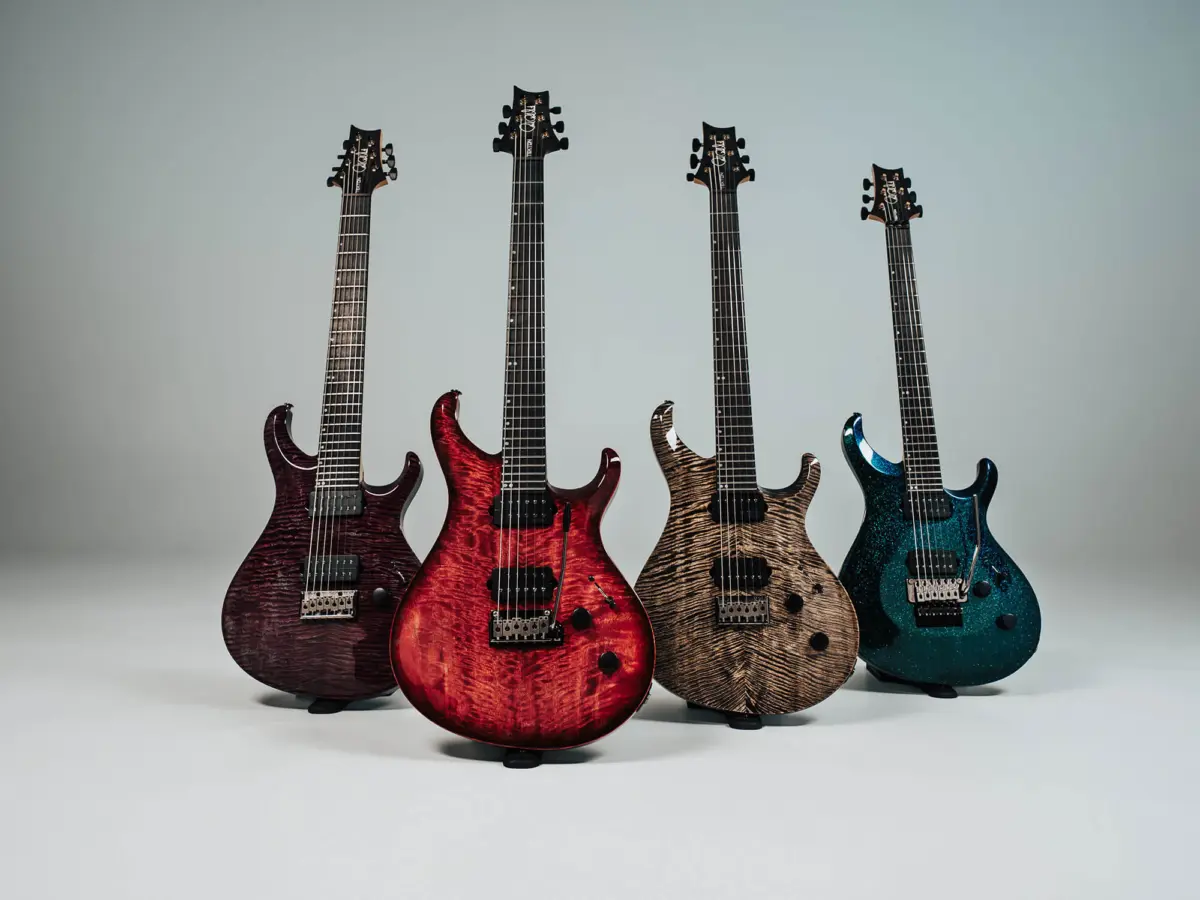
PRS Guitars has officially announced the launch of its innovative Tekton series, an entirely new line of electric guitars meticulously engineered to meet the demanding requirements of the most technical modern players, particularly those leveraging advanced digital amplifier and effects rigs. This strategic introduction marks a significant evolution for the Maryland-based manufacturer, known for its blend of traditional craftsmanship and modern playability, as it ventures deeper into the high-performance guitar segment dominated by precision, speed, and sonic versatility.
The Tekton series represents a bold departure from many of PRS’s established design philosophies, introducing a completely novel body shape alongside a suite of player-centric features tailored for contemporary musical styles. Comprising four distinct models—the hardtail-equipped Tekton, the two-point tremolo Tekton T, the high-performance Tekton Floyd, and the extended-range seven-string Tekton SVN—the series addresses a growing demand within the guitar community for instruments optimized for intricate techniques, extended ranges, and seamless integration with the latest digital processing technologies.
A Strategic Pivot: Addressing the Modern Player Landscape
For decades, PRS Guitars has cultivated a sterling reputation for crafting exquisite instruments favored by professional musicians across genres, from classic rock and blues to jazz and fusion. Models like the Custom 24 and the McCarty have become industry benchmarks, celebrated for their aesthetic beauty, ergonomic comfort, and versatile tones. However, the landscape of modern guitar playing has undergone a seismic shift, driven by the proliferation of progressive metal, shred, djent, and fusion styles, all demanding instruments capable of extreme precision, speed, and sonic clarity, often at lower tunings. Concurrently, the rise of sophisticated digital modeling amplifiers and effects processors from companies like Kemper, Fractal Audio, Line 6, and Neural DSP has transformed how guitarists achieve their tones, necessitating instruments that provide a clean, articulate, and uncolored signal to maximize the capabilities of these digital platforms.
Jim Cullen, Director of Sales at PRS Guitars, articulated the company’s vision, stating, "This is not just introducing a new model. We are planting a flag for a whole new family of guitars. Since day one, PRS has been built around a combination of player feedback and our experience as guitar makers. Listening to musicians while continually refining our craft has helped us create instruments that serve as tools for a wide range of players. Over the years, we have heard a growing call for more modern spec’d PRS guitars. The Tekton is our answer to that call." This statement underscores a proactive response from PRS to market trends and direct player feedback, signaling a commitment to broaden its appeal without compromising its core values of quality and innovation.
Ergonomics and Playability: Engineered for Speed and Comfort
Central to the Tekton series’ design philosophy is an unwavering focus on playability, particularly for guitarists who employ complex techniques requiring exceptional speed and precision. The series introduces an entirely new body shape for PRS, which, while finding a "middle ground" between the flagship Custom 24 and the offset Vela models, presents a more aggressive and streamlined profile. This new contour is not merely aesthetic; it features an exaggerated scoop in the cutaway to facilitate unparalleled upper fret access, crucial for high-velocity soloing and intricate melodic passages. Complementing this is a comfortable belly carve, ensuring ergonomic support during extended playing sessions, a common necessity for musicians pushing technical boundaries.

The neck profile is another area of significant innovation. Tekton series guitars boast the thinnest neck of any instrument in the standard PRS product lineup, carved into a comfortable near "D shape." This thinner profile, combined with a supremely flat 16-inch fretboard radius, directly addresses the need for effortless movement across the fretboard, allowing for rapid legato passages, intricate tapping, and sweeping arpeggios. For context, many traditional guitars feature radii ranging from 7.25 to 12 inches, making the 16-inch radius a clear indicator of the Tekton’s performance-oriented design. The fretboards themselves are crafted from Indian ebony, a dense and resonant wood known for its smooth feel and bright attack, further enhancing playability. Each ebony fretboard is unique, often displaying natural mineral deposits or "birthmarks" as the tree grows, ensuring that every Tekton guitar possesses a distinct character.
Further enhancing the playability are stainless steel frets, renowned for their exceptional durability and smooth feel, which contributes to faster playing and reduced friction during bends and vibrato. Luminlay side dots, a crucial feature for performing musicians, provide clear fretboard guidance in low-light environments, eliminating guesswork on dimly lit stages. The string spacing on the Tekton series is also intentionally wider, mirroring that of the popular Silver Sky and Fiore models. This slightly broader spacing, compared to PRS’s traditional measurements, is a thoughtful inclusion for advanced techniques such as sweep picking, ensuring ample room for articulation and preventing accidental string muting. Each maple neck is fortified with a hormigo strength rod, a material akin to carbon fiber, providing superior stability and resistance to environmental changes—a feature previously seen in PRS’s high-performance Chleo Herman Li signature model.
Sonic Engineering for the Digital Age: The Stylus Pickups
Perhaps the most significant innovation in the Tekton series, especially for its target audience, lies in its meticulously designed Stylus pickups. These PRS-designed humbuckers feature Alnico 5 magnets and are specifically voiced for "clarity, articulation, and character." However, their defining characteristic is a "flatter output" compared to other humbuckers. This design choice is a direct response to the prevalent use of digital amplifier and effects modeling.
In the era of digital rigs, where sophisticated algorithms meticulously replicate the nuances of classic and modern amplifiers, a guitar’s pickups ideally provide a clean, uncolored, and dynamic signal. Traditional high-output humbuckers, while excellent for driving analog tube amps into saturation, can sometimes overwhelm digital preamps, leading to premature clipping or an overly compressed sound that limits the modeler’s ability to shape the tone effectively. The flatter output of the Stylus pickups ensures maximum headroom and dynamic range, allowing the digital rig to interpret and process the guitar’s signal with greater fidelity and flexibility. This approach empowers players to sculpt their tones precisely within the digital environment without fighting against an already heavily colored input signal from the pickups. Despite their flatter output, PRS assures that the Stylus pickups retain significant character, preventing a sterile or lifeless tone. They are also highly versatile, offering both full humbucking and coil-split modes, catering to a wide array of sonic preferences and genres.
Construction and Versatility: A Model for Every Technical Player
The Tekton series offers a diverse range of construction materials and hardware configurations to suit different playing styles and sonic preferences. The Tekton Floyd model, designed for extreme vibrato and tuning stability, features an alder body. Alder is well-regarded for its balanced tone, strong midrange, and clear highs, often favored in guitars requiring articulate, cutting sounds, making it an excellent choice for pairing with a Floyd Rose system. The other three models—the standard Tekton, Tekton T, and Tekton SVN—boast mahogany backs paired with highly figured mango tops. Mahogany provides a warm, resonant foundation with excellent sustain, while mango tops contribute to a visually striking aesthetic and can impart a subtle, unique tonal character.
Each model in the series is equipped with a specific bridge system to cater to diverse performance needs:

- Tekton: Features a hardtail bridge, known for its superior sustain, tuning stability, and direct tonal transfer, ideal for players who prioritize simplicity and robust tone without vibrato.
- Tekton T: Incorporates a two-point tremolo system, offering smooth vibrato capabilities and pitch manipulation while maintaining excellent tuning stability for more expressive playing.
- Tekton Floyd: As its name suggests, this model is outfitted with a Floyd Rose tremolo system, the industry standard for aggressive dive-bombs, flutter effects, and extreme pitch manipulation, crucial for shred and progressive metal guitarists.
- Tekton SVN: The seven-string variant extends the tonal palette for modern genres that demand lower tunings and expanded harmonic possibilities. Its design considerations, including longer scale lengths (implied for optimal tension and clarity in lower registers) and the specialized Stylus pickups, ensure that the low B string remains tight, articulate, and powerful.
The aesthetic of the Tekton series also aligns with its modern ethos. The fretboard features a new simplistic inlay design with offset dots, a subtle yet distinct visual departure for PRS, complementing the sleek, performance-driven design. This minimalist approach maintains PRS’s signature elegance while signaling a forward-thinking design philosophy.
Implications for PRS and the Guitar Market
The introduction of the Tekton series is more than just a product launch; it’s a strategic declaration from PRS Guitars. It signifies the company’s commitment to remaining at the forefront of guitar innovation and its willingness to adapt to the evolving demands of the global guitar community. By directly addressing the needs of technical players and those embracing digital rigs, PRS is positioning itself to capture a segment of the market traditionally dominated by brands like Ibanez, Jackson, Schecter, ESP, and Kiesel.
This move could have several significant implications:
- Broadening Brand Appeal: While PRS has always been revered, the Tekton series could introduce the brand to a new generation of guitarists who might have previously viewed PRS as primarily catering to classic rock or blues aesthetics. This diversification could expand PRS’s market share and reinforce its reputation as a versatile and forward-thinking manufacturer.
- Validation of Digital Rigs: The explicit design of the Stylus pickups for digital rigs validates the increasing prevalence and sophistication of these technologies within professional and amateur setups. It suggests that major manufacturers are now actively designing instruments to complement, rather than simply tolerate, digital amplification.
- Competitive Landscape: The Tekton series will undoubtedly intensify competition in the high-performance guitar market. Its blend of PRS’s renowned craftsmanship with modern specifications offers a compelling alternative to existing offerings, potentially pushing other manufacturers to innovate further.
- Future Design Trends: The design choices in the Tekton series—thinner necks, flatter radii, stainless steel frets, digital-optimized pickups, and ergonomic body carves—could become increasingly influential across the industry, signaling a continued shift towards performance-centric design.
In conclusion, the PRS Tekton series represents a pivotal moment for the company, demonstrating an acute understanding of contemporary guitar playing trends and technological advancements. By combining PRS’s legendary build quality and attention to detail with cutting-edge ergonomics and sonic engineering, the Tekton series is poised to become an indispensable tool for technical guitarists seeking precision, versatility, and seamless integration with the modern digital soundscape, effectively planting a new flag in the evolving territory of high-performance electric guitars.
Learn more about the Tekton series at PRS Guitars.
