


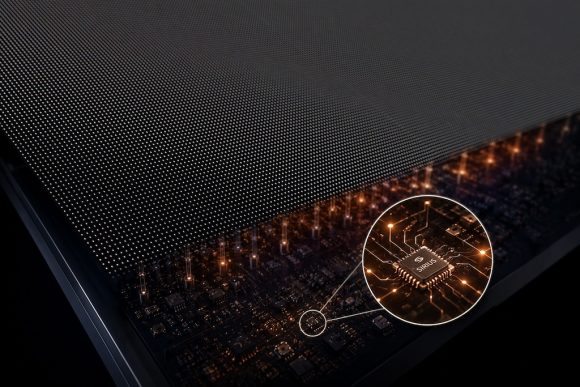
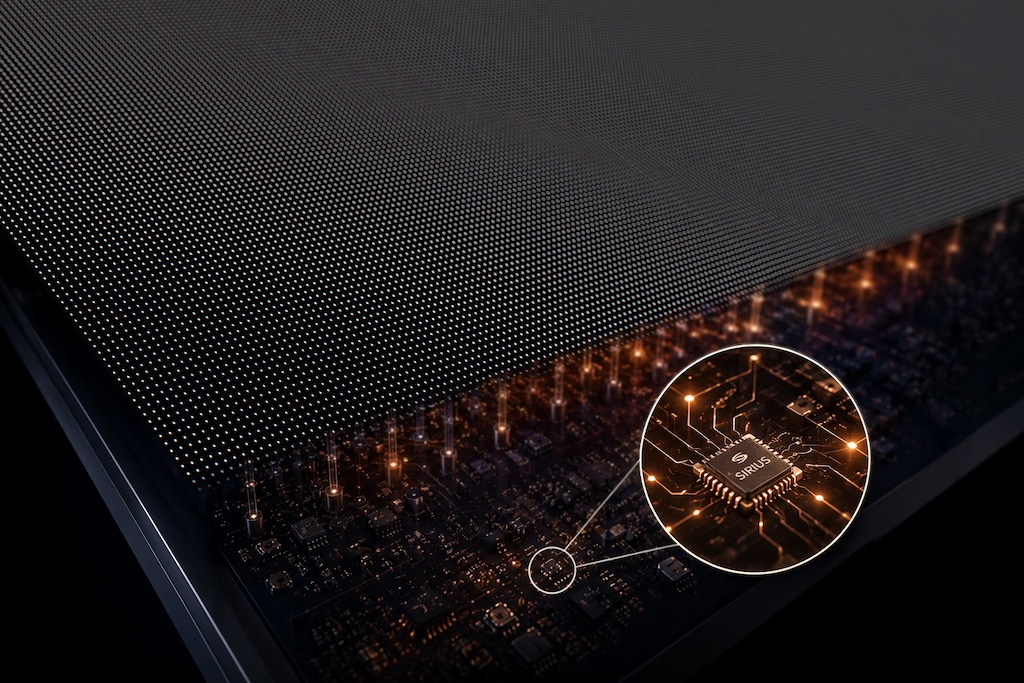
ROE Visual has announced the official launch of Sirius, a frequency-tunable multi-mode IC driver developed specifically to meet the rigorous demands of the professional broadcast and film industries. Integrated exclusively into ROE Visual’s premium LED panels, the Sirius driver represents the culmination of two years of intensive research and development. This strategic move positions ROE Visual among an elite group of manufacturers capable of designing custom-engineered integrated circuits (ICs), moving away from the industry-standard reliance on third-party silicon. By pairing the Sirius IC with the company’s proprietary Deepsky processing platform, ROE Visual has established a closed-loop ecosystem designed to eliminate the technical compromises often found in high-end visual production environments.
The Shift Toward Custom Silicon in LED Technology
For the better part of a decade, the LED display industry has largely operated on a horizontal supply chain model. Most manufacturers, even those in the high-end sector, have utilized driver ICs from a handful of specialized semiconductor firms. While this model allows for rapid production, it often forces manufacturers to build their processing software around the limitations of generic hardware. ROE Visual’s decision to develop the Sirius IC marks a significant departure from this trend.
The primary motivation behind this two-year development cycle was the pursuit of "native performance." In high-stakes environments such as virtual production (VP) for cinema or live broadcast, the interaction between the camera sensor and the LED wall is the most critical point of failure. Generic ICs often utilize dithering—a method of alternating pixels rapidly to simulate higher bit depths—to achieve smooth gradients. While this may be invisible to the human eye, it often manifests as noise, flickering, or "tearing" when captured by high-end cinema cameras. By controlling the hardware design, ROE Visual ensures that the Sirius IC provides true native bit depth, effectively removing the need for these digital workarounds and providing a cleaner signal for the camera sensor.
Addressing the Low-Luminance Challenge in HDR
One of the most persistent hurdles in LED technology is maintaining color accuracy and grayscale integrity at low brightness levels. In modern cinematography, High Dynamic Range (HDR) content requires deep blacks and subtle shadow details. However, most LED panels lose their ability to render smooth transitions as they dim, often resulting in "banding" or a loss of color fidelity in the lower 10% of the luminance curve.
Standard industry practice to combat this involves artificial increases in refresh rates or 6-bit dithering outputted as 10-bit Pulse Width Modulation (PWM). The Sirius IC addresses this by offering a higher native bit depth designed specifically for the ROE Visual hardware architecture. This ensures that even at extremely low luminance values, the grayscale remains flawless and HDR patterns are reproduced without artifacts. This capability is particularly vital for "dark" scenes in film production, where the LED wall serves as the primary light source for actors and sets.
Technical Specifications and Multi-Mode Architecture
The Sirius IC is built upon a sophisticated multi-mode architecture that allows the panel to adapt its driving method based on the specific requirements of the content and the camera. The system utilizes three distinct driving modes to cover the entire brightness spectrum:
- Pulse Width Modulation (PWM): Used for high-brightness scenarios, providing precise and flicker-free control of the LEDs.
- Pulse Amplitude Modulation (PAM): Deployed for mid-to-low brightness levels, PAM ensures a smoother delivery of current, which reduces the digital noise often associated with high-speed PWM switching.
- Continuum Mode: A proprietary innovation designed for extreme low-light performance. Continuum allows the LEDs to maintain a stable output at the very bottom of the luminance curve, ensuring that "true black" does not result in a loss of detail in the near-black regions.
To further enhance camera compatibility, the system operates at an ultra-high base refresh rate of 15,200 Hz. This is significantly higher than the industry standard, which typically hovers between 3,840 Hz and 7,680 Hz. This headroom allows the Deepsky platform to fine-tune the base frequency to match the frame rate and shutter angle of any professional camera. For instance, if a cinematographer is shooting at 60 frames per second with a non-standard shutter angle of 172.8°, the Sirius driver can adjust its frequency to eliminate any risk of scan lines or rolling-shutter artifacts.
Advanced Thermal Management and Color Consistency
Thermal fluctuations are a silent enemy of color consistency in large-scale LED volumes. As LEDs heat up during extended use, their peak wavelength shifts, leading to subtle but noticeable color drifts across the wall. This is a major concern for long production days where visual continuity is paramount.
The Sirius IC integrates a localized temperature sensor within every chip. With a configuration of 16 pixels per IC (utilizing a 1/8 scan ratio), the system generates a high-resolution 16×8 pixel thermal map of the entire LED surface. This data is fed back to the Deepsky processor in real-time, allowing for dynamic calibration adjustments. If a specific section of the wall becomes warmer than the rest—perhaps due to a bright localized light source or restricted airflow—the system compensates for the potential color shift instantly. This ensures that the white point and color gamut remain uniform across the entire display, regardless of the ambient conditions or the duration of the shoot.

Chronology of Development and Strategic Impact
The development of Sirius began in late 2024, following feedback from major film studios and broadcast networks regarding the limitations of existing "off-the-shelf" solutions. By mid-2025, the first prototypes of the custom IC were undergoing laboratory testing, focusing on the integration with the Deepsky processing backbone.
The timing of this release is significant. The virtual production market has moved past its "early adopter" phase and is now entering a period of refinement where technical perfection is expected. Competitors in the space have traditionally focused on pixel pitch and brightness; however, ROE Visual’s pivot toward custom silicon suggests that the next frontier of the industry lies in the underlying electronics and the "camera-readiness" of the panels.
Tucker Downs, R&D Specialist at ROE Visual, emphasized that the industry has spent years relying on "dithering workarounds" to bridge the gap between LED performance and camera sensors. "With the exclusive Sirius IC driver, we are finally moving past those limitations," Downs stated. "By combining true frequency tunability with dynamic current modulation, we provide filmmakers with a canvas that is perfectly synchronized with their sensors. This is a fundamental change for high-end studio environments."
Live Demonstrations and Industry Reception
The Sirius technology is making its public debut at IBC 2026 in Amsterdam. ROE Visual has dedicated a significant portion of its exhibition space (Hall 1D.29) to a specialized demonstration room. To prove the real-world efficacy of the system, the Ruby RB2.2F panels—the first to feature the Sirius-Deepsky ecosystem—are being filmed live by an ARRI Alexa 35 Live camera. This setup allows attendees to see the direct feed on reference monitors, showcasing the lack of moiré, banding, and flicker even under challenging camera settings.
Following IBC, ROE Visual will showcase the system at LEAT CON 26 in Hamburg (Hall A4), targeting the European live events and theater markets. The reception from early testers in the broadcast sector has been positive, particularly regarding the ease with which the system handles the complex rolling shutter systems of modern CMOS sensors.
Broader Implications for the Visual Industry
The introduction of Sirius and the Deepsky platform signals a broader trend toward vertical integration in the LED industry. As the requirements for "in-camera VFX" (ICVFX) become more stringent, the delta between consumer-grade LED technology and professional-grade production tools continues to widen.
For rental houses and production studios, the investment in proprietary technology like Sirius offers a degree of "future-proofing." As camera sensors continue to increase in sensitivity and resolution, the bottlenecks in the production pipeline are shifting toward the display hardware. By eliminating dithering and providing sophisticated thermal and frequency management, ROE Visual is addressing the specific pain points of directors of photography (DPs) and digital imaging technicians (DITs).
Furthermore, the "Continuum" mode for low-light performance could potentially open new doors for the use of LED walls in high-end automotive and luxury retail environments, where reference-level color accuracy is required at low ambient light levels. As ROE Visual rolls out the Sirius IC across its product lineup, the industry will likely watch closely to see if other major manufacturers follow suit in developing their own custom silicon solutions, potentially leading to a new era of "silicon-driven" competition in the LED display market.
