

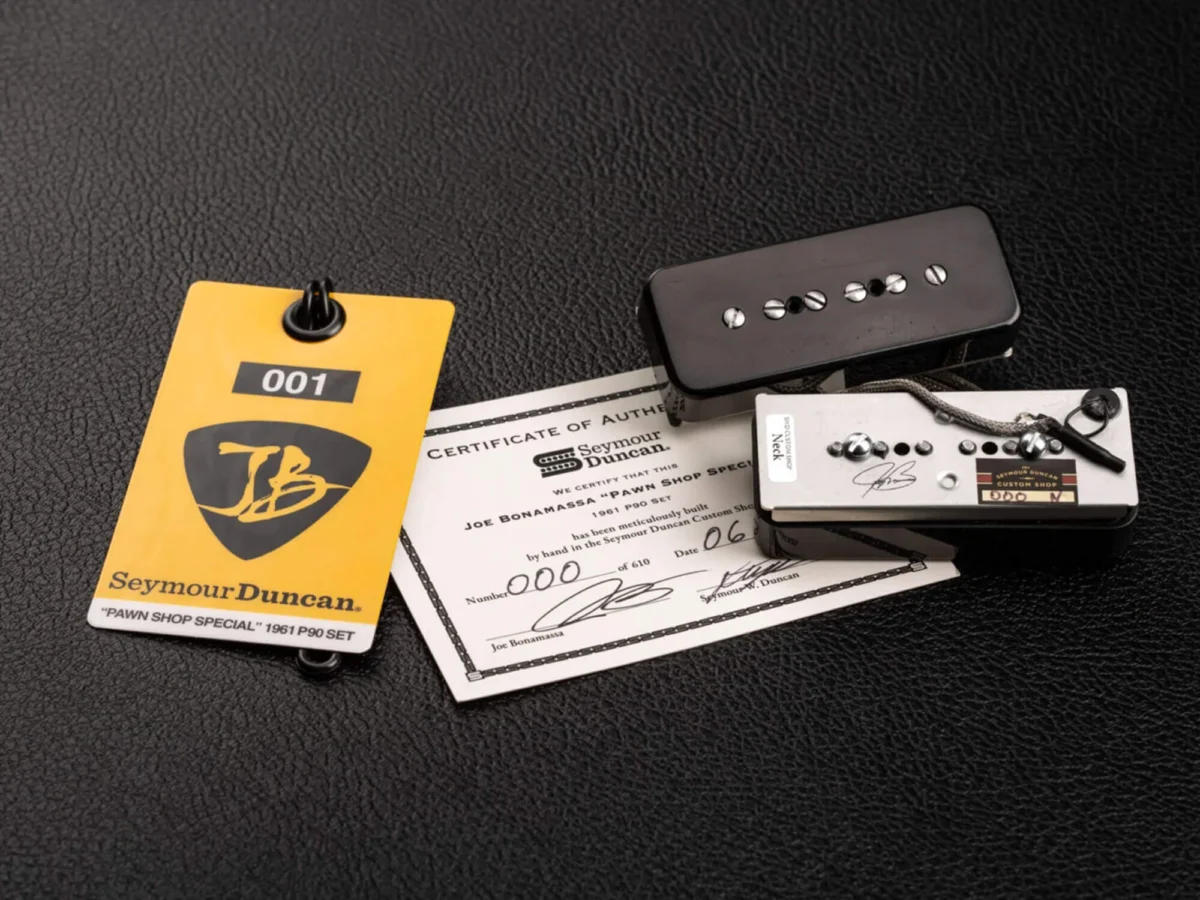
The esteemed blues-rock guitarist Joe Bonamassa has once again partnered with the renowned pickup manufacturer Seymour Duncan to introduce a new Custom Shop offering: the "Pawn Shop Special" 1961 P90 Set. This collaboration aims to meticulously recreate the distinctive sonic characteristics of the P-90 pickups found in Bonamassa’s cherished 1961 Gibson SG Special, an instrument that profoundly influenced his appreciation for this specific pickup type. Crafted with Alnico 4 magnets, a bespoke winding pattern, and a selection of historically accurate components, these new P-90s promise to deliver what is described as "airy highs, expressive midrange and snarling overdrive," embodying the vintage tone that captivated Bonamassa over a decade ago. Available now for $375 per set, this release marks a significant moment for enthusiasts seeking to capture the authentic sound of one of modern blues’ most celebrated artists.
The Genesis of a Revered Tone: Bonamassa’s P-90 Revelation
Joe Bonamassa’s journey with P-90 pickups began in an unexpected setting, fundamentally altering his tonal preferences and leading directly to this landmark collaboration. For years, Bonamassa, like many guitarists, had a preconceived notion of P-90s, often finding them either "too dark or too bright" for his exacting standards. This perspective began to shift dramatically in 2010 during a tour stop in Fort Wayne, Indiana. It was in this unassuming Midwestern city that a member of his crew alerted him to a local pawn shop, a place where guitarists often hope to unearth hidden gems, though such discoveries are, as Bonamassa himself notes, "very rarely" made.
The guitar that would change his perception was a 1961 Gibson SG Special. This particular instrument was not just any vintage find; it was described as a "pristine example of a first-year SG Special," an important distinction given the model’s history. The SG, originally introduced by Gibson in 1961 as a lighter, double-cutaway alternative to the Les Paul, quickly established its own iconic status. Early models, like Bonamassa’s, are particularly prized for their craftsmanship and tonal properties. Upon plugging the pawn shop find into an amplifier at the Embassy Theatre, Bonamassa experienced an immediate epiphany. The P-90s in that specific SG possessed a unique character that transcended his previous reservations, sparking what he now describes as "the beginning of my love affair with P-90s." This serendipitous encounter laid the groundwork for a quest to replicate that elusive tone, culminating in the Seymour Duncan "Pawn Shop Special" set.
A Deeper Dive into P-90 History and Sonic Characteristics
To fully appreciate the significance of Bonamassa’s P-90 revelation and the meticulous efforts behind the new Seymour Duncan set, it is crucial to understand the historical context and unique sonic properties of the P-90 pickup itself. Introduced by Gibson in the late 1940s, the P-90 was the company’s first successful single-coil pickup, predating the more famous PAF humbucker by nearly a decade. It quickly became standard equipment on many Gibson models, including the Les Paul Standard, Goldtop, and various ES series guitars, before the widespread adoption of humbuckers in the late 1950s.
Unlike the narrower, brighter single-coil pickups found in Fender guitars, the P-90 features a wider, flatter bobbin wound with many turns of thin wire, often around two bar magnets (typically Alnico, positioned beneath the coil). This construction gives the P-90 a distinct sonic footprint that bridges the gap between traditional single-coils and humbuckers. P-90s are renowned for their robust output, rich midrange complexity, and a clarity that retains articulation even under significant overdrive. They possess a characteristic "growl" or "snarl" when pushed, yet can deliver sparkling cleans with impressive dynamic range. This versatility made them favorites among early rock and blues pioneers, and they continue to be sought after by modern players for their unique voice. Famous proponents of the P-90 include Leslie West of Mountain, Pete Townshend of The Who, and Bonamassa himself, each extracting different facets of its expressive capability. The P-90’s ability to transition from bell-like cleans to gritty, bluesy crunch and even full-on rock aggression, while maintaining a distinct personality, is what solidifies its place in guitar history.

Seymour Duncan’s Legacy in Tone Recreation and Artist Collaborations
Seymour Duncan has long been a titan in the world of guitar pickups, earning a reputation for both innovative designs and faithful reproductions of classic tones. Founded by Seymour W. Duncan in 1976, the company quickly established itself by offering custom-wound pickups and a deep understanding of vintage designs. Duncan himself is a legendary figure, having studied under the likes of Seth Lover (inventor of the humbucker) and worked with countless iconic guitarists to optimize their sound. This rich heritage positions Seymour Duncan as an ideal partner for an artist like Joe Bonamassa, who is renowned for his meticulous approach to tone and his vast collection of vintage instruments.
The collaboration with Bonamassa is not Seymour Duncan’s first foray into recreating the pickups of his prized vintage guitars. The company has previously been tasked with capturing the essence of other rare instruments from Bonamassa’s "Nerdville" collection. However, the "Pawn Shop Special" marks a significant milestone as it is the very first custom Joe Bonamassa P-90 set developed by the brand. This indicates a level of trust and expertise that transcends standard artist endorsement, delving into bespoke engineering to meet the artist’s precise specifications for a beloved, foundational tone. The Custom Shop division of Seymour Duncan is particularly adept at this, employing skilled winders and technicians who can analyze and replicate the nuances of vintage pickups, from magnetic strength and wire type to winding patterns and material composition. This dedication to authenticity is paramount when an artist of Bonamassa’s caliber seeks to bottle the magic of a specific, cherished instrument.
The Anatomy of the "Pawn Shop Special" P-90s: Crafting Vintage Authenticity
The development of the "Pawn Shop Special" 1961 P90 Set involved a forensic examination of the original pickups in Bonamassa’s 1961 Gibson SG Special, combining historical accuracy with modern manufacturing precision. Several key technical specifications contribute to the faithful reproduction of that iconic tone.
Alnico 4 Magnets: A crucial element in the tonal character of these P-90s is the choice of Alnico 4 magnets. Alnico (an acronym for Aluminum, Nickel, Cobalt) magnets come in various grades (2, 3, 4, 5, 8), each imparting distinct sonic qualities.
- Alnico 2 is known for a softer attack, warm midrange, and less treble, often found in vintage PAFs.
- Alnico 3 is the weakest, offering a very clear, articulate tone with less output, ideal for brighter, lower-output vintage sounds.
- Alnico 5 is the strongest and most common, providing a powerful, scooped midrange, strong bass, and bright treble, favored for modern rock and blues.
- Alnico 4 stands out for its balanced characteristics. It typically offers a strong output similar to Alnico 5 but with a flatter frequency response, meaning less pronounced bass and treble scoops, and a more pronounced, expressive midrange. This magnet type is often lauded for its ability to provide clarity and articulation without harshness, allowing the natural character of the wood and the player’s touch to shine through. For P-90s, Alnico 4 can deliver the desired "snarl" and output while maintaining the expressive, airy highs and complex midrange that Bonamassa found so captivating in his ’61 SG. It contributes significantly to the pickups’ ability to clean up nicely with volume roll-off, while still delivering aggressive tones when driven.
Custom Wind: The term "custom wind" signifies that the winding pattern, wire gauge, and number of turns are specifically tailored to replicate the original pickups. Even subtle variations in these parameters can dramatically alter a pickup’s inductance, resistance, and capacitance, thereby influencing its frequency response, output, and dynamic behavior. The precision involved in matching the wind of a 60-year-old pickup requires extensive analysis and iterative prototyping. This custom approach ensures that the "Pawn Shop Special" P-90s capture the specific harmonic content and dynamic response that Bonamassa values, moving beyond generic P-90 specifications. The result is a pickup that translates the nuances of his playing with fidelity, offering a rich tapestry of tones from shimmering cleans to powerful, singing leads.
Historically Accurate Components: Beyond the magnets and winding, every detail contributes to the overall sound and authenticity. The "Pawn Shop Special" P-90s are outfitted with historically accurate dimpled P-90 bottom plates, covers, and other period-correct details. The material and design of these non-electronic components, while seemingly minor, can affect microphonics, magnetic field distribution, and even vibrational resonance, all of which subtly shape the final tone. The use of era-appropriate materials and construction methods ensures that the new pickups not only sound right but also look and feel like genuine vintage units.

Wax Potting for Performance: A practical feature incorporated into these pickups is wax potting, a process where the pickup is submerged in a mixture of paraffin and beeswax. This process saturates the coil, preventing the individual windings from vibrating against each other. The primary benefit of wax potting is the significant reduction or elimination of microphonic feedback, especially at high volumes and with high-gain amplifier settings. For a touring artist like Bonamassa, who plays large venues and often pushes his amplifiers into overdrive, wax potting is an essential modification for live performance reliability. This detail reflects Bonamassa’s real-world needs as a professional musician, ensuring that the recreated tone remains consistent and feedback-free on stage.
Market Impact and Collector’s Appeal
The release of the Seymour Duncan Joe Bonamassa "Pawn Shop Special" 1961 P90 Set carries significant implications for both Seymour Duncan and the broader market for guitar pickups. For Seymour Duncan, this collaboration further solidifies their position as a premier manufacturer capable of delivering high-end, artist-specific custom shop products. It leverages the immense influence of Joe Bonamassa, whose reputation as a tone aficionado and vintage guitar collector is unparalleled. Artist signature products often generate considerable interest, and Bonamassa’s endorsement carries substantial weight within the guitar community.
The target audience for these pickups is diverse, encompassing devoted Bonamassa fans, P-90 enthusiasts seeking an authentic vintage tone, and players who own Gibson SGs, Les Pauls, or other guitars compatible with P-90s and are looking to upgrade their sound. At a price point of $375 per set, these pickups are positioned in the upper tier of the boutique pickup market, where high-quality, hand-wound, and historically accurate reproductions typically reside. This pricing is competitive with other acclaimed custom P-90 makers such as Lollar, Fralin, and Bare Knuckle, reflecting the premium materials, research, and craftsmanship involved.
Beyond the sonic attributes, the "Pawn Shop Special" set also taps into the lucrative collector’s market. Joe Bonamassa’s collection of vintage instruments is famously housed in "Nerdville," his two private facilities in Los Angeles and Nashville. These locations are not merely storage; they are meticulously curated archives where each instrument is cataloged. The 1961 Gibson SG Special, being the very first instrument he cataloged, holds the inventory item number #001. To commemorate this special place in his collection, the first 610 sets of the new pickups will come with a unique "Nerdville #001" inventory tag, alongside a certificate of authenticity personally signed by both Joe Bonamassa and a representative from Seymour Duncan. This limited-edition aspect significantly enhances the collector’s appeal, turning each set into a piece of Bonamassa’s personal history and a tangible connection to his celebrated tone. This strategy caters to fans who not only appreciate the sound but also the story and rarity associated with their idol’s gear.
Conclusion: A Bridge Between Past and Present Tone
The Seymour Duncan Joe Bonamassa "Pawn Shop Special" 1961 P90 Set represents more than just a new product; it embodies a meticulous quest for a specific, cherished vintage tone and the successful collaboration between a visionary artist and a leading pickup manufacturer. From Bonamassa’s serendipitous discovery of a "pristine" 1961 Gibson SG Special in a Fort Wayne pawn shop to Seymour Duncan’s expert recreation of its unique P-90s, this project bridges the gap between the revered sounds of the past and the demands of contemporary musicianship.
By combining historically accurate components like Alnico 4 magnets and custom winding with modern considerations such as wax potting for performance, these pickups offer players an opportunity to experience the "airy highs, expressive midrange and snarling overdrive" that define Bonamassa’s signature P-90 sound. The limited-edition "Nerdville #001" tags and signed certificates of authenticity further elevate the offering, appealing to both serious players and collectors. As guitarists continue to seek authentic vintage tones, collaborations like the "Pawn Shop Special" underscore the enduring legacy of classic designs and the relentless pursuit of sonic perfection in the modern era. The pickups are currently available, inviting players worldwide to plug in and discover the tone that ignited Joe Bonamassa’s profound "love affair with P-90s."
