

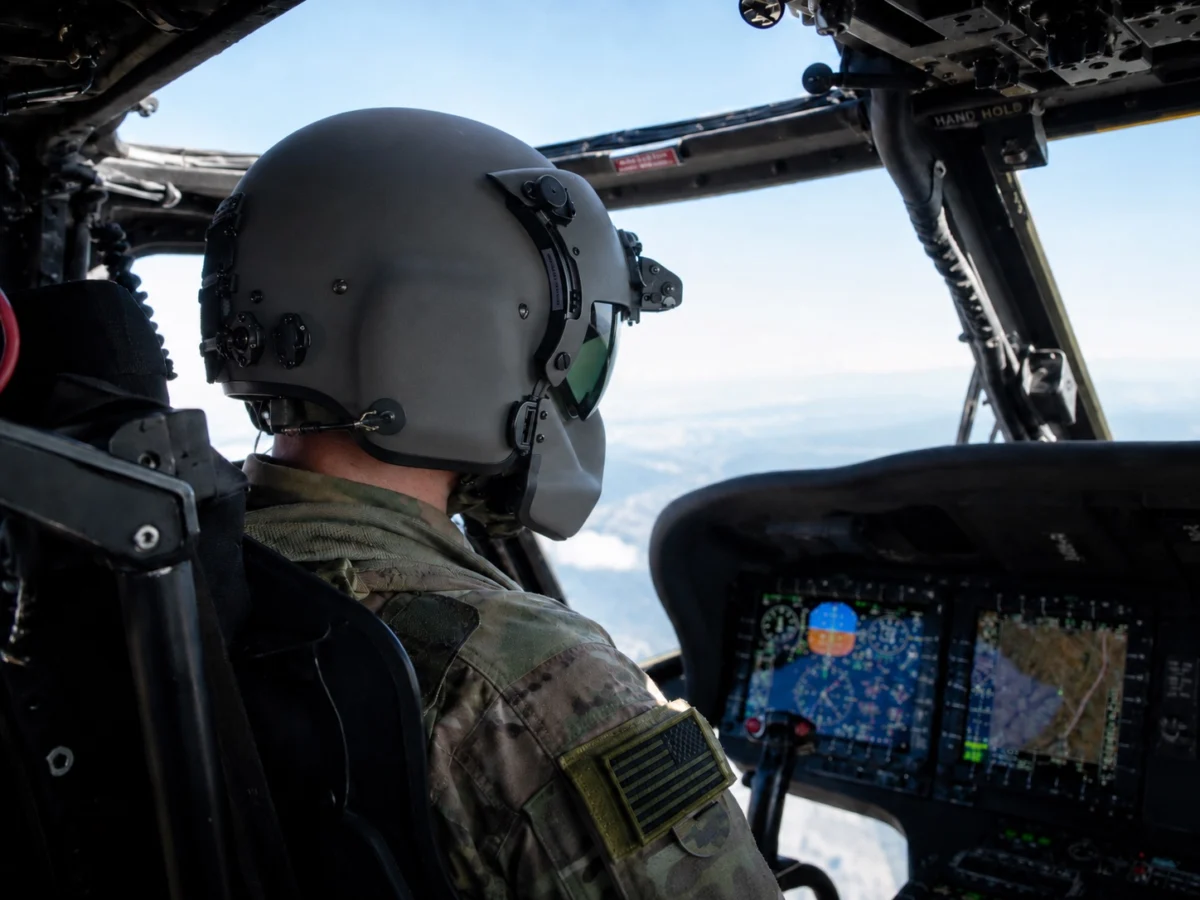
The U.S. Army Aeromedical Research Laboratory (USAARL), in a strategic partnership with several key defense agencies and private sector technology firms, has successfully completed the integration of advanced 3D-spatial-audio technology into two UH-60 Black Hawk helicopters. These aircraft, assigned to the Army Aviation Center of Excellence (AVCOE), represent a significant leap forward in the evolution of cockpit communication systems. By moving away from traditional monaural audio—where all sounds are funneled into a single, centered channel—the Army is leveraging the human brain’s natural ability to localize sound, thereby reducing cognitive load and increasing the survivability of crews in high-stress combat and rescue environments.
The deployment of these systems follows a successful proof-of-concept phase conducted on a dedicated MEDEVAC research helicopter. This initial aircraft served as the primary testbed, marking the first time such sophisticated spatial audio processing was utilized within the U.S. Army’s fleet. With the expansion to two additional Black Hawks at the Lowe Army Heliport, the program moves from the experimental phase into an operational evaluation stage, providing flight instructors and student pilots with tools previously reserved for high-end laboratory simulations.
The Cognitive Bottleneck: The Limitations of Legacy Mono-Audio
For decades, military aviators have operated under a significant auditory disadvantage. Legacy communication systems in tactical aircraft typically utilize mono-audio headsets. In this configuration, every auditory input—including internal crew intercommunication (ICS), multiple external radio frequencies (VHF, UHF, SATCOM), navigation pings, and critical master caution alarms—is blended into a single stream of sound. When multiple sources broadcast simultaneously, the resulting "wall of sound" forces the pilot to perform intensive mental processing to decouple the information.
In high-stress environments, such as low-altitude tactical flight or medical evacuations under fire, this "monaural saturation" can lead to missed radio calls or, more dangerously, the failure to recognize a critical system alarm. The cognitive effort required to distinguish a wingman’s voice from a ground commander’s request, while simultaneously monitoring the aircraft’s mechanical health, consumes mental "bandwidth" that could otherwise be dedicated to flight safety and mission execution. This phenomenon is a primary contributor to auditory fatigue and decreased situational awareness.
The Science of Spatial Audio and Auditory Scene Analysis
The implementation of 3D-spatial-audio is rooted in the psychological principle of Auditory Scene Analysis (ASA). Human hearing is naturally binaural; the brain uses slight differences in the timing and intensity of sound reaching each ear to determine the direction and distance of a source. 3D-spatial-audio technology utilizes complex algorithms, often involving Head-Related Transfer Functions (HRTFs), to simulate these cues electronically.
By applying these algorithms to the cockpit’s communication suite, technicians can "place" different audio channels in specific virtual locations around the pilot’s head. For instance, a call from the co-pilot might be perceived as coming from the right, while a tactical radio frequency used by ground forces might be positioned to the left. Critical emergency warnings can be programmed to sound as if they are originating from the specific direction of the instrument panel or the failing component.
This spatial separation allows pilots to utilize the "Cocktail Party Effect"—the human ability to focus on a single talker in a noisy environment by leveraging directional cues. Research conducted by USAARL suggests that spatial audio can improve speech intelligibility by as much as 20% to 30% in high-noise environments, while simultaneously lowering the listener’s perceived mental effort.
Chronology of the Integration and Testing Phase
The transition of this technology from a research environment to the operational fleet involved a rigorous timeline and multi-agency coordination. The process began with the instrumentation of the USAARL MEDEVAC research helicopter, which provided the baseline data required for airworthiness certification and software calibration.
Once the baseline was established, the project moved to the Lowe Army Heliport to outfit the two AVCOE Black Hawks. The physical installation was an intensive undertaking, requiring over 231 man-hours of labor per aircraft. This process involved not only the installation of the spatial audio processing units but also extensive rewiring of the communications bus to ensure compatibility with existing digital and analog radio systems.
Following the hardware installation, the aircraft underwent two days of dedicated flight testing. These tests were designed to ensure that the spatial processing did not introduce latency—a critical factor in aviation where a delay of even a few milliseconds in a warning tone can be catastrophic. The testing also verified that the spatial cues remained consistent even under the high-vibration and high-noise conditions characteristic of the UH-60 platform.
Collaborative Framework: A Multi-Agency Effort
The success of the integration was dependent on a collaborative ecosystem involving both military and industrial partners. The USAARL served as the lead research entity, focusing on the human factors and physiological impacts of the technology. However, the technical execution required the expertise of several other organizations:
- Army Aviation and Missile Command (AMCOM): Provided the necessary engineering oversight and airworthiness releases to ensure the modifications met stringent safety standards.
- Technology Development Directorate – Aviation (TDD-A): Assisted in the systems engineering and the integration of the software architecture with the Black Hawk’s existing avionics.
- CATI Training Systems: Contributed expertise in simulation and auditory modeling, helping to bridge the gap between virtual training environments and real-world cockpit applications.
- TTM Technologies: Provided the high-reliability hardware components and printed circuit board assemblies required to withstand the rigors of military flight operations.
This partnership highlights the "Total Force" approach to modernization, combining the theoretical research of Army laboratories with the practical engineering capabilities of the defense industrial base.
Pilot Feedback and Operational Impact
Initial feedback from the pilots involved in the evaluation has been overwhelmingly positive. Research pilot Capt. Brandon Allen emphasized the intuitive nature of the system. According to Allen, the technology allows for a natural sorting of information. In a scenario where four different radio channels are active simultaneously, the 3D-spatial-audio allows the pilot to mentally "map" each voice to a location, making it immediately clear who is speaking without having to look at a radio control head.

Test pilots reported three primary benefits:
- Improved Intelligibility: Even in the presence of heavy static or background rotor noise, directional voices were easier to understand.
- Reduced Mental Fatigue: Pilots felt less "drained" after long missions involving complex communications, as the brain did not have to work as hard to filter noise.
- Enhanced Situational Awareness: By linking specific sounds to specific directions, the pilots developed a more "spherical" understanding of their environment.
Col. Thomas Summers, Commander of USAARL, noted that the current phase is about pushing the technology to its limits. The goal is to gather continuous feedback from the Aviation Tactics Instructor Course at the 1st Battalion, 212th Aviation Regiment. These instructors are among the most experienced pilots in the Army, and their insights will drive the iterative development of the system’s user interface and spatial configurations.
Broader Implications for the Future of Military Aviation
The integration of 3D-spatial-audio into the Black Hawk is more than just a headset upgrade; it represents a fundamental shift toward human-centric design in military hardware. As the U.S. Army prepares for Future Vertical Lift (FVL) platforms, such as the Future Long-Range Assault Aircraft (FLRAA), the lessons learned from the UH-60 spatial audio project will be foundational.
Future cockpits will likely be even more data-rich, incorporating augmented reality (AR) helmet-mounted displays and advanced sensor fusion. In such an environment, the auditory channel will be a critical redundant path for information. If a pilot’s visual field is saturated with data, spatial audio can provide the necessary "nudge" to direct their attention to a specific threat or system failure.
Furthermore, the principles of spatial audio tested here have applications beyond the cockpit. The technology could be adapted for ground vehicle commanders, dismounted infantry leaders using advanced radio nets, and even tactical operations centers where multiple streams of data must be monitored simultaneously.
Conclusion and Future Outlook
The U.S. Army Aeromedical Research Laboratory’s successful integration of 3D-spatial-audio into the Black Hawk fleet marks a turning point in how the military approaches communication. By aligning technology with the natural physiological capabilities of the human ear and brain, the Army is effectively increasing the "bandwidth" of its most critical asset: the soldier.
As the two equipped Black Hawks continue to support the Aviation Tactics Instructor Course, the data collected will inform future procurement decisions and technical requirements for the entire Army Aviation branch. The project stands as a testament to the power of iterative research and the importance of addressing the human element in the high-tech landscape of modern warfare. The end goal, as stated by Army leadership, remains clear: to provide aviators with the most intuitive, effective, and safe tools possible to ensure mission success and a safe return to base.
