

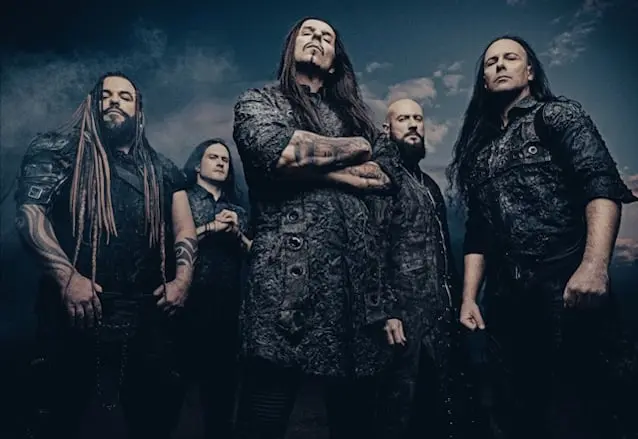
The symbiotic relationship between the Greek extreme metal titans SEPTICFLESH and symphonic arrangements has evolved from a novel experiment to an intrinsic element of their sonic identity. This powerful fusion, once popularized by pioneers such as CRADLE OF FILTH, DIMMU BORGIR, and even METALLICA’s ambitious 1999 project "S&M," has been so deeply integrated into SEPTICFLESH’s core sound that envisioning their future work without orchestral collaboration seems increasingly improbable. The tangible results of this artistic marriage are undeniable, particularly since their triumphant 2008 comeback album, "Communion." Rather than serving as mere embellishment, the orchestra is a central protagonist in SEPTICFLESH’s compositions, delivering sweeping orchestrations and moments of profound grandeur that surge alongside blistering extreme metal passages and the potent, guttural vocals of Spiros Antoniou. This sophisticated synergy is largely orchestrated by Spiros’s brother, Christos Antoniou, a formally trained composer who studied at the London College of Music and now operates as a professional composer.
As of early 2026, SEPTICFLESH is actively engaged in the creation of a new studio album, slated to follow their 2022 release, "Modern Primitive." In recent months, the band has showcased their orchestral prowess with performances alongside the Plovdiv Philharmonic Orchestra and the National Opera Choir of Plovdiv in Plovdiv, Bulgaria. Looking ahead to the immediate future, SEPTICFLESH is preparing for a significant North American tour alongside fellow heavyweights ARCH ENEMY and THE BLACK DAHLIA MURDER. This upcoming tour serves as a potent reminder of the band’s remarkable trajectory, from their formative melodic black/death metal years in the mid-1990s to their more controversial experimental phase with "Revolution DNA" in 1999. In an exclusive interview with BLABBERMOUTH.NET, Christos Antoniou provides an in-depth look at the band’s evolution, their creative process, and their enduring commitment to pushing artistic boundaries. (It is important to note that this interview was conducted weeks prior to the official announcement that Christos Antoniou would be unable to join his bandmates on their North American tour due to an injury.)
The Strategic Hiatus and the Genesis of "Communion"
Reflecting on the band’s three-year hiatus leading up to their 2007 reformation, Christos Antoniou characterized the decision as a strategically sound move that ultimately revitalized the band. "I think it was a wise decision," he stated. "We were a bit lacking with the release of ‘Sumerian Daemons’ because the label, at the time [Hammerheart Records], had some issues with DEATH, Chuck Schuldiner." Antoniou elaborated on the financial and legal entanglements that plagued their previous label, leading to its bankruptcy. This period of uncertainty, coupled with personal and professional pursuits for each member, prompted a collective pause. Christos himself was engaged in composing work at Pinewood Studios in England, while his brother Spiros focused on album artwork for various metal bands, and guitarist Sotiris Vayenas pursued his own endeavors.
"We sat down and said it was time to take a break," Christos explained. "It was a decision, as I said before, and as SEPTICFLESH, when we release something, it has to be important for us. We just don’t want to release an album to say we released an album. We didn’t have anything to offer our listeners at the time. I think this break played an important role. It was a positive act, for sure."
When pressed on whether the hiatus was primarily a business decision or a lack of creative support, Antoniou emphasized the importance of artistic drive over financial considerations. "Money’s not the most important thing," he asserted. "The most important thing is to have the desire, the fire. As I said, the vision there was destroyed in a way. It’s important for an artist to have a vision and the fire that will let him create. Suddenly, we didn’t have this fire. It’s not about money. It’s about soul. We felt that the right decision was to take a break. Of course, during that time, we didn’t know we would return. [Laughs] It was the final chapter for us, ‘Sumerian Daemons’. The circumstances led the band to return with ‘Communion’."
"Communion" as the Definitive Turning Point
Looking back at "Sumerian Daemons," Antoniou acknowledged the band’s consistent drive for experimentation and sonic innovation. "We always try to experiment and to find a new way to suggest colors, new sound – a fresh sound," he remarked. "After ‘Revolution DNA,’ we said it was time to become more aggressive. We don’t regret ‘Revolution DNA’. I think ‘Revolution DNA’ was 1998 and ‘Sumerian’ was 2002. During that time, we felt that our composition process was more aggressive, more experimental and more brutal, in a way."
However, he firmly positioned "Communion" as the band’s most significant artistic watershed moment. "But I don’t think ‘Sumerian Daemons’ is the most important album," Antoniou declared. "I think the most important album was ‘Communion’ because it was the first time we had a serious label behind us [Season Of Mist]. It was the first time we had a live orchestra. We recorded in Prague with the Prague Philharmonic Orchestra, and it was the first time managers and agencies approached us. This was the turning point for us."
This pivotal release not only marked a resurgence for SEPTICFLESH but also redefined their musical direction, solidifying their commitment to the orchestral sound. "We don’t regret our past," Antoniou added. "Many people say, ‘Why don’t you play songs from your past?’ We’re about the future. We are looking forward. The sound of SEPTICFLESH today has the sound of the orchestra."
The positive reception to "Communion" was indeed overwhelming, signaling a renewed engagement with their audience and the broader music industry. "When we said that we are going to form the band again, we said, ‘Take it easy. We don’t have to be anxious. Let the things go on and see how it goes,’" Antoniou recalled. "Gradually, we saw all of this positive feedback. We saw a big difference with a label that had bigger distribution channels. Gradually, things kept getting better and better. With ‘Communion,’ we started to do big tours. We did a European tour with CRADLE OF FILTH, MOONSPELL and GORGOROTH. Then, we went to the States for the first time in 2009 with CRADLE OF FILTH and SATYRICON. Things started to get serious. We were really happy about this. We said that ‘Now it’s our moment. We need to follow this momentum.’"
The Intricacies of Orchestral Integration
Christos Antoniou’s formal education in classical composition and orchestration at the London College of Music has undeniably shaped SEPTICFLESH’s sonic architecture. However, he candidly admits that the integration of metal and orchestral elements remains an ongoing learning process. "We were beginners with ‘Communion’ in terms of the battle between metal and the orchestra," he confessed. "Although I had started classical music composition and orchestration, the battle still goes on. [Laughs] We’re still learning."
The core challenge, according to Antoniou, lies in achieving a delicate balance. "The most important thing is to give the orchestral and metal fields space to breathe and not conflict with each other," he explained. "This is a big headache for our producer, but during ‘Communion,’ the sound is more raw. We were still adapting the orchestra. Gradually, after ‘The Great Mass,’ ‘Titan,’ ‘Codex Omega,’ we’ve reached a moment where sometimes we have to be more careful with how metal and the orchestration blend. With ‘Communion,’ we didn’t have this experience. Of course, the material is more raw. It’s different, ‘Communion,’ than ‘Modern Primitive’ or ‘The Great Mass.’ We’re still learning. We were still learning. We did a good job, though, but there was always room for progress."
Bridging Worlds: The Metal Composer and the Orchestral Realm
The fusion of extreme metal and classical orchestration often sparks curiosity and, at times, resistance from more traditional circles. Antoniou acknowledges that conservative elements within the orchestral world may find their work unusual, but he views this crossover as a positive development in the contemporary music landscape. "If you are a conservative person, then yes," he stated. "Nowadays, metal is everywhere. It’s good that our music is everywhere. If you are conservative, of course you will find it strange that someone who listens to metal also listens to classical music and does film scores. I think nowadays, it’s not so common."
He cited a performance at the Acropolis with Athens’ largest orchestra as an example of the positive reception their music can receive. "Most people there really enjoyed it," Antoniou observed. "Of course, some people will be against it. They are blind and conservative. When you are conservative, you have many limits. You will think our music is Satanic; we don’t have any connection with that. My brother’s voice, to someone, will sound a bit like a dog. [Laughs] I think we’re in 2026, and things are getting better. Crossover projects are everywhere."
Antoniou emphasizes that this artistic pursuit is not a matter of adopting different personas but rather a cohesive expression of his identity as a musician and composer. "I’m myself," he asserted. "I don’t change face when I compose classical music, or when I’m playing music for SEPTICFLESH. I’m the same guy. I don’t have to switch. I’m an introverted guy who studies this work when I have to compose music. It’s the same as when I study, using it as a reference to write for SEPTICFLESH. For me, music is the most important thing. It doesn’t matter if it’s classical or metal. The fire, as I said, has driven me to compose music for metal, classical music and concert music."
The Compositional Process and Band Dynamics
As a professional composer, Antoniou approaches songwriting for SEPTICFLESH with a distinct methodology. "When I write a song for SEPTICFLESH, I don’t write it as a songwriter," he explained. "Maybe that is a difference I took from the concert music world. I take the work as a composition. It’s different because I always have to study. I want my sound to evolve. On the other hand, my brother, Sotiris, Krimh [drummer Kerim Lechner], when they write music, have their own agenda. Mine is this. It’s totally different. They have to compromise because I deliver the most complex things to them. [Laughs] They get worried sometimes. We have a good relationship. We have found the formula that we know works."
He detailed the collaborative workflow, highlighting the challenges and eventual refinements in integrating complex musical ideas. "If we take a song that is very complex, like ‘Babel’s Gate’," Antoniou recounted. "It was a strange situation. [Ex-drummer] Fortis [Bernardo] had to take a score for months to memorize the pattern. Nowadays, it’s getting easier. They know how I work. I know how they work. They give me their parts; I orchestrate; I add some of my style. On the contrary, I give them my orchestral motifs, and then we’ll make the metal parts. We work like that."
The enduring partnership between Christos and his brother, Spiros, is a cornerstone of SEPTICFLESH’s longevity, though it is not without its challenges. "We fight so much," Christos admitted with a laugh. "If he weren’t my brother, we wouldn’t be in the same band. [Laughs] Maybe many other bands have this, but because we are brothers, we continue." He acknowledged a deep understanding between them, stating, "Of course, but that doesn’t change our minds. You know when a fight is coming. Our bandmates know how to deal with it."
The Unwavering Core: Lineup Stability and Artistic Evolution
The consistent lineup of SEPTICFLESH, particularly the enduring presence of Christos and Sotiris Antoniou, is cited as a significant asset. "Sotiris has been with us from the beginning," Christos noted. "We are the backbone of SEPTICFLESH. We have never changed the original members. This is a plus." He likened the band’s creative engine to a "factory," where each member contributes distinct elements: Spiros handles the art and cover designs, Sotiris crafts the lyrics, and Christos spearheads the orchestral arrangements.
The commitment to originality and artistic growth is paramount. "The biggest trouble for an artist is not to repeat himself," Antoniou emphasized. "We have so many minds that provide ideas; it helps us. On the contrary, a person who is alone might be drained because you don’t know when you are repeating yourself. You have to follow your inspiration and filter out what’s best for you. This is a common mistake for artists. They repeat themselves. I’m not saying you have to play jazz, but you have to experiment. Knowledge is power. You have to develop your sound. Always."
Glimpse into the Future: The New Album
Regarding the progress of their forthcoming album, Christos Antoniou offered an optimistic update. "We are nearly at the end of our compositional process," he revealed. "It’s getting faster. Each of these songs needs to find its own shape. Things will change when we add vocals and lyrics, and when we go into the studio; I will be in Prague. Before the mixing, things will change a lot. At the moment, we have 50 percent of the new album."
Comparing the new material to "Modern Primitive," Antoniou indicated a shift towards a more intense and brutal sound, not necessarily in terms of tempo, but in the overall blend of darkness and aggression. "I know it’s faster, but it doesn’t mean the number of beats, the tempo, the BPM," he clarified. "It’s more about how you will blend the dark moments with the fast elements. At the moment, it looks more brutal for sure." This evolution suggests that SEPTICFLESH continues to refine their signature sound, promising another chapter of their ambitious and captivating symphonic death metal journey.
