

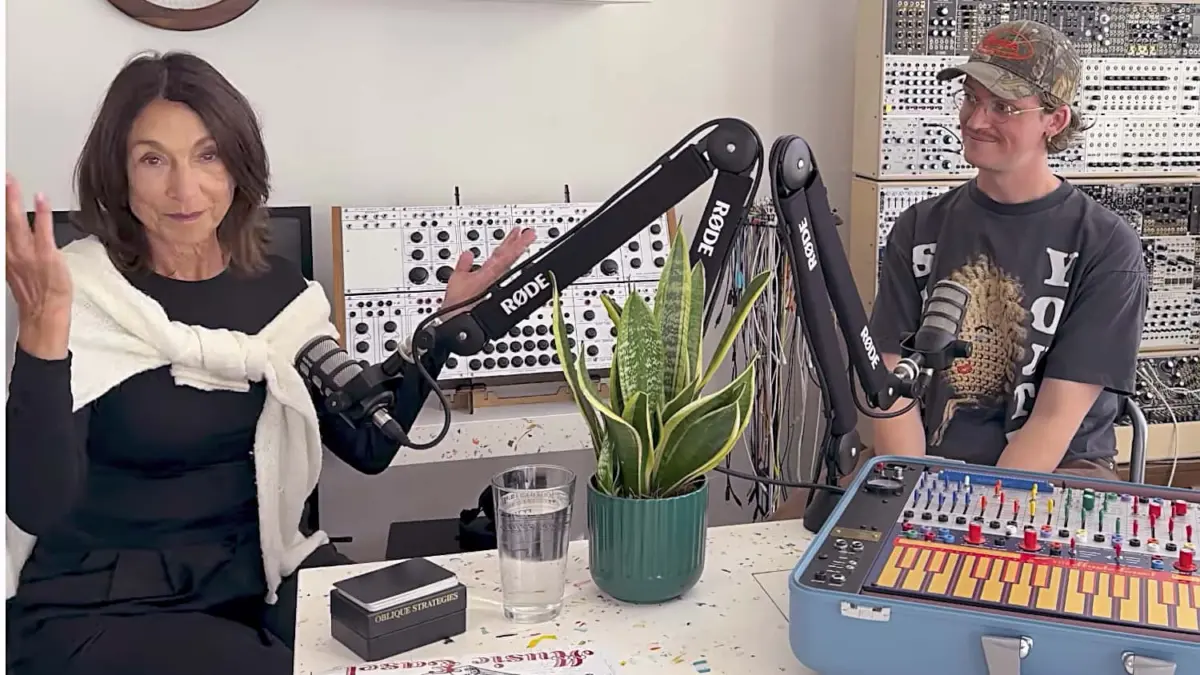
The legendary synthesist and composer Suzanne Ciani recently visited the Signal Sounds showroom in Glasgow to provide an extensive look into her five-decade career, her specialized relationship with Buchla instrumentation, and the shifting landscape of electronic music performance. This appearance, documented in the tenth episode of the Signal Flow Podcast, precedes her highly anticipated performance at Sonica 2026. In a wide-ranging conversation with hosts Luke and Tom, Ciani detailed her journey from building synthesizers in California during the 1960s to her current status as a global icon of the "West Coast" synthesis movement.
The interview serves as a significant historical document, capturing Ciani’s reflections on the evolution of technology and the eventual maturation of the listening public. Known as the "Diva of the Diode," Ciani was one of the first women to achieve prominence in the field of electronic music and sound design. Her recent dialogue provides deep insights into the technical and philosophical differences between various modular systems, the complexities of quadraphonic sound, and the nuances of collaborating with contemporary artists such as the British electronic producer Actress.
The Genesis of West Coast Synthesis and the Buchla Legacy
Suzanne Ciani’s identity as an artist is inextricably linked to the work of Don Buchla, the pioneer who developed the Buchla 100 series Modular Electronic Music System in the mid-1960s. During the interview, Ciani recounted her early years at the San Francisco Tape Music Center and her time at the University of California, Berkeley. It was here that she encountered Buchla’s vision, which stood in stark contrast to the East Coast synthesis philosophy championed by Robert Moog.
Unlike the Moog systems, which utilized a traditional piano-style keyboard and focused on subtractive synthesis, Buchla’s instruments were designed to move away from conventional Western musical structures. They featured touch-sensitive plates, complex oscillators, and a focus on timbre and frequency modulation—a philosophy often referred to as "West Coast synthesis." Ciani explained that being synonymous with the Buchla was not a conscious branding choice but a natural extension of her creative process. She viewed the instrument as a living organism capable of generating organic, evolving textures that traditional instruments could not replicate.
Ciani’s history with the Buchla 200 series, which she continues to use in a modernized 200e format today, represents a commitment to a specific interface that prioritizes gesture and real-time interaction. This commitment was forged during a period when electronic music was largely confined to academic laboratories or experimental underground circles. Her persistence in using these tools eventually led her to New York City, where she established Ciani/Musica, a commercial production house that revolutionized sound design for television and film.
The Architecture of Spatial Audio: Working in Quadraphonic Sound
A central theme of the Signal Flow interview was Ciani’s dedication to quadraphonic sound. While stereo has remained the industry standard for decades, Ciani has long argued that electronic music requires a spatial dimension to truly come alive. Quadraphonic sound involves four independent audio channels positioned at the corners of a performance space, allowing the artist to move sound around the audience in a 360-degree arc.
Ciani described the process of "giving life to sound" through spatialization. In her view, the movement of sound is not merely an effect but a fundamental compositional parameter, akin to pitch or rhythm. By utilizing the Buchla’s voltage-controlled spatial modules, she can manipulate the location of a sound source in real-time, creating an immersive environment that engages the listener’s physical senses.
The technical challenges of touring with a quadraphonic setup are substantial, requiring specific speaker configurations and high-fidelity sound reinforcement. However, Ciani noted that modern technology has made this more feasible than it was in the 1970s. The interview highlighted how spatial audio is currently seeing a resurgence through formats like Dolby Atmos, yet Ciani’s approach remains rooted in the analog tradition of discrete, four-channel performance.
A Chronology of Artistic Evolution and Audience Reception
The timeline of Ciani’s career is marked by several distinct phases, each reflecting her adaptability as a musician. Following her experimental period in the 1960s and 70s, she transitioned into a highly successful career in commercial sound design. One of her most famous contributions was the "pop-and-pour" sound for Coca-Cola, created entirely on a Buchla synthesizer.
In the 1980s, Ciani pivoted toward a more melodic, neo-classical style with her album Seven Waves, which became a cornerstone of the New Age movement. This era saw her move away from modular synthesis toward the piano and digital synthesizers. However, the last decade has seen a dramatic return to her roots. The re-release of her early Buchla recordings and the global "modular renaissance" have introduced her work to a new generation of listeners.
During the interview, Ciani remarked on how audiences have changed since her early days. In the 1970s, her performances were often met with confusion or curiosity. Today, she performs to sold-out crowds of enthusiasts who are intimately familiar with the technicalities of modular synthesis. This cultural shift has allowed her to return to pure, improvisational Buchla performances, knowing that the audience now possesses the vocabulary to appreciate the complexity of her work.
Breaking Barriers: The Gendered History of Classical and Electronic Music
Ciani also touched upon the socio-political aspects of her career, specifically her reaction against the male-dominated world of classical music and early electronic synthesis. In the 1960s and 70s, the academic and professional spheres of music composition were largely inaccessible to women. Ciani’s embrace of the synthesizer was, in part, an act of liberation. The machine did not care about the gender of the person patching the cables.
However, the industry at large was less progressive. Ciani detailed the challenges of being taken seriously as a female composer and engineer in an era when women were rarely seen behind a mixing console. Her success in the commercial world of New York was a testament to her technical proficiency and business acumen. By carving out her own space, she paved the way for subsequent generations of female and non-binary artists in the electronic music sector.
Technical Comparisons: Buchla versus Serge Systems
A notable segment of the Signal Flow discussion focused on the technical nuances between different modular ecosystems, specifically Buchla versus Serge. The Serge Modular system, developed by Serge Tcherepnin in the 1970s, is often cited alongside Buchla as a pillar of West Coast synthesis.
Ciani provided a comparative analysis, noting that while both systems eschew traditional keyboard interfaces, they offer different workflows. Serge systems are known for their "patch-programmability," where a single module can perform multiple functions depending on how it is patched. Buchla systems, conversely, are often characterized by their sophisticated control voltage (CV) management and unique timbral generators. For Ciani, the Buchla remains her "voice" because of its specific ergonomic design and the tactile feedback of the 200 series modules.
Collaborations and the Contemporary Landscape
Despite her status as a pioneer, Ciani remains deeply engaged with the contemporary electronic music scene. Her collaboration with the artist Actress (Darren Cunningham) was a focal point of the interview. The project, titled Lageos, showcased a meeting of two different eras and approaches to electronic music. While Ciani brings a structured yet improvisational analog approach, Actress often works with fragmented, digital, and lo-fi textures.
Ciani spoke highly of the collaborative process, noting that it forced her to think about her instrument in new ways. This willingness to engage with younger artists and different genres has kept her work relevant in an industry that often prioritizes the "new" over the established. Her upcoming performance at Sonica 2026 is expected to continue this trend of pushing boundaries, utilizing her current live setup which includes the Buchla 200e system and an Eventide H9000 for advanced signal processing.
Broader Implications and the Future of Electronic Performance
The insights shared by Suzanne Ciani in this latest interview underscore a broader trend in the music industry: the enduring value of tangible, performance-based electronic music. In an age of software-dominated production, Ciani’s insistence on the "performance" of the synthesizer—where every sound is generated and manipulated in the moment—offers a compelling alternative to the "press play" culture of modern electronic live shows.
Her visit to Glasgow and her participation in the Signal Flow Podcast highlight the global community that has formed around modular synthesis. Retailers like Signal Sounds have become hubs for this community, bridging the gap between historical pioneers and modern hobbyists. As Ciani prepares for her performance at Sonica 2026, her career stands as a bridge between the radical experimentation of the 1960s and the high-tech immersive experiences of the 21st century.
The implications of Ciani’s work extend beyond music into the realms of acoustics, psychoacoustics, and human-computer interaction. By continuing to tour and speak about her craft, she ensures that the philosophy of Don Buchla and the art of spatial sound remain vital components of the musical conversation. Her legacy is not merely one of historical significance but of ongoing innovation, proving that the machines of the past still have much to say about the future of sound.
