

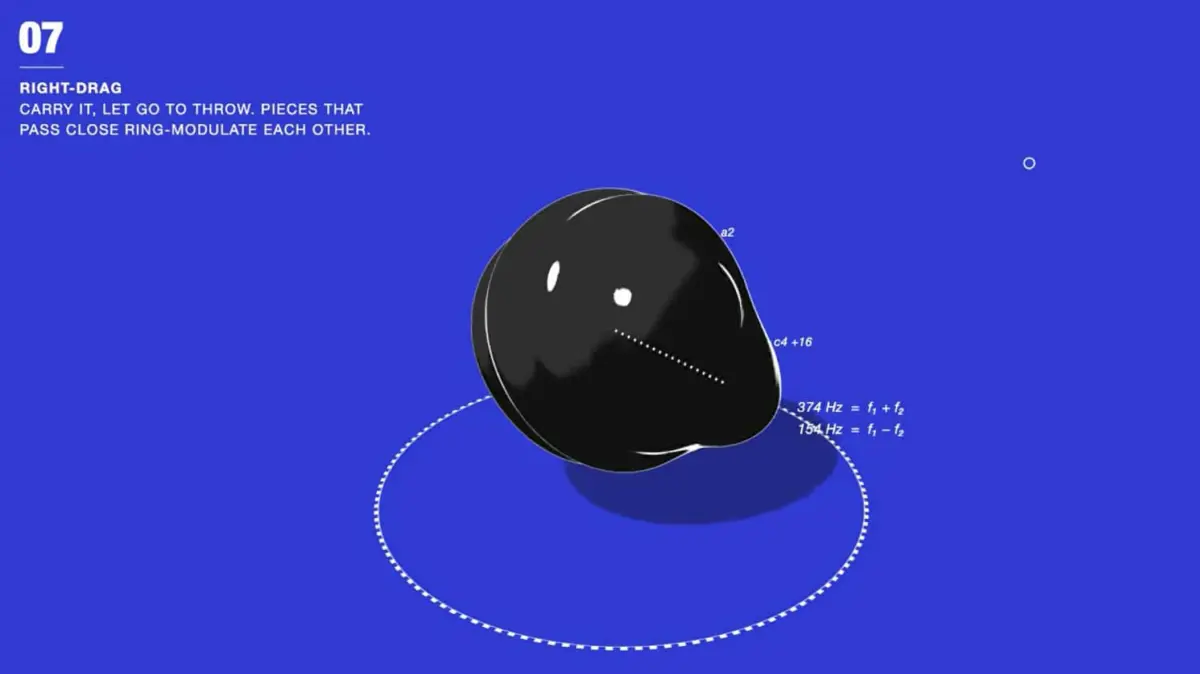
Laboratory 0 has officially released BLOT, a groundbreaking experimental software synthesizer that represents a significant departure from traditional subtractive and frequency modulation synthesis by utilizing modal synthesis as its primary architecture. Unlike conventional virtual instruments that rely on a standard interface of knobs, sliders, and menus, BLOT introduces a tactile, physics-based approach to sound design where the user shapes virtual "matter" on screen to generate audio. This release marks a notable milestone in the evolution of digital signal processing (DSP), offering a highly interactive environment where the geometry of a digital object directly dictates its acoustic properties. By moving away from the traditional oscillator-filter-amplifier paradigm, Laboratory 0 provides musicians and sound designers with a tool that mimics the behavior of physical materials, allowing for the creation of organic, complex, and evolving textures that are often difficult to achieve with standard synthesis methods.
The Mechanics of Modal Synthesis and Geometric Sound Design
At its core, BLOT is built upon the principles of modal synthesis, a form of physical modeling that simulates the resonant characteristics of an object. In the digital environment of BLOT, the user interacts with a visual "lump" of matter. This matter is not merely a graphical representation but a functional map of the instrument’s sonic potential. Every segment of the visual matter acts as a modal resonator, consisting of eight damped oscillators. These oscillators are meticulously tuned based on the size of the piece they represent, ensuring that the resulting sounds maintain a cohesive harmonic relationship.
The tuning system within BLOT utilizes just-intonation ratios relative to a MIDI root note. Just intonation, an ancient tuning system based on whole-number ratios, provides a purity of harmony that differs significantly from the equal temperament used in most modern music. As users manipulate the size of the pieces within the synthesizer, the software automatically settles on these ratios, creating a shimmering, consonant resonance. The physical properties of the "matter"—such as its shape and "heat"—determine critical parameters including the spread of the modes, the brightness of the timbre, and the duration of the decay (ringing). This creates a direct correlation between visual aesthetics and auditory output, where a tall, thin tendril sounds distinctly different from a dense, compact mass.
Interactive Excitation and Sculptural Control
The method by which BLOT generates sound is as unconventional as its interface. Rather than using a standard trigger or envelope, the resonators are "excited" through several physical metaphors. A "slow breathing noise" provides a constant, low-level excitation that keeps the matter in a state of subtle vibration. Users can also interact with the matter through strikes, which simulate percussive impacts, or through friction, which occurs as the user sweeps a cursor over the digital matter.
A unique feature of the engine is the "droplet" system. When the virtual matter is pushed into high-temperature states (a metaphor for high energy or saturation), it begins to emit "droplets"—short, high-pitched tones that rise in frequency as they "burst." This stochastic element adds a layer of unpredictable, granular texture to the sound. Furthermore, the software allows for direct structural manipulation:
- Tendrils and Waveguides: Pulling a piece of matter outward transforms it into a plucked waveguide string. The pitch of this string is determined by its physical length, mimicking the behavior of a guitar or harp string.
- Dents and Formant Filters: Pressing into the matter creates a "dent" that functions as a formant filter. This simulates the acoustic properties of a human mouth or a resonant cavity, where the position and depth of the dent determine the vowel-like qualities of the sound.
- Cutting and Fusing: Users can cut pieces of matter, causing their modes to split into two distinct pitches, or bring pieces together to fuse them back into a single resonator. When pieces are in close proximity but not touching, they undergo ring modulation, a process that creates complex non-harmonic overtones and metallic textures.
Advanced Signal Processing and Feedback Networks
To handle the complex interactions of these modal resonators, Laboratory 0 has implemented a robust back-end processing chain. When the matter is "rubbed" or subjected to high energy, it generates heat, causing the modes to stretch and the drive of each piece to saturate. To manage the resulting harmonic distortion, BLOT employs a 4-pixel oversampled multiband saturator. This ensures that even at extreme settings, the audio remains high-fidelity and free from the aliasing artifacts that often plague digital distortion.
A feedback comb filter, tuned precisely to the MIDI root, further processes the signal, adding resonance and reinforcing the tonal center. The instrument also features a specialized module called "Memory," which is an eight-line feedback delay network (FDN). This network captures the output of the matter and creates a lush, architectural space around the sound, ranging from short, metallic echoes to vast, cavernous reverberations.
The software operates in two distinct modes: "Default" and "Intense." The Default engine is designed for clean, crystalline tones, only introducing saturation when the matter is explicitly rubbed or overloaded. The Intense engine, conversely, applies heat and drive to every interaction, causing even simple strikes or cuts to crackle and distort, making it ideal for industrial or experimental soundscapes. A "Pause" function allows users to freeze the visual state of the matter while the audio continues to ring, enabling the capture of specific geometric configurations that produce desirable timbres.
Historical Context and the Evolution of Experimental Synthesis
The release of BLOT occurs within a broader historical context of experimental music software and physical modeling. Modal synthesis has its roots in academic research from the late 20th century, particularly within institutions like IRCAM (Institut de Recherche et Coordination Acoustique/Musique) and CCRMA (Center for Computer Research in Music and Acoustics). Early implementations of these concepts were often restricted to high-end workstations or complex programming environments like CSound or Max/MSP.
Over the last decade, there has been a significant shift toward bringing these complex synthesis methods into the hands of a wider range of artists. Laboratory 0’s contribution with BLOT is the simplification of the user interface without sacrificing the underlying mathematical complexity. By replacing code and complex patching with a visual, "matter-based" metaphor, the developer has lowered the barrier to entry for experimental sound design. This follows a lineage of "boutique" software development where the focus is on idiosyncratic workflows and unique sonic signatures rather than mass-market appeal.
Community Reaction and Industry Implications
While Laboratory 0 has not released official sales figures—given that the instrument is available as a free download—initial reactions from the electronic music community have been overwhelmingly positive. Sound designers for film and video games have noted the instrument’s ability to create "uncanny" sounds that sit between the organic and the synthetic. On platforms such as Gearspace and KVR Audio, users have praised the instrument for its "tactile" feel, noting that the absence of traditional knobs encourages a more improvisational and exploratory approach to music-making.
Industry analysts suggest that the release of BLOT as a free tool is a strategic move to establish Laboratory 0 as a leader in innovative DSP. By providing such a high-quality, specialized tool at no cost, the developer builds a community of users who may be inclined to support future commercial endeavors. Furthermore, BLOT serves as a "proof of concept" for the viability of non-traditional interfaces in the VST (Virtual Studio Technology) market. As touchscreens and gesture-based controllers become more prevalent in music production, the geometric-shaping workflow of BLOT may become a precursor to a new standard of instrument interaction.
Technical Analysis and Future Prospects
From a technical standpoint, BLOT’s use of 4x oversampling is a critical detail. In the realm of digital synthesis, non-linear processes like saturation and feedback can create frequencies that exceed the Nyquist limit (half the sample rate), resulting in digital "foldback" or aliasing. By oversampling, BLOT processes these interactions at a much higher internal resolution, providing a smoother, more "analog" response to high-energy inputs.
The inclusion of an eight-line feedback delay network also indicates a high level of sophistication. FDNs are often used in high-end algorithmic reverbs because they provide a more natural and dense buildup of reflections compared to simple delay lines. In BLOT, this ensures that the "matter" feels like it exists within a physical space, grounding the experimental sounds in a sense of acoustic reality.
As digital audio workstations (DAWs) continue to evolve, instruments like BLOT challenge the industry to rethink the relationship between the musician and the machine. The "geometry-as-patch" philosophy suggests a future where sound design is less about engineering and more about digital sculpture. Laboratory 0 has positioned BLOT not just as a synthesizer, but as a laboratory for the exploration of the physics of sound.
Availability and System Integration
BLOT is currently available as a free download through Laboratory 0’s Gumroad portal. It is designed to integrate into modern production workflows, supporting MIDI input for root note changes and strike triggers. This allows the synthesizer to be played with a standard keyboard or sequenced within a DAW, despite its non-traditional internal architecture. By bridging the gap between experimental "academic" synthesis and practical "studio" application, BLOT stands as a significant contribution to the current landscape of music technology.
The release of BLOT is a reminder that the boundaries of digital sound are still expanding. While the market is saturated with emulations of vintage hardware, Laboratory 0 has chosen to look forward, utilizing the power of modern CPUs to simulate imaginary materials and impossible geometries. For the modern producer, BLOT offers a window into a world where sound is shaped by hand, heated by friction, and cooled by the silence of a digital void.
