

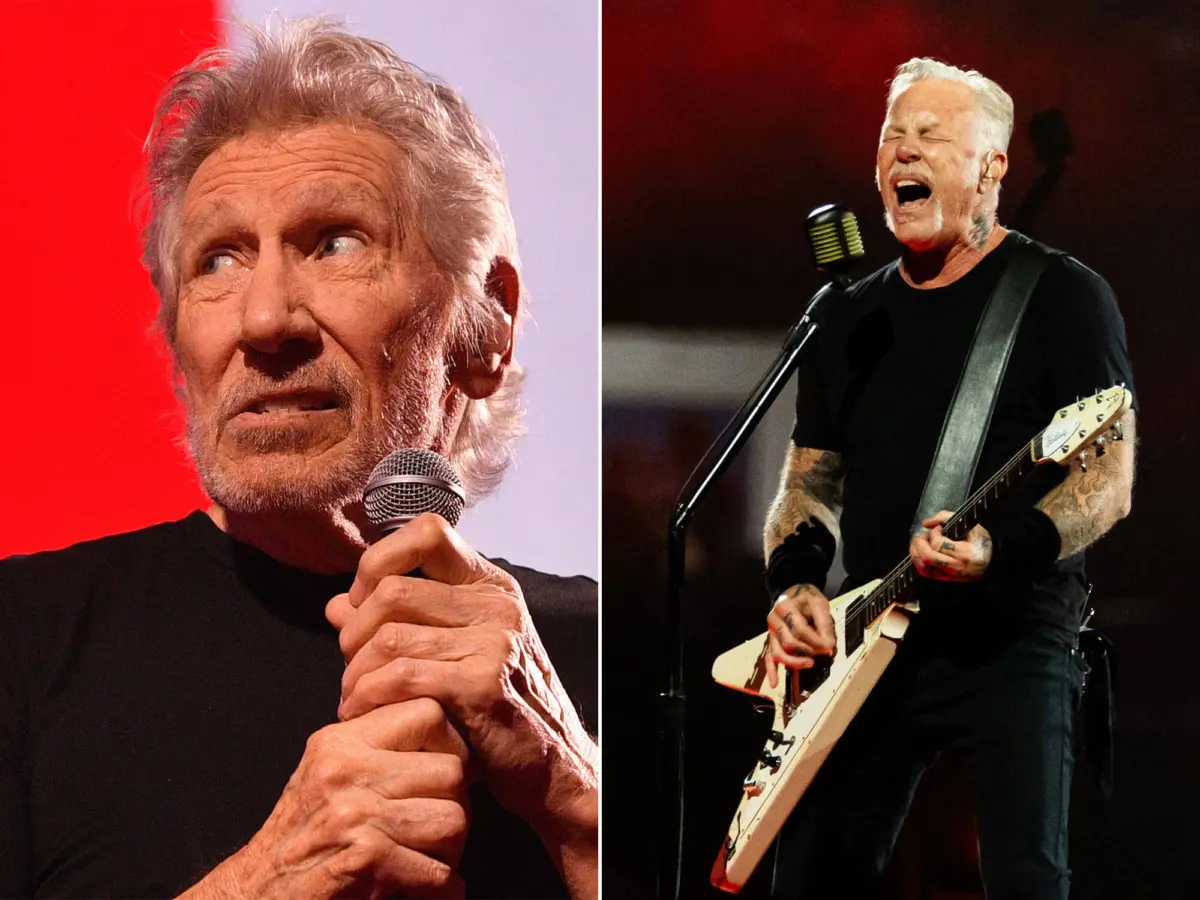
A recent pronouncement by Metallica frontman James Hetfield regarding the band’s apolitical stance during a performance at the innovative Sphere venue in Las Vegas has ignited a fiery response from former Pink Floyd bassist and lyricist Roger Waters, leading to a public exchange that underscores the enduring debate about the role of artists in political discourse. Hetfield’s assertion that Metallica is "not here to influence you with any bullshit" and aims to provide an escape through "love, energy and heavy music" has drawn significant criticism, particularly from Waters, who launched a scathing personal attack questioning Hetfield’s intellect, character, and even his musical prowess.
The Genesis of the Controversy: Hetfield’s Sphere Declaration
The controversy originated from James Hetfield’s remarks made during Metallica’s performance at the cutting-edge Sphere venue. Addressing the audience, Hetfield articulated a clear philosophy for the band’s live shows: "Metallica is not here, like some other entertainers, to influence you with their bullshit. Okay? We are here… no bullshit… we’re here to forget about all the outside shit, okay? Metallica’s agenda is love, energy and heavy music, baby." These comments were perceived by many as a deliberate contrast to a growing trend among contemporary artists who frequently use their platforms to make explicit political and social statements. This trend has seen figures like Hayley Williams of Paramore and rapper Macklemore engage in political commentary during their shows, sometimes leading to consequences, as exemplified by Macklemore’s reported removal from Ed Sheeran’s tour for such actions. Hetfield’s declaration, therefore, positioned Metallica as a counter-narrative, advocating for music as a sanctuary from external strife, a space for shared experience rather than ideological indoctrination.
Public and Historical Backlash: Metallica’s Political Legacy Under Scrutiny
Despite Hetfield’s stated intent to foster an apolitical environment, his comments immediately drew a wave of backlash from fans and commentators alike. Much of the criticism hinged on a perceived inconsistency between his statement and Metallica’s extensive discography, which features numerous songs laden with overt political and social commentary. For decades, Metallica has explored themes of war, injustice, censorship, and societal decay, often with a stark and unyielding perspective.
One of the most frequently cited examples is "One," a powerful anti-war anthem from their 1988 album …And Justice for All. Inspired by Dalton Trumbo’s novel Johnny Got His Gun, the song vividly portrays the horrors of war from the perspective of a severely wounded soldier, making a poignant statement against military conflict. Similarly, "Disposable Heroes," from the 1986 album Master of Puppets, offers a cynical critique of military recruitment and the dehumanization of soldiers. Even songs like "Don’t Tread on Me" from the 1991 self-titled "Black Album," while often interpreted as a statement of American patriotism, draws directly from the Gadsden flag and its historical association with revolutionary and anti-establishment sentiments, which can certainly be construed as political. The entire …And Justice for All album, in particular, is a conceptual masterpiece built around themes of legal injustice, political corruption, and societal oppression. Given this rich history, many found Hetfield’s declaration of an apolitical agenda difficult to reconcile with the band’s artistic output, suggesting a selective memory or a strategic pivot that felt disingenuous to some long-time followers.
Waters’ Fiery Retort: A Barrage of Personal Insults and Musical Dismissal
In the wake of Hetfield’s comments and the subsequent public debate, Roger Waters, known for his own outspoken political views, weighed in with characteristic bluntness during a recent podcast appearance. His response was not merely a disagreement on artistic philosophy but a deeply personal and vitriolic attack on Hetfield. Waters did not mince words, launching into an expletive-laden tirade: "Can we stop talking about this prick? I’m so bored with him. He’s just showing that he’s a complete prick. He’s got an IQ of about three, and why we’re talking about him, I honestly don’t know because he’s a nobody and he’ll always be. He may have a few hundred million dollars or whatever, but he’s a prick."
Waters’ critique extended beyond personal insults, venturing into a direct challenge to Hetfield’s musicianship. He declared Hetfield to be "no musician," a stark dismissal of the Metallica frontman’s widely acclaimed contributions to heavy metal. To bolster his point, Waters recounted an experience: "I heard them playing acoustic instruments and they couldn’t. It was appalling." This particular claim has been met with considerable skepticism by many music critics and fans. James Hetfield’s acoustic playing, particularly on tracks like the intros to "Fade to Black" and "The Unforgiven," as well as numerous live acoustic performances including Metallica’s Symphony & Metallica concerts, is generally regarded as solid and integral to the band’s sound. His rhythm guitar work, a cornerstone of Metallica’s style, is universally recognized for its precision, power, and distinctiveness, influencing generations of metal guitarists. Waters’ assertion thus appears to be a hyperbole, possibly employed for dramatic effect, rather than an accurate musical assessment.
The Broader Context: Roger Waters’ Own Controversial History

The intensity of Roger Waters’ criticism of Hetfield gains additional layers of context when viewed through the lens of Waters’ own long and frequently controversial career. As a principal songwriter and conceptual architect for Pink Floyd, Waters was instrumental in crafting albums like The Wall, which is replete with profound political and social commentary on themes such such as war, societal alienation, authoritarianism, and the education system. His solo career has seen him become an even more explicit political activist, consistently using his music and public platform to advocate for specific geopolitical causes, notably the Palestinian cause, and to express strong anti-war sentiments.
Waters’ history is also marked by highly publicized and often inflammatory actions. In 2023, he garnered international condemnation following a concert in Berlin where he appeared on stage dressed in a Nazi-style uniform, complete with a red armband. This act, part of his long-running "The Wall" stage persona designed to satirize authoritarianism, was nevertheless widely denounced as antisemitic by German police and the U.S. State Department, among others, leading to an investigation and widespread public outcry. This incident highlights Waters’ willingness to employ shock tactics and provocative imagery to convey his political messages, often at the risk of alienating significant portions of his audience and drawing severe criticism. His fierce condemnation of Hetfield’s desire for an "apolitical" stage, therefore, resonates deeply with his own artistic and personal philosophy, which posits that art, especially music, is inherently political and carries a responsibility to engage with societal issues.
The Enduring Debate: Art, Politics, and Audience Expectations
The clash between Hetfield and Waters encapsulates a perennial debate within the arts: can art truly be apolitical, and should artists feel obligated to use their platforms for political messaging? Hetfield’s stance aligns with a perspective that views music as an escape, a universal language capable of uniting people through shared emotional experience, transcending political divides. This viewpoint often prioritizes entertainment and the provision of a temporary reprieve from the complexities of the world. Proponents argue that forcing political agendas onto audiences can alienate fans, reduce artistic expression to mere propaganda, and diminish the universal appeal of music.
Conversely, Waters embodies the philosophy that art is intrinsically political. From this perspective, artists, as observers and commentators on the human condition, have a moral imperative to reflect, critique, and even challenge the socio-political realities of their time. They see art not just as entertainment but as a powerful medium for social change, a mirror reflecting society’s virtues and flaws. The history of music is replete with examples of protest songs, anthems for social justice, and critiques of power, from folk revivalists to punk rock and hip-hop, validating this viewpoint.
This dichotomy also touches upon the commercial realities faced by artists. In an increasingly polarized world, taking a definitive political stance can lead to backlash, boycotts, and a loss of commercial viability, as seen with some artists facing repercussions for their political expressions. Hetfield’s comments might be interpreted by some as a pragmatic move to avoid such pitfalls and maintain Metallica’s broad appeal across diverse fan bases, a strategy that has contributed to their monumental success, selling over 125 million albums worldwide. Waters, having achieved legendary status and financial independence, perhaps feels less constrained by such commercial considerations, allowing him greater freedom to express his convictions without compromise.
Industry and Fan Reactions: A Divided Landscape
While Metallica and James Hetfield have yet to issue a direct response to Roger Waters’ inflammatory remarks, the incident has undoubtedly resonated across the music industry and among fan communities. Many fans of both artists have taken to social media and online forums to express their opinions, often aligning with either Hetfield’s call for escapism or Waters’ demand for political engagement. The debate highlights the diverse expectations audiences place on their musical idols, some seeking pure entertainment, others looking for intellectual stimulation and social commentary.
The broader implications of this exchange extend to the very definition of artistic responsibility in the 21st century. As public figures, artists like Hetfield and Waters wield considerable influence. The choice of whether to leverage that influence for political purposes, or to deliberately steer clear of such matters, remains a deeply personal one, often shaped by individual beliefs, career stages, and the specific historical context. The incident serves as a potent reminder that even within the seemingly universal language of music, fundamental disagreements persist regarding its purpose and its place in society.
Conclusion
The sharp exchange between Roger Waters and James Hetfield is more than just a personal feud between two rock legends; it is a microcosm of a larger, ongoing societal and artistic debate. Hetfield’s aspiration for an apolitical musical haven stands in stark contrast to Waters’ unwavering belief in art as a vehicle for profound political and social critique. This incident underscores the complex and often contentious relationship between creative expression, personal convictions, and the public platform in the modern era, a dialogue that is far from reaching a definitive resolution. As long as artists continue to create and audiences continue to listen, the question of whether music should be a mirror to the world’s problems or a window to forget them will undoubtedly persist.
