

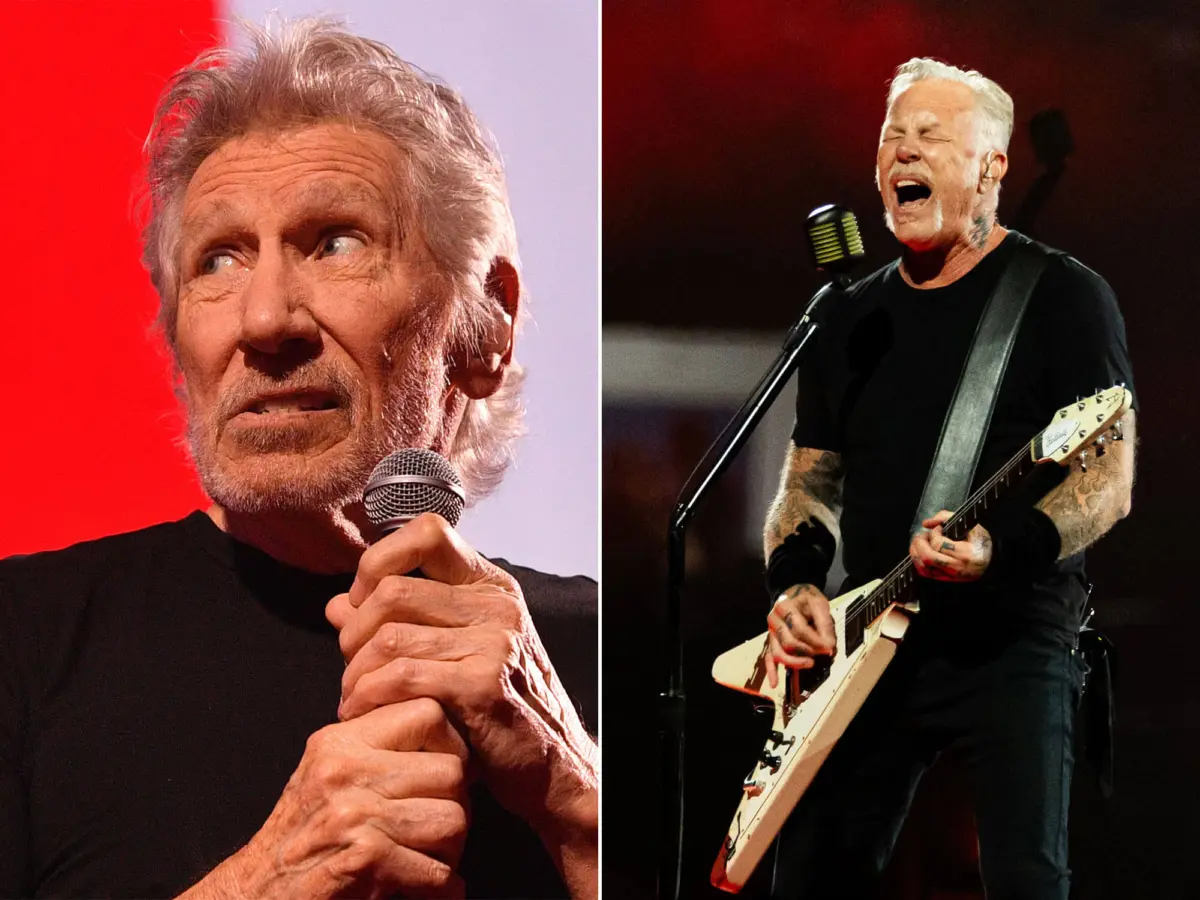
The music world is currently abuzz following a highly charged verbal assault launched by former Pink Floyd co-founder Roger Waters against Metallica frontman James Hetfield. The pointed remarks, delivered during a recent podcast appearance, were a direct response to Hetfield’s declaration at a Sphere performance that Metallica was "not here to influence you with any bullshit," aiming instead to provide an escape through "love, energy and heavy music." Waters’ unreserved condemnation, which included questioning Hetfield’s intelligence and musical prowess, has reignited the long-standing debate within the music industry regarding the role of artists in political and social discourse.
Hetfield’s Apolitical Stance at The Sphere
The genesis of this latest controversy traces back to a performance by Metallica at the state-of-the-art Sphere venue in Las Vegas. The immersive entertainment complex, which opened in September 2023, has quickly become a landmark for its cutting-edge visual technology, hosting residencies by major acts. During one such performance, James Hetfield addressed the audience directly, articulating a clear stance on the band’s artistic mission. "Metallica is not here, like some other entertainers, to influence you with their bullshit," Hetfield asserted. He continued, emphasizing the band’s intention to offer a respite from external pressures: "We are here… no bullshit… we’re here to forget about all the outside shit, okay? Metallica’s agenda is love, energy and heavy music, baby."
This statement was widely interpreted as a direct commentary on a recent trend of musicians incorporating political messages into their live shows, a practice that has seen mixed reactions from audiences and industry figures alike. Notably, artists such as Hayley Williams of Paramore and Macklemore have recently utilized their platforms for political expression, with Macklemore reportedly being dropped from an Ed Sheeran tour due to his outspoken views. Hetfield’s comments positioned Metallica firmly on the side of artistic escapism, prioritizing the musical experience over political advocacy.
Public Reaction and Metallica’s Historical Context
Hetfield’s seemingly apolitical declaration, however, did not go unchallenged. A significant segment of fans and critics swiftly pointed out what they perceived as a contradiction with Metallica’s own extensive discography. The band, a titan of heavy metal formed in 1981, has a well-documented history of engaging with profound social and political themes through their lyrics. Tracks such as "One" from their 1988 album …And Justice for All, a harrowing anti-war anthem inspired by Dalton Trumbo’s novel Johnny Got His Gun, stands as a powerful testament to their willingness to tackle complex issues. Similarly, "Disposable Heroes" from 1986’s Master of Puppets critiques the futility of war and the sacrifice of soldiers, while "Don’t Tread on Me" from the 1991 Black Album evokes themes of liberty and defiance, often interpreted within a political context.
This historical record led many to question the sincerity or consistency of Hetfield’s "no bullshit" pronouncement. Critics argued that while an artist is free to define their current stance, to entirely disavow political influence seemed to disregard a significant portion of Metallica’s artistic legacy and the very narratives that resonated deeply with their global fanbase. The discussion highlighted the complex relationship between an artist’s personal views, their public persona, and the enduring interpretations of their work.
Roger Waters’ Unfiltered Rebuke
It was against this backdrop that Roger Waters, a musician renowned for his own staunch political activism and often controversial public statements, weighed in with an exceptionally vitriolic critique. During a recent podcast appearance, Waters did not mince words when discussing Hetfield’s comments. His response transcended mere disagreement, delving into personal attacks that startled many observers.
"Can we stop talking about this prick? I’m so bored with him," Waters began, setting an immediate tone of contempt. He continued, escalating the rhetoric: "He’s just showing that he’s a complete prick. He’s got an IQ of about three, and why we’re talking about him, I honestly don’t know because he’s a nobody and he’ll always be. He may have a few hundred million dollars or whatever, but he’s a prick."
Waters’ disparaging remarks extended beyond Hetfield’s perceived intellect and character, venturing into an assessment of his musical abilities. "I heard them playing acoustic instruments and they couldn’t. It was appalling," Waters claimed, dismissing Hetfield’s musicianship outright. This particular criticism struck many as an exaggeration, if not an outright misrepresentation, given Hetfield’s well-regarded contributions to Metallica’s acoustic arrangements. Tracks like "Fade to Black" and "The Unforgiven" feature intricate and often acclaimed acoustic guitar work by Hetfield, integral to their sonic identity and widely appreciated by fans and critics alike.
The Historical Intersections of Music and Politics
The intensity of Waters’ reaction is perhaps best understood by examining the long and intertwined history of music and political activism, a tradition in which both Pink Floyd and Metallica have, at different times, played significant roles. Pink Floyd, under Waters’ principal songwriting influence, became synonymous with socio-political commentary. Albums like The Dark Side of the Moon (1973) delved into themes of madness, greed, and consumerism, while Animals (1977) offered a scathing critique of capitalism and class division. Waters’ magnum opus, The Wall (1979), remains a monumental rock opera exploring themes of alienation, war, and the destructive nature of authority, culminating in powerful anti-establishment messages. For Waters, music has always been an inherently political medium, a platform for challenging the status quo and advocating for change.

Metallica, while perhaps less overtly political in their general discourse than Pink Floyd, has undeniably engaged with serious social issues. Beyond the aforementioned anti-war anthems, their music often explores themes of personal struggle, injustice, and societal decay. Their early thrash metal roots were often seen as a rebellion against mainstream culture, and even their later, more commercially successful work retained an edge of cynicism and critical observation. Therefore, Hetfield’s recent statement, advocating for an entirely apolitical space, stands in contrast to certain interpretations of his band’s own artistic legacy, a point that Waters, with his deep-seated conviction in music’s political power, likely found particularly galling.
Roger Waters’ History of Controversial Statements and Actions
Waters’ vehement denunciation of Hetfield is not an isolated incident but rather fits within a pattern of outspokenness and controversy that has characterized much of his post-Pink Floyd career. Throughout his decades-long solo career, Waters has been an unwavering, and often polarizing, voice on a range of political issues, particularly regarding human rights, international conflicts, and geopolitical power structures. His strong pro-Palestinian stance and criticisms of Israeli policies have frequently drawn accusations of antisemitism, which Waters vehemently denies.
One of the most significant recent controversies occurred in May 2023, when Waters drew widespread condemnation for his performance in Berlin. During a concert, he appeared on stage dressed in a Nazi-like uniform, complete with a red armband and a trench coat, while brandishing a fake rifle. German police launched an investigation into the incident, citing concerns over incitement to hatred. The U.S. State Department also issued a statement condemning the imagery, describing it as "deeply offensive to Jewish people and trivializes the Holocaust." Waters defended his actions by stating the outfit was a satirical portrayal of a fascist character from The Wall, intended to criticize totalitarian regimes, a theatrical element he has used for decades. However, the context and timing of the performance, coupled with his existing controversies, led to significant backlash and accusations of insensitivity.
These incidents underscore Waters’ readiness to embrace provocative imagery and rhetoric to convey his political messages, often at the cost of alienating segments of his audience and drawing official censure. His attack on Hetfield, while verbal, carries a similar weight of unvarnished opinion and a refusal to temper his views, regardless of how extreme they may appear to others.
The Broader Implications: Artistic Freedom vs. Social Responsibility
The exchange between Waters and Hetfield taps into a broader, ongoing debate within the entertainment industry: what is the responsibility of an artist? Is their primary role to entertain and provide an escape, as Hetfield suggests, or do they have a moral obligation to use their platform to address social and political issues, as Waters vehemently believes?
Proponents of the "art for art’s sake" perspective argue that music, or any art form, should be a sanctuary from the often-turbulent realities of the world. They contend that audiences attend concerts or consume art precisely to forget their troubles and immerse themselves in a purely aesthetic experience. Forcing political agendas upon them, they argue, can alienate fans and detract from the artistic purity of the work. This viewpoint often emphasizes individual freedom of expression, allowing artists to choose whether or not to engage politically.
Conversely, those who advocate for politically engaged art argue that artists, by virtue of their influence and reach, have a unique capacity and, some would say, a moral imperative to speak truth to power. They see art as a powerful tool for social commentary, consciousness-raising, and even direct activism. In this view, to remain silent on pressing issues is to implicitly endorse the status quo. The history of music is replete with examples of artists who have shaped social movements and challenged norms, from folk protest singers to punk rock revolutionaries.
This dichotomy is not easily resolved, as both perspectives hold validity. Audiences themselves are divided, with some actively seeking political commentary in their entertainment and others preferring a clear separation. The advent of social media has further complicated this dynamic, allowing artists direct, unfiltered access to their audience, but also exposing them to immediate scrutiny and backlash for their views.
Conclusion: An Enduring Conflict of Ideologies
Roger Waters’ explosive remarks against James Hetfield represent more than just a personal feud between two rock icons; they symbolize an enduring ideological conflict within the music industry. On one side stands Waters, a staunch advocate for politically charged art, who views any attempt to sanitize music of its social responsibility as a dereliction of duty. On the other is Hetfield, who, at least in his recent Sphere comments, espouses a vision of music as an apolitical haven, a space for shared energy and escapism.
While Hetfield has yet to publicly respond to Waters’ specific criticisms, the incident ensures continued discussion about the role of celebrity in public discourse, the boundaries of artistic expression, and the often-uncomfortable intersection of personal beliefs and public performance. The exchange highlights the deep divisions that can arise when highly influential figures from different artistic generations and philosophical leanings clash over the fundamental purpose and impact of their craft in an increasingly complex world. Whether this latest verbal volley will lead to a broader dialogue or simply fade into the annals of rock and roll rivalries remains to be seen, but its immediate impact has certainly resonated throughout the global music community.
