

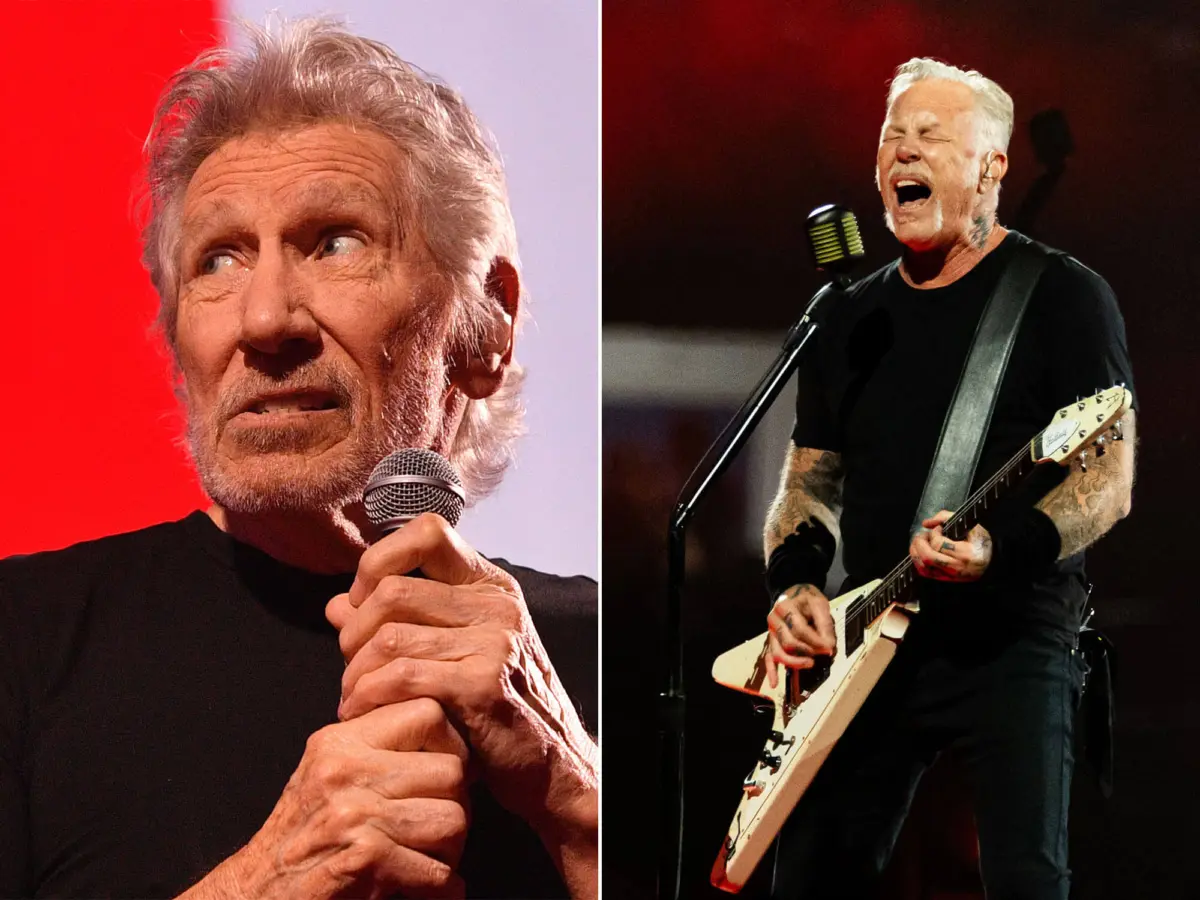
Veteran musician Roger Waters has launched a vitriolic attack on Metallica frontman James Hetfield, lambasting him as a "prick" with an "IQ of about three" and "no musician" in response to Hetfield’s recent comments at the Sphere in Las Vegas. Hetfield had stated that Metallica was "not here to influence you with any bullshit," asserting the band’s agenda was solely "love, energy and heavy music," and aiming for an apolitical performance space. This exchange ignites a long-standing debate within the music industry regarding the role of artists in political and social discourse, especially when an artist’s past work appears to contradict their current public stance.
James Hetfield’s Apolitical Declaration at the Sphere
The genesis of this recent controversy lies in comments made by James Hetfield during Metallica’s performance at the cutting-edge Sphere venue in Las Vegas. Addressing the audience, Hetfield unequivocally declared, "Metallica is not here, like some other entertainers, to influence you with their bullshit. Okay? We are here… no bullshit… we’re here to forget about all the outside shit, okay? Metallica’s agenda is love, energy and heavy music, baby." This statement, delivered to thousands gathered in the immersive, technologically advanced arena, was widely interpreted as a direct response to a growing trend of musicians utilizing their stage time to voice political opinions and advocate for various social causes.
The Sphere itself, a revolutionary entertainment venue opened in September 2023, offers a 360-degree immersive visual and auditory experience. Its design, featuring a massive LED screen wrapping around the audience and an advanced sound system, is engineered to transport attendees into a singular, all-encompassing artistic world. For Hetfield, this environment perhaps underscored his desire for a pure, unadulterated musical experience, free from the divisive nature of political rhetoric. His comments resonated with a segment of the audience and broader public who prefer to separate entertainment from activism, seeking an escape from the often-contentious political landscape in their leisure activities.
Hetfield’s remarks were made against a backdrop where several high-profile artists have recently engaged in overt political commentary during their performances. Notable examples include Hayley Williams of Paramore, who has often spoken out on social issues, and rapper Macklemore, who faced significant repercussions after making pro-Palestinian statements during a concert. Macklemore’s outspokenness on the Israel-Palestine conflict reportedly led to his removal from the lineup of Ed Sheeran’s tour, a decision that sparked further discussion about the commercial and professional risks associated with artists taking strong political stances. Hetfield’s statement, therefore, positioned Metallica as a counterpoint to this trend, advocating for a space where music reigns supreme, unburdened by external ideologies or "bullshit" influences.
The Historical Context: Metallica’s Political Legacy
While Hetfield’s declaration aimed for an apolitical present, it immediately drew criticism from many fans and observers who pointed to Metallica’s extensive history of engaging with profound social and political themes through their music. The band, formed in 1981, rose to prominence during a period marked by Cold War anxieties, social unrest, and a burgeoning thrash metal scene that often served as a vehicle for critiques of power, war, and injustice. This rich lyrical tradition complicates Hetfield’s recent insistence on an apolitical stance, leading to accusations of hypocrisy.
One of Metallica’s most iconic and explicitly political songs is "One," from their 1988 album …And Justice for All. Inspired by Dalton Trumbo’s anti-war novel Johnny Got His Gun, "One" tells the harrowing story of a World War I soldier who loses all his limbs and senses, trapped within his own body, yearning for death. The song is a visceral condemnation of the horrors of war and the dehumanizing impact of conflict. Its powerful lyrics, "Darkness imprisoning me, All that I see, Absolute horror, I cannot live, I cannot die, Trapped in myself, Body my holding cell," combined with its groundbreaking music video, cemented "One" as a definitive anti-war anthem and a poignant commentary on military folly.
Another significant track, "Disposable Heroes," from the 1986 album Master of Puppets, offers a scathing critique of the military-industrial complex and the cynical exploitation of young soldiers. The lyrics depict young recruits being sent to die for political agendas, only to be discarded and forgotten. "Back to the front! You will do what I say, when I say, Back to the front! You will die when I say, when I say," highlight the stark reality of soldiers as mere pawns in larger power games. This song, like "One," clearly positions Metallica within the tradition of protest music, using their platform to question authority and expose societal ills.
Even "Don’t Tread on Me," from the commercially successful 1991 "Black Album," carries significant political undertones. The title and lyrical themes directly reference the Gadsden flag, an iconic symbol of American patriotism and anti-authoritarianism, often associated with libertarian and conservative movements advocating for individual liberty and limited government. While perhaps differing in ideological alignment from some contemporary political statements, the song undeniably engages with political concepts of freedom and national identity. Other songs, such as "And Justice for All," which critiques systemic legal corruption, and "Blackened," addressing environmental destruction, further illustrate Metallica’s historical willingness to tackle complex societal issues.
This extensive back catalog, brimming with politically charged narratives, makes Hetfield’s recent pronouncement particularly jarring for many long-time fans and critics. The disconnect between the band’s artistic legacy and their frontman’s current rhetoric has fueled a debate about authenticity, consistency, and the evolving responsibilities of public figures.
Roger Waters’ Unfiltered Rebuke
It was against this backdrop of controversy that Roger Waters, the outspoken former bassist and lyricist of Pink Floyd, weighed in with an exceptionally blunt and aggressive critique of James Hetfield. Waters, known for his unvarnished opinions and deeply political art, expressed his disdain during a recent podcast appearance, leaving no ambiguity about his sentiments.
"Can we stop talking about this prick? I’m so bored with him," Waters began, immediately setting a hostile tone. He continued, escalating his personal attack, "He’s just showing that he’s a complete prick. He’s got an IQ of about three, and why we’re talking about him, I honestly don’t know because he’s a nobody and he’ll always be. He may have a few hundred million dollars or whatever, but he’s a prick." These comments, devoid of any nuanced argument, focused purely on character assassination, dismissing Hetfield as intellectually inferior and insignificant despite his immense success and influence within the music world.
Waters further extended his critique beyond Hetfield’s character to his musical abilities, stating emphatically, "He’s no musician." He then recalled an unspecified instance: "I heard them playing acoustic instruments and they couldn’t. It was appalling." This particular criticism, however, stands in stark contrast to Metallica’s documented history of performing acoustic material. James Hetfield, along with lead guitarist Kirk Hammett, has delivered numerous well-received acoustic performances throughout their career. Iconic tracks like "Fade to Black" and "The Unforgiven" feature prominent and intricate acoustic guitar intros that are central to their composition. Metallica has also released live albums such as S&M (Symphony and Metallica), which features orchestral arrangements alongside acoustic passages, and participated in MTV’s Unplugged series, showcasing their versatility and proficiency on acoustic instruments. Waters’ assertion thus appears to be either a highly subjective, perhaps deliberately provocative, assessment or an over-exaggeration designed purely for shock value rather than a factual musical critique.

Roger Waters: A History of Provocation and Political Artistry
Roger Waters’ blistering attack on James Hetfield is entirely consistent with his career-long persona as an uncompromising, politically charged artist who never shies away from controversy. From his seminal work with Pink Floyd to his extensive solo career, Waters has consistently used his platform to articulate strong political and social critiques, often challenging established norms and authority figures.
With Pink Floyd, Waters was the primary lyrical architect behind albums like The Wall, a sprawling rock opera exploring themes of isolation, war, and the failings of society; and Animals, a dystopian allegory inspired by George Orwell’s Animal Farm, critiquing capitalism and social hierarchy. These works are steeped in political commentary, reflecting Waters’ deep-seated anti-establishment views and his profound skepticism of power structures.
In his solo career, Waters has continued to be a vocal activist, particularly on issues such as the Israeli-Palestinian conflict, human rights, and anti-war sentiments. He has frequently spoken out against government policies, corporate greed, and what he perceives as Western imperialism. His concerts are often elaborate theatrical productions that integrate overt political messaging, sometimes featuring controversial imagery and provocative statements.
This commitment to political engagement has, however, frequently landed Waters in hot water. In 2023, he faced widespread condemnation for his actions during a concert in Berlin, Germany, where he appeared on stage dressed in a uniform resembling that of an SS officer, complete with a red armband. This imagery, intended by Waters as a critique of fascism and part of a long-standing theatrical persona from The Wall, was widely perceived as antisemitic and offensive, particularly in Germany given its historical context. The incident drew immediate ire from German police, who launched an investigation, and prompted a strong rebuke from the U.S. State Department, which accused Waters of "a long track record of using antisemitic tropes." Waters has consistently denied accusations of antisemitism, arguing his criticism is directed at the policies of the Israeli government, not the Jewish people.
Other controversies include his staunch opposition to Western support for Ukraine in its war with Russia, often echoing Kremlin talking points, and his past remarks on various world leaders and political figures. His outspoken nature has led to accusations of grandstanding, insensitivity, and historical revisionism from various quarters.
Waters’ history, therefore, provides a crucial lens through which to understand his reaction to Hetfield. For an artist who views music as an indispensable tool for social commentary and political awakening, Hetfield’s call for an "apolitical" stage likely represents a profound philosophical disagreement, interpreted by Waters as a dereliction of artistic duty or even intellectual cowardice. This clash highlights two fundamentally different philosophies on the purpose and power of music in contemporary society.
Broader Implications: The Enduring Debate on Art and Politics
The acrimonious exchange between Roger Waters and James Hetfield is more than just a personal spat between two rock legends; it is a microcosm of an enduring and often contentious debate about the role of art and artists in political discourse. This discussion permeates the music industry, public sphere, and academic circles, reflecting diverse perspectives on creative expression, social responsibility, and the nature of entertainment itself.
One perspective, often championed by figures like James Hetfield in his recent statement, advocates for music as a form of pure escapism. Proponents of this view argue that music’s primary purpose is to provide joy, unity, and a temporary respite from the anxieties and divisions of the outside world. They believe that introducing political or social commentary can alienate audiences, disrupt the shared experience, and transform a space meant for enjoyment into a forum for ideological conflict. For these individuals, the stage should be a neutral ground where fans can connect over a shared love of sound and performance, leaving their political differences at the door. From a commercial standpoint, an apolitical stance can also broaden an artist’s appeal, avoiding alienating potential listeners who might disagree with specific political views.
Conversely, a powerful counter-argument, embodied by Roger Waters, posits that art, by its very nature, is inherently political. This perspective suggests that artists, as cultural commentators and observers of the human condition, have a moral obligation to use their platforms to speak truth to power, challenge injustice, and provoke thought. They argue that ignoring the pressing issues of the day is a form of complicity and that music, with its capacity to stir emotions and inspire collective action, is a potent tool for social change. For artists like Waters, to "stick to music" is to abdicate a crucial responsibility, especially when their work has historically engaged with such themes. This view often emphasizes the historical role of protest songs and socially conscious music in shaping public opinion and catalyzing movements.
The Metallica controversy specifically highlights the issue of perceived authenticity and consistency. When an artist with a history of politically charged lyrics suddenly declares an apolitical stance, it raises questions about the sincerity of their past work or a shift in their personal philosophy. Fans often expect a degree of consistency between an artist’s public statements and their artistic output, leading to charges of hypocrisy when a disconnect emerges. This can impact fan loyalty and the public’s perception of the artist’s integrity.
Furthermore, the digital age and the rise of social media have intensified this debate. Artists’ statements, whether made on stage or online, are instantly disseminated, dissected, and debated globally. This amplification means that political stances, or declarations of apolitical intent, carry significant weight and can trigger immediate and widespread reactions, from praise to severe backlash. The "cancel culture" phenomenon further complicates matters, as artists can face professional repercussions and public condemnation for views that are deemed offensive or out of step with prevailing social sentiments.
The Waters-Hetfield feud, therefore, serves as a vivid illustration of these complex dynamics. It underscores the profound philosophical chasm between artists who believe in music’s power as a political instrument and those who prioritize its role as an unadulterated form of entertainment. This ongoing tension reflects a broader societal struggle to reconcile individual expression with collective responsibility, and the ever-evolving expectations placed upon public figures in an increasingly interconnected and polarized world. As long as artists continue to create and perform, this fundamental question about the intersection of art and politics will undoubtedly persist, shaping the landscape of cultural discourse for generations to come.
